Tag: Space
Sciency Words: Entomophagy (Dining on Mars, Part 3)

Today’s post is a special combination post, continuing my Dining on Mars series and also my regularly scheduled Sciency Words series. Today’s new and interesting science or science-related term is:
ENTOMOPHAGY
When humanity finally makes it to Mars, we might not be going alone. We may end up bringing some insects with us.
To be clear, this wouldn’t be an accidental thing. No, we’d be bringing our insect friends on purpose. Why?

The word entomophagy comes from two Greek words meaning “insect” and “to eat,” and it refers to the practice of eating insects.
Personally, I’m not too keen on becoming an entomophage, but that has more to do with my cultural background than anything else. In many parts of the world that are not the United States or Western Europe, entomophagy is quite normal, and in the near future it may become an important means of feeding a growing global population.
But insects-as-food may be even more important for feeding the early colonial population of Mars. That’s because efficiency is the key to surviving on Mars, and insects make for an extremely efficient food souce. They don’t require a lot of room or resources compared to other sources of animal protein, and when you eat them very little goes to waste. I’m told with some species you’re supposed to remove the wings before cooking, but otherwise the entire insect body is edible.
Apparently insect flavors can vary a lot from species to species, and sometimes depend on what the insects ate themselves. I’ve heard certain species described as “nutty” or “lemony” or even “minty.” Others have more meat-like flavors. According to this article from bugible.com, giant water bugs taste like salted banana, and sago grubs taste a little like bacon. And pan-fried crickets with soy sauce taste amazing, or so I’m told.
Actually, after writing this post I’m feeling a bit hungry. Maybe I could get used to entomophagy after all. Anyone care to join me for lunch?
How Martian Microbes Saved My Life
Hello everybody! This is J.S. Pailly reporting in from the surface of Mars, and today I have a big announcement. Life. I’ve discovered life on Mars!
As most professional astrobiologists would have expected, there are no “people” on Mars, nor any signs of animal or plant life. No, the life forms I’ve discovered are microorganisms.
You might be wondering how even microorganisms can survive in the harsh Martian environment, where it’s so cold and so dry, and where toxic perchlorate salts are scattered basically everywhere.

But it turns out those perchlorate salts, which are so hazardous to human life, are the very reason why Martian life is possible.
You see when I first arrived on Mars and started growing my own food here, I sort of forgot about those deadly perchlorates. And yet my crops still grew in the Martian regolith, and I didn’t succumb to the kinds of severe thyroid disorders that perchlorates can cause in humans. Why not? Because something was eating the perchlorates.
The idea that microorganisms might gobble up perchlorate salts shouldn’t come as a surprise. Back on Earth, certain species of anaerobic bacteria, such as Dechloromonas aromatica, can actually help fight pollution by cleaning up perchlorate-contaminated drinking water. D. aromatica will actually swim toward perchlorates and chemically reduce them to produce the energy they need to live. The native Martian microbes must do something similar.
Of course I should make this disclaimer: while I may be here on the surface of Mars, I’m still just a blogger. NASA or some other space agency should still send some qualified astronauts to confirm my findings. Even so, my preliminary research says these Martian microbes are totally real, and they’re rather conveniently helpful too!
Molecular Monday: Perchlorate Salts on Mars
Today’s post is part of a bi-weekly series here on Planet Pailly called Molecular Mondays, where we take a closer look at the atoms and molecules that make up our physical universe.

It’s hard to imagine how anything could survive long on Mars. This has been especially true ever since 2008, when the Phoenix Lander conducted the first ever wet chemistry experiment on Martian regolith and detected a chemical called calcium perchlorate.
I haven’t looked into how this wet chemistry experiment worked, but I’m guessing it involved mixing water with a sample of Mars dust and then running a spectroscopic analysis.
Of course when this calcium perchlorate was detected, the first question was: did Phoenix contaminate its own sample? On Earth, perchlorates are an increasingly common pollutant produced by (among other things) rocket fuel. But if there was any serious contamination of the Phoenix landing site due to Phoenix’s landing rockets, we’d expect to find ammonium perchlorate, not calcium perchlorate.
Also subsequent experiments and observations by the Spirit and Opportunity rovers, the Mars Odyssey orbiter, and other Mars missions have found that chlorine is scattered all over the planet. Most of that chlorine is likely bound up in perchlorate form, and it’s now estimated that calcium perchlorate, magnesium perchlorate, and other perchlorate salts make up anywhere between 0.5% and 1% of the Martian regolith.
For humans, that’s an alarmingly high percentage. More than enough to kill you, or at least to cause you serious thyroid problems. But if you’ve been following along with my blog, you know I’ve been living on the surface of Mars and growing my own food here for over a month now. So why am I not dead?
Well… it turns out there is life here on Mars, and the natives have been surprisingly helpful. More about that in my next post.
Sciency Words: Graben

Today’s post is part of a special series here on Planet Pailly called Sciency Words. Each week, we take a closer look at an interesting science or science-related term to help us expand our scientific vocabularies together. Today’s term is:
GRABEN
According to the appendix of Frank Herbert’s Dune, a graben is defined as “a long geological ditch formed when the ground sinks because of movements in the underlying crustal layers.”
According to real life, a graben is… well, it’s exactly what Frank Herbert said it is. The term comes from a German word meaning trench, which is a nice, direct way to describe what grabens look like: trenches.
Grabens tend to form between two “normal faults” if the faults run more-or-less parallel to each other. In other words, they form when two masses of the planet’s crust start moving away from each other, allowing a thin sliver of material to sink down into the gap between them.

I used to think grabens could only form due to the movements of tectonic plates, which would mean we should only expect to find them on Earth—the only planet known to have active plate tectonics. But really grabens can occur on any world where the planetary crust is moving around, being pushed or pulled in different directions, causing the surface to stretch and crack.
That could explain why grabens, or at least surface features that look an awful lot like grabens, have been observed on the Moon, Mars, and other places in the Solar System. And perhaps that’s also why they were found (will be found?) on the planet Arrakis, all the way out in the Canopus Star System, according to Frank Herbert.
Dining on Mars, Part 2: Lettuce
A few years ago, NASA astronauts started growing lettuce aboard the International Space Station. This was a big deal. The day the astronauts finally got clearance from mission control to eat their lettuce, it made headlines.
Except I remember there was something about this story that really didn’t make sense to me at the time, and honestly still doesn’t. Supposedly getting to eat fresh lettuce was a huge morale booster for the I.S.S. crew. Look, I get this was an important proof of concept, demonstrating that it is possible to grow food in space. But lettuce… a morale booster?
Speaking as someone who’s currently living on the surface of Mars, I can assure you that lettuce is just as exciting here as it was back on Earth.
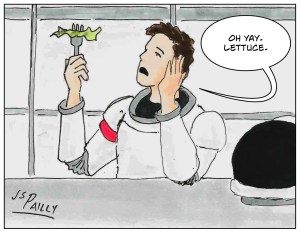
Of course the reality of living on Mars is that you have to stick to a vegan diet. You simply don’t have the room or resources to raise livestock (although as our presence on Mars grows and our habitat structures expand, it may be possible to bring some animals over… but that’s a topic for future posts).
Fortunately experiments back on Earth using Mars regolith simulant have shown than a great many vegetables should be able to grow in Martian soil, not just lettuce. We’ve already talked about potatoes and sweet potatoes. Also according to this article, the research on tomatoes, peas, spinach, and several other crops looks promising.
That’s encouraging news, but that same article also warns that Martian regolith contains elevated levels of metals, such as iron, arsenic, and lead. This is a “further research is required” thing, but it’s possible that plants could absorb some of those metals, meaning my Mars lettuce might end up giving me lead poisoning.
I wish someone had mentioned that to me before I started growing all these crops in Martian regolith.
Sciency Words: Astro-Paleontology

Today’s post is part of a special series here on Planet Pailly called Sciency Words. Each week, we take a closer look at an interesting science or science-related term to help us expand our scientific vocabularies together. Today’s term is:
ASTRO-PALEONTOLOGY
This may be a first for Sciency Words. Usually I discover new words to share with you during the normal course of my research, but this time I thought to myself, “astro-paleontology has got to be a thing by now,” and then went and found that it is.
Or at least it almost was. Back in the 1970’s, astronomer John Armitage wrote a paper titled “The Prospect of Astro-Palaeontology,” officially coining the term. And then it seems nobody followed up on the idea.
The word paleontology comes from several Greek roots and means the study (-logy) of that which existed (-onto-) in the past (paleo-). It think we’re all familiar with what this really means: digging up the fossilized remains of dinosaurs and other organisms that died long ago. By adding the Greek word for star into the mix (astro-), Armitage created a term for the search for and study of the fossilized remains of life on other worlds.
The blog Astro-Archeology did several posts about Armitage’s work. I recommend checking out all three of these posts:
- Review: The Prospect of Astro-Palaeontology, by John Armitage.
- What is Astropalaeontology?
- Interview with John Armitage.
To be honest, I don’t have a whole lot to add to what Astro-Archeology already wrote on this subject, except that the search for alien fossils on Mars is about to heat up.
None of our current Mars missions are equipped to search for life on the Red Planet, either living or dead. But NASA’s next rover, the Mars 2020 Rover, will be. Specifically, Mars 2020 will be designed to hunt for fossilized microorganisms.
So maybe the term astro-paleontology is due for a come-back.
P.S.: You may have noticed that John Armitage and Astro-Archeology spelled this term as astro-palaeontology and I’m spelling it as astro-paleontology, without the extra a. This is a British spelling vs. American spelling thing.
Molecular Monday: Basalt as a Sedimentary Rock
I had a rough week last week, which disrupted my regular posting schedule. But I’ll talk about that on Wednesday for IWSG.
Today I’ve returned to Mars and I’m ready to continue my exploration of the Martian surface. I considered calling today’s post Mineralogical Monday, but really minerals are just a special kind of molecule, so I’ll stick to the Molecular Monday series I already have going.

Before I was so rudely brought back down to Earth, I was visiting Gale Crater. I wanted to meet the Curiosity Rover and maybe get an autograph, but I got distracted by some peculiar rocks.
It’s hard to put into words what was so odd about these rocks. They have the look and feel of sedimentary rocks, but in terms of chemical composition they’re more like basalt. But basaltic sedimentary rock is a contradiction in terms.
Sedimentary rocks form (typically) when sediment accumulates at the bottom of a river, lake, or other body of water. Over time, the sediment becomes compacted or cemented together, and thus a new rock is born.
Basalt is an igneous rock, meaning it forms from cooling magma, and it is chemically vulnerable to water. Basalt tends to include a lot of iron, magnesium, and calcium; water tends to leech these elements out of basalt, leaving a silicon-rich clay behind. So as a sediment sitting at the bottom of a lake or river, basalt wouldn’t last long enough to turn into sedimentary rock.
Fortunately for me, I’m not the only one who’s struggled to find the right terms to describe these weird Martian rocks. Emily Lakdawalla, a well respected science journalist writing for the Planetary Society, wrote an article about this and summed up the inherent contradiction well: “Sedimentary rocks say ‘Mars was wet.’ Basaltic composition says ‘Mars was dry.’”
So how did these basalt-like sedimentary rocks form? I can think of three possibilities:
- Windblown Sediment: Sedimentary rocks can be created by wind rather than water, but as Emily Lakdawalla shows in her article, not all of these Mars rocks can be explained that way.
- Liquids Other Than Water: It’s possible the sediment was deposited by a liquid other than water. That explanation makes more sense to me on a super-cold planetoid like Titan, where water is a rock and rivers are full of methane; however on Mars, water still seems to be the most likely working fluid.
- Flash Floods: Maybe basaltic sediment was only exposed to water for a short time, perhaps during the flash floods that seem to have occurred during Mars’s Hesperian Period.
Most of the rock formations in Gale Crater are already believed to be Hesperian-aged, so the flash flooding idea makes the most sense to me. But of course the Curiosity Rover has been here a lot longer than I have, so I’ll be eager to ask her opinion on the matter.
Magnets on Mars
Today I’m continuing my totally-for-real, I’m-not-making-this-up exploration of Mars. I’m really here on the surface of Mars, walking around and doing science—or rather bouncing around in the low gravity and gawking at cool Mars things.
Last week we talked a bit about my efforts to grow potatoes in Martian regolith, based on experiments conducted by the International Potato Center back on Earth using a “Mars regolith simulant.” I ended up doing a bit of research about what, precisely, a Mars regolith simulant is. Turns out these’s a pretty long history to this stuff.
The earliest simulant appears to have been developed at NASA’s Johnson Space Center and is know as JSC Mars-1. It was made using volcanic ash from Hawaii and the recipe was based on data collected by NASA’s Viking and Pathfinder missions.
As we’ve learned more about Mars, there have been several newer generations of simulant, such as JSC Mars-1a, MMS-1 and MMS-2 (which have been made available for sale to the general public), and most recently JMSS-1, which was developed by the Chinese.
But going back to the original JSC Mars-1, I read something in this article that surprised me: “Approximately 25 wt% of the sample can be lifted with a hand magnet.” Since I’m here on the surface of Mars, that gave me an idea….

Given how much iron is contained in Martian regolith, what happened next shouldn’t have come as too much of a surprise. When I touched my magnet to the ground, most of the Mars-dust didn’t stick, but some of it did.
This is consistent, by the way, with the findings of the Spirit and Opportunity rovers. Magnets attached to the rovers’ Rock Abrasion Tools (R.A.T.) accumulated dust particles as the rovers chipped away at Martian rocks. It’s noteworthy that the R.A.T. magnets collected different colors of dust at different locations, indicating that there are many different kinds of magnetic particle on Mars. Spirit and Opportunity also conducted what’s known as the Magnetic Properties Experiments (M.P.E.), which used magnets to draw stray dust particles out of the Martian atmosphere.
It seems like you’ll find magnetic particles just about everywhere on Mars. Again, this shouldn’t come as much of a surprise. There’s a lot of iron, mostly in the form of hematite and magnetite, on the Martian surface. But still, this is a weird and awesome thing to see in action, at least from an Earthling’s perspective.
Sciency Words: Regolith
Today’s post is part of a special series here on Planet Pailly called Sciency Words. Each week, we take a closer look at an interesting science or science-related term to help us expand our scientific vocabularies together. Today’s term is:
REGOLITH
For a long time, I assumed this was another example of having one word for something here on Earth (soil) and a completely different term for the same thing on another planet (regolith). But no, we have regolith here on Earth too; however, other planets and moons do not appear to have soil, strictly speaking.
American geologist George Perkins Merrill is credited with coining the word regolith back in 1897. The term is based on two Greek words meaning “rock blanket.” I don’t know about you, but that conjures up a strange mental image for me. I mean, who’d want to snuggle up under a blanket of rocks?
But after doing further research, I think Merrill was being pretty clever with this one. Regolith is defined as a layer of loose gravel, sand, or dust covering a layer of bedrock.

As for the distinction between regolith and soil, I think it’s best to define soil as a special kind of regolith: regolith that contains enough organic ingredients to support plant life.
By that definition, Earth has both regolith and soil while places like the Moon and Mars only have regolith. That being said, a lot of people (including professional astro-scientists) go ahead and talk about Martian soil when they really mean Martian regolith.
Unless, of course, Martian regolith turns out to have more organic matter in it than we thought!
 Planet Pailly