Sci-Fi Wisdom: The Simplicity of Play

The original Star Trek TV series had a lot of truly famous episodes.  There was the one about the tribbles, and the one where Spock had a beard. Oh, and the one were Kirk fought that green lizard guy.  I love that one!  But today we’re going to talk about one of Star Trek’s less memorable episodes: the one where the crew of the Enterprise meets the White Rabbit from Alice’s Adventures in Wonderland.

This episode just feels awkward.  I guess some people may like it, but I don’t.  Even so, there was one part near the end that really stuck with me.  It turns out (spoiler alert!) that the White Rabbit is not really the White Rabbit from Lewis Carroll’s book.  It’s a robot designed to replicate something a computer detected in an Enterprise crewmember’s imagination.

When the truth is finally revealed, we get this exchange of dialogue:

God-like Alien: This entire planet was constructed for our race of people to come and play.

Lt. Sulu: Play?  As advanced as you obviously are, and you still play?

Capt. Kirk: Yes, play, Mister Sulu.  The more complex the mind, the greater the need for the simplicity of play.

I bring this up because lately I’ve been dealing with certain real life problems, and like many people struggling with real life problems, I’ve found myself perusing the Internet for self-help articles or watching self-help videos on YouTube.  And there’s one piece of advice I keep seeing over and over again: focus on your goals and cut all the “distractions” out of your life.

By distractions, these videos and articles usually mean things like television, video games, social media… all those forms of entertainment that are self-evidently wasting your time… time that would be better spent working harder on your goals.

This, I believe, is terrible advice.  Look, obviously anything in excess can be a bad thing (there’s a Star Trek quote about that too; it’s in the tribble episode), but the biggest problem that I have, and I think we all have, with our modern world is that everything is so urgent, so demanding, and so complicated. Maybe our minds are not yet as complex as the minds of those god-like aliens on Star Trek, but still… our lives are complicated enough that we do need the simplicity of play.

So whatever your idea of “play” might be, please don’t let anyone tell you it’s a waste of time or that it’s a distraction that needs to be cut out of your life.

Now if you’ll excuse me, I have a Lego rocket ship to build.

Mars in Review

I meant to wrap up my special Mission to Mars series a few weeks ago, but then some stuff happened, and then I got sick, and my whole blogging schedule got messed up.

Anyway, better late then never.

When I launched this mission, I felt like I didn’t know as much about Mars as a space enthusiast/science fiction writer like me should.  I wanted to fix that.  I wanted to immerse myself in everything Martian, and so I did.  For a lot longer than I expected, too.

During that time, I got a much clearer sense of Mars’s history, as told by the geological and chemical evidence.  Without a doubt, Mars was a wet and water world in the distant past, but that does not necessarily mean it was an Earth-like planet. Rather, Mars’s history with water seems to have been brief and violent, with lots of flash flooding caused, perhaps, by the rapid thawing and refreezing of glaciers.

Even so, life could maybe possibly have started to evolve on ancient Mars, and even as the planet dried up, there’s a slim (very slim) chance life could have survived and endured all the way up to the present day. Scientists take this possibility seriously (a lot more seriously than I expected, to be honest), and there’s an active and passionate debate going on about how to explore Mars without contaminating any hypothetical Martian ecosystems with our Earth germs. Two of my favorite posts for this series, “Let a Mars Rover Rove” and “Mars Rovers Must Rove Responsibly,” compared and contrasted the two sides of that debate.

But of course a huge portion of this series was devoted to the future human colonization of Mars.  I wrote several posts about how to get to Mars, reviewing proposals made by Buzz Aldrin (of Moon landing fame), Robert Zubrin (author of The Case for Mars), and Elon Musk (the guy who runs SpaceX).  I also wrote about how future colonists might adapt the calendar to suit the slightly longer Martian day and the significantly longer Martian year. And of course there were all those posts about what kinds of food might be practical on Mars, starting with potatoes and working up to goat cheese.

I’m still no Mars expert.  Mars is the second most thoroughly explored planet in the Solar System, after Earth, and there’s just so much information to sort through.  On top of that, new discoveries are being made all the time.  The already enormous pile of Mars-related knowledge just keeps growing!

But I do at least feel more familiar with the Red Planet, and I hope you do to.  Thank you to everyone who followed along with this series, either for the whole long slog of it or just bits and pieces of it.  If you had any favorite posts from this Mars series, I hope you’ll let me know in the comments.  Also, I’m planning to do “Mars month” again next March, so if you have suggestions about other Mars-related things I should research, let me know!

Sciency Words: Dinosaur

Today’s post is part of a special series here on Planet Pailly called Sciency Words.  Each week, we take a closer look at an interesting science or science-related term to help us expand our scientific vocabularies together. Today’s term is:

DINOSAUR

I did a Sciency Words post on the word dinosaur before, when I participated in last year’s A to Z Challenge, but I never felt satisfied with that post.  For one thing, I missed a golden opportunity to tell you one of the coolest sciency things I’ve learned: dinosaurs are not extinct.

Or rather, to be more technical about it, dinosaurs are or are not extinct depending on how you define the word dinosaur.  You see we have two different systems for classifying life: the traditional Linnaean system and an alternative system called cladistics.

In 1735, Swedish botanist Carl Linnaeus published his book Systema Naturae, introducing the world to his system of binomial nomenclature.  All of a sudden, we humans became Homo sapiens, our cats became Felis catus, and so forth.  But under Linnaeus’s system, plants and animals (and also minerals) had to be classified purely according to their physical characteristics, not their evolutionary heritage.  Darwin’s On the Origin of Species wouldn’t be published for another 124 years.

Then in the 1950’s, German entomologist Willi Hennig introduced a new and improved system which he called phylogenetic systematics, but which has since been renamed cladistics.  A “clade,” in cladistics, is a group of animals that share a common ancestor, and if one animal is part of any given clade, then all of that animal’s descendents are part of that clade too, according to Hennig’s system.

Both of these systems are still in use today.  As this article from Ask a Biologist explains, “[Claudistics] is useful for understanding the relationships between animals, while the Linnaean system is more useful for understanding how animals live.”

So because birds evolved from dinosaurs, birds are dinosaurs, claudistically speaking.  Birds are like a subcategory of dinosaur.  And thus the dinosaurs are still here, strutting and flapping about on this planet.

Out Sick

Welcome to another episode of Molecular Mondays, a special bi-weekly series here on Planet Pailly about chemistry.  Every other Monday, we take a closer look at the atoms and molecules that—

Turns out my muse won’t let me write when I’m sick.  I’ve come down with a really bad cold, or maybe it’s the flu.  I don’t really know, but I should be well enough to write again in time for Sciency Words on Friday.

In the meantime, I’ll do my best to get better, with a little help from this chemical and this chemical and this chemical.

Sciency Words: Clean Meat

Today’s post is part of a special series here on Planet Pailly called Sciency Words.  Each week, we take a closer look at an interesting science or science-related term to help us expand our scientific vocabularies together. Today’s term is:

CLEAN MEAT

There’s a newspaper clipping that’s been circulating around the Internet for a while.  It says:

To all you hunters who kill animals for food, shame on you; you ought to go to the store and buy the meat that’s made there, where no animals were harmed.

This is a stupid quote, purportedly made by a very stupid person (though I’m of the opinion that this was always meant as a joke, because nobody could be that stupid, could they?).  But maybe at some point in the future, thanks to advancements in cloning technology, we really will be able to make meat without harming animals.

Researchers are already working on the idea.  They call it “clean meat.”  What’s clean about it?  Well, because it’s grown from animal cells in controlled, laboratory-like conditions, clean meat is far less likely to pick up bacterial contaminants. Also large-scale production of clean meat would have less of an environmental impact than traditional animal farming, making it cleaner for the environment.

Personally, I’d be happy to eat clean meat.  I’d feel a lot cleaner, morally speaking, if I knew no animals had to suffer to make my delicious cheeseburger.  But there seems to be a lot of concern among the scientific community about whether or not the general public would be willing to eat this stuff.  According to this brief article from International Social Science Research, the key will be making sure the public is well educated about clean meat, especially the health benefits, before the product hits the market.

P.S.: Special thanks to Patrick Walts for cluing me in about this in response to one of my dining on Mars posts.  If clean meat works out here on Earth, it will certainly make it a lot easier to feed a growing colony on Mars, or on any other world for that matter.

IWSG: Dreams and Fairy Dust Won’t Pay the Bills… Or Will They?

Today’s post is part of the Insecure Writer’s Support Group, a blog hop where insecure writers like myself can share our worries and offer advice and encouragement.  Click here to find out more about IWSG and see a list of participating blogs.

As some of you already know, I’ve been going through some stuff.  It started back in December, and the real life problems have just kept coming ever since, one after the other.  It’s been truly unfair.

But I’m recovering, finally.  Those real life problems that have been plaguing me have been resolved, most of them for the better, a few for the worse, but at least they’re resolved and I’m able to move on.

The challenge now is that, during my times of trouble, I seem to have picked up a whole bunch of new writing insecurities, and a few old insecurities have resurfaced as well.  It’s not so much my writing process that I’m worried about but rather my ability to turn writing into a profitable and sustainable career.

Fortunately my muse, who came to my rescue in last month’s IWSG post, has returned to give me some sage advice.

So is my muse right?  I sure hope so.  I’m still dealing with a lot of anxiety, most of it financial in nature, because of the turmoil I just went through.  But I’ve promised my muse that I’ll set that aside, at least while I’m writing, and have faith that so long as I put my best into my stories everything else will somehow turn out okay.

P.S.: I want to mention, because a few people have been asking, that I really wanted to participate in the A to Z Challenge again this year.  I had a plan.  A really good plan. But given the circumstances, I think it’s best if I save it for next year.

Dining on Mars, Part 5: Goat Cheese

Over the last few months, I’ve been on a mission to learn as much as I can about Mars.  As part of that mission, I wanted to know what sorts of foods might one day be part of a Mars colonist’s diet.

We’ve already talked about potatoes and sweet potatoes. We’ve talked about lettuce and other common vegetables, and we’ve talked about entomophagy, the practice of eating bugs.  Some might balk at that idea, but insects are a highly efficient source of animal protein, and on Mars food production must be as hyper-efficient as possible.

We’ve also talked about seafood, specifically tilapia, another efficient source of animal protein.  I sort of think of tilapia as a Martian “luxury food,” though, because I feel like only a large and prosperous Mars colony could spare the room and resources needed for fish tanks.

But hey, if the human colonization of Mars is a success, more and more luxuries will be introduced.  The people of Mars may well demand it as their colonies start to feel less like research outposts more like a true civilization.  So with that in mind, let’s talk about goats.

In his book The Case for Mars, aerospace engineer Robert Zubrin has this to say about sending goats to Mars:

Some years ago a science writer wrote several books in which he popularized the idea of goats as the key to future animal husbandry in space.  They are of convenient size, omnivorous, fast breeding, milkable, and so on.  Be that as it may, I’m city born, but have lived in the more recent portion of my life in a rural area.  I’ve seen what goats can do.

I’ve tried very hard to figure out which science writer Zubrin was referring to here, but I’ve never found the original source.  Over the past few decades, the only person talking about sending goats to Mars seems to be Zubrin himself, and he only brings up the subject in order to tell us what a terrible idea it is.

You see many of the habitat structures we’ll need to build on Mars will be made of fabric or fabric-like materials, the kind of materials goats are prone to nibble on.  Goats are also known to chew on wires and cables.  Also, given Mars’s reduced gravity, these Mars goats will be able to jump really, really high, as pictured above.

Even so, I like this idea.  Goats don’t require a lot of grazing land, and they can eat much of the food waste we humans can’t digest.  They may not be as nutritionally efficient as mealworms or crickets or tipalia, but they’re still a reasonably efficient food source.

Efficient enough, I think, for the needs and desires of a truly prosperous, truly “civilized” Mars.  Finally, our Mars colonists will have meat and milk and, perhaps most luxurious of all, cheese—because few things say “civilization” better than a well-cultured cheese.

Now if we can just get grapes to grow on Mars, so we can have wine….

Sciency Words: Special Region

Today’s post is part of a special series here on Planet Pailly called Sciency Words. Each week, we take a closer look at an interesting science or science-related term to help us expand our scientific vocabularies together. Today’s term is:

SPECIAL REGION

It’s been several months now that I’ve been focusing almost all my research efforts on Mars. During that time, I’ve read a lot about those very special regions of Mars that might be home to alien life, but I didn’t realize until last week that “special region” is, in fact, a technical term.

Not only that, it’s a term whose precise definition has been and continues to be in dispute—exactly the kind of term most worthy of a Sciency Words post!

According to this paper from the journal Astrobiology, a special region is any region on Mars where “terrestrial organisms are likely to replicate” or where there is “a high potential for the existence of extant martian life forms.” By international agreement, NASA and other space agencies are not allowed to risk contaminating these special regions with our Earth germs. Since our current Mars rovers may not be 100% germfree, they’re all banned from exploring those areas.

But where are these regions, exactly? What are their boundary lines? This is where the definition of this term gets murky. We just don’t know enough about Mars to know which regions are special and which are not.

Initially I assumed it would be up to the International Astronomy Union (I.A.U.) to sort this out. They claim to be the sole authority on naming, categorizing, and defining space stuff. Even if you’ve never heard of the I.A.U. before, I can almost guarantee you’ve heard about at least one thing they did.

But in this case, I guess because this is a matter of international law, it’s a different organization that has to define what is or is not a special region. That organization is called COSPAR (Committee On SPAce Research), which is part of the International Council for Science. And COSPAR has been understandably reticent about setting any official definitions or drawing any official boundaries on a map. Like I said, we just don’t know enough about Mars yet.

Instead, COSPAR recommends evaluating potential landing sites on Mars on a case-by-case basis, keeping the latest scientific data in mind, to avoid contaminating any regions that might possibly someday turn out to be special (whenever we figure out what that means). According to this article from NASA, COSPAR reviews and updates the definition of “special region” every two years. Their next formal meeting is scheduled for July of 2018.

P.S.: Wait a second… who put that sign there? They better have decontaminated it first!

Molecular Monday: Mr. Asteroid’s Organic Delivery Service

A lot of what I write about on this blog, and also a lot of what I hope to do as a science fiction writer, comes from reading actual scientific research. Over the years, I’ve gotten pretty good (I think) at wading through all that scientific jargon. But sometimes I invest my time in reading something and… well, it just doesn’t give me a whole lot to work with.

There’s been a lot of press lately about how asteroids and comets deliver loads and loads of organic material to Mars, and what that may mean for our search for Martian life. I thought this would make an excellent Molecular Monday post (today’s post is part of a biweekly series called Molecular Mondays, blah blah, you know the spiel).

But after reading the actual paper, I can’t help but feel that this research has been overhyped.

Don’t get me wrong! It’s good research, as far as I’m able to judge, without any of the usual red flags I’ve learned to watch out for. But it’s based on a computer simulation, a simulation that depends upon quite a few assumptions about asteroid and comet populations in our Solar System. The authors are upfront and honest about this, and they do a good job explaining why they believe their assumptions are justified. This article from IFL Science calls these assumptions “reasonable assumptions,” and that may be true.

But still… this paper makes a lot of assumptions!

The general idea that asteroids and comets deliver organic material to Mars (and other planets) makes sense to me. The conclusion that we should search impact craters on Mars for organics seems sensible enough. It’s just… I don’t know, maybe I’ve missed something important (it wouldn’t be the first time), but with so many assumptions in play, I can’t take any of the specifics from this paper too seriously.

P.S.: I didn’t really talk about chemistry in this post, which is sort of off brand for Molecular Mondays. So I’ll just remind everyone that the word organic does not mean what you may think it means. You can have organic chemicals and organic chemistry without having living organisms.

Sciency Words: Science Autonomy

Today’s post is part of a special series here on Planet Pailly called Sciency Words. Each week, we take a closer look at an interesting science or science-related term to help us expand our scientific vocabularies together. Today’s term is:

SCIENCE AUTONOMY

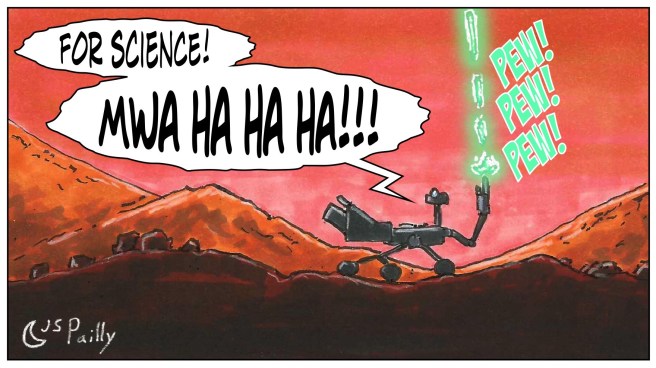
The planet Mars now has its own super villain. In 2016, NASA uploaded new software to the Curiosity rover, giving it a program called AEGIS (Automated Exploration for Gathering Increased Science). Curiosity was already equipped with a high powered laser. Thanks to AEGIS, the rover is now free to use it with or without the input of humans back on Earth.

To quote this article from the Planetary Society:

AEGIS is an example of what we call “science autonomy’, where the spacecraft (the rover in this case) can make decisions on its own about scientific measurements and data—choosing which measurements to make, or having made them, which to transmit to Earth. This is distinct from autonomy in navigation, or in managing onboard systems—both of which Curiosity can also do.

Okay, in all seriousness, I think this is a great idea. One of the biggest frustrations about robotic space exploration is all the time wasted transmitting data back and forth across the Solar System. Due to speed-of-light delays, it can take many minutes, or even hours, to tell a rover what to do and then receive confirmation that the rover has done its job.

With regard to Curiosity’s laser, that instrument is used to vaporize Martian rocks. The resulting rock vapor is then spectroscopically analyzed to identify the rock’s chemical composition. Letting Curiosity do that sort of science on its own has, according to that Planetary Scociety article, saved NASA from a lot of wasted time and effort.

Even so, I can’t help but feel like, if we lived in a comic book universe, this science autonomy thing would be a very, very bad idea. Especially when laser are involved.