Martian Snowflakes

Thus far in my on-again/off-again mission to Mars, I’ve learned that while ancient Mars may have been a wet and watery place, that does not necessarily mean it was anything like Earth. The evidence I’ve seen from Mars’s Tharsis region and the surrounding area suggests that Mars has had a rather violent history with water. But I’ve heard that other regions—most notably the Utopia Planitia region—may have a different story to tell about Mars’s watery past… and its watery present.

I’ve only just started learning about Utopia Planitia, and right away I was in for a surprise. On September 13, 1977, the Viking-2 Lander took a photograph of what appeared to be a light dusting of snow on the ground. Then on May 18, 1979, approximately one Martian year later, it happened again. This is the 1979 photo:
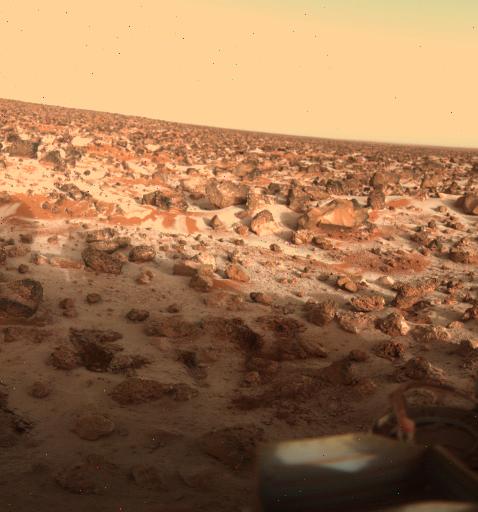
We can’t be 100% sure what happened, specifically. Did it really snow at the Viking-2 landing site, or does it just look like snow? Could it instead be a layer of frost, like how back on Earth morning dew turns to frost during the winter? Is this snow/frost made of frozen H2O, frozen CO2, or a mixture of both?

Personally I’d like to believe that it snowed, and that it was genuine H2O snow. I love snow. I love how quiet and pretty and restful snow is, and somehow the idea of snow drifting even more slowly to the ground (because of Mars’s reduced gravity) appeals to me. I wish I’d started studying something other than the Tharsis Bulge and Valles Marineris canyon earlier, because clearly I’ve been missing out!

P.S.: I think there should be something like the Lunar X-Prize for whoever builds the first snowman on Mars.

Sciency Words: Utopia Planitia

Today’s post is part of a special series here on Planet Pailly called Sciency Words. Each week, we take a closer look at an interesting science or science-related term to help us expand our scientific vocabularies together. Today’s term is:

UTOPIA PLANITIA

As a lifelong Star Trek fanatic, I’ve known the name Utopia Planitia for almost as far back as I can remember. It is (or rather, will be) the site of a prominent human colony on Mars, and by the 24th Century it will be the location of one of Starfleet’s most important shipyards. The U.S.S. Enterprise-D, the U.S.S. Defiant, and the U.S.S. Voyager will all be built there. But where did the name Utopia Planitia come from?

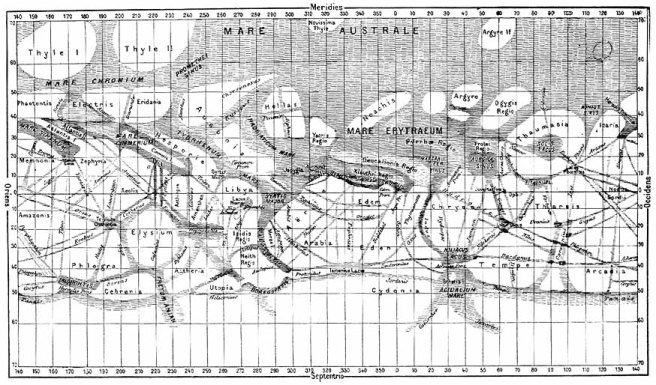
In the 1870’s and 1880’s, Italian astronomer Giovanni Schiaparelli drew what were, at the time, the most accurate and detailed maps of Mars ever produced. But Schiaparelli had a problem. He had trouble matching the pre-established names from older Mars maps to his new map. The old maps were, to put it bluntly, wrong. The new map looked so different that Schiaparelli had to throw out all the old geographic names (goodbye, Kepler-land and Cassini-land!) and make up new ones.

For inspiration, Schiaparelli turned to the Bible, Greek and Roman mythology, and other classical sources. That included several names for “paradise,” like Eden, Arcadia, and Utopia. Clicking the image below will take you to a NASA history page, where you can take a closer look at one of Schiaparelli’s maps (I believe it’s his original map from 1877, but I’m not 100% sure). Bear in mind that this map was drawn based on what Schiaparelli saw through his telescope, and it was intended for use by other telescope observers of his time, so north and south are flipped around.

At about 260° longitude and 50° north latitude, you’ll find a small, triangular shape marked Utopia.

In Greek, the literal meaning of Utopia is “no place,” but the word has come to mean paradise or fantasy-land… a place so idealistically perfect that “no place” like it could exist in reality. And so Utopia Planitia means “the plains of paradise” or “the plains of fantasy.” Thematically speaking, I can’t think of a better place for all those wonderful ships from Star Trek—and the idealistic vision of the future those ships are supposed to represent—to be constructed.

Road Trip to Mars

Way back when I was just starting to teach myself this science stuff in order to improve my science fiction, I discovered Google Earth included, in addition to a highly detailed map of the whole Earth, highly detailed maps of the Moon and Mars. I’m told the program now includes even more worlds to explore: Pluto, Europa, Titan… I imagine there’ll be a whole Google Solar System soon enough.

Anyway, back in those early days of my sciency self-education, I was playing with Google Mars, trying to get a better feel for Martian geography, when a little window popped up asking if I’d like driving directions to the location I’d just clicked on. I’m sure you can imagine my reaction: “Oh, yes please!” But of course this was only a glitch or something, and all the “get directions” options were grayed out.

There’s just something whimsically delightful about the idea that you could hop in your car and drive to space, drive all the way to Mars if you want. Apparently I’m not the only person who thought so. I wonder if those “get directions” options would still be grayed out today, now that Elon Musk has sent one of his old cars on a Mars-ward orbital trajectory.

I realize some people were a bit peeved about the whole first car in space thing. How tacky. How wasteful. Who’s this crazy billionaire throwing his money away on a stunt like that? I get it. To be honest, I kind of agree, and I would’ve preferred it if SpaceX had used the Falcon Heavy’s first test flight to launch something more pragmatic, like a weather satellite or something. Maybe that was too risky, given that a lot of people (myself included) expected the Falcon Heavy to blow up on the launch pad. I don’t know.

But what’s done is done, and while I have mixed feelings about sending a car to space, I do enjoy the whimsy of it. Also, I’ve been pleasantly surprised over the last few weeks by how many people are still talking about the “space car,” and how many of my friends and co-workers have suddenly taken an interest in space, how many of them are asking me about Elon Musk and SpaceX and Mars exploration. I doubt that would have happened if SpaceX had launched a boring old weather satellite or something aboard the Falcon Heavy.

Anything that gets people talking about space and science is a win in my book, but what do you think? Was sending a car to space stupid and wasteful? Totally awesome? Or do you have mixed feelings about it, like I do?

Correction

Thanks to Simon for giving me the heads up about this: Musk’s Tessla Roadster is not, strictly speaking, the first car in space. Click here for more info.

Sciency Words: Baily’s Beads

Today’s post is part of a special series here on Planet Pailly called Sciency Words. Each week, we take a closer look at an interesting science or science-related term to help us expand our scientific vocabularies together. Today’s term is:

BAILY’S BEADS

This is going to be a quick one. I sort of blew all my writing hours this week finishing the first episode of my new short story series: Omni-Science. I don’t regret that. Writing Omni-Science felt awesome, and I hope you liked reading it.

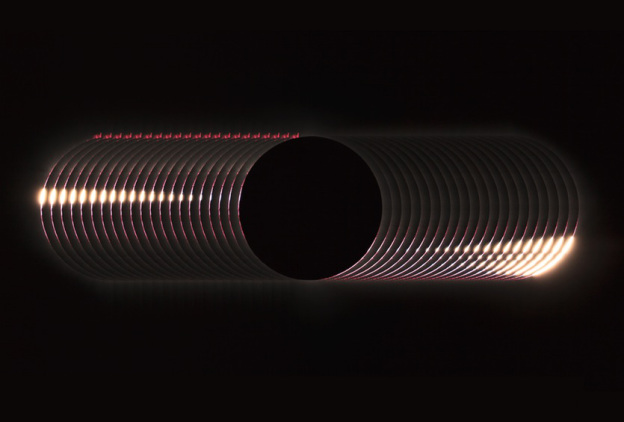
The writing prompt that inspired Omni-Science was this photograph of the “Mondretti cylinder.”

That’s a very strange and mysterious image, certainly strange and mysterious enough to get the machinery in this writer’s brain started. But being the science nerd that I am, I also recognized that this is actually a time-lapse/composite image of a solar eclipse, showing off the “Baily’s beads” effect. (Also when I downloaded the image, the file name had the words “Baily’s beads” in it, which removed any doubts I had about what I was really looking at.)

As I’m sure you know, the Moon is not a smooth, perfect sphere. It’s covered in craggy terrain, and so during an eclipse, just before the Sun disappears entirely behind the Moon, the last rays of sunlight peak out from the gaps between mountains and craters and so forth. As a result, those of us who are using proper safety gear get to see these “beads” of light around the edges of the Moon.

I’m guessing Francis Baily was not the first person to notice this, but in 1836 he became the first to explain it in a paper for the Royal Astronomical Society titled “On the remarkable phenomenon that occurs in total and annular eclipses of the sun.” Those 19th Century English astronomers certainly did have a way with words, didn’t they?

Molecular Monday: Quasar-Induced Chemistry

Today’s post is part of a bi-weekly series here on Planet Pailly called Molecular Mondays, where we take a closer look at the atoms and molecules that make up our physical universe.

As a science fiction writer, one of the things I’m really doing with my research is trying to find excuses to break the laws of physics. So anything that might produce a previously unknown material substance, a substance that might be imbued with properties that are useful for storytelling purposes… that sort of thing is of great interest to me. With that in mind, I recently read a news article about quasars and the weird, unexpected chemical reactions they can cause.

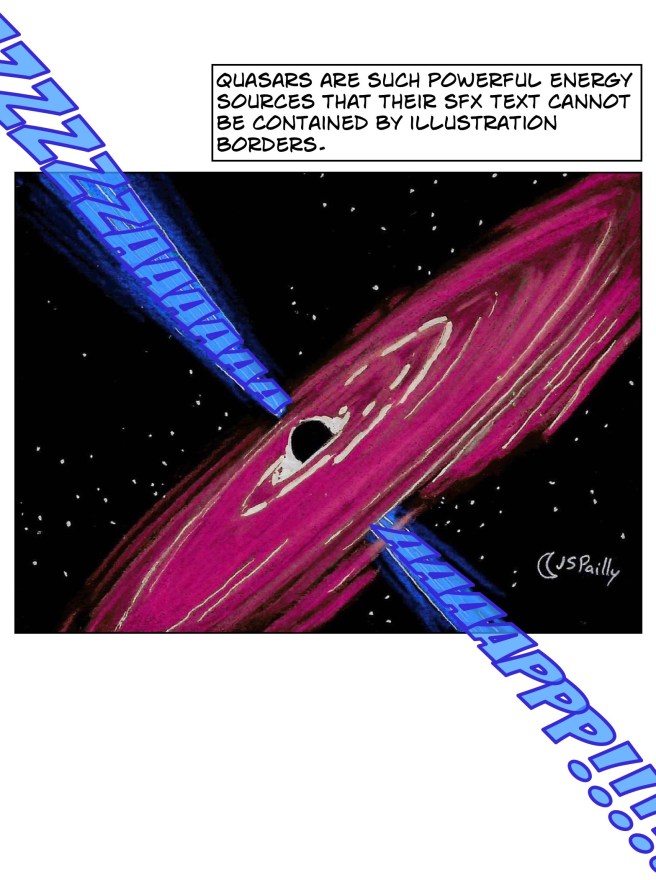
Quasars are black holes with disks of superheated gas and dust swirling around them. Due to the intense heat of the disk, the extreme gravity of the black hole, and the crazy electromagnetic field the two produce together, you end up with these twin laser-like jets of super-accelerated particles shooting away from the quasar in opposite directions.

According to this research paper published in the Monthly Notices of the Royal Astronomical Society, and according to this slightly less technical summary from Physics World, any molecules that happen to get caught in a quasar’s laser beams are ripped apart by a process known as photolysis. Then, after these quasar-zapped particles have had some time to cool off, they can recombine to form new molecules.

I was led to believe by the initial news report I read that this sort of extreme scenario might also cause atoms to recombine in ways that they normally wouldn’t. Unfortunately I don’t see anything in the actual research to back that up. For the most part, quasar chemistry produces fairly ordinary molecules like hydroxyl, carbon monoxide, and molecular hydrogen.

Still, for the purposes of science fiction, some sort of quasar-induced chemical reaction producing strange, new, potentially valuable chemical substances… that may be too awesome of a concept for me to pass up.

Sciency Words: Moon Village

In this week’s episode of Sciency Words, the Moon would like to ask a question, the same question it’s been asking since 1972:

The answer is we humans may be returning to the Moon fairly soon, perhaps within the next decade, but this time we’ll be bringing a far more diverse set of flags to add to the Moon’s collection.

The European Space Agency, also known as the E.S.A., is taking the lead on the next round of Moon missions. For the last few years, Johann-Dietrich “Jan” Wörner, the current E.S.A. director-general, has been talking up the idea of building a Moon village near the Moon’s south pole, a region where large quantities of water ice have been detected.

Apparently interest in Wörner’s Moon village has been growing steadily to the point that Wörner has been quoted saying the village is already “more or less a fact.” I have a feeling the recent successful test of SpaceX’s Falcon Heavy rocket will accelerate that growth in interest.

But my biggest question about this, and the reason I felt this was worthy of a Sciency Words post, is this: why aren’t we talking about a Moon base? Why is it a village? Apparently the terminology was a very deliberate choice. On the E.S.A. website, Wörner writes:

By ‘Moon Village’ we do not mean a development planned around houses, some shops and a community centre. Rather, the term ‘village’ in this context refers this: a community created when groups join forces without first sorting out every detail, instead simply coming together with a view to sharing interests and capabilities.

I remember in first or second grade painting a mural as a class project. Each student was free to paint whatever he or she liked within the guidelines set by the teacher. The Moon village sounds like a similar concept to me, with every participating country or company or other privately funded group doing their own thing within the broader guidelines set by the E.S.A.

I just hope the end result is not quite the eyesore that that mural was when I was a kid.

2017/2018 Mars Mission Update

So I’m going to take a short break from my Mars mission because there are a few other things I want to work on. But I am most definitely not done with Mars.

First off I have two more posts I want to write about dining on Mars. We’ve already talked about growing potatoes and other vegetables in Martian regolith, and we’ve also talked about entomophagy. But as a Mars colony continues to grow, the colonists may be able to sustain some more “luxurious” foods.

I also have two planetary protection papers set aside that I really want to read. One argues in favor of letting our Mars rovers enter regions where biological activity is suspected to be occurring. The other argues against it. I’m not sure what I’ll get out of these two papers, but comparing and contrasting the arguments should be interesting.

Lastly, I’ve been telling you that Mars had a rather violent history with water. The geological evidence suggests lots of flash flooding rather than the kind of stable, long-lasting bodies of water we see here on Earth. But I may have made a bit of a sampling error here because most of what I’ve been reading about focuses on the Tharsis Bulge and surrounding regions. I’ve heard that if I visit other parts of Mars—the Utopia Planitia region, for example—Mars’s history with water might start looking different. I don’t know. We’ll see.

I started this special Mars Mission because I felt like I didn’t know nearly enough about the Red Planet. At this point, I’d say I’ve learned a lot but still have a lot more to learn. So while I’m going to move on to some other research topics right now, I will be coming back to this fairly soon. And if anyone has suggestions for other Mars-y things I should check out, please let me know in the comments.

Sciency Words: Jeans Escape

Today’s post is part of a special series here on Planet Pailly called Sciency Words. Each week, we take a closer look at an interesting science or science-related term to help us expand our scientific vocabularies together. Today’s term is:

JEANS ESCAPE

Once upon a time, there was a molecule on Mars that dreamed of going to space. In fact, once upon a time there must have been a whole lot of molecules in the Martian atmosphere that wanted to go to space, and they apparently succeeded because today Mars’s atmosphere is mostly all gone.

Several factors must have contributed to the success of this molecule-scaled space program. One factor was temperature. The temperature of a gas is really a measure of the average velocity of the molecules in that gas. But remember, that’s the average velocity meaning some individual molecules may be considerably faster or slower than average.

As gas molecules bounce off each other, some of them may also gain or lose momentum, and in some cases a molecule might gain enough momentum to achieve escape velocity (11 kilometers per second on Earth, or 5 kilometers per second on Mars).

At that point, that molecule could achieve its dream and fly off into space (assuming it doesn’t collide with any other molecules on the way out). This can happen with virtually any gas on any planet, but it works best for light-weight molecules (like hydrogen or helium) on low gravity worlds (like Mars).

This process is sometimes called thermal escape, but in the scientific literature I’ve read it seems to be more commonly referred to as Jeans escape.

Sir James Hopwood Jeans was a British mathematician and astronomer. In the early 20th Century, he published prolifically on subjects ranging from star formation to blackbody radiation to the thermal properties of planetary atmospheres. It was this planetary atmospheres work that first led to the idea that a planet could gradually lose its atmosphere to space.

Or at least it was the first time we humans knew anything about it. The atmospheric gas molecules of Mars figured it out a long, long time before that.

Molecular Monday: Top 5 Chemicals on Mars

For today’s Molecular Monday post, I thought I’d try something a little different. I’m counting down my picks for the top five chemicals on Mars. These are chemicals that, in one way or another, are important to helping us understand the Red Planet better.

#5 Possible Methane
Several robotic probes have detected burps of methane on Mars, which could indicate ongoing biological or geological activity—either one of which would be a huge surprise on a world long thought to be both biologically and geologically dead. However, the methane could also be a contaminant leaking from the robots themselves. We’ll have to wait and see with this one.

#4 Hematite
Hematite is a rusty red colored mineral, also known as iron oxide or iron (III) oxide. Almost the entire surface of Mars is covered in hematite, giving the planet its distinctive color. But questions remain about where all this hematite came from. One thing we can be certain about is that Mars’s red color is only skin deep. When the Curiosity rover drilled a hole in the ground, it found the underlying layer was grey.

#3 Carbon Dioxide
Mars’s atmosphere is almost all carbon dioxide, which should help keep the planet warm, but the air is too thin to produce much of a greenhouse effect. As a result, Mars is a little too cold for human comfort. There’s also plenty of frozen CO2 (also known as dry ice) at the poles. Maybe someday we can release all that excess CO2­ and do to Mars what we hope not to do to Earth.

#2 Perchlorate Salts
The most noteworthy perchlorates on Mars are calcium perchlorate and magnesium perchlorate, but there are plenty of other flavors besides those two. Based on data collected all over Mars, it seems these perchlorate salts make up 0.5% to 1.0% of the Martian regolith; that makes the regolith extremely toxic to humans, and we need to figure out what to do about this problem before we can begin any serious colonization efforts. On the other hand, in the unlikely event that life already exists on Mars, perchlorates might (might!) make a good source of chemical energy, similar to the way oxygen is a good source of chemical energy for us.

#1 Water
Humans on Mars will not suffer from a lack of water. There are vast quantities of H2O frozen at the poles and buried in underground glaciers. And there’s little doubt that liquid water once flowed over the planet’s surface, carving river channels and chemically altering the rocks. However, a wet and watery Mars would have looked very different from modern Earth. Rather than standing lakes and rivers, Mars seems to have experienced violent flash floods, perhaps caused by melting and refreezing glaciers, followed by long periods of dryness. Still, the liquid water was definitely there, and there’s a distinct possibility that microorganisms could have started to evolve before the planet dried up completely.

So those are my picks for the top five most interesting and/or important chemicals on Mars. Let me know what you think of this list in the comments, and if people like it, maybe I’ll do something similar for other planets.

P.S.: Honorable mention to the polycyclic aromatic hydrocarbons (PAHs) from the Martian meteorite ALH84001. Like those methane burps, PAHs could either be an indicator of Martian life or a hugely embarrassing scientific mistake.

Sciency Words: Triangular Trade

Today’s post is part of a special series here on Planet Pailly called Sciency Words. Each week, we take a closer look at an interesting science or science-related term to help us expand our scientific vocabularies together. Today I’m really stretching my conception of science-related terms so we can talk about:

TRIANGULAR TRADE

When I was a kid, I had an extensive collection of cards from Star Wars: The Customizable Card Game. At one point, I was trying to trade with a friend to get his Millennium Falcon card, but I didn’t have anything my friend wanted. So we got a third person involved and set up a three-way trade. My extra Princess Leia card went to this third person, who then gave a rare star destroyer to my friend, who then gave me the Millennium Falcon I needed to complete my rebel fleet.

This was sort of like what happens in triangular trade. Like nerdy kids trading Star Wars cards (or non-nerdy kids trading, I don’t know, baseball cards or something), cities or regions or countries set up three-way trade arrangements for their exports. This kind of arrangement served as the basis for much of the world economy in the 18th and 19th Centuries, during the Age of Colonialism.

The most commonly cited example (unfortunately) is the slave trade, where the trade routes between Europe, Africa, and the Americas actually traced out a big triangle across the Atlantic Ocean. European nations exported manufactured goods to their African colonies, which then exported slaves to the American colonies, which then exported things like sugar, cotton, tobacco, etc to Europe.

Obviously triangular trade is more of a historical term than a sciency thing, but much like the word thalassocracy, I feel like this old, history-related term might become applicable again in a far-out, Sci-Fi future where humanity is spreading across the Solar System. And the reason I think that is because Robert Zubrin, one of the foremost Mars colonization advocates in the U.S., wrote about triangular trade in his book The Case for Mars and also in this paper titled “The Economic Viability of Mars Colonization.”

To quote Zubrin from his “Economic Viability” paper:

There will be a “triangle trade,” with Earth supplying high technology manufactured goods to Mars, Mars supplying low technology manufactured goods and food staples to the asteroid belt and possibly the Moon as well, and the asteroids and the Moon sending metals and possibly helium-3 to Earth.

So everybody wins! The people of Earth win, the colonists on Mars win, and all the prospectors and mine workers in the asteroid belt win! Even our moonbase wins (this part might seem counterintuitive, but the delta-v to reach Earth’s Moon from Mars is actually lower than the delta-v to reach the Moon from Earth). And this time, slavery isn’t involved!

Unless the high technology being exported from Earth includes robot slaves who then… hold on, I have to go write down some story ideas.