Living on Mars Time

In the last two episodes of Sciency Words, we’ve been talking about timekeeping on Mars. A “day” on Mars is slightly longer than a day on Earth, and a Martian calendar would require a whole lot of leap years. And (spoiler alert) the Sciency Words post for this coming Friday will also be Mars-time related.

But in the course of my research, I came across this TED Talk by NASA engineer Nagin Cox. She’s one of the people who had to actually live on Mars time as part of her job, and I think she has a lot of valuable insight into what the Martian experience is really like.

For me, one of the major highlights of this is the part where Ms. Cox shows us that she’s wearing two watches: one set to Earth time and one modified to run slower, presumably 2.7% slower, to match Mars time. I’d always assumed this was a computer thing; I didn’t realize physical Mars watches were made.

It would seem that, at least as far as NASA’s Mars watches are concerned, the Martian “day” is still divided up into 24 “hours.” It’s just that these hours are 2.7% longer than hours on Earth. Martian minutes and seconds are also 2.7% longer. Obviously this is inconsistent with S.I. units, but I imagine it cost a lot less to modify an existing watch to run 2.7% slower than it would to design a whole new watch that includes an extra 39 minutes and 35 seconds in a day.

Anyway, for those of you who really want to know what it would be like to live on Mars, I think this is worth watching. It’s about 14 minutes long. To be more precise, it’s 13 minutes and 48 seconds in Earth time, or 13 minutes and 26 seconds in Mars time, assuming I did my math correctly.

And if you’re looking to get a Mars watch of your own, turns out there’s an app for that (click here for the Android version and click here for iPhone).


Sciency Words: The Darian Calendar

Today’s post is part of a special series here on Planet Pailly called Sciency Words. Each week, we take a closer look at an interesting science or science-related term to help us expand our scientific vocabularies together. Today’s term is:

THE DARIAN CALENDAR

In 1986, aerospace engineer and polymath Thomas Gangale published a paper titled “Martian Standard Time” in which he outlined a calendar which could be used by Martian colonists in the future. Gangale named this calendar the Darian calendar after his son, Darius, and he describes the idea in greater detail on his website (click here).

According to the Darian calendar, the Martian year begins on or around the vernal equinox, when the sun is directly above the planet’s equator and spring is just beginning in the northern hemisphere. Because the Martian year is nearly twice as long as Earth’s, we get twenty-four months rather than twelve.

The names of the months alternate between the Latin and Sanskrit names for the Zodiak constellations. Thus the month of Sagittarius (the first month of the year) is followed by Dhanus, then Capricornus, then Makara, then Aquarius, and so on until you get to Scorpius and then Vrishika (the last month of the year). Each month has 28 days… sorry, 28 sols… except Kumbha, Rishabha, Simba, and Vrishika (the 6th, 12th, 18th, and 24th months, respectively) unless it’s a leap year, in which case Vrishika is 28 sols long.

And regarding leap years, there are a lot of them: six every decade, so leap years are actually more common than regular years. But then every hundred years we have to take a leap sol away, and then every five hundred years we have to put it back—I know, this is starting to sound complicated, but it’s not that much worse than what we have to do to keep the Gregorian calendar balanced on Earth.

If you’re wondering about the days of the week (I mean, sols of the week), Gangale thought of that too. Each Mars week is made up of seven sols with names that hark back to the ancient Latin names for the days of the week:

Sol Solis (Sunday)
Sol Lunae (Monday)
Sol Martius (Tuesday)
Sol Mercurii (Wednesday)
Sol Jovis (Thursday)
Sol Veneris (Friday)
Sol Saturni (Saturday)

Also, Gangale designed his calendar so that each date always falls on the same sol of the week. The 1st of Sagittarius is always a Sol Solis, for example. That’s pretty convenient, I think, although it also works out that every month the 13th is always on a Sol Veneris (a Friday), which seems rather unlucky.

The question, of course, is will Martian colonists actually adopt this as their calendar? I don’t know, but it seems certain aspects of the Darian system—such as the way it handles leap years—have already been borrowed for other Mars-related research purposes.

IWSG: Real Life Problems

For this month’s episode of the Insecure Writer’s Support Group, I… actually, I’ve been going through some things. I’m not quite prepared to talk about it yet. So instead, I’m going to turn the floor over to my muse. She has something to say, and perhaps it’s something your muse would like to hear.

* * *

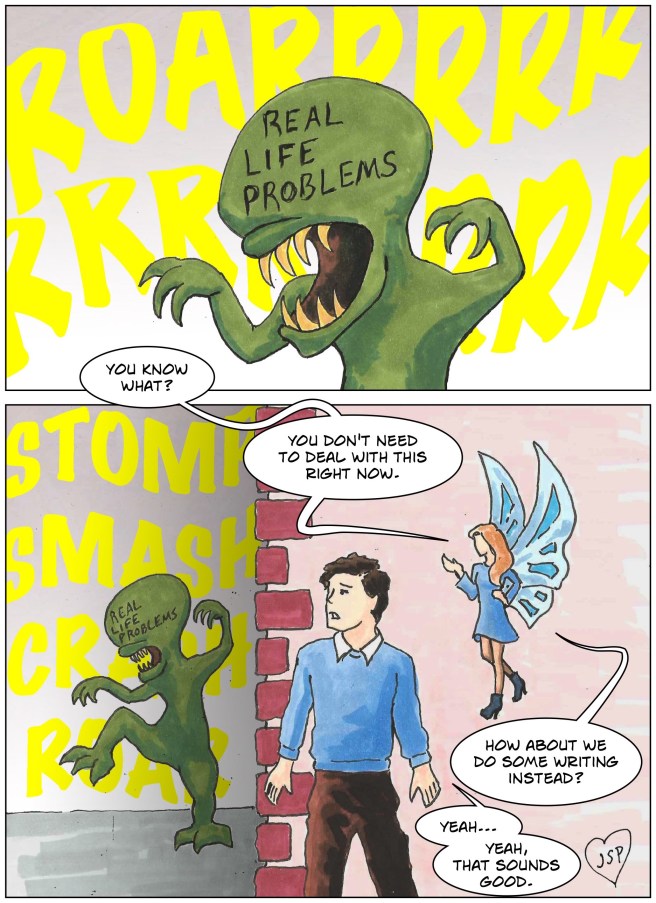
My fellow muses, I think we all know how our writers can be. They live out there… out there in the real world, and sometimes they get caught up in their real life problems. They have chores to do. And jobs. They have to eat sometimes, and they get sleepy and pass out every night.

It’s hard for us, as ethereal beings living in the eternity of imaginary space, to tell when our writers really do need to deal with this “real life” stuff and when they’re just making excuses to skip writing. Personally, I’m really suspicious of this “job” thing. It takes up a lot of my writer’s time, and all he gets for it is something called “money.”

But recently, I had the opportunity to turn the tables on all those distractions out there in the real world. And I took that opportunity.

Now, rather than using his real life problems as an excuse to skip writing, my writer is using writing as an excuse to not deal with his real life problems! Everybody wins!

Okay, maybe I’m not too proud of myself for this one. But sometimes we muses need to be sneaky. We need to be manipulative. We need to do whatever it takes to coerce our writers into writing. And whatever else is going on in my writer’s life right now, at least he’s getting his writing done. As a muse, that’s really all I’m supposed to care about. Right?

Molecular Monday: Mars Burps Methane

Happy New Year’s, and happy Molecular Monday too! I can’t think of a better way to start off 2018 than with a blog post about molecules. Well, no… I probably could, but my schedule says this is what I’m supposed to blog about today, so here we are!

If you’re looking for life on other planets, one of the most common pieces of advice you’ll get is “follow the water.” That is, of course, assuming you can find any liquid water in the first place. But maybe another option is to follow the methane.

The planet Mars seems to have a bit of a methane mystery going on. Mars will sit there, all quiet and normal, for years at a time, but then suddenly…

… and then suddenly all this methane shows up in the planet’s atmosphere.

The most notable of these methane burps occurred in late 2013 and early 2014, when the Curiosity rover started detecting methane levels ten times higher than normal. Where did all this methane come from?

One boring possibility is that it came from the rover itself, a result of some kind of leak. It’s also possible that a meteorite just happened to land near Curiosity, and that this meteorite just happened to be carrying a lot of organic material. Or maybe there was some kind of surprise geological activity nearby that vented methane from somewhere underground.

But the most intriguing possibility is that the methane was produced by biological activity. That is, after all, how most atmospheric methane is produced on Earth. And I recently found this paper offering a possible way to determine once and for all (maybe, hopefully, fingers crossed) if Mars’s methane really does come from a biological source.

From what I gather, having only skimmed through this paper (sorry, I was trying to read this on New Year’s Eve, and there were margaritas), the key is to follow the methane then follow the hydrogen. So the next time Mars burps up some methane, the ratio of methane to hydrogen in the air might reveal the methane’s true source.

Sciency Words: Sol

Today’s post is part of a special series here on Planet Pailly called Sciency Words. Each week, we take a closer look at an interesting science or science-related term to help us expand our scientific vocabularies together. Today’s term is:

SOL

If you’ve read or seen The Martian or pay any close attention to NASA’s ongoing Mars missions, you probably already know what this word means. A sol is a Martian day. The word itself is a shortening of the term solar day, the period of time it takes for a planetary body to rotate once in relation to the Sun.

Technically we could apply this term to any planetary body that experiences regular day/night cycles. A solar day on Earth is 24 hours, as you probably already knew. A solar day on Jupiter is about 10 hours long, and a solar day on Venus is roughly 2,802 hours (or 116.75 Earth days).

But for whatever reason, the shortened form “sol” seems to be used only in reference to Mars, where it equals 24 hours, 39 minutes, and 35 seconds. It’s weird how close a Martian sol is to an Earth day, isn’t it?

Starting with the Spirit and Opportunity missions, NASA has actually made some of its scientists and engineers work on Mars time rather than Earth time. That extra 39 minutes and 35 seconds obviously messes with people’s sleep cycles, eating habits, and social calendars. But it’s important for the crew in mission control to be in sync with the robotics activities taking place on Mars.

Since humans have a natural tendency to be playful with language, a few clever new words have emerged as a result:

  • Yestersol: the sol prior to the current sol, formed by analogy with yesterday.
  • Tosol: the current sol, formed by analogy with today.
  • Solmorrow: the sol after the current sol, formed by analogy with tomorrow.
  • Nextersol: an alternative to solmorrow, presumably formed by analogy with yestersol. Personally I like the sound of solmorrow better.

What really pleases me about these terms is that we haven’t even landed the first humans on Mars yet, and we’re already coming up with vernacular lingo for the Red Planet. Could this be a preview of how Mars colonists might actually speak one day… I mean, one sol? And how else might we adapt human culture to the new environment? I for one am looking forward to Mars’s version of Shakespeare.

Next time on Sciency Words: it’s one thing to know that a Martian day is called a sol, but how the heck are you supposed to find tosol’s date on a calendar?

Sciency Words: Entomophagy (Dining on Mars, Part 3)

Today’s post is a special combination post, continuing my Dining on Mars series and also my regularly scheduled Sciency Words series. Today’s new and interesting science or science-related term is:

ENTOMOPHAGY

When humanity finally makes it to Mars, we might not be going alone. We may end up bringing some insects with us.

To be clear, this wouldn’t be an accidental thing. No, we’d be bringing our insect friends on purpose. Why?

The word entomophagy comes from two Greek words meaning “insect” and “to eat,” and it refers to the practice of eating insects.

Personally, I’m not too keen on becoming an entomophage, but that has more to do with my cultural background than anything else. In many parts of the world that are not the United States or Western Europe, entomophagy is quite normal, and in the near future it may become an important means of feeding a growing global population.

But insects-as-food may be even more important for feeding the early colonial population of Mars. That’s because efficiency is the key to surviving on Mars, and insects make for an extremely efficient food souce. They don’t require a lot of room or resources compared to other sources of animal protein, and when you eat them very little goes to waste. I’m told with some species you’re supposed to remove the wings before cooking, but otherwise the entire insect body is edible.

Apparently insect flavors can vary a lot from species to species, and sometimes depend on what the insects ate themselves. I’ve heard certain species described as “nutty” or “lemony” or even “minty.” Others have more meat-like flavors. According to this article from bugible.com, giant water bugs taste like salted banana, and sago grubs taste a little like bacon. And pan-fried crickets with soy sauce taste amazing, or so I’m told.

Actually, after writing this post I’m feeling a bit hungry. Maybe I could get used to entomophagy after all. Anyone care to join me for lunch?

How Martian Microbes Saved My Life

Hello everybody! This is J.S. Pailly reporting in from the surface of Mars, and today I have a big announcement. Life. I’ve discovered life on Mars!

As most professional astrobiologists would have expected, there are no “people” on Mars, nor any signs of animal or plant life. No, the life forms I’ve discovered are microorganisms.

You might be wondering how even microorganisms can survive in the harsh Martian environment, where it’s so cold and so dry, and where toxic perchlorate salts are scattered basically everywhere.

But it turns out those perchlorate salts, which are so hazardous to human life, are the very reason why Martian life is possible.

You see when I first arrived on Mars and started growing my own food here, I sort of forgot about those deadly perchlorates. And yet my crops still grew in the Martian regolith, and I didn’t succumb to the kinds of severe thyroid disorders that perchlorates can cause in humans. Why not? Because something was eating the perchlorates.

The idea that microorganisms might gobble up perchlorate salts shouldn’t come as a surprise. Back on Earth, certain species of anaerobic bacteria, such as Dechloromonas aromatica, can actually help fight pollution by cleaning up perchlorate-contaminated drinking water. D. aromatica will actually swim toward perchlorates and chemically reduce them to produce the energy they need to live. The native Martian microbes must do something similar.

Of course I should make this disclaimer: while I may be here on the surface of Mars, I’m still just a blogger. NASA or some other space agency should still send some qualified astronauts to confirm my findings. Even so, my preliminary research says these Martian microbes are totally real, and they’re rather conveniently helpful too!

Molecular Monday: Perchlorate Salts on Mars

Today’s post is part of a bi-weekly series here on Planet Pailly called Molecular Mondays, where we take a closer look at the atoms and molecules that make up our physical universe.

It’s hard to imagine how anything could survive long on Mars. This has been especially true ever since 2008, when the Phoenix Lander conducted the first ever wet chemistry experiment on Martian regolith and detected a chemical called calcium perchlorate.

I haven’t looked into how this wet chemistry experiment worked, but I’m guessing it involved mixing water with a sample of Mars dust and then running a spectroscopic analysis.

Of course when this calcium perchlorate was detected, the first question was: did Phoenix contaminate its own sample? On Earth, perchlorates are an increasingly common pollutant produced by (among other things) rocket fuel. But if there was any serious contamination of the Phoenix landing site due to Phoenix’s landing rockets, we’d expect to find ammonium perchlorate, not calcium perchlorate.

Also subsequent experiments and observations by the Spirit and Opportunity rovers, the Mars Odyssey orbiter, and other Mars missions have found that chlorine is scattered all over the planet. Most of that chlorine is likely bound up in perchlorate form, and it’s now estimated that calcium perchlorate, magnesium perchlorate, and other perchlorate salts make up anywhere between 0.5% and 1% of the Martian regolith.

For humans, that’s an alarmingly high percentage. More than enough to kill you, or at least to cause you serious thyroid problems. But if you’ve been following along with my blog, you know I’ve been living on the surface of Mars and growing my own food here for over a month now. So why am I not dead?

Well… it turns out there is life here on Mars, and the natives have been surprisingly helpful. More about that in my next post.


Sciency Words: Graben

Today’s post is part of a special series here on Planet Pailly called Sciency Words. Each week, we take a closer look at an interesting science or science-related term to help us expand our scientific vocabularies together. Today’s term is:

GRABEN

According to the appendix of Frank Herbert’s Dune, a graben is defined as “a long geological ditch formed when the ground sinks because of movements in the underlying crustal layers.”

According to real life, a graben is… well, it’s exactly what Frank Herbert said it is. The term comes from a German word meaning trench, which is a nice, direct way to describe what grabens look like: trenches.

Grabens tend to form between two “normal faults” if the faults run more-or-less parallel to each other. In other words, they form when two masses of the planet’s crust start moving away from each other, allowing a thin sliver of material to sink down into the gap between them.

Fault-Horst-Graben.svg
Image courtesy: Wikipedia.

I used to think grabens could only form due to the movements of tectonic plates, which would mean we should only expect to find them on Earth—the only planet known to have active plate tectonics. But really grabens can occur on any world where the planetary crust is moving around, being pushed or pulled in different directions, causing the surface to stretch and crack.

That could explain why grabens, or at least surface features that look an awful lot like grabens, have been observed on the Moon, Mars, and other places in the Solar System. And perhaps that’s also why they were found (will be found?) on the planet Arrakis, all the way out in the Canopus Star System, according to Frank Herbert.