The Christmas Planet

Yesterday (December 6, 2011), NASA announced the discovery of yet another planet outside our Solar System that might be able to support life.  Its name is Kepler 22 b.  Along with Gliese 581 d and HD 85512 b, this brings the total to three.

Infographic courtesy of NASA/Ames/JPL-Caltech

We do not know for sure that this new planet has life.  We don’t even know if it has liquid water or an oxygen nitrogen atmosphere.  We only know that it’s in the Goldilocks Zone of its parent star, the region where it’s not too hot and not too cold but just right for organic life to develop.

William Borucki, chief scientist for the team that discovered this planet, has been quoted saying, “It’s a great gift.  We consider this sort of our Christmas planet.”  The bigger news, at least in my opinion, is that his team has a list of over 2,000 more possible planets.  Even if only half are confirmed, that’s still a lot of new worlds to study.

As for what life might exist on the Christmas Planet, even if its biochemistry is similar to ours it may not look human.  It may look more like this octopus that recently crawled out of the water and went for a brief stroll on land.

For more information on Kepler 22 b, the “Christmas Planet,” click here.  For artist representations of various planets discovered by the Kepler Mission, click here.  For more on octopi walking on land, click here.

Vacation on Mercury

If you’re looking for someplace warm for your next vacation, it doesn’t get much warmer than Mercury.  The problem is getting there.  Mercury is so close to the Sun that it’s easy for your spaceship to get lost in the Sun’s gravity.  The MESSENGER Probe, currently in orbit of Mercury, took years to get there not because of the distance but because it had to approach at just the right angle with just the right velocity, or else it would’ve crashed into the Sun.

When you finally reach Mercury, you might experience some serious jet lag.  According to NASA, one Mercury day is equal to 58.6 days on Earth, and a Mercury year is about 88 Earth days long.  Also, because of Mercury’s proximity to the Sun, the planet is in a slight space-time warp, due to Relativity.  In fact, the space-time distortions of Mercury’s orbit were one of the first clues supporting Einstein’s Theory of Relativity.

Remember to bring sunscreen.  The daytime temperature is roughly 800 °F, and there’s no ozone layer to protect you from those UV rays.  In fact, there’s not much atmosphere at all, so you may want to pack some oxygen too.

For more information before you plan your trip, check out NASA’s website and be sure to visit Mercury Today for the latest news on the First Planet.  You can also read Ben Bova’s science fiction novel Mercury, which I’m sure is 100% accurate.

About the cartoon: Get it?  The planet Mercury is really hot, so it’s taking its temperature with a mercury thermometer.

100 Years from Now

One hundred years from now, robots won’t only work in factories.  They’ll also make art.  Already, artists in France are using flying robots known as quadcopters to construct some kind of modern art sculpture.  As robots develop emotions, and we all know they will, maybe they’ll find ways to express those emotions through art rather than through the destruction of humanity.  I for one am glad the French are thinking ahead.  Click here for more on robot artists.

One hundred years from now, when you go see the latest art exhibit by Art-bot 9000, you’ll probably drive in a futuristic car that’s more like a modern smart phone. It will have touch screen controls, the exterior will change colors or display text, and it’ll have plenty of other apps.  Toyota recently unveiled a new concept design which could be the first in a long line of smart cars.  Click here for more on that.

And when you drive your smart car off the road because you were too busy playing that classic video game Angry Birds, cybernetic insects will be the first responders to the scene.  Special microchips will control the insects’ brains, and the motion of their wings will generate power for tiny cameras and sensors that will determine if you are alive and how much medical attention you need before the smart ambulance shows up.  Click here for more on cyborg insects.

We have a wonderful, strange future to look forward to, and if you don’t think you’ll still be alive one hundred years from now to enjoy it, click here.

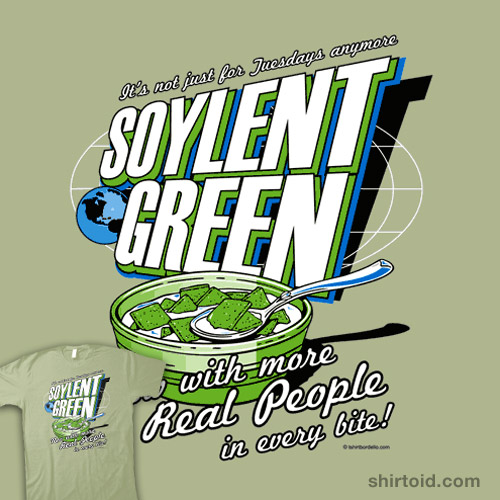
Double Check Your Soylent Green

Does your seafood seem fishy?  Well, the FDA has approved a new technique to double check that your seafood is what the label says it is.  Restaurants will soon begin using a DNA bar code test to verify the species of any fish on their menus.

Maybe some day we can use a similar technique to verify that our Soylent Green is made of real people, not imitation people.

Click here for more on DNA bar coding for fish.

Sci Friday

You may remember a recent experiment where neutrinos appeared to travel faster than light.  Well, they did the experiment again, and the neutrinos did it again.  Whatever is going on, it may be the first hint at a new kind of physics.  Or maybe there’s a sci-fi rift in space and time right in the middle of Europe.

Here are this week’s sciency links.

Honey, I Shrunk a Wasp

How small can animals get?  Researchers have been studying the fairy wasp, one of the smallest animals on Earth, and found that the wasps have made some sacrifices in order to be so small.  The cells that make up their brains and nervous systems are missing some parts (to be specific, they’re missing nuclei).

Fairy wasp compared to two single celled organisms.

So shrinking people, like in Honey, I Shrunk the Kids, might not be a good idea.  It’s certainly possible to discard parts of your brain cells and remain alive—the fairy wasp proves that—but would you still be the same person?

Fantastic Voyage by Isaac Asimov solved this problem by explaining that shrunken people are actually made of tiny, shrunken atoms.  Regularly sized atoms are full of empty space, and since they’re government by quantum mechanics they’re prone to weird behavior anyway, so this weird atom shrinking idea makes some sense.

Obviously the wasps are doing fine with their minimalist brain cells, and once again this proves just how flexible life can be.  You can even make wasps smaller than single celled organisms.

Curious About Mars

Science fiction fans know a lot about Mars.  Fans of H.G. Wells know there is life there, watching us keenly and closely with far greater intelligence than man’s.  Fans of Doctor Who know not to drink Martian water.  Fans of really bad B-movies know the bad guys of Mars are no match for Santa Claus (if you haven’t heard about this movie before, you need to click here).

Mars Dust Storm Brews in Hellas Basin and Northern Polar Cap
Source: Hubblesite.org

Scientists are finally catching up.  Mars, they once said, is too harsh an environment for life to exist.  It doesn’t have liquid water. It doesn’t have any protection from cosmic radiation. It doesn’t have the carbon compounds needed for life as we know it.

Now they aren’t so sure.  They’ve found evidence of liquid water, and maybe that excess radiation from space isn’t so bad after all.  It is possible, they say, for microbial life to exist on Mars (which is why you shouldn’t drink the water).  As for those carbon compounds… a new probe is scheduled to launch this weekend to check on that.

The Mars Science Laboratory, also known as the Curiosity Rover, is the biggest, most sophisticated machine ever sent to Mars.  It’s the size of a car, carries ten different scientific instruments, and NASA says it has enough plutonium fuel to keep it running for at least two years… probably more.  It will land in a place called Gale Crater, where it will examine exposed layers of ancient rock and search for organic compounds in Martian soil.

No doubt Curiosity will find evidence of what we Sci-Fi fans and Santa Claus already know: there is life on Mars… life that apparently doesn’t know the true meaning of Christmas.

Links

Sci Friday

The sad news is that Russia’s mission to Mars is still stuck in Earth orbit.  The good news is that next week, NASA is sending its own rover to Mars.  Hopefully that one will work okay.

Here are this week’s sciency links.

Good News for Vampires

The new Twilight movie premiers this Friday.  I don’t know about you, but I plan to be standing in line Thursday night waiting for the midnight showing.

The Twilight series focuses on the Cullens, a family of vampires who have decided for ethical reasons not to feed on humans.  They drink the blood of animals instead and jokingly compare themselves to vegetarians.  Thanks to modern science, more vampires will soon be able to live the “vegetarian” lifestyle.

Researchers in France say they’ve found a way grow red blood cells in the lab.  Previous experiments with artificial blood focused on making a synthetic blood substitute.  This time, they’ve made real blood: fully functional blood cells no different from the kind already in your veins.

Scientists took stem cells from a patient and coaxed them into becoming red blood cells.  Once this worked, the new blood cells were given to the patient as a transfusion.  Since the blood was real blood made with the patient’s own DNA and not a man-made substitute, it went right to work, and the body accepted it without trouble.

Vampires should be really excited about this news, because this blood will taste exactly like the real thing and provide the same nutritional value.  They won’t have to kill humans anymore.

For more information on growing blood in the lab, click here.