Oxygen Sheath (Tomorrow News Network: A to Z)

Hello, friends!  Welcome back to the A to Z Challenge.  For this year’s challenge, I’m telling you more about the universe of Tomorrow News Network, my upcoming Sci-Fi adventure series.  In today’s post, O is for:

OXYGEN SHEATH

It should not surprise you to learn that oxygen is one of the strongest oxidizers in the known universe.  For some of us, that makes oxygen a source of biochemical energy and a necessity for life.  But for many other life forms, oxygen’s oxidizing power is too much to handle, making oxygen a deadly poison.

There’s not much middle ground here.  You either need oxygen to survive, or oxygen means instant death, depending on whether your species evolved in an oxygen rich or oxygen poor environment.

When human colonists first arrived on Litho, they set up generators for a static oxygen sheath: a force field bubble that keeps Litho’s natural atmosphere out and holds an artificial oxygen atmosphere in.  The oxygen sheath isn’t perfect.  Near the oxygen sheath’s perimeter, you can smell ammonia seeping through.  And of course, all the alkaline dust particles covering Litho’s surface still pose a bit of an air quality concern.  Colonists are encouraged to wear nose filters whenever outdoors.

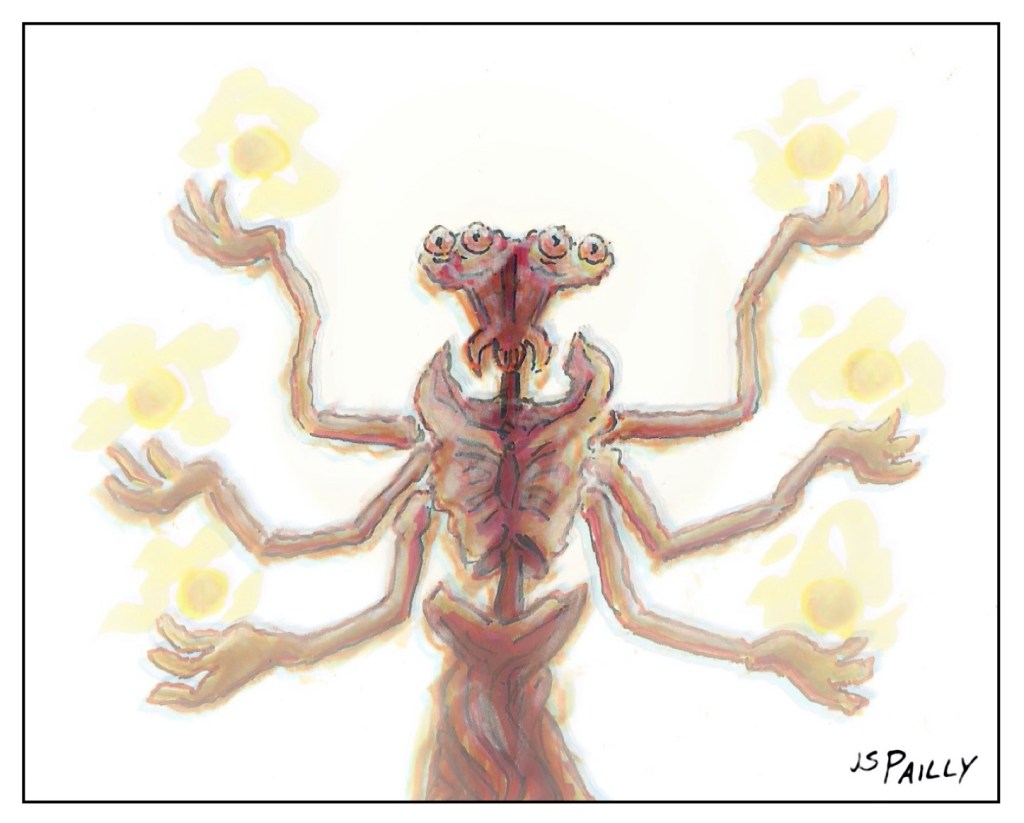
But the biggest concern related to the oxygen sheath has to do with Litho’s native life forms: the scrubby, slimy cyanomolds.  Those cyanomolds evolved in an oxygen poor environment.  Oxygen should kill them.  And yet, for reasons that remain unclear, the cyanomolds are thriving under the oxygen sheath’s influence.

Litho Colony is now partially surrounded by a mold forest.  Giant, bulbous masses have swollen up, with coral-like fringes and lots of creeping vines and tendrils.  To some, it’s a disgusting sight; to others, the cyanomolds have their own alien beauty.  Like so many things about life, it’s a matter of perspective.  But if left unchecked, the cyanomolds would spread rapidly across the colony grounds.  Keeping that mold forest under control has become a real nuisance for the colonists.

Next time on Tomorrow News Network: A to Z, we’ve already met young Milo Marrero.  Now it’s time to meet Milo’s dad.

The New Galactic Chemical Registry (Tomorrow News Network: A to Z)

Hello, friends!  Welcome back to the A to Z Challenge.  For this year’s challenge, my theme is the Sci-Fi universe of Tomorrow News Network, and in today’s post, N is for:

THE NEW GALACTIC CHEMICAL REGISTRY (N.G.C.R.)

In the first book of the Tomorrow News Network series, there’s a bit of narration about a chemical substance called lithium trinate.  For any chemistry buffs who might be reading this, you’re right: that’s not a real name for a chemical.  Allow me to explain.

Here in the 21st Century, the International Union of Pure and Applied Chemistry (I.U.P.A.C.) is in charge of naming and categorizing chemicals.  But according to Tomorrow News Network, at some point in the future, all the I.U.P.A.C. naming conventions will be replaced by a new system called the Galactic Chemical Registry.

And then at some point even farther into the future, the Galactic Chemical Registry will be changed and updated once more, thus leading the the creation of the New Galactic Chemical Registry (N.G.C.R.).  The sciences have a long history of redefining key terms, of updating or replacing old systems of nomenclature with new ones.  So by the 44th Century, something like the N.G.C.R. could exist. It’s possible.

So lithium trinate might be a real chemical, a chemical whose original I.U.P.A.C. name has been changed in the N.G.C.R.  Or lithium trinate might be some exotic new outer space chemical that’s totally unknown to 21st Century science.

I can at least tell you lithium trinate was inspired by a real chemical substance called lithium nitride.  I did my research.  I’m pretty sure I got my sciency facts right.  But just in case I overlooked something important, just in case I made some silly mistake, the N.G.C.R. gives my story a bit of plausible deniability.

Next time on Tomorrow News Network: A to Z, even in the 44th Century, humans still need oxygen to breathe.

Milo Marrero (Tomorrow News Network: A to Z)

Hello, friends, and welcome back to the A to Z Challenge!  For this year’s challenge, I’m telling you more about the universe of Tomorrow News Network, my upcoming Sci-Fi adventure series.  In today’s post, M is for:

MILO MARRERO

Milo’s full name is Milo Moneo Militaeus Marrero.  It’s an awkward name, which is fitting because Milo is an awkward teenage boy.  He is one of the 786 colonists living on Litho.

Like many awkward teenage boys, Milo has a crush on a girl.  Also, Milo doesn’t pay much attention in school, he tends to skip his apprenticeship in hydroponics, and he’s got a few minor citations from colonial security on his semi-permanent record.

Oh, and Milo is also a news junkie.  Most of the colonists don’t really follow the news.  As mentioned in yesterday’s post, Litho Colony is so very, very far away from all the war and chaos and interplanetary drama that keeps making headlines.  People have more immediate concerns, like meeting their work quotas and keeping the colony running.

But Milo has developed a peculiar fascination with the Tomorrow News Network, a news organization run by time travelers, a news organization that literally brings you tomorrow’s news today.

So when a certain attractive and popular journalist from the Tomorrow News Network shows up on Litho Colony, most people don’t know who she is, and they don’t really care.  She’s probably doing a business story about A.E.I.  Litho Colony has been turning such an extraordinary profit for A.E.I., after all!

But Milo knows better.  This journalist from T.N.N.—she isn’t just any journalist from T.N.N.  She’s Talie Tappler, the woman who covered the assassination of Reginald Zaphiro, the woman who covered the crash at Roswell, the woman who covered the Planet Eater attack on Hyla Prime.

And now that same T.N.N. reporter is walking around on Litho with a cybernetic cameraman in tow, and Milo is determined to find out why.

Next time on Tomorrow News Network: A to Z, chemistry is already a complicated subject.  By the 44th Century, it’s going to be even more complicated.

Litho Colony (Tomorrow News Network: A to Z)

Hello, friends!  Welcome to another episode of the A to Z Challenge!  This year, I’m telling you all about the universe I created for my upcoming Sci-Fi adventure series, Tomorrow News Network.  In today’s post, L is for:

LITHO COLONY

In case you were wondering, the galaxy is not a peaceful place.  We’ve already met the Galactic Inquisitor.  We’ve learned a little about the Hykonian Hegemonic Empire, and we’ve talked about Earth’s Imperial Exofleet.  But for the good people of Litho Colony, all those wars, all that conflict and strife—those things are very, very far away.

Litho is the outermost moon of the planet Berzelius, located in the Vesper Beta-Beta Star Sector.  The chemical element lithium is superabundant in the moon’s crust (hence the name Litho), and so Alkali Extraction Incorporated (A.E.I.) has established a small mining colony there.

That colony has been extraordinarily profitable, supplying more than half the lithium for the Outer Territories and a full 15% for the Earth Empire as a whole.  A.E.I.’s earnings keep going up, and the colonists are being well compensated for their work.

Don’t let the industrial aesthetic of the place fool you: Litho Colony is a cozy and comfortable place to live.  The hydroponics dome supplies plenty of fresh food; no one has to eat synthetic mush or take nutrition tabs.  The recreation facility is top notch, and there’s even a fully staffed school.  Litho Colony is the kind of place where people can—and do—raise families.

In short, Litho is a quiet, peaceful, isolated colony world on the frontier of space.  Nothing bad ever happens there.  And this peaceful, isolated colony world will be the setting for The Medusa Effect, book one of the Tomorrow News Network series.

And next time on Tomorrow News Network: A to Z, we’ll meet an awkward teenage boy who calls Litho Colony home.

Kotta kottomira (Tomorrow News Network: A to Z)

Hello, friends, and welcome to week three of the A to Z Challenge!  For this year’s challenge, I’m telling you all about the universe of Tomorrow News Network, my upcoming Sci-Fi adventure series.  In today’s post, K is for:

KOTTA KOTTOMIRA

My muse is right.  If I told you what the words Kotta kottomira mean in universe, that would be a huge spoiler for The Medusa Effect, book one of the Tomorrow News Network series.  Unfortunately, I don’t have any other K-words to write about.

Hmmm….

Well, I can tell you this.  As part of my writing process, I host what I call “editing parties.”  I invite a few friends over for dinner.  Then after we eat, I read aloud a selection of whatever my current work in progress is.  It’s a great way to get instant feedback.  It’s far more effective than traditional beta reading, in my opinion.

Now in earlier drafts of The Medusa Effect, Kotta kottomira (whatever that is!) was originally Komse komsavia.  As far as gibberish space alien words go, I thought Komse komsavia looked good on the page.  It sounded right in my head, and beta readers never commented on it.  But when I read those words aloud to my friends, my friends started laughing.

Turns out that Komsa komsavia sounds too much like the French phrase comme ci, comme ça, meaning “neither good nor bad” or “eh, it’s so-so.”  At that point in the story, I had not yet revealed what my alien gibberish was supposed to mean, but it definitely was not supposed to mean that!

So I changed it.  Very special thanks to David and Andrea for helping me catch that little mistake.  Hopefully Kotta kottomira makes better alien gibberish than what I had before, and hopefully the ending of The Medusa Effect has not been spoiled for you by this blog post!

Next time on Tomorrow News Network: A to Z, Litho is a peaceful, isolated colony world.  Nothing bad could ever happen there.

Journalistic Integrity (Tomorrow News Network: A to Z)

Hello, friends!  Welcome to another episode of the A to Z Challenge.  For this year’s challenge, I’m telling you more about the universe of Tomorrow News Network, my upcoming Sci-Fi adventure series.  In today’s post, J is for:

JOURNALISTIC INTEGRITY

Tomorrow News Network has lots of weird aliens, cool planets, and gigantic spaceships.  Also, time travel.  Plenty of time travel.  But in a sense, T.N.N. isn’t really about any of that stuff.  Really, this is a series about journalism.

They say write what you know.  Just about every aspiring author has heard that advise at some point.  Well, I’ve spent over a decade working in the news business.  It’s an exciting and important job.  It can also be a frustrating and depressing line of work, depending on what happens to be in the news today.  The news business is what I know, so that’s what I write about.

Which brings us to the issue of journalistic integrity.  To quote my main character, the time traveling news reporter Talie Tappler:

You have to understand: we at the Tomorrow News Network have a policy.  We report the news.  We do not make the news, or remake the news, or interfere with the news in any way.  […]  It’s a matter of journalistic integrity.

Talie’s sense of journalistic integrity will be a source of conflict in most (if not all) of the Tomorrow News Network adventures.  She is a time traveler.  She knows the future.  When she shows up to cover a newsworthy event, she knows already what’s going to happen.  She knows who will suffer, who will die, and who will stand triumphant in the end.

And Talie will not interfere.  She will not meddle with history.  She will not alter time.  All Talie will do is smile coyly and tell you, “It’s a matter of journalistic integrity.”

Next time on Tomorrow News Network: A to Z, I will very awkwardly try to tell you about Kotta kottomira without revealing what those words mean (because that would be a major, major spoiler).

P.S.: A while back, I wrote a guest post for Fiction Can Be Fun about the real life origins of Tomorrow News Network.  So if you want to know more about how I’ve incorporated my work experience into my Sci-Fi writing, please click here.

Inverted Space (Tomorrow News Network: A to Z)

Hello, friends, and welcome back to the A to Z Challenge.  For this year’s challenge, I’ve been telling you more about the universe of Tomorrow News Network, my upcoming Sci-Fi Adventure series.  In today’s post, I is for:

INVERTED SPACE

On ancient Earth, there were three great revolutions in physics.  First came Isaac Newton and his laws of classical mechanics.  Then came Albert Einstein with his theories of special and general relativity.  And lastly, near the end of the 21st Century, Dr. Harold Strickland published his theory of inverted space.

In the simplest possible terms, inverted space is a place where the laws of physics are reversed.  It’s a universe of anti-physics, if you will.  Dr. Strickland believed that in order for our universe to exist as it does with the laws of physics that it has, then an equal and opposite universe must also exist to create balance.

One might expect such a radical and bold theory to spark debate and controversy among the scientific community.  It did not.  Few took any notice of Strickland’s work at the time.  It wasn’t until many years after Strickland’s death that he received the recognition and credit he deserved.  What changed?  The discovery of faster-than-light technology.

You see in our universe, nothing can travel faster than the speed of light; in inverted space, nothing can travel slower than light.  Of course, jumping into inverted space is dangerous.  The laws of physics are reversed, after all.  The attractive forces that hold atoms and molecules together become repulsive forces.  Molecular and atomic decoherence can occur within seconds!

But a quick jump in and out of inverted space is relatively safe, and a sequence of quick, carefully calculated “inversions” can allow a spacecraft to cross the vast distances of the galaxy.

It’s also worth noting that in inverted space, time runs backwards instead of forwards.  This troubled Dr. Strickland, yet it was an unavoidable consequence of his math.  If you were to jump through inverted space and then jump back to your starting location, would you not arrive before you departed?  Would this not violate causality and create a time travel paradox?

As it turned out, nature has its own ways of preventing paradoxes, even if Dr. Strickland couldn’t find them in his math.  When you push two magnets together, either positive to positive or negative to negative, the magnets resist.  They repel each other, and the harder you try to push them together, the harder they push back.

Something similar occurs in inverted space.  If you jump through inverted space and then attempt to jump back to your original location, your spacecraft will be deflected off course.  Your past and present selves seem to repel each other, like magnets, and so this is known as the chronomagnetic effect.

Nothing in the theory of inverted space predicted this chronomagnetic effect would exist, and nothing about the theory of inverted space can help explain why it occurs.  So while inversion theory is more advanced than relativity theory or classical mechanics, it still does not provide a complete picture of how the universe works.

For a complete picture of how the universe works, you’d have to learn about chronotheory, the science of time travel.  And next time on Tomorrow News Network: A to Z, we’ll talk about the people who use chronotheory to bring you tomorrow’s news today.

Hykonians (Tomorrow News Network: A to Z)

Hello, friends!  For this year’s A to Z Challenge, I’m telling you a little more about the universe of my upcoming Sci-Fi adventure series, Tomorrow News Network.  In today’s post, H is for:

HYKONIANS

Much like Mr. Cognis, the cyborg who’s addicted to emotions, the Hykonians are an idea that I salvaged from one of my old, abandoned manuscripts.  Actually, they appear in more than one of my old manuscripts.  You see, the Hykonians and I… we have a long history.

As a small child, I was already a space adventurer.  Sometimes I’d recruit other kids on the playground to be my crew.  The jungle gym was our spaceship, and we had to defend Earth from evil space aliens.  And what were those evil space aliens called?  They were called Hykonians, of course!  I have no idea how I came up with that name.  It just sounded right.

As I transitioned from playing on jungle gyms to writing my own stories and drawing my own comic books, the Hykonians continued to serve as my go-to bad guys.  They abducted humans for their evil experiments.  They hurled planet crusher missiles at Earth.  And when I started writing about time travel, the Hykonians were first in line to steal my hero and heroine’s time machine.

In science fiction, alien species often fit into easy categories.  You’ll find a warrior race or a logical race or a spiritually transcendent race or a race that’s obsessed with social media or a race that cannot understand the concept of love.  But because the Hykonians have been so many things in so many stories, I have a hard time pinning them down in that way.

In one story, I made them highly religious to the point of superstitious.  In another, they were led by a technocratic form of government that rejected anything but pure scientific fact.  They were an egalitarian culture, sometimes; but in one story I started exploring racial divisions in their society, with certain Hykonians jokingly calling themselves “High-konians” while others were referred to as “Low-konians.”  Also, at one point I wanted the Hykonians to be totally asexual.  Now they have four genders, and translating Hykonian pronouns into English is a huge problem.

So when I write about the Hykonians in Tomorrow News Network, I intend to honor everything that they’ve been in all those old stories.  Does that make Hykonian culture messy and confusing?  Yes.  Yes it does.  It’s just like human culture in that way.

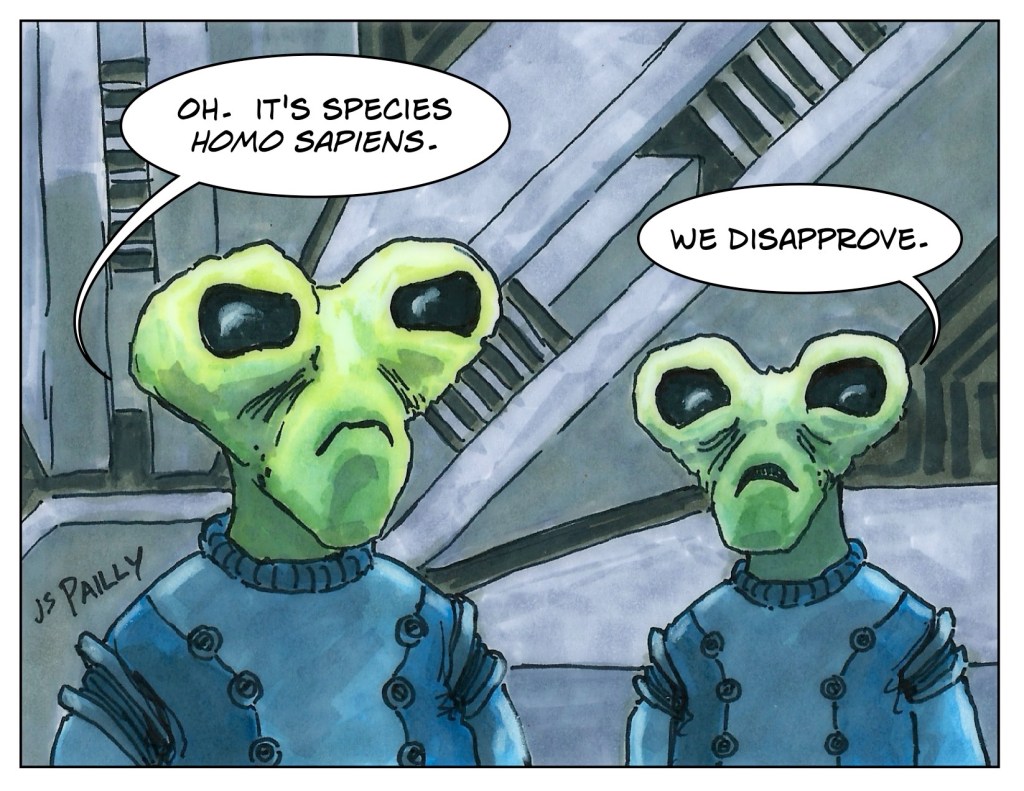
In Tomorrow News Network, the border of the Hykonian Hegemonic Empire is only a few lightyears away from Earth.  The Hykonians are effectively our next door neighbors.  And they’d be friendly neighbors, except that things sort of got off on the wrong foot between our two species.  Thus, the Hykonians do not approve of us Earthlings.

And unfortunately, we Earthlings have good reason to keep our guard up against them.

Next time on Tomorrow News Network: A to Z, anything that travels faster than light must also travel backwards through time.

The Galactic Inquisitor (Tomorrow News Network: A to Z)

Hello, friends!  Welcome back to the A to Z Challenge.  For this year’s challenge, I’m telling you a little more about the universe of Tomorrow News Network, my upcoming Sci-Fi adventure series.  In today’s post, G is for:

THE GALACTIC INQUISITOR

I’ve put a lot of thought into the world-building for Tomorrow News Network, and in these A to Z posts I’ve done my best to provide lots of detail (without straying into spoiler territory, of course).  But for today’s post, I’m afraid I don’t have many details to offer.

No one knows who the Galactic Inquisitor is.  No one knows where he/she/it came from, or how long he/she/it has been around, or what the source of his/her/its power might be.  On digi-stream, rumor has it that the Galactic Inquisitor is a giant insectoid, perhaps the last living remnant of the ancient insectoid races who once ruled the universe.

But of course, you shouldn’t believe everything you read on digi-stream.

While the identity and origins of the Galactic Inquisitor remain a mystery, his/her/its philosophy of justice has been made abundantly clear to anyone who’s had to stand trial in the Galactic Inquisitor’s court.  In the Galactic Inquisitor’s own words:

Real power must understand its own strength.  Real power must learn to be gentle.  Otherwise, real power will make itself the enemy of true justice.

However, despite these words, the Galactic Inquisitor is rarely gentle when exercising his/her/its power.  In the name of true justice, whole star systems have been obliterated.  Entire species have been wiped out, and vast dead zones of sterilized worlds have been left scattered throughout the galaxy.

And so in matters of interplanetary law, it is often wiser to settle disputes as swiftly and as independently as possible, before the Galactic Inquisitor feels the need to intervene.

Next time on Tomorrow News Network: A to Z, the human race has neighbors!

The Fermi Paradox (Tomorrow News Network: A to Z)

Hello, friends!  For this year’s A to Z Challenge, I’m telling you more about the universe I’ve created for my upcoming Sci-Fi adventure series, Tomorrow News Network.  In today’s post, F is for:

THE FERMI PARADOX

Okay, bear with me.  This post is going to get weird.  Some of what I’m going to tell you is true.  The rest is totally made up Sci-Fi nonsense.

THIS PART IS FACT

Historians disagree about the exact date, but sometime around 1950, nuclear physicist Enrico Fermi was having lunch with a few physicist colleagues.  The topic of conversation: extraterrestrial life.  It was during this conversation that Fermi famously quipped: “But where is everybody?”

Dr. Fermi then proceeded to lay out all the reasons why advanced alien civilizations should exist out there among the stars, and also all the reasons why we should have detected their presence by now.  And yet, despite our best efforts, we’ve found nothing.  So where is everybody?

This question is now known as the Fermi Paradox.  If you’re a scientist involved in SETI research, you will have to grapple with this issue at some point.  And if you’re a science fiction writer creating a sprawling Sci-Fi universe full of advanced alien civilizations, well… you should probably imagine up some sort of solution to the Fermi Paradox.

Mind you, it doesn’t have to be the most scientifically plausible solution.  But some of your readers will surely be wondering about this, so….

THIS PART IS FICTION

In time index 117-299, a Hykonian observation vessel crashed on Earth near a small Earthling village named Roswell.  The cause of the crash remains unknown.  The fate of the Hykonian crew remains unknown.  And what happened to the wreckage of the spacecraft itself?  Again, unknown.

Due to the suspicious circumstances surrounding the Roswell incident, the Galactic Inquisitor was forced to intervene.  The Hykonian Hegemony has demanded retribution; meanwhile, the local authorities on Earth continue to claim ignorance (something, something, weather balloons).  Until this matter is resolved, the Galactic Inquisitor has imposed an isolation ordinance over Earth.

All forms of interstellar communications are being jammed, and no spacecraft shall be permitted to enter of leave the Solar System.  Recent violations of this ordinance by NASA’s Voyager 1 and Voyager 2 space probes are currently under investigation.

Most Earthlings are left wondering, understandably, why they seem to be alone in the universe.  And so things shall remain until the Galactic Inquisitor’s ordinance is lifted.

Speaking of the Galactic Inquisitor, next time on Tomorrow News Network: A to Z, we’ll meet the timeless, near godlike being who maintains law and order in the galaxy.