Sciency Words: Planet X

Sciency Words PHYS copy

Today’s post is part of a special series here on Planet Pailly called Sciency Words. Each week, we take a closer look at an interesting science or science-related term to help us all expand our scientific vocabularies together. Today’s word is:

PLANET X

Planet X is perhaps the most abused term in modern astronomy. The name has been coopted by astrologers, conspiracy theorists, and on occasion science fiction writers.

The name originated with Percival Lowell, better known as that guy who thought he saw canals on Mars. Based on apparent inconsistencies in the orbits of Uranus and Neptune, Lowell predicted that a ninth planet must exist: something massive enough that its gravity would perturb Uranus and Neptune’s orbits.

With the discovery of Pluto in the 1930’s, Lowell’s Planet X hypothesis seemed to be confirmed.
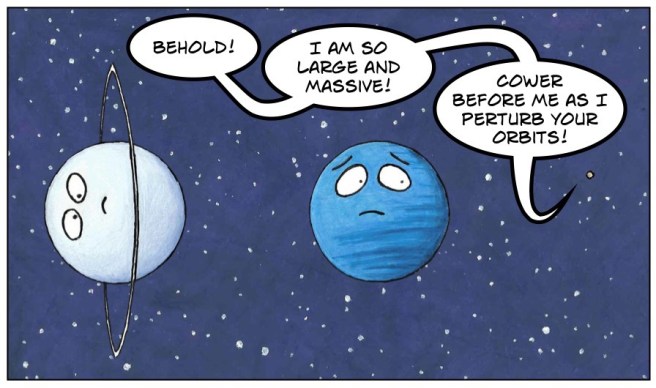
Dc08 Perturbing Orbits

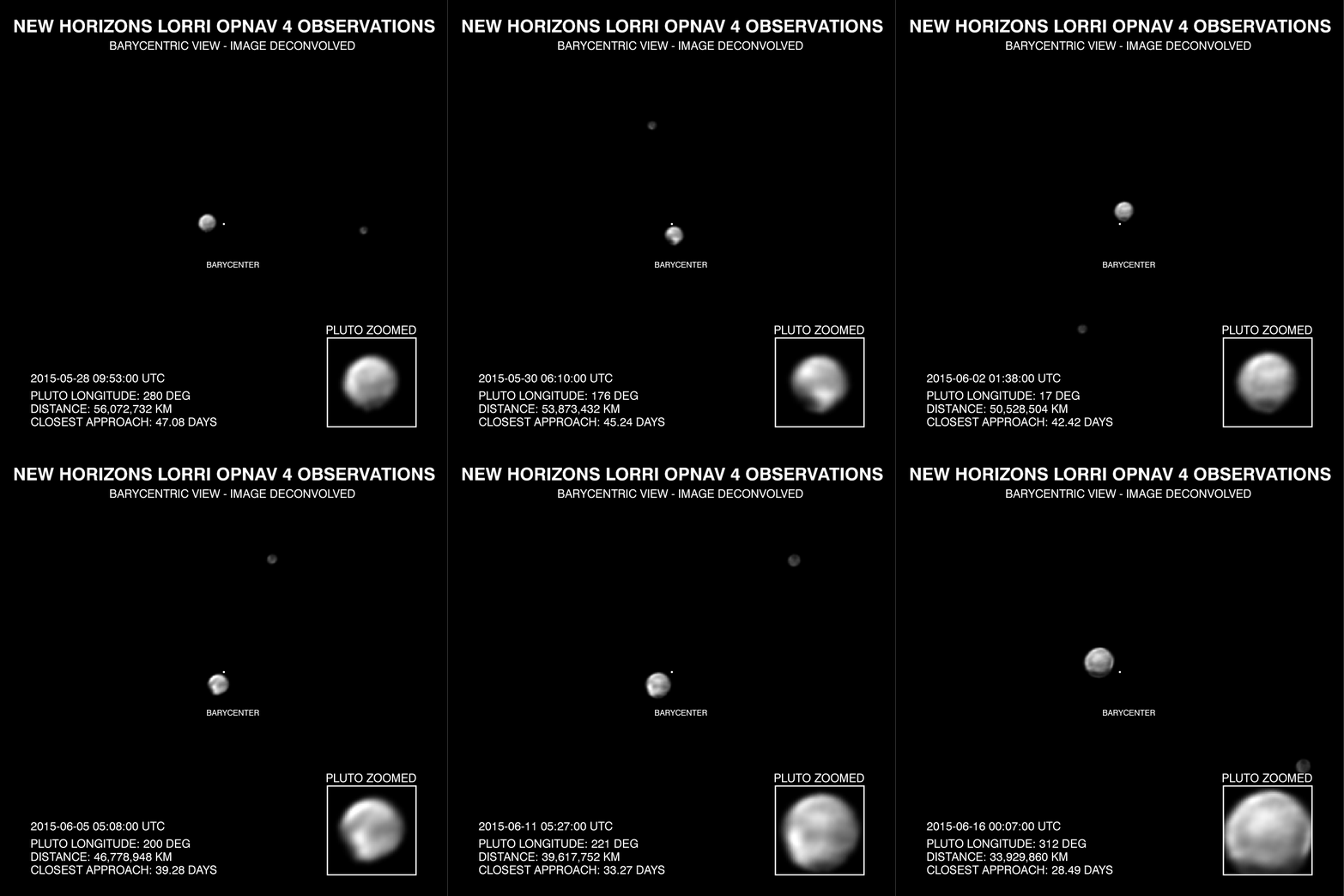
Later, it became apparent that Pluto was tiny. In fact, it looked like Pluto was barely large enough to be a planet at all.
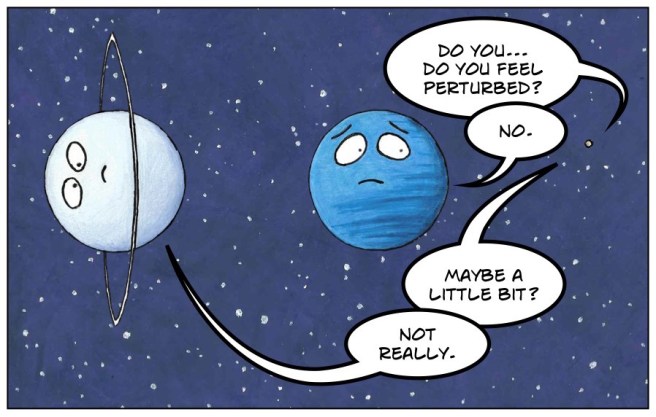
Dc08 Orbits Unperturbed

Then in the late 1980’s and early 1990’s, Voyager 2 revealed that we had miscalculated the mass of Neptune. Uranus and Neptune were exactly where they should have been all along. It was our math that was faulty.

The original Planet X hypothesis is now thoroughly defunct, just like that whole Martian canals thing. However, the term is still used as a placeholder name for any hypothetical as-yet-undiscovered planet hiding in the outer Solar System.

Dc08 Planet X

The term also remains annoyingly popular among conspiracy theorists.

P.S.: Planet X discovery announcements seem to pop up every few months. Just last week, astronomers announced the possible discovery of a Planet X and a Planet Y. Maybe this time it’s for real, but based on past experiences I’m guessing it’s not. Everyone stay skeptical and don’t get caught up in the hype.

* * *

Today’s post is part of Pluto/Kuiper belt month for the 2015 Mission to the Solar System. Click here to learn more about this series.

Why Haven’t Neptune and Pluto Collided?

When I was a kid, something really bothered me about the Solar System. If Pluto’s orbit crosses the orbit of Neptune, why don’t the two planets (Pluto was still considered a planet back then) collide with each other?

According to one of my science teachers, Pluto has just been lucky so far. But sooner or later, my teacher said, a collision will happen.

THIS IS FALSE!

Regular Planet Pailly readers will know that I sometimes complain about the science education I received as a child. I’ve had to unlearn a lot of the things I’d been told, and this is another example of that.

Odds are there used to be other dwarf planets that crossed Neptune’s orbit. Probably lots of them. They’re gone now, either because they collided with Neptune or (more probably) they got hurled out of the Solar System by Neptune’s gravity.

At least one former dwarf planet was yanked out of its original orbit and became Neptune’s largest moon. That would be our old friend Triton. The one that looks like a cantaloupe.

Pluto survived only because it happened to have an orbital resonance with Neptune. Pluto completes exactly two orbits for every three orbits of Neptune. The math works out such that Pluto and Neptune have never met. They miss each other every single time one crosses the other’s orbit.

Dc07 Crossed Orbits

So I guess my old science teacher was right about one thing. Pluto is lucky. Lucky enough that it has its Neptune dodging orbit.

P.S.: Pluto isn’t the only lucky one. Several other objects have 2:3 orbital resonances with Neptune, allowing them to safely cross Neptune’s orbital path. The most noteworthy is Orcus, which is under consideration to be classified as yet another dwarf planet.

* * *

Today’s post is part of Pluto/Kuiper belt month for the 2015 Mission to the Solar System. Click here to learn more about this series.

Meet a Dwarf Planet: Makemake

This is Makemake.

Dc06 Makemake

Makemake is a pretty typical dwarf planet. It has a nice, spherical shape, unlike Haumea. Its nearly circular orbit keeps is well inside the Kuiper belt at all times, unlike Pluto or Eris; however, Makemake’s orbit is inclined 29º relative to the plane of the Solar System.

Kuiper belt objects with such extreme inclinations are collectively known as the “hot population.” Why are they hot? Because scientists are bad at naming things. The hot population is just as cold as the rest of the Kuiper belt.

Based on current estimates, Makemake is either the third or fourth largest Kuiper belt object, after Pluto, Eris, and possibly Haumea. Makemake and Haumea are similar enough in size that astronomers can’t be sure which is bigger. The current best guess seems to be that Makemake is slightly larger.

The weirdest thing about Makemake is that it appears to have no moons. This is truly surprisingly. Most dwarf planets and indeed many known Kuiper belt objects have managed to pick up a moon or two. With so much rocky and icy debris floating around, it’s hard not to.

Yet somehow, Makemake has managed to stay single, making this “hot population” dwarf planet the Kuiper belt’s most eligible bachelor.

Dc06 Makemake Flirting

Sciency Words: Binary Planets

Sciency Words BIO copy

Today’s post is part of a special series here on Planet Pailly called Sciency Words. Each week, we take a closer look at an interesting science or science-related term to help us all expand our scientific vocabularies together. Today’s word is:

BINARY PLANET

If Pluto isn’t a planet, what is it? In 2006, the International Astronomy Union reclassified Pluto as a dwarf planet, but they considered other options as well. One idea was to classify Pluto and its largest moon Charon as binary planets.

Dc05 Binary Planets
Bonus points to anyone who can translate this.

The term “binary planets” comes by analogy with the term “binary stars,” which are stars that orbit each other. Proposed technical definitions of binary planets include:

  • A pair of planetary bodies that orbit a point located somewhere between them (it’s not clear how close to the middle that point needs to be).
  • A pair of planetary bodies co-orbiting a star that have close to the same mass (it’s not clear how similar their masses have to be).

Isaac Asimov, the grandmaster of science fiction and one of the greatest science communicators of his day, proposed his own definition for binary planets, or rather double planets, as he called them. Asimov’s definition was based on the gravitational attraction each planet had for the other.

In his books on science, Asimov applied the term double planet not only to Pluto and Charon but also to Earth and the Moon. After all, the Moon does exert a pretty strong gravitational pull on the Earth, arguably comparable to the gravitational pull the Earth exerts on the Moon.

Pluto and Charon have such an unusual relationship with each other that modern scientific literature often still calls them binary planets, even though the I.A.U. has rejected that terminology. Occasionally, the Earth/Moon system is also referred to this way.

The existence of two binary or almost binary planet systems in our own Solar System suggests that we may find other binary worlds orbiting distant stars. Binary habitable planets may even be possible. As this article from Discovery News suggests, civilizations on one or both planets might end up in “a fevered space race that would dwarf our space race of the 1960’s.”

At the very least, such a setting could offer loads of potential for a science fiction story.

* * *

Today’s post is part of Pluto/Kuiper belt month for the 2015 Mission to the Solar System. Click here to learn more about this series.

Pluto’s Volcanoes: Weird or Normal?

Recent headlines have been saying that we’ve discovered volcanoes on Pluto. But these aren’t “normal” volcanoes. They’re cryovolcanoes: volcanoes that erupt with ice rather than lava.

You may have also heard or read somewhere that cryovolcanoes are something new, something never before seen elsewhere in the Solar System.

Dc04 Cryovolcanic Worlds

Okay, cryovolcanism is nothing new. It was first observed on Triton, Neptune’s largest moon, back in 1989. Similar cryovolcanic activity has been studied in detail on Enceladus, one of Saturn’s moons, and there’s compelling evidence that Jupiter’s moon Europa has it too.

When cryovolcanoes erupt, they spew a mix of icy cold materials, often water with other chemicals like nitrogen or ammonia. This icy mix may originate from subsurface reservoirs of liquid water or, in the case of Europa and Enceladus, vast subsurface oceans that may (or may not) be capable of supporting alien life.

But Pluto’s cryovolcanoes are still kind of special. Previously known cryovolcanoes are basically cracks or fissures amidst an otherwise relatively flat landscape. Pluto’s are tall mountains with openings on top. They look like volcanoes.

Dc04 Cryovolcanic Eruptions

So what we’re seeing on Pluto is new to us, but it’s not entirely new. In fact, we should really stop thinking of cryovolcanism as rare or strange or exceptional. Given how many places in the outer Solar System either have or are suspected to have cryovolcanic activity, it’s actually Earth’s “normal” red-hot lava volcanoes that are weird.

Links

Volcanoes on Pluto Look a Lot Like Those on Earth and Mars from Ars Technica.

Pluto Revealed with Cathy Olkin from TEDx Detroit.

Meet a Dwarf Planet: Haumea

Don’t feel too bad for Pluto. Pluto has a lot of new dwarf planet friends out in the Kuiper belt. Today, we’re meeting the dwarf planet known as:

HAUMEA

Haumea is a funny looking object. It’s sort of bulgy at the middle. Just look at this totally legit Hubble image I found.

Dc03 Haumea

Okay, that’s actually not a Hubble image. Haumea is so small and so far away from Earth that we can’t get a clear image of it, not even with Hubble. So how do we know what Haumea looks like?

In our telescopes, Haumea appears as just a tiny point of light, but its brightness fluctuates at regular intervals. The best explanation for this is that Haumea must be misshapen. As the dwarf planet rotates, the wider sides reflect more sunlight than the narrower sides.

Dc03 Haumea's Rotation

The changing brightness also tells us Haumea’s rate of rotation. As it turns out, a Haumean day is less than four hours.

Gravity tries its best to pull Haumea into a spherical shape, but planets (and dwarf planets) always tend to bulge a little at the equator due to their own rotation. Since Haumea rotates extra fast, it’s extra bulgy, and also somewhat elongated along one axis. Hence the peculiar, oval shape in the fake Hubble image above and also in many other artistic renderings of what Haumea might look like.

So even though we’ve never actually photographed Haumea, we know it’s a funny looking object. The question I really want to know is how many other Haumea-like planets and dwarf planets might be out there in our universe?

* * *

Today’s post is part of Pluto/Kuiper belt month for the 2015 Mission to the Solar System. I can’t believe this mission is almost over! Click here to find out more about this series.

Sciency Words: Planet

Sciency Words MATH

The 2015 Mission to the Solar System has finally brought us to Pluto, so for today’s edition of Sciency Words, let’s talk about the scientific term:

PLANET

In 2006, the International Astronomy Union established the first ever official definition of a planet. To be a planet, an object must:

  • Orbit the Sun and not orbit anything else.
  • Be roughly spherical.
  • Have cleared most other objects or debris from its orbital path.

Pluto failed this last test. We now know that Pluto is just one of many small, icy objects in a sort of second asteroid belt known as the Kuiper belt.

Rather than demote Pluto to the ignoble status of “large asteroid,” the I.A.U. created a new category of astronomical objects called “dwarf planets.” The name comes by loose analogy with a category of small stars called “dwarf stars.” It’s worth mentioning that while dwarf stars are still a type of star, dwarf planets are not considered a type of planet.

To qualify as a dwarf planet, an object must:

  • Orbit the Sun and not orbit anything else.
  • Be roughly spherical.
  • Have NOT cleared most other objects or debris from its orbital path.

So did the I.A.U. get it right? Do these definitions of planet and dwarf planet make sense? Some astronomers would say no (don’t get too excited, Pluto fans; it’s not for the reason you think).

How are we supposed to apply these definitions to exoplanets, planets orbiting other stars? Most exoplanets cannot be observed directly. The few that are visible in our telescopes appear as just a few pixels. So how can we see if they’re spherical? How can we tell if there’s debris in their orbital paths or not?

The I.A.U. is now considering defining planets in a more mathematical way, using the following factors:

  • The planet’s mass (we can usually estimate that without directly observing the planet).
  • The planet’s orbital period (which can also be estimated without direct observation).
  • The mass of the host star (or stars).

If the mathematics work out such that an object should be able to clear its orbital path of debris within a predetermined timeframe (10% of the host star’s lifespan, perhaps), then it qualifies as a planet.

We can safely assume that any object with enough mass to clear its orbit would be also spherical, due to its own gravity. So astronomers wouldn’t have to visually confirm that an exoplanet is round.

Right now, this idea is only a proposal. But if the I.A.U. adopts this new definition of planet, it can be applied equally well to objects in our own Solar System and objects orbiting distant stars.

P.S.: Under the new definition, Pluto still isn’t a planet.

Dc02 Pluto's Not Mad

Links

A Quantitative Criterion for Defining Planets by Jean-Luc Margot.

A New “Mathematical” Definition Proposed for What Constitutes a Planet from Universe Today.

* * *

Today’s post is part of Pluto/Kuiper belt month for the 2015 Mission to the Solar System. Click here to learn more about this series.

IWSG: A Christmas Muse

InsecureWritersSupportGroup

For these Insecure Writer’s Support Group posts, I usually talk about my muse. Sometimes, I turn the floor over to my muse and allow her to talk about me, her insecure writer.

Anyway, it’s December, so my muse and I are starting to think about what we want for Christmas. Here are some of the things I hope my muse will give me:

  • New story ideas.
  • New settings to explore.
  • New characters to learn about.
  • New plot devices to exploit.
  • New ways to slip sciency stuff into my stories.

Above all, I’m asking my muse to give me enough enthusiasm to keep me writing throughout the coming year.

As for what my muse wants for Christmas…

Dc01 Christmas Muse

Muses can be mean sometimes.

So what do you hope your muse will give you for Christmas (or whichever holiday you’re celebrating this year)?

* * *

Today’s post is part of the Insecure Writer’s Support Group, a blog hop hosted by Alex J. Cavanaugh and co-hosted this month by Sandra Hoover, Mark Koopmans, Doreen McGettigan, Megan Morgan, and Melodie Campbell. To see a full list of participating blogs, or maybe to join the group yourself, click here.

Molecular Monday: Amorphous Ice

Welcome to Molecular Mondays! Every other Monday, we examine the atoms and molecules that serve as the building blocks of our universe, both in reality and in science fiction. Today we continue our investigation of:

WATER

Nv12 Water Facts

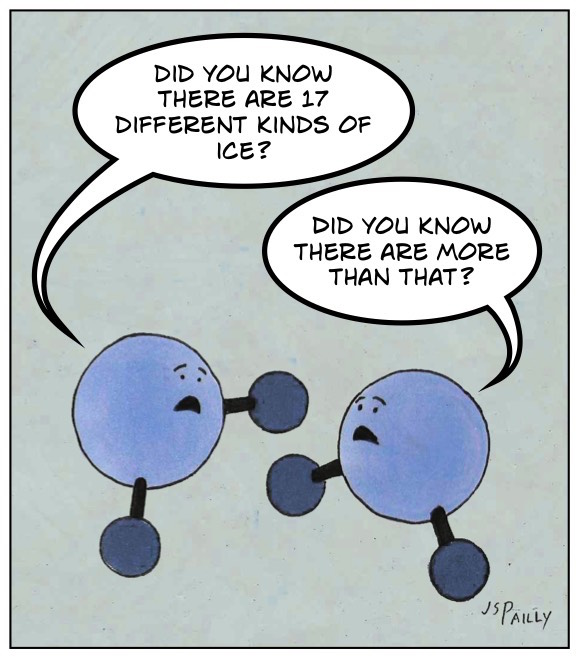
In my previous Molecular Monday post, I told you about some of the exotic forms of water ice believed to exist on other planets, where pressures and temperatures are radically different than what we’re familiar with here on Earth.

But those seventeen forms of ice were only crystalline ices, ices where the water molecules line up to form neat geometric patterns. It takes energy (heat) for water to crystallize. That may seem counterintuitive, but consider that 0º C is a whole lot hotter than absolute zero.

In the darkest depths of space, it’s too cold for water to crystallize. Instead, water molecules freeze solid in a random, haphazard way. This is called amorphous ice, or sometimes porous ice, and it is believed to be the most common form of water in the universe (even though it hardly ever appears here on Earth, except under laboratory conditions).

When handling amorphous ice, be careful. For one thing, it can react violently to changes in pressure. Here’s a brief video where samples of high density amorphous ice transition into low density amorphous ice due to lowering the pressure.

Also, because amorphous ice has a random structure, microscopic cavities often form between water molecules. That’s why it’s also called porous ice. Other chemicals can get trapped inside these internal pores. Melting the ice (or even adding heat to crystallize the ice) could accidentally release those chemicals, or allow them to mix, with unpredictable results.

In the distant Sci-Fi future where humanity has spread throughout the Solar System and beyond, interplanetary travelers will be dependent on whatever sources of water they can find in space. Appropriate safety measures should be put in place for harvesting water from comets, asteroids, or even small icy moons like Europa or Enceladus. Amorphous ice can be full of unpleasant surprises.

Links

Goddard Lab Works at Extreme Edge of Cosmic Ice from NASA’s official website.

Why Comets Are Like Deep Fried Ice Cream from JPL’s official website.

Supercooled and Glassy Water from Physics Today.

Sciency Words: Ring Arcs

Sciency Words PHYS copy

Today’s post is part of a special series here on Planet Pailly called Sciency Words. Each week, we take a closer look at an interesting science or science-related term to help us all expand our scientific vocabularies together. Today’s word is:

RING ARCS

Something’s wrong with Neptune’s rings.

Nv11 Neptune's Arcs

Neptune has five rings, all named after astronomers or scientists associated with significant Neptune-related discoveries. They are (in order of increasing distance from Neptune):

  • Galle: named after the guy who discovered Neptune, sort of. He had help from…
  • Le Verrier: named after the guy who calculated Neptune’s exact position, allowing Galle to “discover” it.
  • Lassell: named after the discoverer of Triton, Neptune’s largest moon.
  • Arago: named after the teacher who encouraged Le Verrier in his calculations and helped defend Le Verrier in a dispute with…
  • Adams: named after another person who calculated Neptune’s position before its discovery and started a fuss with Le Verrier over who deserved credit.

There was plenty of drama surrounding the discovery of Neptune, and that has been preserved in the names of the rings that also surround the planet.

Neptune has an unnamed sixth “ring,” if we can be generous enough to call it a ring, located between Arago and Adams. A small moon named Galatea also orbits within that gap. This unnamed ring doesn’t circle all the way around the planet, so it is better described as an “arc.”

Furthermore, a short segment of the outermost ring (Adams) is also broken up into several small arcs. These arcs were originally named Liberty, Equality, and Fraternity (bonus points to anyone who can tell me what the planet Neptune has to do with the French Revolution).

Later, two more arcs were found in the Adams ring, so the list became (in order):

  • Courage: the faintest arc.
  • Liberty: often described as the “leading arc,” even though Courage orbits ahead of it.
  • Equality 1 and Equality 2: the Equalities are so close together that they’re almost a single arc.
  • Fraternity: brings up the rear and is the largest and brightest of Neptune’s arcs.

The existence of these arcs doesn’t make a whole lot of sense. Ring particles should spread out the fill the gaps within a matter of months, yet the arcs have remained stable since their discovery in the 1980’s.

An orbital resonance with Galatea is almost certainly involved, but mathematical models of Galatea and the Adams arcs don’t always match with observations. Neptune may have an additional as-yet-undiscovered moon near its rings, or perhaps some other unknown factor is at work.

Probably aliens.

P.S.: Neptune isn’t the only planet with arcs in its rings. Saturn has them too. So Neptune: you don’t have anything to feel embarrassed about.

Links

Neptune’s Rings and “Ring Arcs” from JPL’s Voyager Mission webpage.

Rings of Neptune from Universe Today.

Stability of Neptune’s Ring Arcs in Question from Letters to Nature.

* * *

Today’s post is part of Neptune month for the 2015 Mission to the Solar System. Click here to learn more about this series.