TRAPPIST-1: A Sky Full of Planets

Okay, one more post about TRAPPIST-1 and its seven planets, and then I promise I’ll move on to another topic. But this is something that’s just too awesome for me to skip.

You know that goofy trope you sometimes see in Sci-Fi movies or comic books? The one where the hero is standing on the surface of some alien planet and there are a whole bunch of other planets in the sky? Like, not just a moon or two, but a ton of huge planets looming over the horizon.

Well, apparently if you stood on the surface of one of the planets in the TRAPPIST-1 system, you’d be able to look up and see the other planets in the sky. Not just as tiny points of light but as large orbs.

The planets of TRAPPIST-1 are packed extremely close together, it seems. Several articles I’ve read, such as this one from Spaceflight 101, suggest that weather patterns and surface features would be visible to the naked eye.

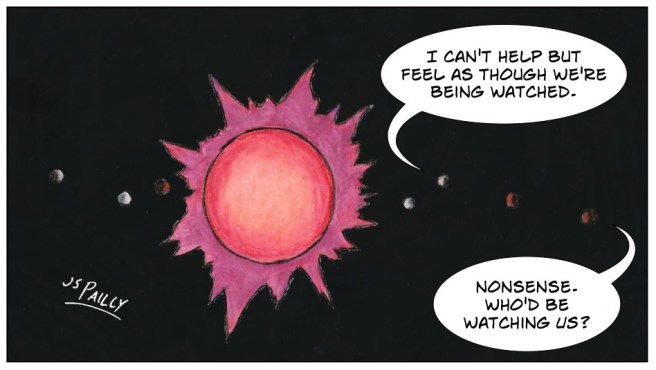
I’m guessing the view would not be quite as epic as what I drew for the illustration above, but still… it would be stunning to see it. Just remember to bring proper radiation gear. TRAPPIST-1 is still a flare star.

Sciency Words: Ultra-Cool Dwarf Star

Sciency Words PHYS copy

Today’s post is part of a special series here on Planet Pailly called Sciency Words. Each week, we take a closer look at an interesting science or science-related term to help us expand our scientific vocabularies together. Today’s term is:

ULTRA-COOL DWARF STAR

At some point, I want to profile each of the planets in the TRAPPIST-1 system one by one for my Exoplanet Explorer series. But it’s too early for that. Right now, we don’t know much about these planets except that they’re there.

But I can say something about TRAPPIST-1 itself. It’s a type of star called an ultra-cool dwarf star.

mr10-ultra-cool-trappist-1

Apparently TRAPPIST-1 has just barely enough mass to cause hydrogen fusion in its core. That means that for a star, it doesn’t produce a whole lot of energy, and thus its temperature is relatively low. Based on my rough math and statistics I got from Wikipedia, it looks like TRAPPIST-1 is less than half the temperature of our Sun.

This is one of the things that makes TRAPPIST-1 so interesting to me, and why it’s really starting to capture my imagination. It’s not just about all those Earth-like planets. The star itself helps set a lower limit for just how small and cold stars can be.

TRAPPIST-1: A Mini-Solar System

Right now, TRAPPIST-1 is getting a ton of attention. If feels like just about every single telescope on Earth or in Earth-orbit has been stealing glances of this very tiny star and its seven Earth-like planets.

mr08-observing-trappist-1

But we’ve discovered lots of other exoplanets, many of them Earth-like, and many of them in multi-planet systems. So why is TRAPPIST-1 getting so much special attention?

There Could Be Aliens!

Okay, yes. There could be aliens.

But I doubt it. TRAPPIST-1 is a flare star. We’ve met flare stars before. You don’t want to live near one.

Also, these planets are so close to their parent star that they are almost certainly tidally locked, with one side perpetually facing the sun and the other side perpetually turned away from it. Katy Perry could write a song about how hot and cold these planets must get.

Still, it’s not impossible for life to evolve under these conditions. Just don’t get your hopes up.

An Astrophysicist’s Dream Come True

There’s still a lot I haven’t read yet about TRAPPIST-1, and no doubt there’s even more information still to come. But at this point, I’m getting the impression that this miniaturized solar system is like an astrophysicist’s dream come true. Here’s why I think that:

  • From our vantage point here on Earth, these planets pass directly in front of their star (i.e.: they “transit” their sun). This is convenient for us. It’s a lot easier to collect data about transiting planets than non-transiting ones.
  • These planets are all very close to their parent star, and therefore they all have relatively short orbital periods. That means more transits and more opportunities to collect data.
  • There are so many planets so tightly packed together that it’s easy for us to study the gravitational interactions between them.
  • And again, because these planets have short orbital periods, these gravitational interactions are sort of accelerated compared to similar interactions in our own Solar System or in other star systems we’re currently observing. I imagine these interactions are also much stronger, since the planets are so much closer together.

TRAPPIST-1 is basically a mini-solar system running on fast-forward. We can collect loads of data about it in a matter of days or weeks, rather than years or decades, and use that data to refine our current theories about solar system dynamics.

That, I think, is the real reason TRAPPIST-1 and its seven planets are such a big deal. At least that’s what’s got me the most excited about them, and why I think we’ll be hearing a lot about the TRAPPIST-1 system for many years to come.

If we happen to discover alien life there as well, that’ll just be an added bonus.

Molecular Monday: Superatoms

Molecular Mondays Header

Today’s post is part of a special series here on Planet Pailly called Molecular Mondays. On the first Monday of the month, we take a closer look at the atoms and molecules that make up our physical universe, both in reality and in science fiction. Today, we’re talking about:

SUPERATOMS

It’s a bird! It’s a plane! It’s a superatom!

mr06-superatom

Okay, Superman isn’t the right reference to make for this post. I should probably make a reference to the Power Rangers, or perhaps Captain Planet. “When your powers combine, I am Superatom!”

Superatoms vs. Molecules

Atoms combining together is nothing new. That’s called a molecule. You could say that a superatom is basically just a molecule that acts like a giant atom.

In normal molecules, each atom gets to hold on to its own electron cloud, more or less. Yes, the atoms do share electrons. Yes, some molecular structures allow electrons to travel freely between atoms. Yes, sometimes an atom ends up losing an electron and never gets it back.

But for the most part, each atom still has its own unique electron cloud or electron shell structure around it, and therefore each atom still retains its own distinct chemical identity on the periodic table of elements.

In a superatom, something wildly different happens. An entirely new electron cloud forms, not around any individual atoms but around the molecule as a whole. This supercloud even has layers or shells, and it can form chemical bonds, just like the electron cloud around an ordinary atom would.

So Much for the Periodic Table

Because superatoms have their own electron clouds and can form chemical bonds with other atoms—or other superatoms—we can use them to create new molecules: molecules that would not be possible using just the hundred-plus elements on the periodic table.

So if you’re a chemist or an engineer (or a science fiction writer) and you can’t find the chemical element you need on the periodic table, you now have more options. You might be able to find (or invent) a super-element to do the job instead.

P.S.: I wonder if Star Trek’s dilithium might be a super-element that incorporates two lithium atoms.

Sciency Words: Earth Similarity Index

Sciency Words BIO copy

Today’s post is part of a special series here on Planet Pailly called Sciency Words. Each week, we take a closer look at an interesting science or science-related term to help us expand our scientific vocabularies together. Today’s term is:

EARTH SIMILARITY INDEX

As I’m sure you’ve heard by now, astronomers have discovered seven planets orbiting a nearby star called TRAPPIST-1. Even more exciting, most or all of these new worlds are being described as Earth-like planets. But what does that actually mean?

You’d be surprised by how many “Earth-like” planets/moons we have right here in our own Solar System.

Ag16 Earth-like Worlds
From left to right: Venus, Earth, Mars, and Titan (Saturn’s largest moon).

Earth-like is a rather vaguely defined term. So in 2011, a paper published in the journal Astrobiology attempted to establish an official mathematical system for calculating just how Earth-like an exoplanet is. It’s called the Earth Similarity Index or E.S.I.

Basically, the E.S.I. takes certain characteristics of a planet that can be quantified—such as a planet’s mass, radius, temperature, etc—and compares them to Earth’s. An E.S.I. score of zero indicates a planet that has absolutely nothing in common with Earth, while an E.S.I. of one means the planet is an exact match for Earth… at least with regard to the characteristics being measured and included in our calculations.

Of course even a planet with an E.S.I. of one is not necessarily habitable, so the same Astrobiology paper also proposes a Potential Habitability Index or P.H.I. But that, I think, is a Sciency Word for another day.

P.S.: If you want to dive into the math behind the E.S.I., click here.

IWSG: Patience

This past month, my muse and I have been having the same conversation over and over again.

mr01-patience-is-a-virtue

I don’t feel particularly insecure at the moment. Just impatient.

I’ve set some pretty ambitious goals for myself in 2017, and I’m making real progress toward those goals. That’s a plus. And I’m moving at a steady pace, which is a big plus. It’s just that my pace—steady as it is—is a bit slower than I’d hoped for.

So it’ll take me a little longer than I’d imagined to reach my goals. Which is okay. I’m not complaining. If it sounds like I’m complaining, that’s honestly not my intention.

I’m working at a slow and steady pace, and that’s probably the best thing for a writer. I’d much rather write at a slow and steady pace than deal with those boom/bust cycles that I and, I suspect, most new and aspiring writers suffer through.

So again, I’m not complaining. I don’t feel particularly insecure at the moment. On the contrary, I’m quite secure in the knowledge that I will achieve my goals—sooner or later. I just wish it could be sooner rather than later.

I guess I’ll just have to be patient.

* * *

Insecure Writers Support Group Badge

Today’s post is part of the Insecure Writer’s Support Group, a blog hop where insecure (or impatient) writers like myself can share our worries and offer advice and encouragement. Click here to find out more about IWSG and see a list of participating blogs.

Sciency Words: Light Curve

It’s been almost a week since I arrived at KIC 8462852, better known as Tabby’s Star, and discovered that the aliens really are building a megastructure. I still have a lot of questions, but the aliens aren’t giving me a lot of answers, and I think it’s time I moved on.

Which brings me to today’s edition of Sciency Words.

Sciency Words MATH

Each week, we take a closer look at some science or science-related term to help us all expand our scientific vocabularies together. Today’s term is:

LIGHT CURVE

We met astronomer Bradley Schaefer in Wednesday’s post. Writing for Scientific American, he defines a light curve as “a measure of brightness as a function of time.”

So the light curve of a star with a constant brightness would be a straight line. If you found small, symmetrical dips in that line, that might mean there’s a planet in orbit, especially if the dips appear at regular intervals. Here’s an example of what that looks like, courtesy of NASA.

Other patterns of dips or spikes along a light curve could tell you if you’re looking at a binary star, or a flare star, or a variable star… looking at light curves is a great way to study stars.

As for Tabby’s star, its light curve is apparently a straight line most of the time, aside from tiny fluctuations that typically indicate solar flares and/or sunspots. In other words, Tabby’s star looks normal.

And then abruptly, dips appear in the light curve. Asymmetrical dips, as opposed to the symmetrical dips caused by transiting planets. In some cases, the line doesn’t so much dip as plunge downward, and that means… umm… astronomers do not know what that means.

Any serious discussion about Tabby’s Star should really begin with its weird, almost spastic light curve. I’m choosing to end here, however, because the aliens have made it clear that I’m not welcome.

fb24-escaping-tabbys-star

Now I need to find another megastructure to study, and the best way to do that is to examine the light curves of other stars.

More Megastructure Mystery

On Monday, I arrived at KIC 8462852, better known as Tabby’s Star, and discovered that yes, the aliens really are building a megastructure. My next question is: how long has this been going on?

fb22-too-many-questions

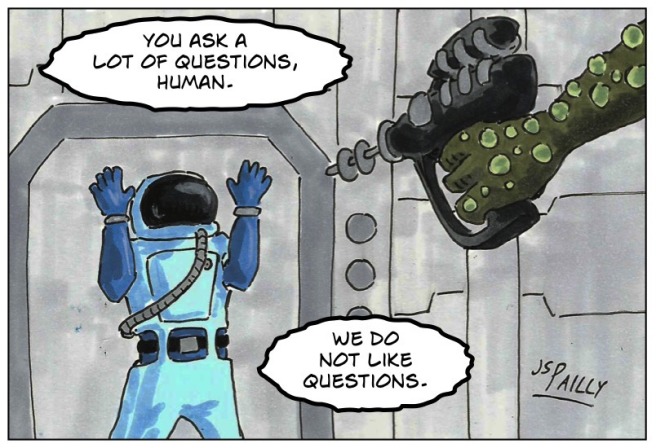
These aliens are not turning out to be all that friendly. Fortunately, there’s been some investigative work done back on Earth.

Astrophotography has been around for well over a century now. Even though no one paid much attention to Tabby’s Star until recently, that region of the sky has been photographed before. So following the publication of Tabetha Boyajian’s WTF paper, astronomer Bradley Schaefer started checking those old photographic plates.

And according to Schaefer’s findings, Tabby’s Star has been decreasing in brightness since at least 1890. It would seem the megastructure has been growing in size, obscuring more and more of the star, for quite some time now.

But can we trust the accuracy of those old photographic plates? According to astronomer Michael Hippke and colleagues, no. No we can’t. The degree of uncertainty is too high, Hippke claims, to make a conclusive determination about Tabby’s Star’s brightness over time.

There’s been a pretty intense argument between Schaefer and Hippke ever since. If nothing else, it’s an excellent example of how scientists debate each other. Click here to read Schaefer’s side of it, and click here for Hippke’s.

So if Schaefer is right, construction of the megastructure may have been underway circa 614 C.E. (that’s 1890 C.E. minus the 1276 years it takes for light from Tabby’s Star to reach Earth). And if Hippke’s right… well, who knows when the aliens got started? They’re certainly not telling.

Tabby’s Megastructure Mystery

So I’ve flown my spaceship all the way out to KIC 8462852, better known as Tabby’s Star, and what do you know? The aliens really are building a megastructure out here.

fb20-tabbys-star

This whole situation is pretty weird, I know; but the weirdest thing is that when I check my ship’s sensors, I can’t detect any thermal emissions from the megastructure or any of the spaceships involved in constructing it.

The lack of thermal emissions (or the lack of an “infrared excess,” as the experts call it) is one of the main reasons why Tabetha Boyajian and other legitimate scientists don’t really buy the alien megastructure hypothosis.

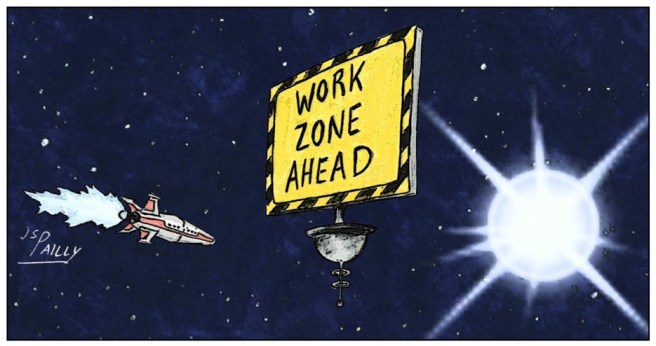
Think about it. If Tabby’s Star hosts an active work zone, with spaceships flying around and construction workers welding space girders and stuff, you’d expect all that activity to produce some heat. Even without the construction activity, the megastructure itself should be pretty warm due to the star it encircles.

And all that heat should be detectable in the form of infrared radiation. But whether you observe Tabby’s Star with a telescope back on Earth or the sensor grid of my imaginary spaceship, the total amount of infrared light is exactly what you’d expect from an F-type main-sequence star. No more, no less.

Since I’m here, I decided to ask one of the alien construction workers about this. Here’s what he told me: “Yeah, we been masking our thermal emissions. What of it? We don’ts wants nobody snooping in our business. Now scram, smelly human!”

Not exactly the answer I was expecting, but I guess I’ll take what I can get.

P.S.: If you want to learn more about Tabby’s Star and how citizen science helped uncover its mysterious behavior, I strongly recommend this SciShow interview with Tabetha Boyajian. That’s where I first learned about the “infrared excess” issue that I discussed in today’s post.

Sciency Words: Tabby’s Star

Sciency Words PHYS copy

Today’s post is part of a special series here on Planet Pailly called Sciency Words. Each week, we take a closer look at an interesting science or science-related term to help us expand our scientific vocabularies together. Today’s term is:

TABBY’S STAR

Something’s wrong with a star named KIC 8462852. It flickers. It dims by as much as 22% for no apparent reason. This is an F-type main-sequence star, meaning it’s only a little bit larger than our Sun. F-type stars shouldn’t behave like this.

KIC 8462852 is sometimes called the WTF Star, because of the paper that first described its abnormal fluctuations in brightness. That paper was subtitled “Where’s the Flux?”

The star is also known (and perhaps better known) as Tabby’s Star, in honor of Tabetha Boyajian, the lead author on that paper.

There are several possible explanations for what might be happening to Tabby’s Star, but it’s the least likely explanation that’s gotten the most hype. Could it be aliens? SETI decided to check it out. They didn’t find anything. But still… it could be aliens.

Massive alien starships might be transiting the star, blocking some of its light. Or perhaps there are enormous space stations orbiting the star. Or maybe we’ve caught an advanced alien civilization in the act of building some kind of megastructure (like a Dyson sphere) completely encircling their sun.

Most professional astronomers do not think it’s aliens. Tabetha Boyajian herself doesn’t seem to take the idea seriously and often jokes about the crazy emails she gets from people who do. And to be perfectly clear, I do not take this alien megastructure hypothesis seriously either.

But just to be sure, I’ve decided to hop into my imaginary spaceship and fly out to KIC 8462852, just so I can see for myself what’s really going on. Wish me luck! I’ll let you know what I find next week.

fb17-approaching-tabbys-star