Sciency Words: Noösphere

Today’s post is part of a special series here on Planet Pailly called Sciency Words. Each week, we take a closer look at an interesting science or science-related term to help us expand our scientific vocabularies together. Today’s term is:

NOÖSPHERE

Earth has a lot of “spheres.” There’s the atmosphere, which is the sphere of air surrounding our planet, and the lithosphere, which is the sphere of rock making up our planet’s crust and upper mantel. Earth has a hydrosphere (all of Earth’s surface water) and a biosphere (all of Earth’s organisms, collectively).

Over time, scientists have come to appreciate how all these “spheres” are interconnected with each other, maintaining conditions on this planet that are just right for life. At the risk of sounding New Agey, it’s almost like Earth is alive, like Earth is a single organism, and we’re just small parts of a greater whole. If so, perhaps we can add one more sphere to the list: the noösphere.

The term noösphere (pronounced either new-o-sphere or know-o-sphere) was coined in the 1920’s by a Jesuit priest named Tielhard de Chardin. The word comes from two Greek words: nous, meaning mind, and sphere, meaning sphere. In other words, the noösphere is the sum total of all the knowledge and intelligence on our planet.

Or going back to the New Agey stuff, the noösphere is Earth’s mind. We humans are like cells in Earth’s body, but we’re not just any old cells: we’re Earth’s brain cells. You might even say Earth has started to develop a new level of intelligence, a noösphere 2.0, as all us brain cells form a new series of neural connections with each other (in other words, the Internet is making Earth smarter).

Of course we could push this analogy too far. Are human beings really worthy of being compared to brain cells? Is the Internet really making our planet smarter?

While I’m not ready to declare humanity to be Earth’s brain, I do think the concept of the noösphere is interesting and warrants some discussion. The various spheres of our planet are interconnected, sometimes in weird and surprising ways; so how does the noösphere—the accumulated knowledge and intelligence of all humanity—contribute to (or detract from) the greater whole?

P.S.: I first learned about the noösphere in David Grinspoon’s recent book Earth in Human Hands, which I’ll be reviewing next week.

Sciency Words: Tardigrade

Today’s post is part of a special series here on Planet Pailly called Sciency Words. Each week, we take a closer look at an interesting science or science-related term to help us expand our scientific vocabularies together. Today’s term is:

TRADIGRADE

Tardigrades, a.k.a. water bears… there’s just something lovable about them. They’re kind of cute for microorganisms (or kind of horrifying, depending on which picture you’re looking at). And they’re absurdly tough. They can survive almost anything. They can even survive in space.

There have been several experiments now where tardigrades were taken to low Earth orbit and exposed to the vacuum of space for prolonged periods of time. Most of them survived the experience. In the absence of food, water, or oxygen, tardigrades can enter a state of suspended animation, and their cells have the ability to repair their D.N.A. if it gets damaged by solar or cosmic radiation.

In fact tardigrades seem to be so well adapted to the hazards of space that it’s sometimes suggested (usually not by serious scientists) that these little guys might come from space.

German pastor and zoologist Johann August Ephraim Goeze is credited with discovering tardigrades in 1773. Goeze called them Kleiner Wasserbär, which is German for “little water bear,” because the way they walk on their eight pudgy, little legs reminded Goeze of the plodding movements of bears.

In 1777, Italian biologist/Catholic priest Lozzaro Spallanzani made further observations of these creatures. Spallanzani called them il Tardigrado, meaning “slow walker,” again because of the slow, plodding manner in which they walk. The English words tardy and tardiness are closely related, etymologically speaking.

Today we’ve retained both tardigrade and water bear as common names for these creatures. Apparently some people also call them moss piglets, which is just adorable. Over a thousand species of tardigrade have been identified, all classified under the phylum Tardigrada.

As for the question about where tardigrades came from—are they native to this planet, or did they immigrate to Earth from someplace else?—I can only say this: if tardigrades do have an extraterrestrial origin, they must have arrived on Earth a very, very long time ago. The oldest known tardigrade fossils date back to over 500 million years ago (meaning they may have been here since the Cambrian explosion).

Sciency Words: Type A Behavior Pattern

Today’s post is part of a special series here on Planet Pailly called Sciency Words. Each week, we take a closer look at an interesting science or science-related term to help us expand our scientific vocabularies together. Today’s term is:

TYPE A BEHAVIOR PATTERN

In my daily life, I’ve been hearing a lot about type A and type B personalities lately. Don’t know why. It just keeps coming up in conversations for some reason, but I’m never sure which one I’m supposed to be. Since these are scientific terms, I figured it was time I did some research.

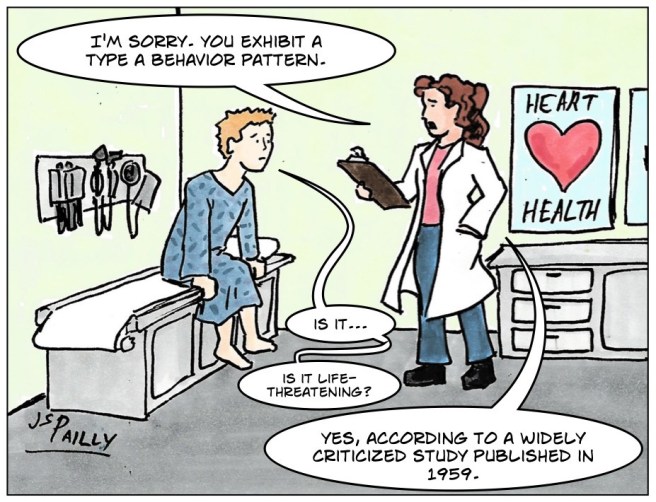
Turns out that type A and type B were originally cardiology terms. They didn’t come from the field of psychology at all. Back in the 1950’s, some cardiologists noticed that they had two kinds of patients: those who sat calmly in the waiting room and those who fidgeted impatiently.

The fidgeters came to be known as “type A,” and they seemed to be more likely to have coronary disorders than the “type B” non-fidgeters. Soon a study was conducted. The type A behavior pattern (abbreviated T.A.B.P.) was further defined as “[…] an intense, sustained drive for achievement and as being continually involved in competition and deadlines, both at work and in their vocations.”

These were people with a lot of ambition, which isn’t necessarily a bad thing, but they also tended to stress themselves out. They got impatient easily, both with themselves and with others, and were sometimes prone to hostile behavior at work, home, or basically anywhere. With that in mind, the results of the study may not seem like a surprise: a clear corrolation between type A behavior and an elevated risk of high blood pressure and heart disease.

If you’re type A, don’t panic. There were some big problems with that initial study, most notably that it only sampled middle-aged men and failed to account for other key health factors like diet. Subsequent research on both men and women of all ages produced less conclusive results.

And yet debate continued for some time after that, possibly because of some undue influence by the tobacco industry. It seems tobacco companies surreptitiously funded more research on type A behavior then argued, both publically and in court, that personality types pose a greater health risk than cigarettes.

It seems cardiologists started abandoning this whole idea by the 1990’s. Psychologists still seem to use the terms, but sparingly. At this point, I’m not sure if the whole type A vs. type B thing is meaningful anymore, scientifically speaking; and yet a lot of people do seem to identify as one or the other.

So I don’t know. What do you think? Are type A and type B behavior patterns useful ways to describe people, or should we just let these terms go?

P.S.: If I must pick one or the other, I’m going to start telling people I’m type B, because I don’t fidget in waiting rooms.

Sciency Words: Airglow

Today’s post is part of a special series here on Planet Pailly called Sciency Words. Each week, we take a closer look at an interesting science or science-related term to help us expand our scientific vocabularies together. Today’s term is:

AIRGLOW

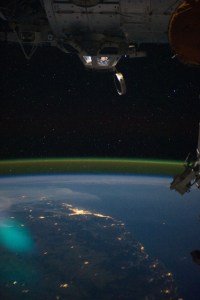
Have you ever been floating in space, looked down at the Earth, and noticed a faint halo of green light around the planet? Me neither, but that light is there and it’s called airglow. Why’s it called that?

This is Anders Angstrom, a 19th Century Sweedish research and one of the founders of the science of spectroscopy. He’s the guy who, in 1868, first observed the airglow phenomenon.

As often happens in science, this was a serendipitous discovery. Angstrom was trying to study one thing when he accidentally discovered something else. He was using a spectroscope to measure the emission lines of the aurora borealis—or to put that in plain English, he was trying to find out precisely which colors make up the Northern Lights.

To Angstrom’s surprise, one of the aurora colors—a narrow band of green—was always present in the sky even when the aurora wasn’t happening. Angstrom couldn’t explain this, but over the coming decades other researchers would continue investigating this faint green glow, ruling out one possibility after another: it couldn’t be starlight, or moonlight, or light pollution….

Eventually scientists settled on an explanation involving chemistry. We now know that chemical reactions in the atmosphere release energy in the form of photons. The most noticeable reactions involve oxygen reacting with itself, producing photons of a specific wavelength, a wavelength corresponding to a narrow band of green light.

We’ve also observed airglow on other planets. The different colors we see on Venus, Jupiter, or Saturn can tell us a lot about the chemicals in those planet’s atmospheres. And some day a faint green emission line from an exoplanet may lead us to the discovery of alien life.

Image courtesy of NASA.

I opened this post from a vantage point in space, because as I understand it Earth’s airglow is a lot easier to see from up there. But it can be seen from down here on the ground too if you have sharp eyes, a good camera (or a good spectroscope), and know what to look for. Click here to learn more.

Sciency Words: Plasma Torus

Today’s post is part of a special series here on Planet Pailly called Sciency Words. Each week, we take a closer look at an interesting science or science-related term to help us expand our scientific vocabularies together. Today’s term is:

PLASMA TORUS

Saturn may have the most beautiful rings in the Solar System, but Jupiter’s got the most impressive plasma torus. Torus is the proper mathematical term for a donut shape, and plasma refers to ionized gas. Put the two words together and you get a giant, donut-shaped radiation death zone wrapped around a planet’s equator.

Jupiter’s plasma torus is faint, almost invisible; but if we take the totally legit Hubble image below and enhance the sulfur emission spectra, you’ll see what we’re talking about.

Ever since the discovery of Jupiter’s decametric radio emissions, astronomers have known there must be a relationship between Jupiter’s magnetic field and its moons. Well, I say moons plural, but it’s really only one moon we’re talking about: Io.

It wasn’t until the Voyager mission that we figured out why Io has so much influence over Jupiter’s magnetic field. In 1979, the Voyager space probes discovered active sulfur volcanoes on Io. They also detected ionized sulfur and oxygen swirling through space conspicuously near Io’s orbital path.

It seems that due to Io’s low surface gravity, Io’s volcanoes can easily spew a noxious mix of sulfur dioxide and other sulfur compounds up into space. Jupiter’s intense and rapidly rotating magnetic field acts as a sort of naturally occurring cyclotron, bombarding these sulfur compounds with radiation, breaking them apart into ionized (electrically charged) particles and accelerating those particles round and round the planet.

The result is a giant, spinning, donut-shaped cloud of ionized gas. We’re talking about a lot of radiation here—seriously, keep your distance from the Io plasma torus! We’re also talking about a lot of electrically charged, magnetically accelerated particles moving through a planetary magnetic field.

One source I read for today’s post described Io as “the insignificant-looking tail that wags the biggest dog in the neighborhood.” Jupiter has by far the largest, strongest magnetic field of any planet in the Solar System, but thanks to this plasma torus, it’s Io—tiny, little Io—that has the real power in the Jovian system.

Next week, we’ll go take a look at Jupiter’s auroras. They’re rather different from the auroras we have here on Earth, and SPOILER ALERT: Io has a lot of control over them.

Sciency Words: Decametric Radio Emissions

Today’s post is part of a special series here on Planet Pailly called Sciency Words. Each week, we take a closer look at an interesting science or science-related term to help us expand our scientific vocabularies together. Today’s term is:

DECAMETRIC RADIO EMISSIONS

The decameter doesn’t get as much love as the meter or the kilometer, but it’s still a perfectly legitimate S.I. unit of measure. It equals ten meters.

In 1955, astronomers Bernard Burke and Kenneth Franklin detected radio emissions coming from the planet Jupiter, radio emissions with wavelengths long enough to be measured in decameters. Thus these emissions came to be known as the decametric radio emissions.

Surprisingly, the decametric radio emissions don’t radiate out into space in all directions. Instead, they shoot out like laser beams. Or perhaps I should compare them to searchlights. As a result, we can only detect them here on Earth if they happen to be aimed right at us.

Now here’s the part that I find really interesting. There are currently seven known sources for the decametric radio emissions, and they’re classified into two groups: Io-dependent and Io-independent.

The Io-independent sources require Jupiter’s magnetic field to align with Earth just so in order for us to hear them. And the Io-dependent sources? Well, they depend on Io, one of Jupiter’s moons. Jupiter’s magnetic field has to align with Earth, and Io has to be in the proper phase of its orbit.

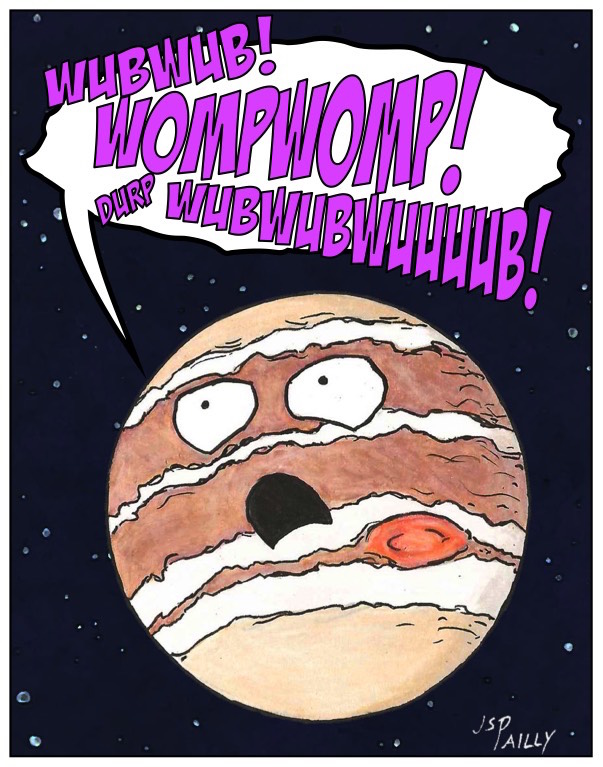
I’m not sure why I think the decametric radio emissions would sound like dubstep. Click here, here, or here to find out what they actually sound like.

In next week’s edition of Sciency Words, we’ll take a closer look—a much closer look—at Io. It seems this humble little moon does more than adjust Jupiter’s radio emissions. Io wields enormous power and influence over the entire radiation environment surrounding Jupiter.

P.S.: Okay, on second thought, maybe we shouldn’t get too close to Io.

Sciency Words: Stochastic

Today’s post is part of a special series here on Planet Pailly called Sciency Words. Each week, we take a closer look at an interesting science or science-related term to help us expand our scientific vocabularies together. Today’s term is:

STOCHASTIC

At first glance, stochastic appears to have a pretty easy definition. Basically, it means random. A stochastic event can be defined, quite simply, as a random event. So why do scientists need this weird term? Why can’t they just say random if they mean random?

I’ve seen this word now in a surprisingly wide range of scientific fields, most recently in relation to the population dynamics of endangered species and then in relation to the magnetic field of Jupiter. The thing is that in actual usage, stochastic and random aren’t quite synonyms. A better definition for stochastic might be “seemingly random.”

The word originates from a Greek word meaning “to aim at” or “to shoot at.” So it’s an archery term, but the Greeks also used it to mean “to guess at.” I like this linguistic metaphor because a guess really is like aiming for the truth; whether or not you hit the mark is another matter.

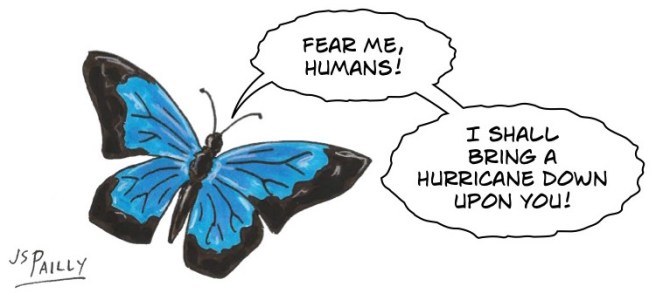
Anyway, the word seems to have migrated from Greek to German to English, and in its modern scientific sense it refers to something that might be predictable in theory but appears to be random in practice. As an example, you may have heard that the flapping of a butterfly’s wings could set in motion a chain of events ultimately leading to a devastating hurricane.

In theory, these butterfly-initiated hurricanes could be predicted, if only we knew the exact locations and flapping behaviors of every single butterfly on Earth (along with a million and one other factors). But in practice, since we can’t gather all the necessary data, we can only make educated guesses about when and where the next hurricane will hit.

In other words, hurricanes are stochastic events. They seem random, even though they’re not.

Sciency Words: Technological Geometrization

Today’s post is part of a special series here on Planet Pailly called Sciency Words. Each week, we take a closer look at an interesting science or science-related term to help us expand our scientific vocabularies together. Today’s term is:

TECHNOLOGICAL GEOMETRIZATION

In 1990, the Galileo spacecraft was on its way to Jupiter and needed to perform a gravity assist maneuver at Earth. This turned out to be a golden opportunity for science. Could a typical NASA space probe equipped with a standard suite of instruments detect signs of life on a planet where we already knew life existed?

In a 1993 paper, Carl Sagan and colleagues presented their findings in this “control experiment for the search for extraterrestrial life.” The paper explores all the things Galileo observed and, more intriguingly, some of the big things Galileo missed. Things like the “technological geometrization” of the planet’s surface, as the paper called it.

As far as I can tell, technological geometrization is not a term that’s stuck in the scientific lexicon, which is a shame. I think it’s a really good term. It refers to the way technologically advanced civilizations would tend to create geometric patterns on their surfaces of their planets.

The planet Coruscant from the Star Wars universe is a great example. The entire planet is urbanized, to the point that natural geological features are completely covered over. From space, all you can see are straight lines and perfect circles—efficient city planning on a global scale.

As another example, back in the 1800’s Percival Lowell and an embarrassingly large number of other astronomers thought they saw canals crisscrossing the surface of Mars. Those canals, if they really existed, would have been clear evidence of a technologically advanced society geometrizing their planet.

Earth’s surface displays only the faint beginnings of technological geometrization: rectangular patches of farmland and the grid patterns of streets and highways. These features are visible from space (Google Earth proves that), but you have to get fairly close to Earth to notice those kinds of details.

Apparently Galileo didn’t get close enough. At an image resolution of 1-2 kilometers per pixel, the technological geometrization of Earth was effectively invisible.

P.S.: That paper by Sagan and Company was a really good paper. It served as the basis for my recent “Alien Eyes on Earth” series.

Sciency Words: Coronal Heating Problem

Today’s post is part of a special series here on Planet Pailly called Sciency Words. Each week, we take a closer look at an interesting science or science-related term to help us expand our scientific vocabularies together. Today’s term is:

CORONAL HEATING PROBLEM

This is the Sun. He’s kind of a big deal, and he knows it.

The interior of the Sun is several million degrees Celsius. By comparison, the surface of the Sun is quite chilly. It’s only a few thousand degrees. Still, if you were standing on the surface of the Sun, you wouldn’t last long.

But before you launch yourself into space to escape the heat, there’s something you should know: as you fly away from the Sun, passing through the corona, the temperature starts getting hotter again. It’s not quite as hot as the interior, but still… we’re back into million-plus degree heat.

If that doesn’t make sense to you, that’s okay. It doesn’t make sense to me either, or anyone else. Astro-scientists have been baffled by this for decades now. They call it the coronal heating problem.

I first heard about the coronal heating problem back in 2014, when I was starting my research for what became the 2015 Mission to the Solar System. To be honest, it’s not something I’ve spent a lot of time thinking about since then. Every once in a while, it comes up again and I think, “Oh right… so they still haven’t figured that out yet?”

But as you may heave heard last week, NASA’s on the case. Their newly named Parker Solar Probe is going to skim very close to the Sun and try to figure out what the heck’s going on.

Parker is scheduled for a launch window in July/August of 2018. Its mission is expected to last until 2025. So hopefully a decade from now, whenever I’m reminded of the coronal heating problem, it won’t be a problem anymore, and I’ll be able to think, “Oh right… they finally figured that out!”

Sciency Words: Biogenic (Alien Eyes on Earth, Part 5)

Today’s post is part of a special series here on Planet Pailly called Sciency Words. Each week, we take a closer look at an interesting science or science-related term to help us expand our scientific vocabularies together. Today’s term is:

BIOGENIC

A passing alien spacecraft has been observing our little, blue planet for two weeks now, and it’s time they reported their findings back to their homeworld. One word—one scientific term—will feature prominently in their report: biogenic.

Actually, it’ll be the word xygjaflubozux, but that roughly translates into English as biogenic. It’s an adjective meaning “generated by biological processes.”

It’s difficult to impossible to directly detect life forms on a distant planet, so instead good astro-scientists go looking for chemicals that may have biogenic origins.

In the case of Earth, the aliens report they’ve detected an alarming amount of oxygen in the atmosphere. Oxygen is such a highly reactive chemical that it’s hard to imagine how it could persist in a planet’s atmosphere over long periods of time, unless….

Then there’s methane (which we never talked about in this series… oops). The presence of methane is even harder to explain, because methane reacts so readily with oxygen. All that methane should oxidize away within fifty years, unless….

Could it be biogenic oxygen? Biogenic methane? What about some of the other strange chemicals in Earth’s atmosphere, like nitrous oxide? Could there be biological processes at work constantly replenishing these chemicals in Earth’s atmosphere? These questions will be debated among the alien scientific community for many standard cycles to come.

The only unambiguous evidence of life on Earth, from the aliens’ perspective, were those radio signals coming from the planet’s surface. In a sense, you might say these signals have a biological origin, though I doubt human astro-scientists would describe them as biogenic radio emissions. But maybe the word xugjaflubozux has a slightly broader flavor of meaning and could still apply (how should I know? I don’t speak alien!).

This is the final post for my “Alien Eyes on Earth” series. The aliens have to move on and explore other star systems, but something tells me they’ll be back.

Today’s post was inspired by a 1993 paper by Carl Sagan and others. Sagan and his colleagues wanted to know which of Earth’s features can be observed by a passing spacecraft and, perhaps more interestingly, which features cannot.