Hello again, friends! Welcome back to the A to Z Challenge. For this year’s challenge, my theme is the universe of Tomorrow News Network, my upcoming Sci-Fi adventure series. In today’s post, U is for:
URTHU
“Earth-like” can be a misleading term, both in real life and in the universe of Tomorrow News Network. Lots of planets can be described as Earth-like, in one manner or another. That doesn’t necessarily mean Earthlings would be able to live there.
There are only handful of truly Earth-like planets in our galaxy—planets with oxygen/nitrogen atmospheres, planets with oceans of liquid water, planets with chlorophyll-green vegetation growing on their surfaces. And these very few planets are all the result of terraforming projects funded by the Earth Republic (or later by the Earth Empire).
Terra Nova, Terminus, Xanadu… these are some of terraforming’s greatest success stories. But terraforming technology has had one noteworthy failure: the Earth II project. What exactly went wrong on Earth II? No one knows, but in his final transmission, the Earth II colonial administrator said: “We worked to transform this planet, and the planet worked just as hard to transform us.”
As a result of linguistic corruption, the name Earth II has become Urthu. At least that is the name used by the creatures that still live there.
In The Medusa Effect, Urthu is mentioned only in passing, and that’s all the attention it gets. As the Tomorrow News Network series progresses, will Urthu turn out to be more important than a throwaway line? Maybe. Maybe not. Maybe I just had a really tough time picking a U-word for the A to Z Challenge, and I’ll never have anything to say about Urthu again. Who knows what the future may bring?
Next time on Tomorrow News Network: A to Z, imagine you’re sitting at home watching the news on the viewlink when the signal abruptly cuts to static.
Hello, friends. My theme for this year’s A to Z Challenge is the universe of Tomorrow News Network, my upcoming Sci-Fi adventure series. The alphabet being what it is, we’ve had to wait a long time to meet this character. But finally, the day has come. In today’s post, T is for:
TALIE TAPPLER
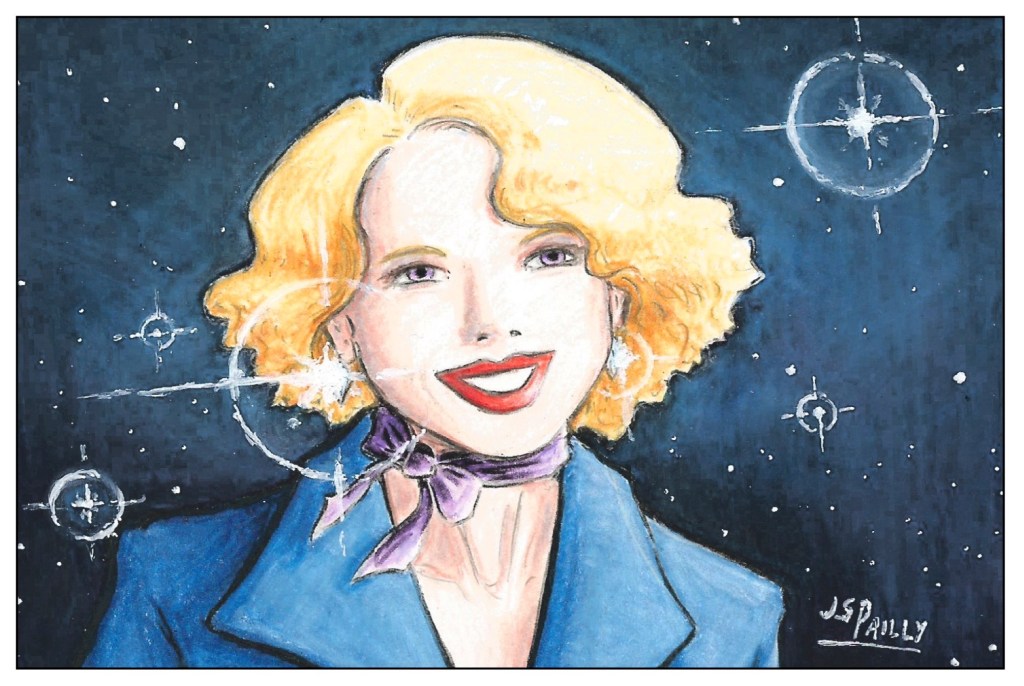
Don’t let that cute smile fool you. This woman is the living embodiment of bad news. Talie is a journalist and a time traveler, and as the Tomorrow News Network’s most prominent “reporter extraordinaire,” she is sent out to cover the biggest, juiciest, most exciting and most devastating news stories throughout the space-time continuum.
I have been working on Tomorrow News Network for almost ten years now, and right from the start there were three important facts that I knew about Talie.
Her Professional Vanity: Talie tends to fuss over her hair and make-up, and she dresses in a manner that some might describe as “business sexy.” Talie is what people in the news business call on-air talent. Her look is part of her job. The Tomorrow News Network has over 900 quadrillion viewers, so reporters must always look their absolute best on camera.
Her Timeless Perspective: In many of the stories Talie covers, people suffer. People die. But from Talie’s point of view, this is just history, and isn’t it thrilling to see history unfold exactly as it should? You can forgive Talie if she seems a bit insensitive at times. Or maybe you can’t. Either way, Talie has no intention of interfering with historical events, no matter how desperately you beg for her to intervene.
Her Secret Enemy: [REDACTED REDACTED REDACTED REDACTED REDACTED REDACTED REDACTED REDACTED REDACTED REDACTED REDACTED REDACTED REDACTED REDACTED REDACTED REDACTED REDACTED REDACTED REDACTED]. But while Talie does believe in the public’s right to know, there are some things that must still be kept confidential. Everyone is safer that way.
Whenever I talk about Tomorrow News Network, I struggle to describe Talie’s role in the series. In some ways, she’s the protagonist. She is the character most prominently featured throughout the series.
But in some ways, she’s more like a recurring antagonist. Characters like Milo Marrero are desperate to find out what the future will be; Talie is the one keeping the future secret. She’s the one stopping people like Milo from achieving their goals.
So should I call Talie my protagonist or antagonist? As one of my beta-readers once said, Talie is definitely an “agonist” of some kind. But as another beta-reader suggested, perhaps another literary term would suit Talie better: she is “the herald,” the character whose arrival initiates change, the character whose appearance signals that a story is about to begin.
Because if you ever have the misfortune of meeting Talie Tappler, you can be certain that she’s come for a reason, and whatever that reason is, it’s unlikely to be good news.
Next time on Tomorrow News Network: A to Z, there once was a human colony named Earth II. We’ll find out what happened to it.
Hello, friends, and welcome once more to the A to Z Challenge. My theme for this year’s challenge is the universe of Tomorrow News Network, my upcoming Sci-Fi adventure series. In today’s post, S is for:
S.P.Q.R.
The main character in Tomorrow News Network is Talie Tappler. She’s a journalist. She’s also a time traveler, and there’s a common stereotype about time travelers that definitely applies to her. Everywhere and everywhen time travelers go, they always wear or carry an antique watch. The more out of its own place, the more out of its own time the watch can be, the better.
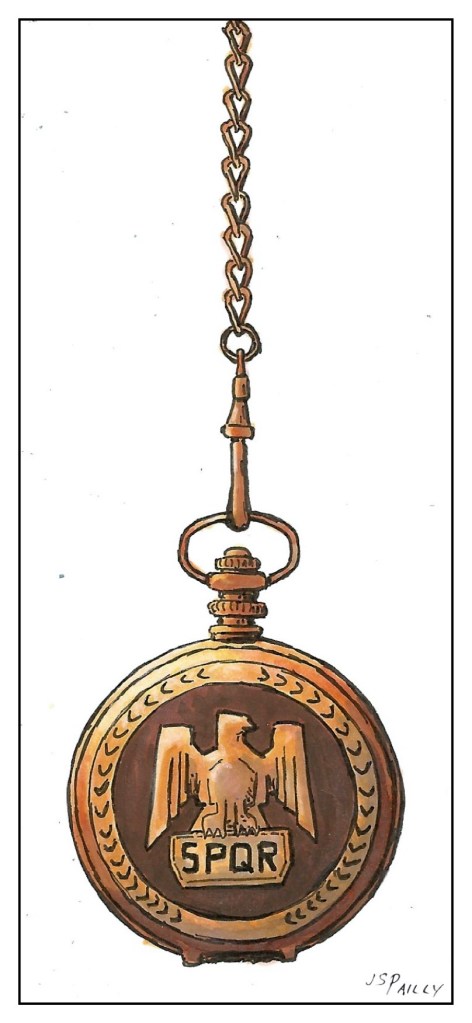
Talie’s pocket watch is about as out of its place and out of its time as anything can get. When Milo Marrero first sees Talie’s watch, he notices the image of an eagle and the initials S.P.Q.R. are engraved on the brass casing. Milo’s accustomed to seeing the corporate logo of A.E.I. everywhere he goes, so he assumes S.P.Q.R. must be some other interplanetary mega-corporation.
Some of you, dear readers, may already know just how wrong Milo is about that. For the rest of you, allow me to explain. S.P.Q.R. stands for Senatus Populusque Romanus, which is Latin for “the Senate and People of Rome.” In ancient times, the letters S.P.Q.R. were stamped on Roman currency or carved into Roman monuments.
Also, apparently, the letters were engraved into the brass casings of ancient Roman pocket watches. Except… wait, the Romans never had pocket watches, did they? That sort of technology wouldn’t appear on Earth until many centuries after the fall of Rome. So where did Talie’s watch come from? How did she get it?
I’m not going to answer those questions. Not yet. I can only tell you that I have longterm plans for the Tomorrow News Network series, and eventually I do plan to tell the story behind Talie Tappler’s watch.
And speaking of Talie Tappler, next time on Tomorrow News Network: A to Z, we will finally meet T.N.N.’s infamous “reporter extraordinaire.”
Hello, friends, and welcome back to the A to Z Challenge. For this year’s challenge, I’m telling you more about the universe of Tomorrow News Network, my upcoming Sci-Fi adventure series. In today’s post, R is for:
Litho, the outermost moon of the planet Berzelius, is also marked with a distinctive surface feature: a triple spiral formation in the northern hemisphere. Officially, that triple spiral is known as Arfwedson Circumcurio, in honor of Johan August Arfwedson, the ancient Earthling who first discovered lithium.
Circumcurio is, of course, an exo-geology term referring to spiral-like surface features on alien worlds. Many worlds in the explored galaxy have these circumcurio features, though Litho’s Arfwedson Circumcurio is larger and more distinctive than most.
Admittedly, the name Arfwedson Circumcurio is a bit of a mouthful. The colonists who actually live on Litho rarely use that name and instead refer to the region simply as “the Redlands.”
The Redlands are a desert covered in lithium trinate (a dark red powder-like substance). You can find lithium trinate and other lithium compounds pretty much anywhere you go on Litho (hence the name), but the highest concentrations are out in the Redlands. Alkali Extraction Incorporated has therefore focused most of its lithium harvesting efforts on the Redlands, and Litho Colony itself is situated right on the outskirts of the Redlands region.
A word of caution: lithium trinate is a highly reactive chemical compound. Never touch it with your bare hands. It will irritate and burn your skin, and it will do far worse to your lungs if you inhale the dust. Please follow the safety guidelines delineated in A.E.I.’s company handbook.
Next time on Tomorrow News Network: A to Z, there’s a common stereotype about time travelers. They always wear or carry antique watches.
Hello, friends! Welcome back to the A to Z Challenge. For this year’s challenge, I’m telling you a little more about the universe of Tomorrow News Network, my upcoming Sci-Fi adventure series. In today’s post, Q is for:
QUAD-UNITS
So far, most of my A to Z posts have focused on things that will appear in The Medusa Effect, book one of the Tomorrow News Network series. A few posts have covered material that I plan to include in future books. But this post is the first time we’re talking about something that I had to cut.
Litho Colony’s residential district was originally made up of just a few small prefab housing units. As the colony grew, more prefabs units were added, and recently a dozen new quad-units were constructed as well.
Quad-units are larger housing modules designed to accommodate up to four separate families. They’re really big, really bulky structures. Maybe they’re a little too big and bulky, or at least that’s what some of the older colonists say. But given how successful and prosperous Litho Colony has been, A.E.I. has plans to build at least a dozen more quad-units next season. It’s really the best way to keep up with the colony’s population growth.
In early drafts of The Medusa Effect, I devoted several paragraphs to the quad-units. Those paragraphs helped me show that Litho Colony is prosperous and growing. However, I say that and show that in other ways too, and that particular section of text was really slowing down the pace of the story. To make matters worse, this was in a scene where the pace needed to start picking up.
So reluctantly, I cut that whole section. Why am I telling you about something that didn’t make it into the book? Because I know some of the people reading these A to Z posts are fellow writers. Some of you have also had to cut stuff out of your stories, stuff that you enjoyed writing, stuff that you really, really, really wanted to hold on to.
This post is basically a quick reminder to you, my fellow writers, that you’re not alone. We all have to make tough choices in our writing sometimes. It’s okay to cut stuff if you have to.
Next time on Tomorrow News Network: A to Z, the official name of the Redlands is Arfwedson Circumcurio. But don’t worry. Nobody who lives on Litho ever calls the Redlands by their official name.
Hello, friends! Welcome once again to the A to Z Challenge. For this year’s challenge, I’m telling you more about the universe of Tomorrow News Network, my upcoming Sci-Fi adventure series. In today’s post, P is for:
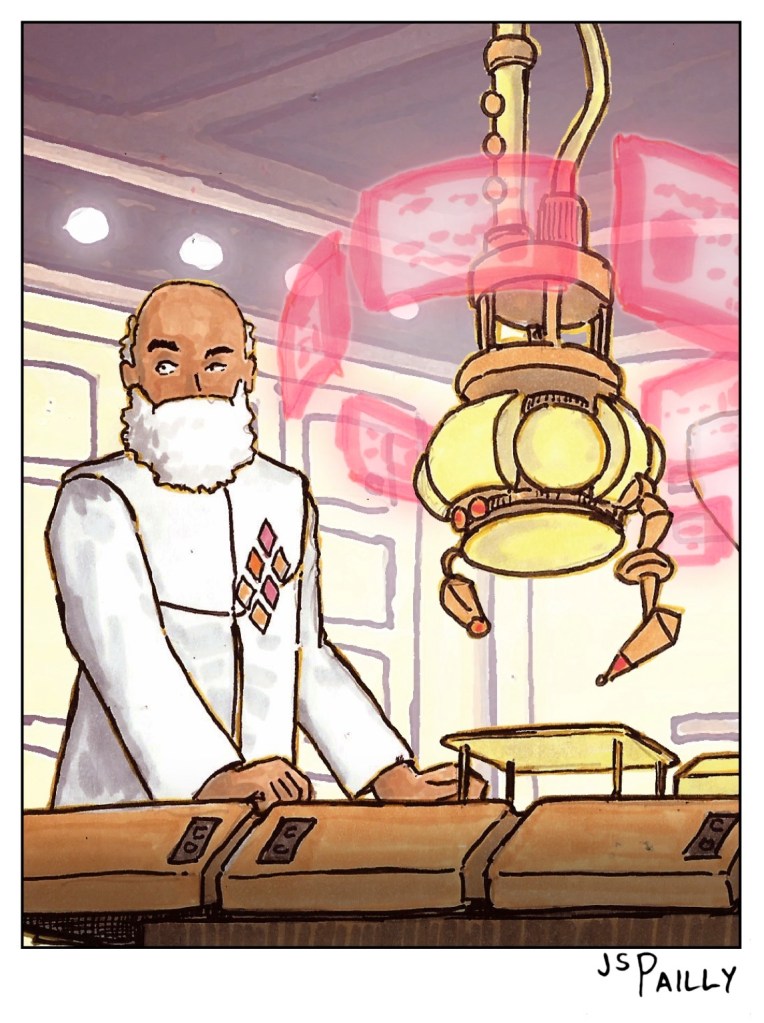
THE PROFESSOR
In a previous post, we met Milo Marrero, one of the younger colonists living on Litho. Today, I’d like to introduce you to Milo’s dad. Milo’s dad is a stern and imposing figure in Milo’s life, and… you know what, rather than telling you what Milo’s dad is like, how about I show you. Who’s ready for an excerpt from The Medusa Effect, book one of the Tomorrow News Network series?
* * *
“I saw her!” Milo said. He’d rushed to the Alpha Building, all the way up to his father’s laboratory. “I saw Talie Tappler!”
“Who?”
Milo’s father–or rather “the Professor,” as everyone else knew him–had glanced up for just a moment, uttering nothing more than that single syllable: Who? Both the Professor and his junior assistant, a young woman called Ramirez, were hunched over the worktable in the center of the room, running scans on the latest mineral samples from the Redlands.
“Dad, I’ve told you about her: Talie Tappler, that reporter from the Tomorrow News Network. She’s here! She’s doing a story about us!”
Ramirez snorted a laugh. “Who’d do a story about this zero-glitz colony?”
“Zero-glitz?” the Professor grumbled beneath his thick beard. Then the Professor said, assuming his most professorial tone: “Young lady, young man, I’ll have the both of you know this colony supplies more than half the lithium for the Outer Territories, plus a full 15% for the Empire as a whole. I’m not surprised this… this Tappy woman would do a story about that.”
“Tappler,” Milo corrected with an exasperated sigh.
“Hmph… whoever!”
The Professor gave his assistant a curt nod, and Ramirez reached for the next sample container. With a cold hiss, the canister opened, and Ramirez spilled its contents onto the scanner bed. The system beeped twice, indicating it was ready, and the Professor pressed his thumb into the big green go-button.
“Dad, listen,” Milo said. “Talie’s not some ordinary journalist. She’s with the Tomorrow News Network. That means she can travel through time!”
“Yes, yes. That’s obvious,” the Professor said.
Milo gritted his teeth. He wanted to shout, to scream at his father, the oh-so-venerable Professor; but what could Milo say? The old man didn’t follow the news, aside from financial reports. He’d never seen Talie in action, didn’t know the kinds of stories she covered: war and chaos, assassinations and terrorism, the rise and fall of mighty space empires!
Milo approached the worktable, leaned on the outer guardrail. He was wearing his coveralls loose, contrary to company handbook guidelines, and the papery fabric made a crinkling sound when he moved.
The Professor glanced up. “Well… ehmm…,” he said. His bushy eyebrows were furrowed as though he were trying to solve a difficult puzzle. It would take the scanner another minute or two to finish its current sequence. “Well,” the Professor said in the meantime, “what’s this time traveler saying about us?”
And just like that, Milo felt a sudden thrill of relief, a sudden surge of hope.
“Okay,” Milo began, “so she interviewed a few people in the outdoor commons, asked questions like ‘What do you do here?’ or ‘How long have you lived here?’ That sort of stuff. Normal stuff, right? But then she started talking about the mining equipment and the prefab units, how everything looks so sparkly new, how we have such a promising future ahead.”
Ramirez pretended to scoff. “How could anyone say such despicable things about us?”
Milo scowled but pressed on regardless: “She mentioned the local economy.”
“Oh?” the Professor said.
“She said we’re primed for rapid growth.”
At that, the Professor grinned. “Well now, you don’t need to be a time traveler to figure that out. Why, this planetoid’s mineral wealth alone could make us all rich, but then you add in the meso-lithium. The price of mesotronic elements keeps going up. The company’s earnings tripled last quarter, which means higher percentages for us!”
Abruptly, the scanner beeped. Fresh data flashed across the holo-display.
“Dad, please!” Milo said, ready to present his most damning piece of evidence yet. “Listen, she used these exact words: ‘What could such happy, prosperous colonists possibly have to fear?’”
Professor Marrero nodded as though he were listening, but his finger was tracing a string of numbers across the holographic display. In one ear, out the other, as the ancient Earthlings used to say. The Professor mumbled something to himself–doing rough estimates on the fly, it sounded like. Then he reached for a datapad and started cross-referencing the new readings against a library index.
An orbital survey chart materialized above the worktable, and there, rendered in topographic contours, were the Redlands. Or rather there was “Arfwedson Circumcurio,” as the region was officially labeled on the map, but nobody who lived on Litho ever referred to the Redlands by their official name. An indicator flashed at the current sample’s point of origin. Ramirez said something about the decay ratio, and the Professor agreed that the numbers looked good. Very good. “Primed for economic growth? I’d say so!” the old man added with a chuckle.
* * *
Next time on Tomorrow News Network: A to Z, Litho Colony really is a happy and prosperous place. Just check out those new quad-units they’re constructing.
Hello, friends! Welcome back to the A to Z Challenge. For this year’s challenge, I’m telling you more about the universe of Tomorrow News Network, my upcoming Sci-Fi adventure series. In today’s post, O is for:
OXYGEN SHEATH
It should not surprise you to learn that oxygen is one of the strongest oxidizers in the known universe. For some of us, that makes oxygen a source of biochemical energy and a necessity for life. But for many other life forms, oxygen’s oxidizing power is too much to handle, making oxygen a deadly poison.
There’s not much middle ground here. You either need oxygen to survive, or oxygen means instant death, depending on whether your species evolved in an oxygen rich or oxygen poor environment.
When human colonists first arrived on Litho, they set up generators for a static oxygen sheath: a force field bubble that keeps Litho’s natural atmosphere out and holds an artificial oxygen atmosphere in. The oxygen sheath isn’t perfect. Near the oxygen sheath’s perimeter, you can smell ammonia seeping through. And of course, all the alkaline dust particles covering Litho’s surface still pose a bit of an air quality concern. Colonists are encouraged to wear nose filters whenever outdoors.
But the biggest concern related to the oxygen sheath has to do with Litho’s native life forms: the scrubby, slimy cyanomolds. Those cyanomolds evolved in an oxygen poor environment. Oxygen should kill them. And yet, for reasons that remain unclear, the cyanomolds are thriving under the oxygen sheath’s influence.
Litho Colony is now partially surrounded by a mold forest. Giant, bulbous masses have swollen up, with coral-like fringes and lots of creeping vines and tendrils. To some, it’s a disgusting sight; to others, the cyanomolds have their own alien beauty. Like so many things about life, it’s a matter of perspective. But if left unchecked, the cyanomolds would spread rapidly across the colony grounds. Keeping that mold forest under control has become a real nuisance for the colonists.
Next time on Tomorrow News Network: A to Z, we’ve already met young Milo Marrero. Now it’s time to meet Milo’s dad.
Hello, friends! Welcome back to the A to Z Challenge. For this year’s challenge, my theme is the Sci-Fi universe of Tomorrow News Network, and in today’s post, N is for:
THE NEW GALACTIC CHEMICAL REGISTRY (N.G.C.R.)
In the first book of the Tomorrow News Network series, there’s a bit of narration about a chemical substance called lithium trinate. For any chemistry buffs who might be reading this, you’re right: that’s not a real name for a chemical. Allow me to explain.
Here in the 21st Century, the International Union of Pure and Applied Chemistry (I.U.P.A.C.) is in charge of naming and categorizing chemicals. But according to Tomorrow News Network, at some point in the future, all the I.U.P.A.C. naming conventions will be replaced by a new system called the Galactic Chemical Registry.
And then at some point even farther into the future, the Galactic Chemical Registry will be changed and updated once more, thus leading the the creation of the New Galactic Chemical Registry (N.G.C.R.). The sciences have a long history of redefining key terms, of updating or replacing old systems of nomenclature with new ones. So by the 44th Century, something like the N.G.C.R. could exist. It’s possible.
So lithium trinate might be a real chemical, a chemical whose original I.U.P.A.C. name has been changed in the N.G.C.R. Or lithium trinate might be some exotic new outer space chemical that’s totally unknown to 21st Century science.
I can at least tell you lithium trinate was inspired by a real chemical substance called lithium nitride. I did my research. I’m pretty sure I got my sciency facts right. But just in case I overlooked something important, just in case I made some silly mistake, the N.G.C.R. gives my story a bit of plausible deniability.
Next time on Tomorrow News Network: A to Z, even in the 44th Century, humans still need oxygen to breathe.
Hello, friends, and welcome back to the A to Z Challenge! For this year’s challenge, I’m telling you more about the universe of Tomorrow News Network, my upcoming Sci-Fi adventure series. In today’s post, M is for:
MILO MARRERO
Milo’s full name is Milo Moneo Militaeus Marrero. It’s an awkward name, which is fitting because Milo is an awkward teenage boy. He is one of the 786 colonists living on Litho.
Like many awkward teenage boys, Milo has a crush on a girl. Also, Milo doesn’t pay much attention in school, he tends to skip his apprenticeship in hydroponics, and he’s got a few minor citations from colonial security on his semi-permanent record.
Oh, and Milo is also a news junkie. Most of the colonists don’t really follow the news. As mentioned in yesterday’s post, Litho Colony is so very, very far away from all the war and chaos and interplanetary drama that keeps making headlines. People have more immediate concerns, like meeting their work quotas and keeping the colony running.
But Milo has developed a peculiar fascination with the Tomorrow News Network, a news organization run by time travelers, a news organization that literally brings you tomorrow’s news today.
So when a certain attractive and popular journalist from the Tomorrow News Network shows up on Litho Colony, most people don’t know who she is, and they don’t really care. She’s probably doing a business story about A.E.I. Litho Colony has been turning such an extraordinary profit for A.E.I., after all!
But Milo knows better. This journalist from T.N.N.—she isn’t just any journalist from T.N.N. She’s Talie Tappler, the woman who covered the assassination of Reginald Zaphiro, the woman who covered the crash at Roswell, the woman who covered the Planet Eater attack on Hyla Prime.
And now that same T.N.N. reporter is walking around on Litho with a cybernetic cameraman in tow, and Milo is determined to find out why.
Next time on Tomorrow News Network: A to Z, chemistry is already a complicated subject. By the 44th Century, it’s going to be even more complicated.
Hello, friends! Welcome to another episode of the A to Z Challenge! This year, I’m telling you all about the universe I created for my upcoming Sci-Fi adventure series, Tomorrow News Network. In today’s post, L is for:
LITHO COLONY
In case you were wondering, the galaxy is not a peaceful place. We’ve already met the Galactic Inquisitor. We’ve learned a little about the Hykonian Hegemonic Empire, and we’ve talked about Earth’s Imperial Exofleet. But for the good people of Litho Colony, all those wars, all that conflict and strife—those things are very, very far away.
Litho is the outermost moon of the planet Berzelius, located in the Vesper Beta-Beta Star Sector. The chemical element lithium is superabundant in the moon’s crust (hence the name Litho), and so Alkali Extraction Incorporated (A.E.I.) has established a small mining colony there.
That colony has been extraordinarily profitable, supplying more than half the lithium for the Outer Territories and a full 15% for the Earth Empire as a whole. A.E.I.’s earnings keep going up, and the colonists are being well compensated for their work.
Don’t let the industrial aesthetic of the place fool you: Litho Colony is a cozy and comfortable place to live. The hydroponics dome supplies plenty of fresh food; no one has to eat synthetic mush or take nutrition tabs. The recreation facility is top notch, and there’s even a fully staffed school. Litho Colony is the kind of place where people can—and do—raise families.
In short, Litho is a quiet, peaceful, isolated colony world on the frontier of space. Nothing bad ever happens there. And this peaceful, isolated colony world will be the setting for The Medusa Effect, book one of the Tomorrow News Network series.
And next time on Tomorrow News Network: A to Z, we’ll meet an awkward teenage boy who calls Litho Colony home.








 Planet Pailly