NASA’s Next Flagship Mission

Let’s imagine you’re NASA. You have two big flagship-class missions coming up: one to search for life on Mars (launcing in 2020) and another to search for life on Europa (launching in 2022). These flagship missions are big, expensive projects, so Congress only lets you do one or two per decade.

After 2022, the next flagship mission probably won’t launch until the late 2020’s or early 2030’s, but still… now is the time for you to start thinking about it. So after Mars and Europa, where do you want to go next? Here are a few ideas currently floating around:

  • Orbiting Enceladus: If you want to keep looking for life in the Solar System, Enceladus (a moon of Saturn) is a good pick. It’s got an ocean of liquid water beneath it surface, and thanks to the geysers in the southern hemisphere, Enceladus is rather conveniently spraying samples into space for your orbiter to collect.
  • Splash Down on Titan: If there’s life on Titan (another moon of Saturn), it’ll be very different from life we’re familiar with here on Earth. But the organic chemicals are there in abundance, and it would be interesting to splash down in one of Titan’s lakes of liquid methane. If we built a submersible probe, we could even go see if anything’s swimming around in the methane-y depths.
  • Another Mars Rover: Yes, we have multiple orbiters and rovers exploring Mars already, but some of that equipment is getting pretty old and will need to be replaced soon. If we’re serious about sending humans to Mars, it’s important to keep the current Mars program going so we know what we’re getting ourselves into.
  • Landing on Venus: Given the high temperature and pressure on Venus, this is a mission that won’t last long—a few days tops—but Venus is surprisingly similar to Earth in many ways. Comparing and contrasting the two planets taught us how important Earth’s ozone layer is and just what can happen if a global greenhouse effect get’s out of control. Who knows what else Venus might teach us about our home?
  • Orbiting Uranus: This was high on NASA’s list of priorities at the beginning of the 2010’s, and it’s expected to rank highly again in the 2020’s. We know next to nothing about Uranus or Neptune, the ice giants of our Solar System. Given how many ice giants we’ve discovered orbiting other stars, it would be nice if we could learn more about the ones in our backyard.
  • Orbiting Neptune: Uranus is significantly closer to Earth than Neptune, but there’s an upcoming planetary alignment in the 2030’s that could make Neptune a less expensive, more fuel-efficient choice. As an added bonus, we’d also get to visit Triton, a Pluto-like object that Neptune sort of kidnapped and made into a moon.

If it were up to me, I know which one of these missions I’d pick. But today we’re imagining that you are NASA. Realistically Congress will only agree to pay for one or two of these planetary science missions in the coming decade. So what would be your first and second choices?
Going Up: Jupiter’s Auroras Get Weirder Than Ever

Last week, the Juno mission flew over Jupiter’s Great Red Spot and sent back some spectacular close-ups. But I’m not ready to talk about that. Not yet. I’m still catching up on the Juno news from two months ago.

Toward the end of May, NASA released a ton of fresh data from Juno, including new information about Jupiter’s auroras. Astro-scientists had previously known about two sources contributing to these auroras: the solar wind and the Io plasma torus. Now Juno may have discovered a third.

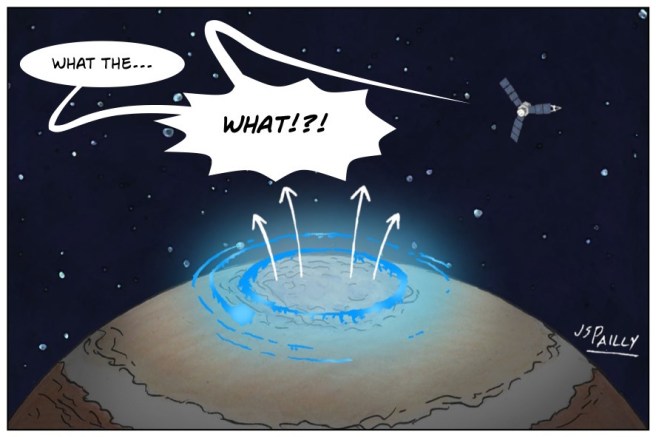
As Juno flew over Jupiter’s poles, it detected electrically charged particles flying up.

I can’t emphasize enough how weird this is. I wanted to write about it right away, but I held off doing this post because I was sure I must have misunderstood what I was reading.

Auroras are caused by electrically charged particles accelerated down toward a planet’s magnetic poles. These particles ram into the atmosphere at high speed, causing atmospheric gases to luminesce. At least that’s how it’s supposed to work. I guess nobody told Jupiter that.

In addition to the “normal” downward flow of particles from the Sun and Io, Jupiter’s magnetic field apparently dredges charged particles up from the planet’s interior and hurls them out into space. So Jupiter’s auroras are triggered by a mix of incoming and outgoing particles.

This definitely falls under the category of “further research is required.” Even now, I still feel like I must have misunderstood something. This is just too weird and too awesome to be true.

P.S.: As for the Great Red Spot, I’m waiting to hear something about the microwave data. We’re going to find out—finally!—just how far down that storm goes.

Sciency Words: Airglow

Today’s post is part of a special series here on Planet Pailly called Sciency Words. Each week, we take a closer look at an interesting science or science-related term to help us expand our scientific vocabularies together. Today’s term is:

AIRGLOW

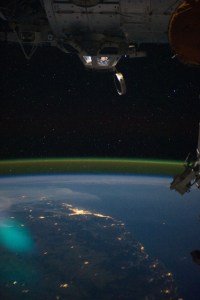
Have you ever been floating in space, looked down at the Earth, and noticed a faint halo of green light around the planet? Me neither, but that light is there and it’s called airglow. Why’s it called that?

This is Anders Angstrom, a 19th Century Sweedish research and one of the founders of the science of spectroscopy. He’s the guy who, in 1868, first observed the airglow phenomenon.

As often happens in science, this was a serendipitous discovery. Angstrom was trying to study one thing when he accidentally discovered something else. He was using a spectroscope to measure the emission lines of the aurora borealis—or to put that in plain English, he was trying to find out precisely which colors make up the Northern Lights.

To Angstrom’s surprise, one of the aurora colors—a narrow band of green—was always present in the sky even when the aurora wasn’t happening. Angstrom couldn’t explain this, but over the coming decades other researchers would continue investigating this faint green glow, ruling out one possibility after another: it couldn’t be starlight, or moonlight, or light pollution….

Eventually scientists settled on an explanation involving chemistry. We now know that chemical reactions in the atmosphere release energy in the form of photons. The most noticeable reactions involve oxygen reacting with itself, producing photons of a specific wavelength, a wavelength corresponding to a narrow band of green light.

We’ve also observed airglow on other planets. The different colors we see on Venus, Jupiter, or Saturn can tell us a lot about the chemicals in those planet’s atmospheres. And some day a faint green emission line from an exoplanet may lead us to the discovery of alien life.

Image courtesy of NASA.

I opened this post from a vantage point in space, because as I understand it Earth’s airglow is a lot easier to see from up there. But it can be seen from down here on the ground too if you have sharp eyes, a good camera (or a good spectroscope), and know what to look for. Click here to learn more.

Io: Jupiter’s Ugliest Moon

For today’s post, I hopped in my imaginary spaceship and flew all the way out to Io, one of Jupiter’s moons. Without a doubt, Io is the ugliest object in the Solar System.

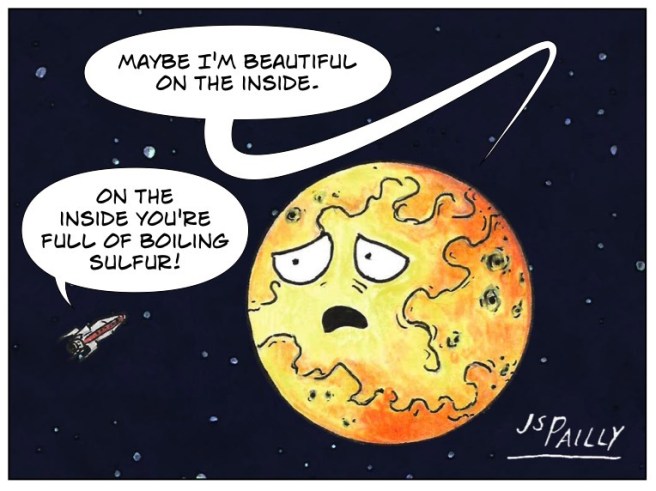
I know, that’s mean. I shouldn’t say things like that. But come on, just look at it. Seriously, look at it. It’s like some moldy horror you might find in the back of the fridge.

So yeah, Io’s hideous. Let’s go look at something else instead. Something pretty, like Jupiter’s auroras.

We have auroras back on Earth, of course, but Jupiter’s are a whole lot bigger, a whole lot more powerful, and when viewed in ultraviolet, a whole lot brighter. Also, unlike Earth’s auroral lights which come and go, Jupiter’s are always there. They may vary in intensity, but they never stop, never go away.

Auroras are caused by charged particles getting caught in a planet’s magnetic field, directed toward the magnetic poles, and colliding at high speed with molecules in the planet’s atmosphere.

On Earth, those charged particles come mostly from the Sun in the form of solar wind. No doubt the solar wind contributes to Jupiter’s auroras as well, but the greater contributing factor is actually—believe it or not—Io. That’s right: ugly, little Io causes Jupiter’s auroras. I guess spreading ionized sulfur all over the place is good for something after all!

In fact if you ever get to see a Jovian aurora, you’ll notice little knots in the dancing ribbons of light. These knots correspond to the positions of several of Jupiter’s moons. And the largest, brightest, most impressive of these knots… that one belongs to Io.

Jupiter.Aurora.HST.mod.svg
Image courtesy of Wikipedia.

So I guess today’s lesson is that even the ugliest object in the Solar System can still help make the universe a more beautiful place.

Sciency Words: Plasma Torus

Today’s post is part of a special series here on Planet Pailly called Sciency Words. Each week, we take a closer look at an interesting science or science-related term to help us expand our scientific vocabularies together. Today’s term is:

PLASMA TORUS

Saturn may have the most beautiful rings in the Solar System, but Jupiter’s got the most impressive plasma torus. Torus is the proper mathematical term for a donut shape, and plasma refers to ionized gas. Put the two words together and you get a giant, donut-shaped radiation death zone wrapped around a planet’s equator.

Jupiter’s plasma torus is faint, almost invisible; but if we take the totally legit Hubble image below and enhance the sulfur emission spectra, you’ll see what we’re talking about.

Ever since the discovery of Jupiter’s decametric radio emissions, astronomers have known there must be a relationship between Jupiter’s magnetic field and its moons. Well, I say moons plural, but it’s really only one moon we’re talking about: Io.

It wasn’t until the Voyager mission that we figured out why Io has so much influence over Jupiter’s magnetic field. In 1979, the Voyager space probes discovered active sulfur volcanoes on Io. They also detected ionized sulfur and oxygen swirling through space conspicuously near Io’s orbital path.

It seems that due to Io’s low surface gravity, Io’s volcanoes can easily spew a noxious mix of sulfur dioxide and other sulfur compounds up into space. Jupiter’s intense and rapidly rotating magnetic field acts as a sort of naturally occurring cyclotron, bombarding these sulfur compounds with radiation, breaking them apart into ionized (electrically charged) particles and accelerating those particles round and round the planet.

The result is a giant, spinning, donut-shaped cloud of ionized gas. We’re talking about a lot of radiation here—seriously, keep your distance from the Io plasma torus! We’re also talking about a lot of electrically charged, magnetically accelerated particles moving through a planetary magnetic field.

One source I read for today’s post described Io as “the insignificant-looking tail that wags the biggest dog in the neighborhood.” Jupiter has by far the largest, strongest magnetic field of any planet in the Solar System, but thanks to this plasma torus, it’s Io—tiny, little Io—that has the real power in the Jovian system.

Next week, we’ll go take a look at Jupiter’s auroras. They’re rather different from the auroras we have here on Earth, and SPOILER ALERT: Io has a lot of control over them.

The Insecure Mars Rover’s Support Group

Today’s post is part of the Insecure Writer’s Support Group, a blog hop where insecure writers like myself can share our worries and offer advice and encouragement. Click here to find out more about IWSG and to see a list of participating blogs.

* * *

Okay, today’s post is about writing. I promise. Just bear with me.

Late last month, the Opportunity rover straightened its wheels and resumed driving. You may be thinking, “Who cares? That doesn’t sound like a big deal.” But for regular Mars rover fans, this made headlines.

Mars rovers have their moments of glory: discovering new kinds of salt, observing evidence of liquid water, or detecting the faint whiffs of organic chemicals. One day a Mars rover may even uncover signs of past or present Martian life.

But between those moments of discovery comes the day to day (or rather sol to sol) drudgery of Mars roving. Moving a few inches forward. Turning your wheels. Communicating your status back to Earth then waiting 8 to 48 minutes for the go ahead from mission control to move a few inches more. Every small rock or patch of gravel can become a serious obstacle, and climbing a small hill can take months or even years.

The payoff comes eventually in the form of amazing discoveries, but only after long, tedious months of maneuvering cautiously and methodically across the craggy Martian wasteland.

Now I promised this post would in fact be about writing, and it is. A few weeks ago, I somehow got myself stuck in some gravel, so to speak. The kind of small, annoying problem that could bring my entire mission to a grinding halt. It’s only in the last few days that I’ve managed to straighten my wheels, and now I’m ready to resume driving… eh, I mean writing.

Sciency Words: Decametric Radio Emissions

Today’s post is part of a special series here on Planet Pailly called Sciency Words. Each week, we take a closer look at an interesting science or science-related term to help us expand our scientific vocabularies together. Today’s term is:

DECAMETRIC RADIO EMISSIONS

The decameter doesn’t get as much love as the meter or the kilometer, but it’s still a perfectly legitimate S.I. unit of measure. It equals ten meters.

In 1955, astronomers Bernard Burke and Kenneth Franklin detected radio emissions coming from the planet Jupiter, radio emissions with wavelengths long enough to be measured in decameters. Thus these emissions came to be known as the decametric radio emissions.

Surprisingly, the decametric radio emissions don’t radiate out into space in all directions. Instead, they shoot out like laser beams. Or perhaps I should compare them to searchlights. As a result, we can only detect them here on Earth if they happen to be aimed right at us.

Now here’s the part that I find really interesting. There are currently seven known sources for the decametric radio emissions, and they’re classified into two groups: Io-dependent and Io-independent.

The Io-independent sources require Jupiter’s magnetic field to align with Earth just so in order for us to hear them. And the Io-dependent sources? Well, they depend on Io, one of Jupiter’s moons. Jupiter’s magnetic field has to align with Earth, and Io has to be in the proper phase of its orbit.

I’m not sure why I think the decametric radio emissions would sound like dubstep. Click here, here, or here to find out what they actually sound like.

In next week’s edition of Sciency Words, we’ll take a closer look—a much closer look—at Io. It seems this humble little moon does more than adjust Jupiter’s radio emissions. Io wields enormous power and influence over the entire radiation environment surrounding Jupiter.

P.S.: Okay, on second thought, maybe we shouldn’t get too close to Io.

Space Chimp Lives!

Today I’d like to share an amusing photograph from the early days of space exploration. This is Ham the Chimpanzee.

His name comes from the laboratory that trained him for his mission: the Holloman Aerospace Medical Center. That’s important to know because Ham’s training is a key part of his story.

Ham was not just another confused and frightened animal strapped into a rocket and launched into space (though it sounds like he was definitely very frightened during his trip). Ham had a mission. He had a job to do during his flight. And he did it.

Specifically, Ham was trained to push a lever when he saw a flashing blue light. During training, he was rewarded with a banana pellet if he did his job correctly (he was also punished with electric shocks if he did his job incorrectly).

Ham’s success was significant because it proved that even under the physical stresses of space flight, it is possible to respond to visual stimuli and perform basic tasks. A human astronaut would therefore be able to operate the controls of a spacecraft during flight, which was an important thing for NASA to know in the early days of space exploration.

P.S.: I assume human astronauts are still rewarded with banana pellets when they do a good job (and also punished with mild electric shocks when they do their jobs incorrectly).

Links

Ham (Chimpanzee) from Wikipedia.

A Brief History of Animals in Space from NASA.

Ham the Astrochimp: Hero or Victim? from The Guardian.

Sciency Words: Stochastic

Today’s post is part of a special series here on Planet Pailly called Sciency Words. Each week, we take a closer look at an interesting science or science-related term to help us expand our scientific vocabularies together. Today’s term is:

STOCHASTIC

At first glance, stochastic appears to have a pretty easy definition. Basically, it means random. A stochastic event can be defined, quite simply, as a random event. So why do scientists need this weird term? Why can’t they just say random if they mean random?

I’ve seen this word now in a surprisingly wide range of scientific fields, most recently in relation to the population dynamics of endangered species and then in relation to the magnetic field of Jupiter. The thing is that in actual usage, stochastic and random aren’t quite synonyms. A better definition for stochastic might be “seemingly random.”

The word originates from a Greek word meaning “to aim at” or “to shoot at.” So it’s an archery term, but the Greeks also used it to mean “to guess at.” I like this linguistic metaphor because a guess really is like aiming for the truth; whether or not you hit the mark is another matter.

Anyway, the word seems to have migrated from Greek to German to English, and in its modern scientific sense it refers to something that might be predictable in theory but appears to be random in practice. As an example, you may have heard that the flapping of a butterfly’s wings could set in motion a chain of events ultimately leading to a devastating hurricane.

In theory, these butterfly-initiated hurricanes could be predicted, if only we knew the exact locations and flapping behaviors of every single butterfly on Earth (along with a million and one other factors). But in practice, since we can’t gather all the necessary data, we can only make educated guesses about when and where the next hurricane will hit.

In other words, hurricanes are stochastic events. They seem random, even though they’re not.

What’s the Minimum Viable Population of a Space Colony?

Let’s say we’ve found a human-friendly planet orbiting another star, and we’ve decided to go colonize it. How many people should we send? In terms of maintaining a healthy human gene pool, what’s the minimum viable population for a distant, isolated space colony?

If you’re anything like me, you’ve spent many a sleepless night pondering that question.

I sincerely doubt anyone can provide us with a firm, specific number. However, there is a sort of generalized rule of thumb in the field of conservation biology called the 50/500 rule.

Originally proposed in 1980 by geneticist Ian Franklin and biologist Michael Soule, the 50/500 rule tells us:

  • Populations below 50 are under near-term threat of extinction due to inbreeding.
  • Populations below 500 are under long-term threat of extinction because the gene pool is too small to adapt to environmental changes.

Except the 50/500 rule is not a hard scientific law. It’s just a rule of thumb, and it has many, many detractors.

Even Michael Soule, one of the co-creators of the rule, seems to have gotten pretty frustrated by the way people took the rule literally. Here’s an interesting and, I think, revealing article about some endangered parrots. A team of conservationists contacted Soule, asking if they should even bother trying to save these parrots, because there were only 48 left.

There also an argument to be made that the numbers 50 and 500 are too low and that a 100/1000 rule would be more appropriate. And of course, can we really apply this rule to all species equally when some species reproduce more rapidly than others or face different kinds of environmental challenges, etc, etc….

Still, if we’re trying to imagine a colony of humans on some distant world, a colony struggling for short-terma and/or long-term survival, I think the 50/500 rule at least gives us a good place to start.