Mercury A to Z: Five

Hello, friends!  Welcome back to the A to Z Challenge.  For this year’s challenge, my theme is the planet Mercury, and in today’s post F is for:

FIVE

Today’s post is really an important life lesson: you can’t always trust your own eyes.  Your eyes will play tricks on you, and they may cause you to make some pretty embarrassing mistakes.  Back in the late 1800’s, Italian astronomer Giovanni Schiaparelli’s eyes played a trick on him, causing him to miscalculate Mercury’s rotation rate.

We touched on this briefly in a previous post.  Based on telescopic observations of Mercury, Schiaparelli determined that Mercury has a rotation rate of approximately 88 Earth days.  This matches nicely with Mercury’s orbital period, which is also about 88 Earth days long.  If Schiaparelli’s calculations were correct, this would mean that Mercury is tidally locked to the Sun.  The same thing happened to Earth’s Moon.  The Moon’s rotation rate and orbital period are both approximately 27 Earth days long, which is why the same side of the Moon always faces toward the Earth.

But Schiaparelli’s calculations were not correct.  We now know that Mercury’s true rotation rate is about 59 Earth days, not 88.  So how did Schiaparelli, an otherwise highly competent and highly accomplished astronomer, get this so wrong?  It’s because when he started his observing campaign of Mercury, he noticed a pattern of splotches on Mercury’s surface that kind of looked like the number five.  And as he continued his observations, he kept seeing this splotchy five shape on Mercury’s surface.

The thing is, if you stare long enough and hard enough at the surface of Mercury, you can probably find the number five in several different places.  I’d normally include one of my own drawings here, but in this case I think you really need to see an actual map of Mercury.
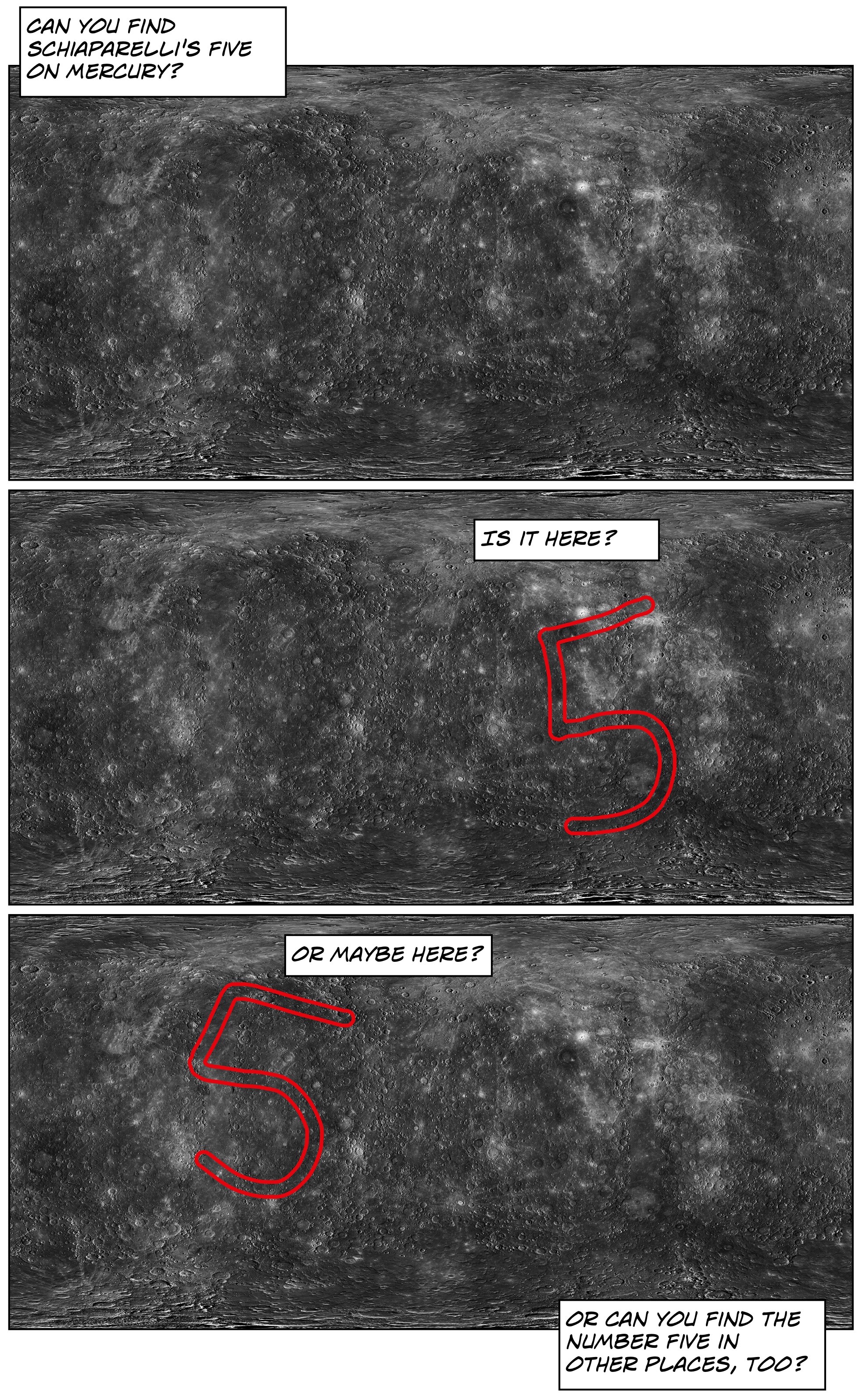
Map of the surface of Mercury, reproduced three times, with outlines showing locations where Giovanni Schiaparelli's figure of five might be.
Original map from NASA, public domain image.

A bit of confirmation bias was probably at work.  After seeing a five on Mercury the first few times he looked, Schiaparelli had an expectation.  He expected to see the five again, and every time he did find a five on Mercury, Schiaparelli assumed it was the same five.  To make matters worse, Schiaparelli also thought he could see clouds on Mercury, so whenever he saw only part of a five, he could easily deceive himself into assuming the rest of the five must be hidden under cloud cover.

As a result, Schiaparelli calculated Mercury’s rotation rate based on faulty observations, and he got a result that triggered a second case of confirmation bias.  Just as the Moon is very close to the Earth, Mercury is very close to the Sun, so it made sense—it fit well with Schiaparelli’s expectations—that Mercury rotation rate would match its orbital period.  It made sense, in Schiaparelli’s mind, for Mercury to be tidally locked to the Sun.

To be fair to Schiaparelli, another astronomer had previously tried to calculate Mercury’s rotation rate and gotten an answer of 24 hours (the same as Earth’s rotation rate).  So while Schiaparelli was wrong, he was, at least, less wrong than the last guy.  And that’s often the way science advances.  Science isn’t always right, but it keeps becoming less and less wrong than it was before.

WANT TO LEARN MORE?

Here’s an article from Astronomy.com about Schiaparelli’s five, and some of the other shapes he thought he saw on Mercury’s surface.

And regarding that point I made at the end, about science being less and less wrong than it was before, here’s a famous article by Isaac Asimov called “The Relativity of Wrong.”  It’s a must read for anyone who has even a passing interest in how science works.

Mercury A to Z: Exosphere

Hello, friends!  Welcome back to this year’s A to Z Challenge.  My theme for this year’s challenge is the planet Mercury, and in today’s post E is for:

EXOSPHERE

When I was preparing for this A to Z series on Mercury, a friend and I were joking that I should do “atmosphere” for the letter A.  The body of the post would simply say: “There isn’t one.”  And that would be the end of it.  But that wouldn’t be 100% true, and it wouldn’t be fair to poor, little Mercury.  Mercury does, in fact, have an atmosphere.  An extremely thin atmosphere, so thin it’s almost nonexistent.  But it is not entirely nonexistent.

Scientists usually refer to Mercury’s atmosphere as an “exosphere” to help distinguish it the thicker, heavier air layer that the word atmosphere traditionally implies.  Mercury’s exosphere is made of a little hydrogen, a little helium… there’s a little oxygen and a little sodium… a little potassium… a little calcium… there’s a little of a lot of different things, which adds up to not very much.

The hydrogen and helium presumably come from the Sun.  As the solar wind washes over the planet, hydrogen and helium atoms get tangled up in Mercury’s magnetic field and end up being incorporated (temporarily) into Mercury’s exosphere.  Some of the helium may also come from the radioactive decay of elements like uranium in Mercury’s crust.  As for the oxygen, sodium, and everything else, that stuff probably outgasses from the planet’s interior.  When Mercury formed, certain gases were trapped inside, and those gases have been very slowly leaking out of the planet ever since.  This outgassing process may help explain why Mercury appears to be shrinking (but we’ll talk about that in a future post).

But any gas you might find in Mercury’s exosphere is only there temporarily.  Mercury’s low gravity, plus the intense heat of the Sun, plus the constant pressure of the solar wind “blowing” on the planet, mean that Mercury’s exosphere is constantly blowing off into space.  Just as quickly as Mercury can gain a few atoms worth of atmosphere, he’ll lose them again.  In fact, as you can see in the totally legit Hubble image below, Mercury has a very faint comet-like tail of atmospheric gases, billowing off into space.

Cartoon image of Mercury, singing "You Take My Breath Away" to the Sun, while Mercury's atmospheric gasses blow off into space as a comet-like tail.

Just kidding.  That’s not really a Hubble image.  The Hubble Space Telescope has never observed Mercury.  Due to Mercury’s proximity to the Sun, trying to image Mercury would run the risk of burning out Hubble’s optics.  Some other space telescope must have taken that picture.

WANT TO LEARN MORE?

Today, I want to recommend a book simply titled Mercury, by William Sheehan.  It’s part of a series of books on the Solar System called Kosmos.  I’ve read a few of these Kosmos books now, and they are all wonderful.  Finding a book about one specific planet can be difficult (unless that planet is Mars), so if there’s a specific planet you want to learn more about, I highly recommend checking out the Kosmos series.

Also, if you want to see a for real picture (a for real for real picture) of Mercury’s comet-like tail, click here.

Mercury A to Z: Density

Hello, friends!  For this year’s A to Z Challenge, my theme is the planet Mercury.  Mercury may not be the most exciting planet in the Solar System, but he’s interesting in his own way, and I think he deserves a little more love and attention than he usually gets.  In today’s post, D is for:

DENSITY

In recent years, astronomers have discovered literally thousands of exoplanets (planets orbiting stars other than our Sun).  Every once in a while, one of these newly discovered exoplanets will be described as “Mercury-like.”  Now what do you think makes a planet “Mercury-like” in the minds of exoplanet hunters?  Are Mercury-like exoplanets small?  No, not necessarily.  Are they very close to their suns?  Again, not necessarily.  The most Mercury-like quality of a Mercury-like exoplanet is its density.  Mercury is an abnormally dense planet, due to the fact that Mercury has an abnormally large core.

Mercury’s core takes up roughly 85% of the planet’s internal volume.  For the sake of comparison, Earth’s core constitutes only 17% of Earth’s total volume.  For this reason, I sometimes like to call Mercury the avocado planet, because much like the seed inside an avocado, the core of Mercury is shockingly large.

The most likely explanation is that Mercury started out as a much larger planet, perhaps even an Earth-sized planet.  But then, in the very early days of the Solar System, young Mercury collided with another planetary body (in case anyone’s wondering, this would have happened long before the collision that created Caloris Basin).  Most of Mercury was destroyed.  Most of the debris from the collision probably fell into the Sun.  All that’s left today is the planet’s original iron core, buried under a relatively thin skin of rocky material.

So modern day Mercury is almost entirely made of iron, an extremely dense metal—which explains why Mercury is such an extremely dense planet.  The second densest planet in the Solar System, after Earth.

Now I have to level with you: I thought this was going to be one of the easier blog posts to write for this A to Z series, because I thought I already knew basically everything I needed to know about this topic.  But apparently there’s been some new research since the last time I read up about Mercury’s density and internal structure.

Decades ago, scientists assumed that Mercury’s core would be solid.  A planet as small as Mercury surely would have lost all his internal heat by now.  However, Mercury does have a magnetic field.  Planetary magnetic fields are usually caused by liquid metal sloshing around in a planet’s interior; ergo, Mercury must have a liquid core after all.  Right?

But apparently a few years ago (and this is the part I only learned about a few days ago), scientists were looking over gravity data from NASA’s MESSENGER Mission and realized that Mercury’s core cannot be entirely liquid.  Mercury’s core must be part liquid, to explain the magnetic field, but also part solid to explain MESSENGER’s gravity measurements.  So scientists now believe Mercury has a solid inner core surrounded by a liquid outer core.

So that’s a new thing that I have learned, and now it is a thing that you have learned, too.

WANT TO LEARN MORE?

I’m going to recommend this article from EarthSky.org, explaining (in layperson’s terms) how scientists determined that Mercury must have this part liquid/part solid core.

And for anyone interested in the original research, here’s a link to the original research paper about Mercury’s liquid/solid core (I haven’t had a chance to read that paper yet, but I’m looking forward to doing so soon).

I also want to mention this article from ScienceNews.org, which briefly discusses one of those Mercury-like exoplanets I was talking about in the beginning of this post.  In fact, the exoplanet K2-229b is so Mercury-like that scientists have nicknamed it “Freddy” (get it?—because of the singer Freddy Mercury!).

Mercury A to Z: Caloris Basin

Hello, friends!  For this year’s A to Z Challenge, we’re exploring the planet Mercury.  In today’s post, C is for:

CALORIS BASIN

It seems like just about every planet has its thing.  Saturn has her rings.  Jupiter has his Great Red Spot.  Mars has both Olympus Mons and Valles Marineris, the largest volcano and the largest canyon, respectively, in the entire Solar System.  And as for Mercury, Mercury has Caloris Basin, an absurdly large crater in Mercury’s northern hemisphere.

So how did Mercury end up with such a big crater?

Based on what science currently knows about the history of the Solar System in general, and the history of Mercury in particular, Caloris Basin most likely formed during an event known as the Late Heavy Bombardment.

About four billion years ago, the Solar System looked a little different than it does today.  The gas giants (Jupiter, Saturn, Uranus, and Neptune) were engaged in these gravitational tug-of-wars with each other, pulling each other into new orbits, swapping places with each other, and generally causing chaos in the outer Solar System—and generally making a mess of the inner Solar System, too.  All those gravitational tug-of-wars in the outer Solar System sent tons and tons and tons of stray asteroids hurtling toward the inner Solar System.  All the inner planets (Mercury, Venus, Earth, and Mars) took a beating.  Earth’s Moon took a beating, too.

A particularly large asteroid must have slammed into Mercury near the end of the Late Heavy Bombardment.  We know this must have been near the end of the Late Heavy Bombardment because Caloris Basin has only a few smaller, younger-looking craters inside it, while the surrounding terrain is thoroughly peppered with older-looking craters.  That impact must have been a truly Earth-shattering Mercury-shattering event, sending ripples and shockwaves all the way around the planet, leaving geological marks that can still be seen to this day.

Caloris Basin was discovered in 1974 by NASA’s Mariner 10 space probe.  At the time of the discovery, Caloris Basin was only half in daylight, so the full size of the crater was unknown.  You may recall from yesterday’s post that Mariner 10 visited Mercury three times, but due to an unfortunate coincidence of orbital mechanics, Caloris Basin was only half in daylight every single time Mariner 10 showed up.  And it was always the same half of Caloris Basin, too.  So the full size of the crater remained uncertain until the 2010’s, when the MESSENGER Mission entered orbit of Mercury and finally imaged the entire crater in full daylight.

Based on Mariner 10’s data, scientists originally guessed that Caloris Basin was 1300 km (810 miles) in diameter, making it larger than Texas.  MESSENGER revealed that its actually 1550 km (960 miles) in diameter, making it even more larger than Texas.

WANT TO LEARN MORE?

Here’s an article from Astronomy.com, going into a little more detail about how Caloris Basin formed and what we currently know about it.

And here’s an article from Wondrium about the Late Heavy Bombardment, how it happened, and how we know about it.

Also, I thought I read somewhere that Caloris Basin was the largest impact basin in the Solar System, and an early draft of this blog post included that detail.  But that’s not true.  Apparently the largest impact basin in the Solar System is Utopia Planitia on Mars.  For anyone interested, here’s a Wikipedia page listing all the largest craters known to exist in the Solar System.

Mercury A to Z: BepiColombo

Hello, friends!  Welcome to the second posting of this year’s A to Z Challenge!  My theme this year is the planet Mercury, and in today’s A to Z post, the letter B is for:

BEPICOLOMBO

Mercury is a pretty lonely planet.  Only two spacecraft have ever come to visit: NASA’s Mariner 10 space probe, which conducted a series of flybys in the 1970’s, and NASA’s MESSENGER Mission, which orbited Mercury for several years in the 2010’s.  But don’t feel too bad.  Soon, Mercury will be welcoming not one but two new guests, thanks to a joint mission by the European and Japanese space agencies.  And that name of that mission?  BepiColombo.

But first, a little history lesson.  Back in the late 1800’s, Italian astronomer Giovanni Schiaparelli determined that Mercury’s rotation rate (the time it takes for Mercury to spin on its axis) equals approximately 88 Earth days, or exactly one Mercurian year.  Unfortunately, Schiaparelli’s calculations were way off (we’ll talk about that more in a future post), and it took another Italian scientist, named Giuseppe “Bepi” Colombo, to fix Schiaparelli’s mistake.

In the 1960’s, thanks to new RADAR observations of Mercury, astronomers discovered that Mercury’s true rotation rate is approximately 59 Earth days, or precisely two-thirds of a Mercurian year.  And I do mean precisely two-thirds of a Mercurian year.  Odd coincidence, right?  Don’t worry.  We’ll talk about that more in future posts, too.  For now, all you need to know is that Giuseppe Colombo was the lead author on a paper that explained how Mercury could have gotten itself into this rather curious predicament.

The history lesson’s not over yet!  In the 1970’s, NASA was planning their first mission to Mercury, a mission known as Mariner 10.  But getting to Mercury isn’t easy.  Mercury is very small, and the Sun is very big.  The orbital mechanics of approaching such a small object in space, so close to such a big object, are really complicated.  NASA scientists thought the best they could do was aim carefully and do one quick flyby of Mercury.  But NASA was wrong, and once again, Giuseppe Colombo stepped in to correct the mistake.

Colombo showed NASA an alternative flight trajectory, involving a never-tried-before gravity assist maneuver near Venus, which would cause Mariner 10 to fly past Mercury, circle around the Sun, then fly past Mercury again… and again!  Thanks to Colombo’s orbital calculations, Mariner 10 was able to do three flybys of Mercury for the price of one.

Fast forward to modern times.  When ESA (the European Space Agency) and JAXA (the Japanese Aerospace eXploration Agency) decided to team up for a Mercury mission, they had no trouble picking a name.  In honor of Colombo’s outstanding contributions to the study and exploration of Mercury, the mission was officially named BepiColombo (one word, no space or hyphen—I’m not sure why it’s like that, but it’s one word).

BepiColombo is already in space, on route to Mercury.  When it arrives in 2025, it will separate into two spacecraft: the Mercury Planetary Orbiter (M.P.O.), built by Europe, and the Mercury Magnetospheric Orbiter (M.M.O.), built by Japan.  Together, these two spacecraft will follow up on some of the lingering mysteries about Mercury (i.e., other stuff that we’ll talk about in future posts).

WANT TO LEARN MORE?

I’m going to recommend this article from Univere Today, entitled “Who was Giuseppe “Bepi” Colombo and Why Does He Have a Spacecraft Named After Him?”

I’m also going to recommend this article from the Planetary Society, entitled “BepiColombo, Studying How Mercury Formed.”

And for those of you who enjoy reading scientific papers for fun, like I do, here is Giuseppe Colombo’s original research paper from 1965, explaining how Mercury’s rotation rate ended up being precisely two-thirds of a Mercurian year.

Mercury A to Z: Amorphous Ice

Hello, friends!  Welcome to my very first post for this year’s A to Z Challenge.  You don’t know what the A to Z Challenge is?  That’s okay.  You can click here if you want to learn more.  My theme for this year’s challenge is the planet Mercury, and in today’s post the letter A is for:

AMORPHOUS ICE

It gets really hot on Mercury.  You probably knew that already.  Mercury is, after all, the planet closest to the Sun.  But it may surprise you to learn that it also gets really cold on Mercury.  Extremely cold.  Like, we’re talking spit-goes-clink levels of cold.

Much like the Moon, Mercury has virtually no atmosphere.  That means there’s no atmospheric convection to transfer heat from the dayside of Mercury to the nightside.  Atmospheres can also act as a sort of blanket to keep a planet’s surface warm during the night.  But again, Mercury has virtually no atmosphere.  No blanket effect.  All the heat Mercury’s surface soaks up during the long Mercurian day is lost during the equally long Mercurian night.  As a result, the nightside of Mercury is one of the absolute coldest places in the entire Solar System.

Now, imagine if there were a place on Mercury where it is always night and never day.  Places like that exist at the bottoms of deep, dark craters clustered around Mercury’s north and south poles.  Shielded by crater rims and tall crater walls, the bottoms of those polar craters are cloaked in eternal darkness, and they are eternally cold.  Anything that happens to fall into one of those craters would freeze solid and could stay frozen for millions or even billions of years.

Back in the 1990’s, scientists began to suspect that those deep, dark craters around Mercury’s poles might be full of water (frozen water, obviously, but still… water).  And then in the 2010’s, NASA’s MESSENGER space probe took a closer look and confirmed it.  There is, in fact, water (in ice form) on Mercury.  Water on Mercury, of all places!

But I remind you again, the bottoms of Mercury’s polar craters are obscenely and stupidly cold.  Too cold for water to freeze the way it freezes on Earth.  On a molecular scale, the ice we find here on Earth has a neat and orderly crystalline structure.  Scientists call our Earthly kind of ice “ice Ih” or “hexagonal ice,” because the water molecules fit together in a hexagon pattern.  But the ice on Mercury is more likely to be what scientists call “amorphous ice.”

Amorphous ice is what happens when water freezes so fast that the water molecules don’t have time to arrange themselves in any sort of crystalline structure.  On a molecular scale, the water molecules are scattered haphazardly about.  No hexagons.  No patterns or shapes.  The ice is structurally shapeless—a.k.a., amorphous.  This doesn’t occur often here on Earth, except in certain astrophysics laboratories, but amorphous ice is extremely common out in space.

Comets and asteroids?  Whatever water they have is, partially or wholly, in the form of amorphous ice.  The surfaces of Europa, Ganymede, and the other icy moons of the outer Solar System?  They may be partially composed of amorphous ice.  And the ice inside those polar craters on Mercury (and similar polar craters on the Moon)?  You can bet on that being amorphous ice, too.

WANT TO LEARN MORE?

Water can freeze in so many different ways, with so many different crystalline and non-crystalline structures.  Here’s a brief video from Sci-Show about all the different kinds of ice scientists currently know about.

I also want to recommend this article from ZME Science, briefly summarizing the history of how water ended up on Mercury, how scientists on Earth first detected it, and how the MESSENGER mission later confirmed it.

Lastly, this is a far more technical source than the other two, but this paper on amorphous ice in the Solar System is the best source I could find stating, explicitly, that the ice on Mercury is probably amorphous ice. 

A to Z Challenge Theme Reveal

Hello, friends!

Do you have a favorite planet?  Each planet of the Solar System is beautiful in its own way, and weird in its own way, and dangerous in its own way.  It’s almost like each planet has its own distinct personality.  When you start learning about the planets, it’s hard to not pick a favorite.  My own favorite is Venus, but that’s not what I want to talk about today.  Today, I’m announcing my theme for this year’s A to Z Challenge, and that theme will be:

THE PLANET MERCURY

For those of you who don’t know, the A to Z Challenge is a month long blogging event.  Throughout the month of April, participants write twenty-six blog posts (starting with A, ending with Z) on a topic of their choice.  In previous years, I’ve used the A to Z Challenge as a platform to talk about scientific terminology, the search for alien life, and humanity’s future as a spacefaring species.  If you want to learn more about the A to Z Challenge, and if you’re interested in signing up yourself, please click here.

Now you may be wondering about the theme I picked this year.  Out of all space/science topics I could cover for an A to Z series, why the heck would I pick Mercury?  Mercury is not Mars, or Saturn, or Pluto.  Mercury is not a super exciting place.  There’s virtually no atmosphere.  There are absolutely no signs of life.  And if you’re thinking about future human habitats in space, Mercury may be the least appealing piece of real estate in the entire Solar System.

Observing Mercury with a telescope is inconvenient, due to Mercury’s proximity to the Sun.  Reaching Mercury with a spacecraft is also inconvenient, again due to the planet’s proximity to the Sun.  And what does all the inconvenience of observing Mercury or traveling to Mercury get you?  A grey rock.  There are a bunch of craters.  It gets really hot during the day, due (yet again) to the proximity of the Sun.  And there’s not a whole lot else worth saying about Mercury, right?

Wrong.  By the end of this year’s A to Z Challenge, I do not expect to change your mind about whatever your favorite planet happens to be.  My favorite planet will still be Venus.  But I do hope you’ll come to appreciate Mercury for what he truly is: a humble grey rock, with a few weird quirks, and a surprisingly big heart (by which I mean a surprisingly big planetary core–for such a small planet, Mercury has an enormous core!).

P.S.: I will be taking the rest of March off from regular blogging.  I’m still picking up the pieces after a recent family emergency, and I’ve decided that whatever free time I do have for blogging should go to preparing for this A to Z series.  So I’ll see you all on April 1st, when “A” will be for “amorphous ice.”

Our Place in Space: Tolkien Crater

Hello, friends!  Welcome to Our Place in Space: A to Z!  For this year’s A to Z Challenge, I’ll be taking you on a partly imaginative and highly optimistic tour of humanity’s future in outer space.  If you don’t know what the A to Z Challenge is, click here to learn more.  In today’s post, T is for…

TOLKIEN CRATER

You would not expect to find water on Mercury.  If there ever was water on Mercury, you’d expect it to boil away into space pretty quickly.  I said the exact same thing about water on the Moon yesterday, and yet it turns out there is water on the Moon, trapped in ice form at the bottom of craters near the Moon’s north and south poles.  The same is true for craters near the north and south poles of Mercury.  To my eternal delight, one of those water-filled craters is named after fantasy author J.R.R. Tolkien.

By longstanding tradition, craters on Mercury are named after historically important artists, authors, and musicians.  There are a few exceptions, because a few craters were named before that tradition was established, but the vast majority follow the rule.  And so there’s a crater named after Shakespeare, and a crater named after Van Gogh, and a crater named after Mozart.  John Lennon has a crater named after him.  Walt Disney has a crater.  And so does J.R.R. Tolkien.

Tolkien Crater happens to be located near Mercury’s north pole.  As a result, the bottom of Tolkien Crater is perpetually shielded from sunlight by the crater walls.  It’s extremely dark and extremely cold—cold enough for frozen water to remain stable over cosmic time scales, despite Mercury’s lack of any significant atmosphere or Mercury’s proximity to the Sun.

In the distant future, as humanity spreads out across the Solar System, we may end up deciding to colonize Mercury.  Mercury has resources humans in the future may need: large quantities of metal and perhaps, also, large quantities of helium-3 (necessary for powering nuclear fusion reactors, assuming we ever figure out how to make nuclear fusion reactors work).  If humans do colonize Mercury, places like Tolkien Crater will be valuable real estate.

Most likely, human habitats on Mercury will be built underground.  It’s easier and safer to live underground than to live on Mercury’s surface.  As a result, I like to imagine that people living in and around Tolkien Crater will refer to their subsurface dwellings as “Hobbit holes.”  However, considering how important mining operations would be for a successful Mercury Colony, some sort of reference to the Mines of Moria might be more appropriate.

Let’s just hope those Mercury colonists do not delve too greedily or too deep, lest they awaken something slumbering in the darkness.

Want to Learn More?

Universe Today has an article on how and why we might colonize Mercury.  And here’s an article from Wired.com about the naming of Tolkien Crater.

Lastly, I feel that I have to mention this: if you haven’t seen a picture of Disney Crater, you really need to click here and see a picture of Disney Crater.

What Color are All the Planets?

Hello, friends!

So as you know, Earth is “the Blue Planet” and Mars is “the Red Planet.”  By my math, that leaves us with six other planets in our Solar System that don’t have color-related nicknames.  Today, I’d like to try and fix that.

Jupiter was the toughest.  He’s actually lots of different colors: red, grey, white, orange… and then the Juno mission recently showed us that Jupiter’s polar regions are blue!  Of course Jupiter is most famous for being red in that one specific spot, but even the Great Red Spot changes colors from time to time, fading from red to pink to white before turning red again.

Anyway, those are my picks for the color-related nicknames for all the planets.  Do you agree with my picks?  Disagree?  Let me know in the comments below!

Need a New Role Model? Meet Mercury! — My Hubble Abode

Hello, friends!

Venus is my favorite planet, and it probably always will be. In my mind at least, Venus is the planet with the most personality. But Fran from My Hubble Abode makes a pretty compelling case for Mercury, and I can at least agree that Mercury deserves a lot more love than it currently gets. So to anyone who hasn’t picked a favorite planet yet, please take the following into consideration:

What’s your favourite planet? Saturn? Jupiter? Earth? It’s probably not Mercury, so here are 3 reasons that it should be your favourite planet! Mercury flaunts his natural face A poreless face has been all the rage, but there’s nothing about Mercury’s surface that says smooth. Mercury has the most cratered surface out of all the […]

Need a New Role Model? Meet Mercury! — My Hubble Abode