IWSG: A Muse’s Apprentice

Insecure Writers Support Group Badge

We all know writers feel insecure sometimes. That’s what the Insecure Writer’s Support Group is all about. What we writers might not realize, or may sometimes forget, is that our muses get insecure too.

With that in mind, I’m going to turn the floor over to my muse. She has something to say, and maybe it’s something you or your muse would like to hear.

* * *

We all know the rule: one muse per writer. There just aren’t enough of us fairy-folk around to start doubling up. But I wish I could have a helper or an assistant or something. I wish I had an apprentice muse working under me. Then I could really get stuff done.

Sp07 Two Muses

The truth is I can’t do everything myself. I can put as many ideas into my writer’s head as I want, but that doesn’t mean he’ll write them down. You know how humans are. They’re easily distracted. Their minds wander. They keep complaining about being “too tired.”

It would be nice if I could get some help. Unfortunately, King Oberon and Queen Titania have rejected my requests to start a muse internship program. That leaves me only one option: I’ll have to convince my writer to pull his own weight. Well, that plus the weight of a pen, I guess.

That way, when I give my writer ideas, he’ll be able to move his own hand over to the paper, without any magical help at all.

Molecular Monday: Liquid Water vs. Liquid Methane

Molecular Mondays Header

Welcome to Molecular Monday! On the first Monday of the month, we take a closer look at the atoms and molecules that make up our physical universe. Today, we’re comparing some of the properties of:

LIQUID WATER AND LIQUID METHANE

So you’re a moon or other planetary body, and you want to get some biochemical action going on. First, you need some organic substances. Titan has set a great example with the tholin haze that forms spontaneously in its atmosphere.

Next, you need a liquid to dissolve that organic material in, in the hopes that the organic material will recombine as amino acids, peptide chains, and ultimately DNA. But which liquid should you choose? Liquid water (as seen on Earth) or liquid methane (as seen on Titan)?

Pick Water!

Water (H2O) makes an excellent solvent for our purposes because it’s a polar molecule. There are two big reasons for water’s polarity.

  • First, oxygen has an extremely high electronegativity, meaning oxygen atoms like to yank electrons away from other atoms. Within a water molecule, oxygen’s electron-hogging tendencies cause it to become negatively charged, while the two hydrogen atoms become positive.
  • Second, you know how water molecules have that Mickey Mouse shape? Because of that shape, with the two hydrogen atoms bent toward each other, the positive charges accumulate on one side of the molecule and the negative charge accumulates on the other.

Thus, water is a polar molecule, and it’ll go around interacting with other polar molecules, like tholins or amino acids.

Don’t Pick Methane

Unlike water, methane (CH4) is a nonpolar molecule. Why?

  • Carbon is slightly more electronegative than hydrogen, but not by much, so the atoms in a methane molecule share electrons almost equally. This minimizes the electric charges that might build up inside the molecule.
  • Methane molecules are symmetrical, with the carbon atom in the center and the four hydrogens evenly spaced around in, like the four corners of an equilateral pyramid.

Sp05 Methane vs Water

Any electrical charges in a methane molecule balance out, due to the molecule’s symmetry. And those charges are fairly weak anyway, due to the similar electronegativities of carbon and hydrogen.

I won’t be so bold as to say life can’t develop in a liquid methane environment, but the idea does seem a bit farfetched in light of the chemistry. Polar molecules like tholins just aren’t likely to dissolve in a methane lake, like the lakes found on Titan.

On the other hand, the universe keeps surprising us, and the giant lake monster I recently met on Titan might dispute my assessment of Titan’s biochemical potential.

P.S.: Titan’s lakes also contain liquid ethane, but that doesn’t really change anything. Ethane is also nonpolar.

Sciency Words: Linea

Sciency Words MATH

When Voyager 1 trained its camera on the moons of Jupiter, scientists back on Earth had no idea what to expect. Turned out they were right. Voyager was snapping photos of geological features unlike anything anyone had ever seen before. Which meant it was time to make up some new sciency words!

LINEA

Europa has the youngest, smoothest-looking surface of any object in the Solar System.

Ag04 Europa Blush

But as you can see in the totally legit Voyager 1 image above, Europa’s icy blue surface is not without blemish.

It’s crisscrossed with cracks and fissures that appear to be filled with some sort of reddish-brown substance. Astronomers adopted the term linea (plural lineae) to describe these features. This was not astronomers at their most creative or imaginative; linea is just the Latin word for line.

Europa has a subsurface ocean of liquid water. There might be alien sea creatures swimming around in that subsurface ocean. Or there might not. If we want to find out, Europa’s lineae may be a good place to start looking.

The reddish-brown substance is believed to seep up through the cracking, fissuring ice. Does it include organic material? Amino acids? Maybe some sort of alien DNA? Hopefully NASA’s Europa Clipper mission will be able to find out (pending Congressional approval and so forth).

Lineae are most commonly associated with Europa, but the term has also been used to describe line-like features on a handful of other worlds, including Mars (although Mars’s recurring slope lineae are very different from lineae on Europa).

In next week’s edition of Sciency Words, we’ll continue exploring the moons of Jupiter. There are plenty of other terms that had to be invented following Voyager 1’s visit.

P.S.: I once ate at a seafood restaurant named Nova Europa. I know it was supposed to be Mediterranean-themed, but that is not what I was thinking about when they served my calamari.

How to Fly on Titan

My trip to Titan is almost over. Soon, I’ll have to find some other planet or moon to blog from. But before I leave, there’s one last thing I want to do: fly.

Titan’s atmosphere is about 50% denser than the atmosphere on Earth. Combine that with the low surface gravity (a mere 14% of Earth normal) and it should be possible, theoretically, for me to put on some wings and flap around in the sky like a bird.

Taking my cue from the myth of Icarus, my artificial wings will not be made of wax, although it’s cold enough here on Titan that there’d be no danger of wax wings melting.

So with my non-wax wings strapped to my arms, I leap into the air, and….

Ag31 Flight on Titan 1

Okay, that didn’t go according to plan, so I turn to the Internet for help (the wifi on Titan is surprisingly good, by the way). I soon find this helpful article from the Journal of Physics Special Topics.

One option is that I try to get a running start. I’m really going to have to sprint here; average human running speed (6 m/s) won’t cut it. I need to reach a minimum of 11 m/s. And…

Ag31 Flight on Titan 2

… nope. I’m a nerd, not an athlete. Sprinting isn’t my thing.

So my next option is to build bigger wings. According to the paper from Physics Special Topics, the total area of my wings needs to be at least 4.7 m2. I’ll go for 5 m2, just to be safe.

The good news is that once I’m off the ground, I won’t need to use much energy to stay aloft. Flying on Titan should be “effortless and relatively easy […] without any sort of propulsion device.” Sounds like just a little light flapping should do the trick.

Okay, so here we go.

Ag31 Flight on Titan 3

P.S.: The Journal of Physics Special Topics may be my new favorite scientific periodical, with articles covering topics like cows jumping over the Moon, the effects of general relativity on Santa Claus, and the atmospheric loss caused by opening a portal between Earth and the Moon (as depicted in the video game Portal 2).

I Think You’ll Find It’s a Bit More Complicated Than That — A Book Review

Today I thought I’d try doing a book review. Not really my thing, but since I read a lot of sciency books anyway, why not blog about them? I’m going to start with a book called I Think You’ll Find It’s a Bit More Complicated Than That by Ben Goldacre.

I picked this book up based solely on the title. It expresses bluntly exactly how I feel about the portrayal of science in the popular press and in popular culture in general.

The book is actually a collection of articles, most of which originally appeared in the Guardian. Goldachre tackles news reports, advertisements, and quack scientists in an effort to show how scientific data get oversimplified or misinterpreted by the media and others. As a result, real science morphs into pseudoscience, and pseudoscience masquerades as real science.

A lot of the book seems to confirm a thought that I’ve had before (and written about before): be wary of purported scientists who won’t show their methods or data. Science is about sharing as much as possible, not protecting your secret recipes for cancer “cures” or whatever.

There was one common crime against science that I was not previously aware of: misleading press releases. Even reputable institutions conducting legitimate research have P.R. departments, and these P.R. departments will occasionally (or perhaps not so occasionally) overhype scientific discoveries in their press releases.

I intend to be far more skeptical of press releases in the future. I also intend to pick up more of Goldachre’s books: Bad Science and Bad Pharma. Even though these books are outside my primary field of interest (planetary science), I’ve come to believe that the best way to understand how science does work (or at least should work) is to examine science gone wrong.

Sciency Words: Flare Star

Sciency Words BIO copy

Today’s post is part of a special series here on Planet Pailly called Sciency Words. Each week, we take a closer look at an interesting science or science-related term to help us all expand our scientific vocabularies together. Today’s term is:

FLARE STAR

Good Star Trek fans will remember the Battle of Wolf 359, when the Borg came to assimilate us all. Thirty-nine Federation starships were lost. Nearly 11,000 people were killed. #NeverForget

Good Trekkies may also be aware of the fact that Wolf 359 is a real place. It’s a red dwarf star in the constellation Leo, located within a mere eight light-years from Earth.

Also, Wolf 359 is a UV Ceti variable star, or what is more commonly called a flare star. Flare stars experience dramatic, unpredictable increases in brightness across the EM spectrum, including increases in highly destructive X-ray and gamma ray emissions.

And when a flare star starts to flare up, it can happen quickly. In 1952, the star UV Ceti (for which the UV Ceti variable star category is named) became about 75 times brighter in a period of only twenty seconds.

It’s believed that the flare activity of flare stars is similar to the kind of solar flares we’ve observed on our own Sun. Except the Sun’s solar flares are usually not so intense. And when it comes those X-rays and gamma rays, our Sun doesn’t even come close to what spews out of flare stars.

So perhaps parking thirty-nine starships next to a flare star wasn’t the smartest thing Starfleet could have done. Maybe… just maybe… what happened at Wolf 359 wasn’t the Borg Collective’s fault.

Ag26 Battle of Wolf 359

P.S.: Another flare star has been in the news a lot lately: Proxima Centauri. We now know, thanks to the European Southern Observatory, that Proxima does have an Earth-like planet in orbit. So the next question is just how thoroughly that planet has been cooked by Proxima’s violent flare-ups.

Do Not Go Swimming on Titan

I’ve made a friend on Titan: a giant, multi-tentacled monster that swims around in Titan’s lakes of liquid methane. Today, my new friend invited me to go swimming with him. While that does sound like fun, there are a few problems with that idea:

  • I can’t exactly change into my swimming trunks. There’s no oxygen in Titan’s atmosphere, so I need my bulky spacesuit. But even if that weren’t a problem….
  • Liquid methane is a cryogenic fluid. It’s not quite as cold as liquid nitrogen, but still… If I stick my toe in the methane, my toe will probably flash freeze and shatter. But even if that weren’t a problem….
  • I would sink straight to the bottom of the lake. Liquid methane is significantly less dense than water and significantly less dense than the human body. I wouldn’t be able to float, and I certainly wouldn’t be able to swim.

However, I didn’t want to disappoint my new friend, and I did come prepared for a possible excursion over a methane lake. So I hurried back to my spaceship and grabbed my boat.

Ag24 Lake Monster of Titan

Life on Titan: Infrared Eyes

I’ve been exploring the surface of Titan for several weeks now. During my time here, I have not discovered alien life, but alien life sure has discovered me. Fortunately, the Titanian lake monster I met on Friday is friendly, and he was super excited about meeting someone “from the stars.”

“Wait,” I said, “you know about the stars?”

“Oh yes,” the lake monster said. “I look up at them, twinkling in the night, and also the great orb with the rings around it.”

This really left me flummoxed. I can’t see Saturn at all from the surface of Titan (and I was pretty upset about it too). I certainly can’t see the stars. I can’t even see the Sun through all the tholin haze layered up in Titan’s atmosphere.

However, the tholin haze does allow certain wavelengths of light to pass through, mostly in the infrared part of the spectrum. The haze is almost completely transparent at a wavelength of 2000 nanometers (nm), which is how the infrared camera on the Cassini spacecraft has been able to photograph Titan’s surface.

The human eye can only detect light between roughly 400 and 700 nm. That’s because humans evolved on a planet where the 400 to 700 nm range is dominant, while life on Titan evolved in an environment where infrared light shines the most clearly.

So my new lake monster friend sees in infrared, possibly right around the 2000 nm range, and when he looks up into the sky he can see the Sun and stars and even Saturn, while all I see is gloomy orange haze.

Sciency Words: In Situ

Sciency Words PHYS copy

Today’s post is part of a special series here on Planet Pailly called Sciency Words. Each week, we take a closer look at an interesting science or science-related term to help us all expand our scientific vocabularies together. Today’s term is:

IN SITU

Today I’m continuing to blog from the surface of Titan, Saturn’s largest and most mysterious moon. No more reading about Titan in books and journals or on the Internet. Right now, I can do my Titan research “in situ,” as the real scientists would say.

Ag19 Life on Titan

“In situ” basically means “on location.” It comes from the Latin words for “on” and “location.” Alternative translations include “in the place” or “situated in,” but I think “on location” works best for our purposes.

Just about any time you find the phrase “in situ” in a scientific text, you can mentally substitute the words “on location” without changing the meaning of the sentence one bit.

  • The Mars rovers conduct in situ experiments to identify Martian geological features.
  • In the future, colonists cannot depend on supply missions from Earth for all their needs. They’ll have to make use of in situ resources.
  • Triton (Neptune’s largest moon) probably didn’t form in situ, but was captured by Neptune’s gravity after forming elsewhere.

Regarding in situ planetary science, contrast it with the observational science done using telescopes or laboratory experiments that attempt to recreate conditions on other worlds. Or you could contrast in situ research against something like a sample return mission, where material is brought back to Earth rather than analyzed on location (I mean, in situ).

Meanwhile on Titan

While in situ research has its advantages, it’s still only as good as the human doing the research. If life exists on Titan, it’s bound to be very different from life on Earth, with biochemistry totally unlike our own.

I can’t just look into a methane lake and see if any alien microbes are swimming around. I have to know what to look for before I look. I have to know which experiments to do before I do them. Which is why I still have to read books and journals and Internet articles about Titan. Otherwise, I might miss something important.

P.S.: Ah! It’s got my leg! Send help!

Proxima Centauri Has a Planet!

Ohmigod, ohmigod, ohmigod!

Okay, calm down, James. Breathe. Breathe.

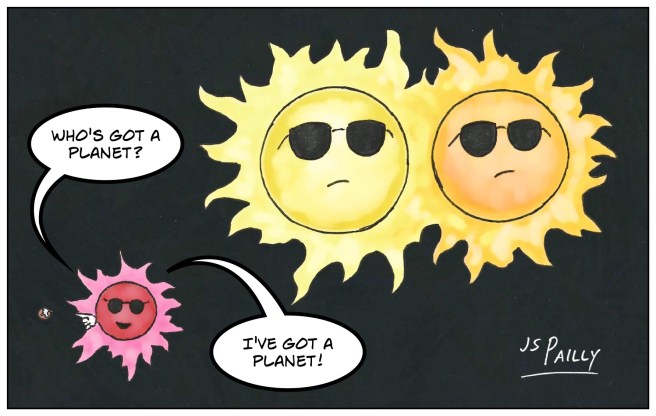
Okay. Let’s take a look at Alpha Centuari, a binary star system located within a mere 5 light-years from Earth. In the bottom corner of the image, you can see a red dwarf star called Proxima Centauri, which is believed to be a companion to the Alpha Centauri pair. And in orbit of Promixa, you can see… you can see… ohmigod!

Ag16 Alpha Centauri

Apparently the European Southern Observatory (ESO) has discovered a planet orbiting Proxima. Not only that, it’s an Earth-like planet. And furthermore, it’s within Proxima’s habitable zone. This according to an unnamed source in a German newspaper.

The ESO is a highly respected, extremely trustworthy astronomical institution. As for unnamed sources… okay, let’s put our skeptical hats back on.

Let’s also remember that Earth-like planets are not necessarily all that Earth-like. For the last few weeks, I’ve been blogging from the surface of Titan, which is often described as one of the most Earth-like worlds in the Solar System. And let me tell you, it is miserable here. I guess there could be life on Titan, but not life as we humans understand it.

Mars is also sometimes described as Earth-like, and believe it or not, so is Venus.

Ag16 Earth-like Worlds

Supposedly the ESO will release its official findings at the end of August. Until then, we’ll just have to sit back, wait patiently, and stay skeptical.

P.S.: Ohmigod! Proxima Centauri might have… might… I can’t even! OH MY GOD!!!

Link

Earth-like Planet Around Proxima Centauri Discovered from Universe Today.