Sciency Words: WIMPs (An A to Z Challenge Post)

Today’s post is a special A to Z Challenge edition of Sciency Words, an ongoing series here on Planet Pailly where we take a look at some interesting science or science related term so we can all expand our scientific vocabularies together. In today’s post, W is for:

WIMPs

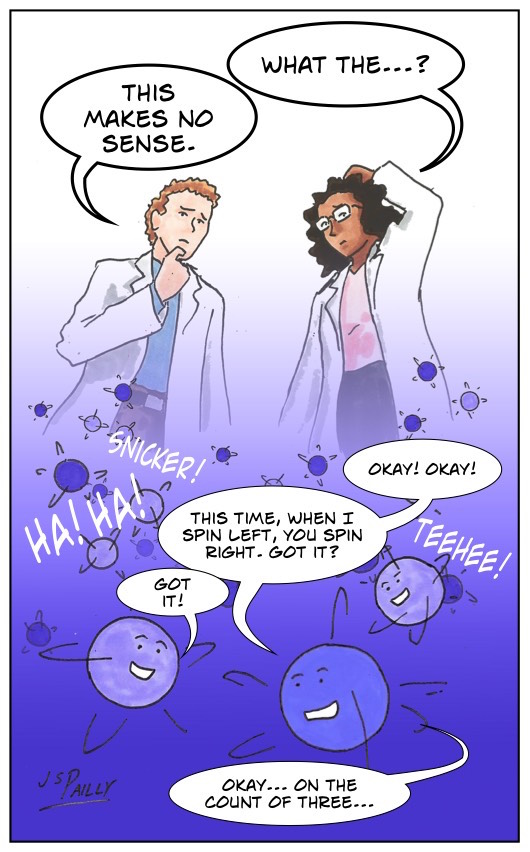
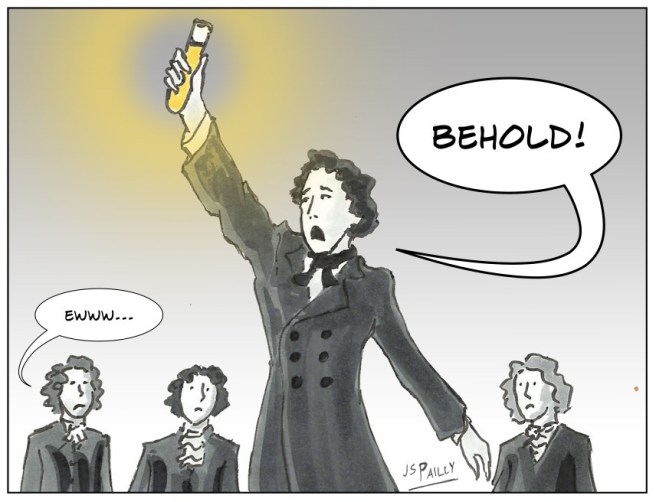
Approximately 85% of the matter in the universe is invisible; or if it’s not invisible, then it’s doing a really good job hiding from our telescopes. We call this invisible and/or well-hidden matter “dark matter.” We know about its existence only because of its gravitational effects, and also because of its childish taunting.

Scientists love acronyms, especially clever acronyms. There are many possible explanations for the dark matter phenomenon. One of them is a hypothetical subatomic particle called a WIMP: a Weakly Interacting Massive Particle.

Under the current standard model of particle physics, the universe is governed by four fundamental forces: gravity, electromagnetism, the weak nuclear force, and the strong nuclear force. Click here to learn everything you could possibly need to know about these forces.

If WIMPs exist, they interact with some of the fundamental forces, but not others.

  • Gravity: yes.
  • Electromagnetism: no.
  • Weak nuclear force: maybe yes.
  • Strong nuclear force: probably no.

Light is a result of electromagnetism. Since WIMPs don’t interact with the electromagnetic force, that would explain why we can’t see them.

But invisible particles like WIMPs aren’t the only possible answers to the huge question mark of dark matter. What about matter that’s visible but well hidden? Massive Astrophysical Compact Halo Objects (or MACHOs) are massive but faint objects in space, such as brown dwarfs, rogue planets, or black holes—the kinds of objects that would have a lot of gravity but would be difficult to spot with a telescope.

I have to imagine someone worked really hard to come up with MACHO as an acronym, so it would match well with WIMP. While there are other hypotheses out there, somehow the WIMPs vs. MACHOs debate seems to get the most attention. Which hypothesis does the best job explaining the dark matter mystery?

At this point, to the best of my knowledge as of this writing, physicists still cannot prove or disprove the existence of WIMPs. However, a recent astronomical survey seems to have ruled the MACHOs out of consideration. There simply cannot be enough black holes, brown dwarfs, and other stuff out there to account for 85% of the matter in the universe.

So the WIMPs haven’t won (at least not yet), but the MACHOs definitely lost. Big time. The MACHOs are losers. Big, fat losers. Hey, that’s not me saying that; it’s just what the science acronyms are telling us.

Next time on Sciency Words: A to Z, another reason to get mad at the I.A.U.

Sciency Words: Volatile (An A to Z Challenge Post)

Today’s post is a special A to Z Challenge edition of Sciency Words, an ongoing series here on Planet Pailly where we take a look at some interesting science or science related term so we can all expand our scientific vocabularies together. In today’s post, V is for:

VOLATILE

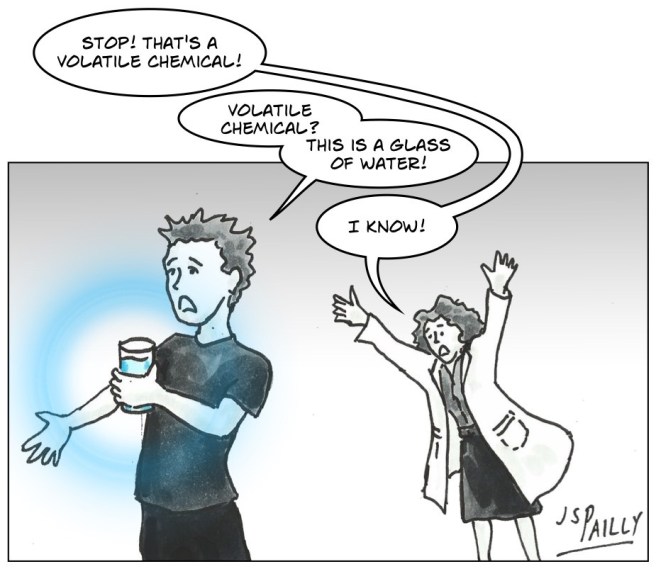
Whenever I hear somebody talk about volatile chemicals, I’m never quite sure what they mean. This is another case of a word that means one thing to the general public and something rather different to professional scientists.

In chemistry, a volatile chemical—also refered to simply as “a volatile”—is a chemical substance that tends to evaporate spontaneously under ordinary temperature/pressure conditions. A common example of a volatile here on Earth is water.

Of course you may encounter other chemicals here on Earth far more volatile than water. Just think about alcohol or gasoline. You might also think about nitrogen, oxygen, or hydrogen, because if you manage to get these chemicals into their liquid phases, they will immediately turn back into gases at the first opportunity. That makes them extremely volatile.

To be clear, the volatility of a chemical has nothing to do with how flammable, explosive, reactive, or unstable it is. That may seem a little confusing, but unlike previous confusing chemistry terms we’ve seen (like organic or reduction), I’m not sure I can fault chemists for this one. The chemistry definition is actually closer to the original meaning of the word; in a sense, it’s the rest of us who’ve been using the word wrong.

When volatile first entered the English language from French, it could mean either “light weight” or “evaporating quickly.” The “violent and unpredictable” meaning didn’t come until later. If you go further back into the word’s history, you find it derives from a Latin word meaning “to fly away,” which is actually an apt description of what atoms and molecules do when a volatile chemical evaporates.

Next time on Sciency Words: A to Z, the WIMPs will take on the MACHOs. Which acronym will win?

Sciency Words: Uranus (An A to Z Challenge Post)

Today’s post is a special A to Z Challenge edition of Sciency Words, an ongoing series here on Planet Pailly where we take a look at some interesting science or science related term so we can all expand our scientific vocabularies together. In today’s post, U is for:

URANUS

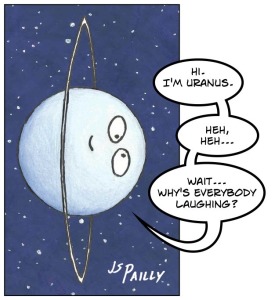
I feel really sorry for the planet Uranus.

I’m really sorry, sideways buddy, but they’re not laughing with you. They’re laughing at you.

Rumor has it NASA wants to send a space probe to Uranus in the late 2020’s or early 2030’s. It’ll be the first time we’ve visited an ice giant since the Voyager 2 flybys of Uranus and Neptune, back in the 1980’s. I’m pretty excited about this, but I can’t talk about a Uranus mission without people starting to snicker at me.

So how did the seventh planet of the Solar System end up with such an unfortunate name? Here’s a quick rundown of how this happened:

  • On March 13, 1781, English astronomer William Herschel discovered a new planet beyond the orbit of Saturn.
  • As a good, patriotic Englishman, Herschal named the new planet Georgium Sidis, Latin for “George’s Star,” in honor of King George III (the same King George mentioned in the Declaration of Independence).
  • For obvious reasons, the name Georgium Sidis wasn’t popular outside of England. Several alternatives were proposed, including Herschel, Neptune, and Uranus.
  • Uranus went on to become the most widely used name around the world, until in the mid-1800’s even England officially accepted the name.

In ancient mythology, Uranus was the god of the sky, the father of Saturn and the grandfather of Zeus. He was an extremely important deity, so it made a certain sense to bestow this prestigious name on such a prestigious discovery: the first new planet discovered since ancient times.

German astronomer Johann Elert Bode proposed the name. As a German, he presumably didn’t realize how it would sound in English—or maybe he did know and was deliberately trolling King George! That’s my personal theory.

Whatever Bode’s intentions were, Uranus is now stuck with its name and all the jokes that come with it. Which is a shame. Such a strange and mysterious planet deserves better.

Next time on Sciency Words: A to Z, we’ll be working with volatile chemicals.

Sciency Words: Thagomizer (An A to Z Challenge Post)

Today’s post is a special A to Z Challenge edition of Sciency Words, an ongoing series here on Planet Pailly where we take a look at some interesting science or science related term so we can all expand our scientific vocabularies together. In today’s post, T is for:

THAGOMIZER

Once upon a time, there was a caveman by the name of Thag Simmons. According to Gary Larson’s Far Side comic strip, Thag met an unfortunate end when he was clubbed to death by the spiky tail of a stegosaurus. As a result, cavemen began to call the stegosaur’s spiky tail a thagomizer.

Larson’s thagomizer comic was originally published in 1982. Death by thagomizer may sound like a gruesome way to go, but based on my own research about cavemen/dinosaur interactions, I have reason to believe Thag Simmons had it coming.

Over the course of this Sciency Words: A to Z series, we’ve seen some scientific terms that were pretty clever, and some that were kind of dumb, and a few that are truly misleading. But until now, we haven’t talked about scientific terms that come from pop culture.

In 1993, paleontologist Ken Carpenter was making a presentation about the most complete stegosaurus skeleton ever found, and he needed a term for the dinosaur’s distinctive spiky tail. One of the spikes had apparently broken and healed, which was compelling evidence that stegosaurs really did use their spiky tails as weapons.

In homage to Gary Larson, Carpenter chose the term thagomizer, and the term has now become the proper, semi-official term for that part of stegosaurus anatomy.

I want to thank @breakerofthings for letting me know about this term. I’d originally planned to do something else for T, but I think this was much better. Be sure to check out A Back of the Envelope Calculation, where “breaker” is doing an A to Z Challenge series on materials science in Sci-Fi/Fantasy.

Next time on Sciency Words: A to Z, how do you pronounce Uranus?

Sciency Words: Spaghettification (An A to Z Challenge Post)

Today’s post is a special A to Z Challenge edition of Sciency Words, an ongoing series here on Planet Pailly where we take a look at some interesting science or science related term so we can all expand our scientific vocabularies together. In today’s post, S is for:

SPAGHETTIFICATION

I have noted that in thought experiments involving black holes, it is traditional to enter the black hole feet first. Therefore, let’s jump feet first into a black hole and try to imagine what happens.

According to a recent paper in the Journal of Physics Special Topics (my all time favorite physics journal), there’s a reasonable chance you’d remain conscious, at least for a while, after crossing the black hole’s event horizon.

That is, assuming the black hole’s mass is greater than 19,000 solar masses. Apparently the more massive a black hole, the longer you’ll last before you pass out. The authors of the paper also assume you were in relatively good health before entering the black hole.

As you continue to fall toward the center of the black hole—a point of infinite density called the singularity—you’ll be accelerating so fast that you’ll start to lose consciousness. The human heart really struggles with pumping blood when you’re experiencing such high G-forces.

And honestly, that’s probably for the best, because things are about to get super weird. The gravity inside a black hole is so intense that, in essence, your feet are falling significantly faster than your head, and the rest of your body is being stretched out in between.

As you keep falling toward the singularity, you become so stretched and elongated that you look less and less like a person and more and more like a spaghetti noodle. And so this process is called—I kid you not—spaghettification.

Next time on Sciency Words: A to Z, if you didn’t like death by spaghettification, how do you feel about death by thagomizer?

P.S.: Other recent papers from the Journal of Physics Special Topics include:

I think you can see why this is my all time favorite physics journal.

Sciency Words: Reduction (An A to Z Challenge Post)

Today’s post is a special A to Z Challenge edition of Sciency Words, an ongoing series here on Planet Pailly where we take a look at some interesting science or science related term so we can all expand our scientific vocabularies together. In today’s post, R is for:

REDUCTION

In his book Atom: Journey Across the Subatomic Cosmos, Isaac Asimov writes:

It often happens that a poor name is given to an object or a phenomenon to begin with, either out of ignorance or out of bad judgment. Sometimes, it can be changed in time, but often the ill-chosen name is used so commonly by so many that it becomes inconvenient or even impossible to change it.

Hank Green says much the same thing at the beginning of this episode of Crash Course: Chemistry on oxidation and reduction.

I wish someone had told me this in high school chemistry, because I could never make sense out of reduction. The name confused me too much, because it means the opposite of what it should mean.

Some atoms are naturally greedy for electrons. These atoms are called oxidants.

And some atoms are naturally well inclined to give electrons away. These atoms are called reductants.

When a reductant gives an electron to an oxidant, the reductant is said to have been oxidized. And when an oxidant gains an electron from a reductant, the oxidant is said to have been reduced.

Yes. The gaining of an electron is called reduction, a word typically associated with the losing of something. Just… how even? This is one of the most fundamental reactions in all of chemistry. No wonder chemistry is so notoriously hard!

Apparently long ago, it was observed that some substances become lighter after undergoing a chemical reaction. Hence, reduction. We now know the substances in question were gaining electrons (which weigh practically nothing), while incidentally losing other, heavier things in the form of gases. But how were scientists of the 18th Century supposed to know that?

We can take some consolation in the fact that when a chemical substance gains electrons, its oxidation number goes down. So in that sense, the word reduction doesn’t seem completely stupid.

But Asimov and Green hit upon a key insight on how scientific terminology works—or rather, why it doesn’t always work. When you really delve into the scientific lexicon, you find this naming before understanding trend everywhere. As a result, we’re now stuck with a ton of confusing, counterintuitive names for important scientific concepts.

Next time on Sciency Words: A to Z, we’ll jump feet first into a black hole.

Sciency Words: Quantum (An A to Z Challenge Post)

Today’s post is a special A to Z Challenge edition of Sciency Words, an ongoing series here on Planet Pailly where we take a look at some interesting science or science related term so we can all expand our scientific vocabularies together. In today’s post, Q is for:

QUANTUM

Quantum physics is the study of atoms and subatomic particles, and it get’s pretty weird. It’s almost as though all these quantum particles are playing a joke on us.

However, the quantum world isn’t completely loony. It’s not a place where anything goes. There are rules to how quantum particles behave; it’s just that these rules fly in the face of what we humans would call common sense.

But for our purposes here on Sciency Words, we won’t get into all those common-sense-defying rules. We’re more interested in the word quantum itself. How did this poor, innocent word get itself entangled with such a weird, wacky branch of science?

The story begins with Einstein (as so many things do). In one of his 1905 “Miracle Year” papers, Einstein needed a word to describe a particle of light. Einstein was arguing that light isn’t a continuous wave, as had previously been thought, but is actually made up of tiny particles (we now know light is both a particle and a wave at the same time, but I said we wouldn’t get into that common-sense-defying stuff).

Einstein chose the word quantum (plural: quanta) for his light particles. It’s a word closely associated to words like quantity or quantifiable. Basically, a quantum is something you can count. Specifically, it’s something you have to count in whole numbers, because you’re dealing with discrete units of a substance that cannot be divided into smaller units of the same substance.

Einstein’s light quanta would later be renamed photons, but the usage of quantum/quanta to describe other indivisible units at the atomic and subatomic level would continue.

Ultimately, this whole field of study would be dubbed quantum mechanics thanks to two papers published in 1925, the first by Max Born and Pascual Jordan, and the second by Max Born, Pascual Jordan, and Werner Heisenberg. At that time, all this quantum stuff was already pretty strange, and it would just keep getting stranger going forward.

And yet even today, modern quantum physics has stayed somewhat true to the root meaning of the word quantum, because it still deals with a lot of whole numbers. I should mention, of course, that there are plenty of non-whole numbers involved, such as Planck’s constant, and then there’s the whole matter of fermions and their non-integer spins (someone will yell at me in the comments if I don’t acknowledge that stuff).

But whole numbers and whole number ratios still play an extremely important—some might even say weirdly important—role in quantum physics, because you can’t have half an electron or half a photon or half a quark. You’re dealing with particles you must count in whole numbers, because they cannot be divided into anything smaller.

Next time on Sciency Words: A to Z, what do you do when a word means the opposite of what it’s supposed to mean?

Sciency Words: Planet (An A to Z Challenge Post)

Today’s post is a special A to Z Challenge edition of Sciency Words, an ongoing series here on Planet Pailly where we take a look at some interesting science or science related term so we can all expand our scientific vocabularies together. In today’s post, P is for:

PLANET

In 2006, the International Astronomy Union approved a new, official definition of planet, and Pluto didn’t make the cut. Word has it Pluto took the news well.

The I.A.U.’s concern at the time was that more and more small, Pluto-like objects were being discovered, making Pluto seem less like the ninth planet and more like the first of some new class of thing.

To be fair, the I.A.U. did try to come up with a planet definition that would include Pluto while excluding the dozens or perhaps hundreds of other objects potentially out there. But it just didn’t work out.

So to meet the official, I.A.U. sanctioned definition, an astronomical body must meet three requirements:

  • It must orbit the Sun.
  • It must be spherical, due to the pull of its own gravity.
  • It must have cleared its orbital path of debris (this is the part of the planet test that Pluto failed).

Of course, if a definition can be changed once, it can be changed again. Recently, a group of six NASA scientists—specifically, six scientists from NASA’s New Horizons mission to Pluto—put forward a new proposal, which reads:

  • A planet is a sub-stellar mass body that has never undergone nuclear fusion and that has sufficient self-gravitation to assume a spheroidal shape adequately described by a triaxial ellipsoid regardless of its orbital parameters.

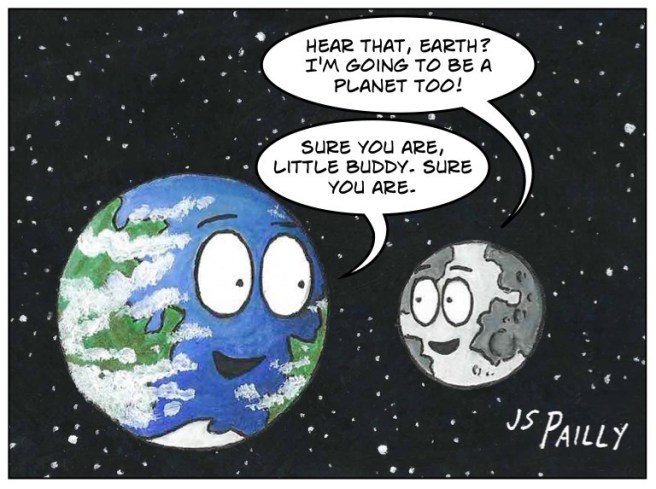
In other words, if it’s round, and it’s not a star or wasn’t a star at some point in the past, then it’s a planet. Under this new definition, Pluto’s back in the planet club! And so is the Moon, weirdly enough, along with many other moons elsewhere in the Solar System. In fact, the new definition would reclassify over one hundred Solar System objects as planets—possibly more than that.

The next I.A.U. general assembly meeting will be held in August, 2018. If they’re going to change the definition of planet again, that’s when they’ll do it. But I very much doubt it’ll happen.

Even though this is probably a lost cause, I want to say something in defense of the New Horizons team’s proposal. The strongest objection seems to be that moons should not be planets. I get that, but in my mind any world that I can picture myself standing on or walking on… I don’t know, that just feels planet-y to me.

I frequently catch myself calling Titan and Europa planets, even though they’re moons. Same for Pluto, Eris, Ceres, and all the other objects currently in the dwarf planet category. And I can’t help myself, but I keep calling Endor from Star Wars a planet, even though it’s specifically referred to multiple times in dialogue as a “forest moon.” All of these places—even fictional moons like Endor—feel planet-y to me.

And yes, even the Moon—the most quintessential moon of them all—has a certain planet-esque quality to it when I imagine myself living there, walking around, going about my daily business. I could get used to the Moon being a planet.

Next time on Sciency Words: A to Z, we’ll shrink from planet-scale to the scale of subatomic particles, and we’ll find out what’s so quantum about quantum mechanics.

Sciency Words: Organic (An A to Z Challenge Post)

Today’s post is a special A to Z Challenge edition of Sciency Words, an ongoing series here on Planet Pailly where we take a look at some interesting science or science related term so we can all expand our scientific vocabularies together. In today’s post, O is for:

ORGANIC

Sometimes scientists name things before they fully understand them. Such is the case with the entire field of organic chemistry.

Organic chemicals are called organic because, it was once thought, they could only be produced by living organisms. There was something almost mystical, almost magical about living things, scientists believed. They spoke of a mysterious “vital energy” without which certain chemical reactions simply could not occur.

Then in 1828, Friedrich Wöhler synthesized urea–a key ingredient in urine–in a test tube. That sounds kind of gross, but it was a monumental achievement in the history of science.

Sort of like how Newton showed that the same laws of physics which apply here on Earth also apply to the planets and stars, Wöhler’s urea synthesis demonstrated that the same laws of chemistry apply to both living and non-living matter.

The group of chemicals that scientists had been calling “organic” do have at least one thing in common: carbon. They all incorporate carbons atoms, typically carbon atoms bonded to other carbon atoms or to hydrogen atoms (certain simple carbon compounds like CO2 are generally not considered organic).

Perhaps some other name would be more appropriate for these complex carbon molecules, but scientists had been calling them organic chemicals and talking about organic chemistry for a while. The name had already stuck.

I suppose we could rationalize the modern usage of organic by saying we organisms need organic chemicals to live; but thanks to Wöhler, we now know organic chemicals do not need us organisms in order to exist.

Next time on Sciency Words: A to Z, let’s see if we can get Pluto’s planet status back.

Sciency Words: Negatron (An A to Z Challenge Post)

Today’s post is a special A to Z Challenge edition of Sciency Words, an ongoing series here on Planet Pailly where we take a look at some interesting science or science related term so we can all expand our scientific vocabularies together. In today’s post, N is for:

NEGATRON

In 1896, J.J. Thomson discovered the electron: a subatomic particle with a negative electric charge. Then in 1932, Carl Anderson discovered a new kind of electron. It was exactly the same as the old one, except it had a positive charge.

Anderson decided to name this new kind of electron a positron, and he wanted to retroactively rename the old one a negatron.

When matter and antimatter particles like these get into arguments, they always end the same way: the particles annihilate each other. Which is why it’s so important for nuclear physicists to keep matter and antimatter apart.

Anyway, under Carl Anderson’s naming scheme, we’d still get to use the word electron, but electron would be sort of like a genus name, with positron and negatron being two species of electron. That’s a nifty way to think about matter/antimatter pairs, if you ask me. Too bad the idea didn’t stick.

Or so I thought….

To my surprise, I was able to find negatron in a dictionary—a standard dictionary, not even a special dictionary of science. To my further surprise, spell-check recognizes negatron as a word. According to Google ngrams, the word is still in use, and when I did a search on Google Scholar, I found a ton of papers—recent papers—using the term in relation to nuclear physics.

So that subatomic particle pictured above—whether it likes it or not, it really is a negatron.

Next time on Sciency Words: A to Z, it’s dangerous to name a concept before you fully understand it.