Haumea Has Rings

I have to begin this post by apologizing to Pluto. Pluto, I’m sorry. You’re really neat and interesting and I like you a lot; but the truth is Haumea is now my favorite dwarf planet.

Last week, a paper in the journal Nature announced that the dwarf planet Haumea has rings.

Haumea’s rings were discovered during an occultation, when Haumea (as viewed from Earth) passed directly in front of a distant star. The rings caused the star to flicker slightly just before and after the occultation occurred. This, by the way, is exactly the same way the rings of Uranus were discovered.

Haumea was already a pretty strange and interesting object even before we knew about the rings. All planets (and dwarf planets too) bulge a little at the equator; that’s just what happens when you’re constantly spinning on one axis. But Haumea is spinning considerable faster than normal, completing a full rotation every 3.9 hours.

As a result, Haumea doesn’t just bulge at the equator; it’s stretched and elongated into an oval shape. But this brings us to some bad news. According to that same paper from Nature, Haumea’s shape is “inconsistent with a homogeneous body in hydrostatic equilibrium.”

The math went a little over my head on this one, but being in a state of hydrostatic equilibrium means an object is spherical, or at least ellipsoidal, due to the pull of its own gravity. This is one of the requirements for being a dwarf planet, according to the I.A.U.’s current definition.

So Haumea—which I just declared to be my favorite dwarf planet—might not be a dwarf planet at all! This could be good news for Pluto. If the I.A.U. decides to officially demote Haumea from dwarf planet to… I don’t know what, I guess Pluto will become my favorite dwarf planet again by default.
Better Atoms with Atom Smashing (Molecular Monday)

Atom smasher. If you ask me, there’s something deliciously primal about that term. I know we’re talking about particle physics, one of the most advanced and sophisticated and math-intensive branches of modern science, but still….

One of the reasons we do this incredibly barbaric thing to atoms is in the hope that, if we smash atoms together just so, their nuclei will fuse into new atoms. Bigger atoms. Better atoms? Possibly. We won’t know if we don’t try!

Unfortunately so far, all our bigger and possibly better atoms tend to fall apart before we can really experiment with them. They’re just too big and unwieldy for the strong nuclear force to hold them together. In most cases, our newly fused atoms undergo radioactive decay in a matter of seconds, or milliseconds, or sometimes even microseconds.

And yet we keep trying. Element 103 (lawrencium) was unstable, so we made element 104 (rutherfordium). That turned out to be unstable too, so we made element 105, then 106 and 107 and so on. At this point, we’re up to element 118 (oganesson) and we still haven’t found any of these super-heavy elements to be stable, despite predictions going back to the 1960’s that some of them should be.

But perhaps we’ve missed something. When element 117 (tennessine) was discovered, it was unstable. No surprise there. It existed for maybe a few milliseconds before it decayed. But when it decayed, according to this article from Scientific American, another element was produced as a byproduct: element 103, lawrencium. Which I told you just a paragraph ago was unstable, so who cares?

Except this was a different isotope of lawrencium than any previously seen, with a few extra neutrons in its nucleus. Enough extra neutrons to make lawrencium stable. Well, stable-ish. With a half-life of about eleven hours, it’s stable enough that we could conceivably do some experiments with this stuff, maybe start getting a sense of what its chemical properties are.

No doubt we’ll soon be hearing about elements 119 and 120, but the discovery of an almost stable isotope of element 103 suggests we may yet find other stable or semi-stable isotopes among the elements we’ve already identified. All we have to do is keep smashing atoms together.

* * *

Today’s post is part of a bi-weekly series here on Planet Pailly called Molecular Mondays, where we take a closer look at the atoms and molecules that make up our physical universe.

Sciency Words: Island of Stability

Today’s post is part of a special series here on Planet Pailly called Sciency Words. Each week, we take a closer look at an interesting science or science-related term to help us expand our scientific vocabularies together. Today’s term is:

ISLAND OF STABILITY

According to Star Trek: Voyager, in the 24th Century there will be 246 elements on the periodic table. In one episode, the Voyager crew discovers element 247, and to their astonishment that element is stable.

Here in the 21st Century, on modern day Earth, there are only 91 naturally occurring elements. Element 43, technetium, and everything above element 92, uranium, have to be produced artificially. And these artificial elements are all unstable. Some of them, especially the really, really high numbered ones, are so unstable that they’re effectively useless.

When an atomic nucleus gets too big, the so-called strong nuclear force is no longer strong enough to hold the whole thing together. You can also run into problems if you don’t have a comfortable balance of protons and neutrons. At that point, when atoms are too big or improperly balanced, they start shedding nuclear particles until they can stabilize themselves. This process is called radioactive decay.

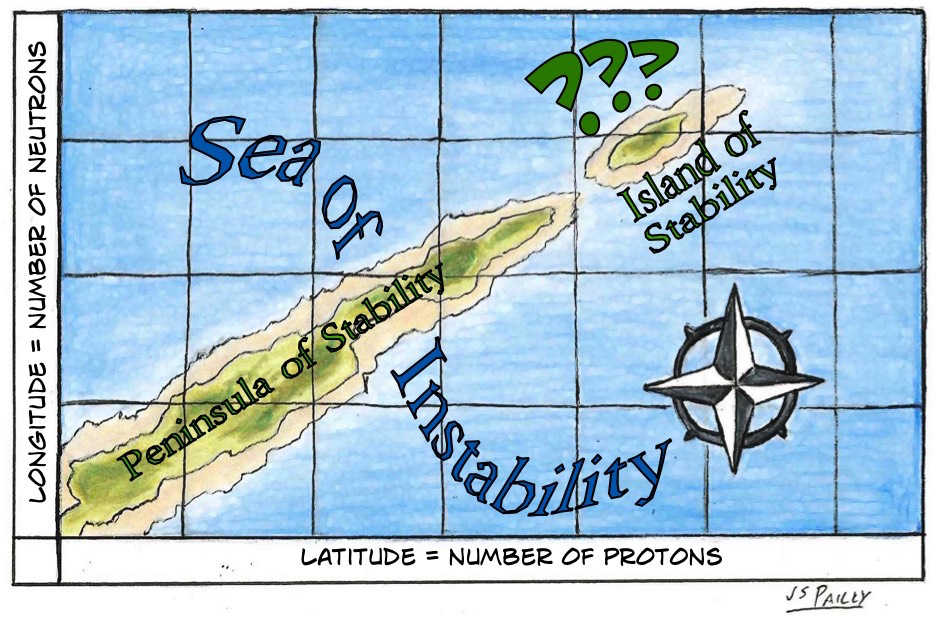
If you want, you can draw a chart with the number of protons in an atom along one axis and the number of neutrons along the other. But charts are boring, so let’s draw a map instead.

Physicist Glenn Seaborg (for whom element 106, seaborgium, is named) was apparently a big fan of maps. I imagine he and J.R.R. Tolkein would have gotten along well. In the 1960’s, Seaborg started referring to groups of atomic isotopes by “geographical” names, and these names have stuck.

On the map above, the landmass stretching up from the bottom left corner represents all the stable and semi-stable isotopes. This “Peninsula of Stability” is surrounded by a “Sea of Instability.” But somewhere out in that sea, according to Seaborg and others, certain very large atoms might theoretically become stable. These atoms would have just the right balance of protons and neutrons to hold themselves together despite their extreme size. These “magically” stable isotopes are represented by the Island of Stability.

Physicists have been trying to find the Island of Stability for decades now, but it seems to be perpetually just over the horizon. It was once predicted that elements 110 and 114 might be stable. They’re not. I remember reading that element 118 might turn out to be stable. It didn’t. Now there’s a prediction about element 120. We’ll have to wait and see about that one.

Also there’s a possibility that we’ve been skirting along the island’s coast, so to speak. Maybe if we just add a few more neutrons to some of the unstable elements we’ve already found, they’ll stabilize. Maybe. More on that in next week’s Molecular Monday post.

Personally, I think Star Trek: Voyager was on to something. My prediction is that the Island of Stability will be found all the way out at element 247, and I recommend the IUPAC name it Janewayium.

Sciency Words: Brainjacking

Today’s post is part of a special series here on Planet Pailly called Sciency Words. Each week, we take a closer look at an interesting science or science-related term to help us expand our scientific vocabularies together. Today’s term is:

BRAINJACKING

This is the kind of word you’d expect to find in one of those young adult Sci-Fi dystopia novels. Instead, I first encountered the term in a recent issue of Scientific American.

The word brainjacking is formed by analogy with hijacking. One possible definition involves a parasitic organism taking control of a host’s brain, perhaps altering the host’s brain chemistry in some way. A well known example is the zombie ant phenomenon, which is caused by a parasitic fungus.

But Scientific American was actually talking about humans, not ants—humans with medical implants in their brains, implants which may be vulnerable to hacking. Deep brain stimulation (D.B.S.) systems are sort of like pacemakers for the brain, and they’ve proven to be effective at controlling the symptoms of neurological disorders like Parkinson’s.

According to the abstract for this paper from World Neurosurgery, electronic brainjacking could come in two forms:

  • Blind attacks, which require no patient specific knowledge. Hackers could incapacitate or kill patients, or they could steal data from D.B.S. devices.
  • Targeted attacks, which do require some knowledge about the patient and how, specifically, the D.B.S. system is being used. Hackers could attempt to induce pain, control motor functions, enhance or repress emotions, or manipulate the brain’s rewards system.

Apparently these D.B.S. devices do not have a lot of security features built in, and what’s more they’re deliberately designed to be accessed and programmed wirelessly. That might at first seem like a serious design flaw, but it’s actually a necessary feature. In case of an emergency, E.M.S. personnel may need quick and easy access to your device.

Based on what I’ve read about brainjacking, there are zero documented cases of hackers actually attempting to do this… yet. But it’s clearly something both neuroscientists and cyber-security experts are worrying about.

And if there ever is a future where brain implants become ubiquitous, for both medical and non-medical purposes, then brainjacking may be a word everyone needs to know.

IWSG: Unlearn What You Have Learned

Today’s post is part of the Insecure Writer’s Support Group, a blog hop where insecure writers like myself can share our worries and offer advice and encouragement. Click here to find out more about IWSG and to see a list of participating blogs.

* * *

I own an imaginary spaceship. It’s a pretty useful thing for a science fiction writer to have. It allows me to travel all over the universe, visiting all the moons and planets and nebulae I want to write about. I’ve been to Titan, I’ve seen the alien megastructure at Tabby’s Star, and soon I’ll be going to Mars to look for Martians.

Turns out my imaginary spaceship can also take me to fictional planets, so today I’m visiting the planet Dagobah from the Star Wars universe and getting some surprisingly useful writing advice from Master Yoda.

Friends have told me this before. My muse has told me this, and so have fellow writers at all stages of their careers. Writing rules should really be called writing guidelines or writing suggestions, and some of them are really stupid suggestions too.

And yet many of these so-called rules have stuck with me, and I’ve had a tough time dislodging them from my brain. Right now, the “rule” I need to unlearn is this: when editing, cut down your word count by 15%. Or sometimes it’s stated as 10%, or 25%, or whatever. The point is cutting down your word count will make your story better.

This should really be called a writing exercise. It’s meant to teach you how to write tighter prose, and at some point I really needed to be taught that. But this simple writing exercise has transformed into an absolute rule, or a inviolable commandment, and it’s time for me to let it go.

So what writing rules have you had to unlearn?

Molecular Monday: Boron Isn’t Boring

Welcome back to another edition of Molecular Mondays, a special biweekly series here on Planet Pailly combining two of my least favorite things: chemistry and Mondays.

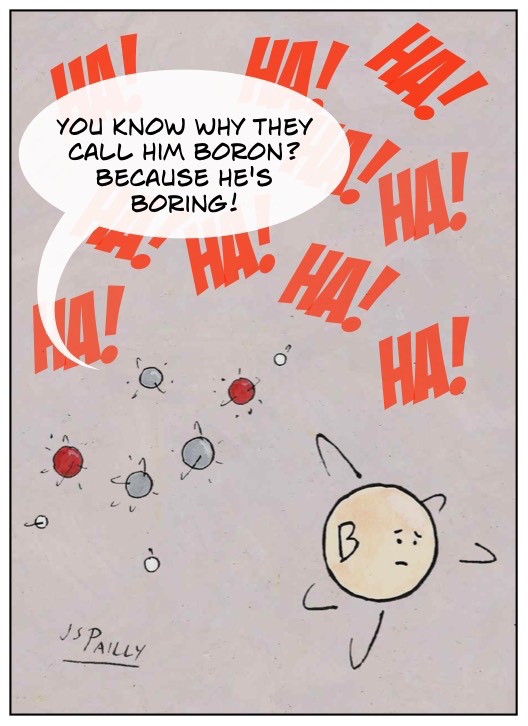
At some point long, long ago, I read a book about the periodic table of the elements. Chapter five was about boron, and what I remember learning was that boron is kind of useless. Certain boron-containing compounds are used in cleaning detergents, and while boron is not particularly toxic to humans, it’s deadly to insects, so it makes a good insecticide.

And that was basically it. Nothing more to know. Time to move on to chapter six: carbon.

So when the news came out that the Curiosity rover had detected boron on the surface of Mars, my initial reaction was “who cares?” But then I read more, and I soon realized that I’d been grossly under-informed about the fifth element from the periodic table.

First off, finding boron on Mars posed a real challenge. The Curiosity rover used an instrument called ChemCam, which basically zaps rock samples with a laser and performs a spectroscopic analysis on the resulting rock vapor.

According to this paper published in Geophysical Research Letters, scientists were looking for two spectral lines, both in the ultraviolet part of the spectrum, which are characteristic of boron: 249.75 nm and 249.84 nm. Annoyingly, iron also produces a spectral line at 249.96 nm, so ChemCam can only confirm boron’s presence in samples that have low iron content, which are hard to come by on Mars. Iron oxide is basically everywhere.

But despite this difficulty, boron was detected. Why should I or anyone else care? Because it was detected in veins of sedimentary rock, meaning that at some point long ago when Mars still had lakes and rivers and oceans of liquid water, boron must have been mixed into that water (likely in the form of borate, a compound of boron and oxygen).

Again, why should anyone care? Because some of the fragile molecules necessary for life decompose in open water, but borate can help stabilize those molecules, allowing them to combine to form RNA. Boron itself is not incorporated into our modern DNA, but its presence here on Earth may have helped life get started—and if boron was present on Mars, mixed into ancient Martian waters, it could have helped life get started there too.

Could have. We still don’t know for sure, but as I’ve hinted previously I am planning a little trip to Mars aboard my imaginary spaceship. Stay tuned. I’ll be sure to let you know if I find anything.

Sciency Words: Moon

Today’s post is part of a special series here on Planet Pailly called Sciency Words. Each week, we take a closer look at an interesting science or science-related term to help us expand our scientific vocabularies together. Today’s term is:

MOON

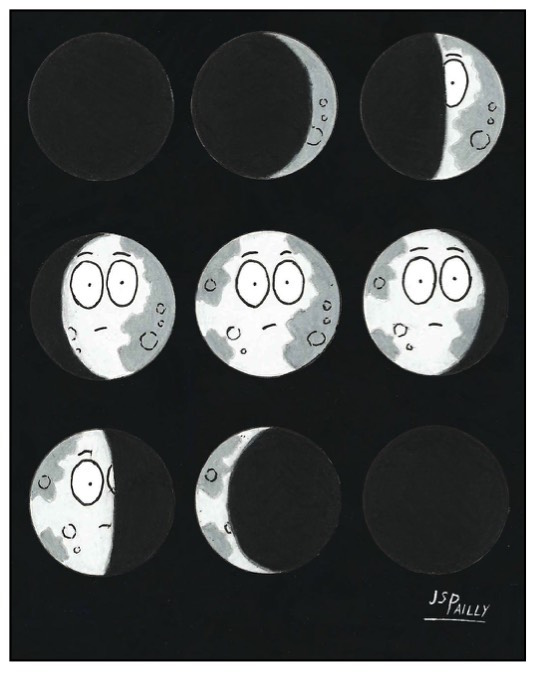
There are three things I want to cover with today’s post. Firstly, for anyone who may not already know, Earth’s moon is officially called the Moon (with a capital M). Unless you don’t speak English, in which case it’s called whatever it’s called in your language, provided that you treat the word as a proper noun. This according to the International Astronomy Union (I.A.U.), the one and only organization with the authority to name and classify astronomical objects.

Phases of the Moon.

Of course the Moon is not the only moon out there, so I also want to talk a little about the official I.A.U. sanctioned definition of the word moon. Unfortunately there isn’t one, which seems odd given how the I.A.U. are such stickers about their official definition of the word planet.

A common unofficial definition is that a moon is any naturally occurring object orbiting a planet, dwarf planet, or other kind of minor planet (such as an asteroid or comet). Except this definition creates some problems:

Saturn has like a bazillion moons!

Since there’s no lower limit on size or mass, you could consider each and every fleck of ice in Saturn’s rings to be a moon.

The Moon isn’t a moon!

In a very technical sense, the Moon does not orbit the Earth. The Earth and Moon both orbit their combined center of mass, a point called a barycenter. In the case of the Earth-Moon system, the barycenter happens to lie deep inside the Earth, so this distinction may not seem important, but…

Pluto is Charon’s moon, and Charon is Pluto’s!

The barycenter of the Pluto-Charon system is a point in empty space between the two objects. Pluto is the larger of the pair, so we generally consider Charon to be Pluto’s moon; however, you could argue that Pluto and Charon are moons of each other. You could even write a love song about their relationship.

Of course I’m not seriously arguing that Saturn has billions upon billions of moons, nor am I arguing that our own Moon is not really a moon. There does seem to be some ambiguity about Charon’s status (is Charon a moon, or are Pluto and Charon binary dwarf planets?), but I’m not sure if this ambiguity has caused any real confusion in scientific discourse.

Still, as we learn more about moons in our own Solar System and also moons in other star systems, I think the I.A.U. will eventually have to come up with an official definition. And that brings me to the third and final thing I wanted to cover today: exomoons.

An exomoon would be defined as a moon (whatever that is) orbiting a planet or other planetary body outside our Solar System. Finding exoplanets is hard enough, so as you can imagine, searching for exomoons really stretches the limits of current telescope technology. But astronomers are trying, and next month (October, 2017) the Hubble Space Telescope will be making special observations of a planet named Kepler-1625b in an attempt to confirm a possible exomoon detection.

Exoplanet Explorer: WASP 12b

Imagine you’re a poor, helpless planet orbiting a normal yellow dwarf star, a star not so dissimilar to our own Sun. But that star keeps drawing you closer and closer… and closer. You know this could end badly for you, but you cannot resist. Soon, it’s too late. Like the monster from Stephen King’s It, the star is going to eat you alive.

Such is the fate of WASP 12b, an exoplanet discovered in 2008 by the SuperWASP planetary transit survey. Wasp 12b is a carbon rich planet, with an atmosphere of mostly methane and carbon monoxide, and astronomers suspect the planet’s core might be made of graphite and diamond.

You could describe WASP 12b as a hot Jupiter, a gas giant that’s strayed perilously close to its parent star. WASP 12b is also sometimes referred to as a chthonian planet, though in my opinion that seems a bit premature. The planet appears to be in its final death throes, so to speak, but it’s not quite dead yet.

In 2010, observations by the Hubble Space Telescope revealed that the planet’s atmosphere is being stripped away, with streams of matter falling toward the star to be “consumed.” Eventually all that will remain of WASP 12b is its core. At that point, I think the term chthonian planet will be appropriate.

That is assuming, of course, that anything will remain at all. Given how violently WASP 12b is being destroyed, it’s possible even that diamond core will be ripped apart and devoured. According to current estimates, we’ll have to wait about 10 million years to find out—a surprisingly short period of time in the cosmic scheme of things.

P.S.: To my surprise, WASP 12b has started making headlines just in the last few days. Astronomers recently determined the planet is incredibly dark in color, almost pitch black. That seemed strange to me at first, but I guess if you’re going to have a planet with that much carbon, the dark coloration kind of makes sense.

Exoplanet Explorer: COROT 7b

In 2009, the French-built COROT space telescope made an astonishing discovery: a planet. A planet that was, at least at the time, the most Earth-like exoplanet ever discovered. Except as we’ve discussed previously, “Earth-like” exoplanets are not necessarily much like Earth. In this case, the term chthonian planet may be a better fit.

Exoplanets are often named after the telescope used to discover them; therefore, this planet has been officially designated COROT 7b (the T, by the way, is silent… it’s a French thing). A press release announcing COROT 7b’s discovery said it has a surface you can walk on. That’s true enough, but I don’t recommend going for a stroll there. The weather forecast sounds terrible.

It’s believed that COROT 7b started out as a gas giant, like Jupiter or Saturn, but it was drawn into an orbit way too close to its parent star. Due to the star’s intense heat and radiation, COROT 7b’s entire atmosphere would have boiled away, leaving only the shrunken, shriveled core of the planet behind.
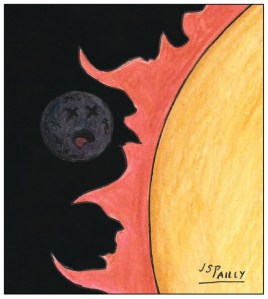
That shrunken core, which is still orbiting way too close to its parent star, is predicted to be tidally locked, meaning one side of the planet is always facing the sun and the other side is always turned away. That creates an enormous temperature discrepancy similar to, but more extreme than, the temperature discrepancy on Mercury.

And according to this paper from the Royal Astronomy Society, the temperature on the daylight side is high enough to vaporize rock. Allow me to emphasize that point. It’s not just hot enough to melt rock; oh no, that would be too normal. It’s hot enough to vaporize rock. So while COROT 7b seems to have lost its original atmosphere, it may have developed a new atmosphere composed of gaseous sodium and silicon and iron, along with other things we’re not accustomed to thinking of as atmospheric gases.

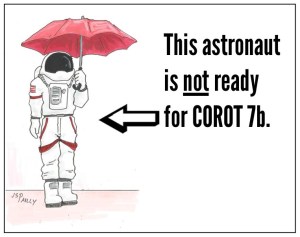
Then on the night side, where the temperature is much colder, all that vaporized rock would condense to form “mineral clouds,” and pebbles would fall like rain. Or perhaps hail is a more apt analogy. Anyway, if you’re going to go for a walk on COROT 7b, you’ll need more than an umbrella to deal with the weather.

Sciency Words: Chthonian Planet

Today’s post is part of a special series here on Planet Pailly called Sciency Words. Each week, we take a closer look at an interesting science or science-related term to help us expand our scientific vocabularies together. Today’s term is:

CHTHONIAN PLANET

In ancient Greece, there were two ways to pray: with your arms raised up to the gods of Olympus or with your arms lowered in deference to the gods of the underworld, also known as the chthonic or chthonian deities.

Regarding spelling and pronunciation, the “chth” thing makes more sense if you’re familiar with how the Greek alphabet works. Much like the “p” in psychology or the “h” in rhinoceros, the “ch” in chthonian becomes silent in English.

English often retains these silent letters as a way to remind us of a word’s origin and history. Also, we have to do something to keep our spelling bees interesting.

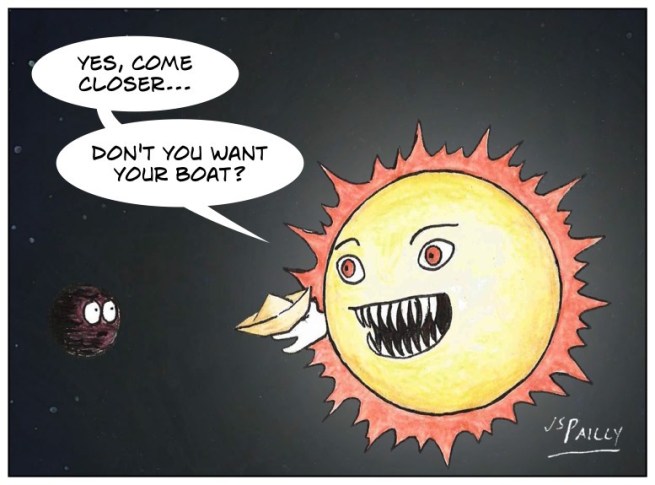
Chthonian became an astronomy term in 2003 thanks to this paper: “Evaporation rate of hot Jupiters and formation of Chthonian planets.” The paper describes a scenario in which a hot Jupiter—a gas giant orbiting waaaaay to close to its parent star—has its entire atmosphere stripped away by solar radiation. Only the planet’s rocky and/or metallic core remains. It would probably look something like this:

This is actually a pretty clever play on the original meaning of chthonian, which could refer to the underworld and all things death-related OR could just mean the earth and everything beneath its surface.

In one sense, chthonian planets are dead. Very, very dead. Also, because a chthonian planet is still located dangerously near to its parent star, conditions there would be truly hellish. But in another sense, these chthonian planets would look like any other Earth-like exoplanets, meaning they are rocky, terrestrial worlds, as opposed to Jupiter or Saturn-like gas giants.

For the time being, the idea of chthonian planets is still more or less theoretical. We have not yet proven definitively that such worlds exist. However, several candidate chthonian planets have been identified. I’ll introduce you to two of them next week.