Welcome to the Insecure Writer’s Support Group! If you’re a writer, and if you feel in any way insecure about your writing life, click here to learn more about this awesome group!
Umm, hi. This is James’s muse. My writer is… unavailable for writing today, so I’m just going to take care of writing this post myself.
The good news is that my writer finished the A to Z Challenge. His theme was the scientific search for alien life. My writer has always been laser-focused on writing science fiction—he’s not interested in writing anything else—so it should be obvious why he wanted to dedicate so much time and effort to this topic.
My role in all this was, of course, to feed my writer inspiration. But it’s also my job to help my writer manage his time and to give him that vital push to keep going when he needs it. And getting through those last few letters of the alphabet… my writer needed a lot of help with that. I had to push him really hard, and I had to make him give everything he’s got.
So now my writer’s kind of burned out. He’ll probably need a few days off before he gets back to his regular writing routine. Muses should not do this to their writers on a regular basis, but in this case I’d say it was worth it. And whenever my writer wakes up from his nap, I’m pretty sure he’d agree with me.
Welcome to a special A to Z Challenge edition of Sciency Words! Sciency Words is an ongoing series here on Planet Pailly about the definitions and etymologies of science or science-related terms. In today’s post, Z is for:
THE ZERO-ONE-INFINITY RULE
All month, we’ve been talking about astrobiology, SETI, and the possibility that we are not alone in the universe. I’d like to end this series with a prediction for the future, and conveniently my prediction is related to a Z-word: the zero-one-infinity rule.
The zero-one-infinity rule was originally created by Dutch computer scientist Willem Louis Van Der Poel. For the purposes of computer programming, the rule has to do with how many times a user is allowed to do a thing (whatever that thing might be).
It makes sense for a user to never be allowed to do a certain thing (zero), or it makes sense for a user to do a thing only once (one). But if you’re going to allow a user to do a thing more than once, you may as well let the user do that thing as many times as the user wants. As a rule of thumb, the zero-one-infinity rule means there’s no reason to impose arbitrary limits on what users can do.
The zero-one-infinity rule has been adapted to many other scientific fields, including the field of astrobiology. How many places can life exist in the universe?
Zero: the universe might not allow life to exist at all. Of course we already know this isn’t true, otherwise we wouldn’t be here.
One: the universe might only allow life to develop once. In this view, Earth is a crazy exception, a one-time fluke in a universe that otherwise does not allow life to exist.
Infinity: the universe allows life to exist anywhere and everywhere it can. Life might still be rare in this view, but there are no arbitrary limits imposed on life.
I remember in the 80’s and early 90’s there were a lot of people (including one of my science teachers) who honestly believed our Solar System might be unique. No other star except our Sun was known to have planets. Maybe that was because there were no other stars with planets. In short, our Solar System was a “one” in the zero-one-infinity rule.
Then in 1992, astronomers announced the discovery of the first known exoplanets—planets orbiting a star other than our Sun. At the time, we still had no idea just how many exoplanets we might find, but if the universe had allowed two solar systems to form, why not three? Why not a dozen, or a thousand, or a million? As soon as the case for “one” crumbled, the possibilities were suddenly limitless.
In this special edition of Time Magazine, there’s a brief mention of the zero-one-infinity rule. In that article, NASA scientist Chris McKay sums up the whole field of astrobiology by saying, “So what we’re searching for is two.” Because once we know that life developed on not one but two worlds… why not three? Why not a dozen, or a million? The possibilities will be truly limitless.
Welcome to a special A to Z Challenge edition of Sciency Words! Sciency Words is an ongoing series here on Planet Pailly about the definitions and etymologies of science or science-related terms. In today’s post, Y is for:
YOUNG SURFACE
Imagine a nice, smooth, clean sheet of asphalt: a parking lot, maybe, with no cracks or potholes or blemishes of any kind. Just looking at it, you would know, with a reasonable degree of certainty, that this asphalt had been laid down recently. It’s new. It is, in effect, a young surface.
In much the same way, planetary scientists can look at the surface of a planet or moon and infer, with a reasonable degree of certainty, how young or old that surface must be. Look at the Moon or Mercury; they’re covered in craters, showing that their surfaces must be very, very old. Or look at Mars, where some regions are more heavily cratered than others, implying (intriguingly) that some surfaces are relatively old and some are relatively young.
And then there’s Europa, one of Jupiter’s moons. Europa may be covered in weird, orangey-red cracks, and it may have a few other orangey-red blemishes, but overall it’s surprisingly smooth, and there are very few craters. This makes Europa look a whole lot younger than it actually is. In fact, Europa is said to have the youngest-looking surface in the whole Solar System.
Europa’s surface is made of ice, specifically water ice. This is not so uncommon for a moon in the outer Solar System. It’s so cold out there that water behaves like a kind of rock.
But unlike most other icy moons, Europa must be doing something to get rid of old, crater-y surface ice and replace it with new, clean, smooth ice. And once you really start thinking of water as a kind of rock, you might be able to guess what Europa’s doing. As stated in this paper from Nature Geoscience: “[…] Europa may be the only Solar System body other than Earth to exhibit a system of plate tectonics.”
Except unlike Earth’s techtonic plates, which float atop a layer of magma (liquid rock), Europa’s plates would be floating atop “magma” that is actually liquid water—twice as much liquid water as we have here on Earth, according to some calculations.
And while liquid water may or may not be necessary for life, we do have good reason to suspect that any place that has liquid water might also have life. Personally, based on everything else I’ve learned about Europa, I’d be more surprised if we didn’t find something living there.
Next time on Sciency Words A to Z, I have a prediction for the future.
Welcome to a special A to Z Challenge edition of Sciency Words! Sciency Words is an ongoing series here on Planet Pailly about the definitions and etymologies of science or science-related terms. In today’s post, X is for:
XEROPHILE
You can’t have life without water. Everybody knows that, right? Right? Well, apparently there are some microorganisms on this planet who didn’t get the memo.
The Atacama Desert in Chile is one of the most un-Earth-like environments on Earth. It is severely dry. It almost never rains there, and even when it does it’s a pathetic trickle. And it’s been like this for over a hundred millions years, making the Atacama Desert the oldest continuously arid region in the world.
At this point, the Atacama Desert has been so dry for so long that, chemically speaking, it has more in common with the surface of Mars. Most notably, in my opinion, the toxic perchlorate salts found on Mars are also present in the Atacama—0.4 to 0.6 wt% for Mars compared to 0.3 to 0.6 wt% for the Atacama, according to this article. A near perfect match!
It was once thought the sands of the Atacama Desert were sterile, and experiments on soil samples seemed to prove it. However, thanks to “improved extraction protocols,” we now know better. As reported in this paper, titled “Bacterial diversity in hyperarid Atacama Desert soils,” it seems a great many bacterial species have found their way into the Atacama and adapted to the harsh environment.
In general, organisms that can survive in extreme conditions are known as extremophiles. The term applies especially well to organisms that actually thrive in environments that should kill them. There are many subcategories of extremophile, such as:
Thermophiles: organisms that love extreme heat.
Barophiles: organisms that love extreme pressure.
Acidophiles: organisms that love acid.
Halophiles: organisms that love salt.
Any organism that can survive in the Atacama Desert would be considered a xerophile, which comes from a Greek word meaning dryness. They’d also probably be halophiles, given the presence of those perchlorate salts. As noted in this article: “Xerophilic organisms are often also halophilic, some of them occurring in hypersaline solutions.”
So what does all this mean for our chances of finding life on Mars? I think that should be obvious. However, it’s worth noting that even xerophiles require some water. Remember, even in the Atacama Desert it rains a little. Fortunately for any xerophiles who might be eeking out an existence on Mars, there seem to be a few rare trickles of water there too.
Next time on Sciency Words A to Z, have you seen Europa, the moon of Jupiter? She looks a whole lot younger than she really is. So what’s her secret?
Welcome to a special A to Z Challenge edition of Sciency Words! Sciency Words is an ongoing series here on Planet Pailly about the definitions and etymologies of science or science-related terms. In today’s post, W is for:
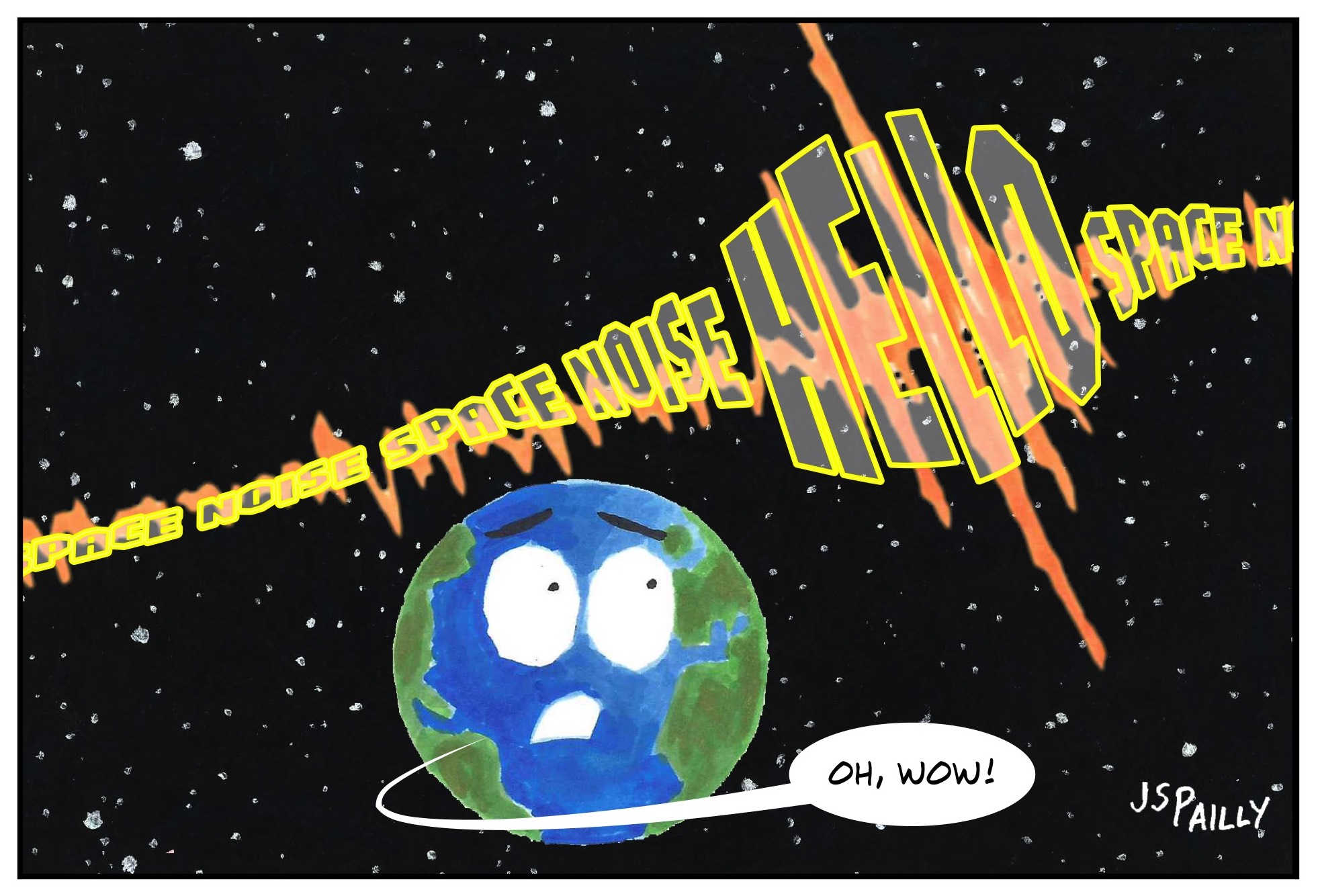
THE WOW! SIGNAL
There’s a ton of radio noise in space, coming from stars and nebulae and black holes and so forth. There’s so much radio noise that it can easily drown out the relatively weak radio and television broadcasts that might be coming from a planet like Earth.
So if aliens want to talk to us, they’re going to have to send a much stronger transmission, something that will come through loud and clear over all that other space noise. And in 1977, astronomers at Ohio State University picked up exactly that kind of signal.
As the story goes, Ohio State was conducting a SETI search with their “Big Ear” radio telescope. The telescope recorded electromagnetic emissions coming from space, reporting the strength of those emissions on a scale from 0 to 9. If Big Ear happened to pick up anything stronger than a 9, it represented that with a letter—A represented a 10, B represented 11, and so forth.
On the morning of August 18, 1977, astronomer Jerry Ehman was reviewing Big Ear’s latest data when he saw a bunch of large numbers, and even a few letters. Famously, Ehman circled those letters and numbers and wrote one word next to them: Wow!
Appropriately, this is now known as “the Wow! Signal” (the exclamation point is usually included in the name).
In one sense, the Wow! Signal is exactly what SETI scientists were hoping to find. Even the radio frequency—approximately 1420 megahertz—was consistent with expectations. In this 1959 paper, physicists Giuseppi Cocconi and Philip Morrison singled out 1420 MHz as the frequency extraterrestrials were most likely to use.
But in another sense, the Wow! Signal was not what we wanted it to be, because it only happened one time, and it has never repeated since. Despite many follow-up searches of the constellation Sagittarius (like this one or this one), where the Wow! Signal originated from, we’ve never picked up a signal like it again.
As I’ve said several times this month, in our search for alien life, we have to hold ourselves to the same standards as a court of law: proof beyond a reasonable doubt. The Wow! Signal very well might have been aliens… it might have been anything… and that’s the problem. Unless and until we pick up the Wow! Signal again, we can’t prove one way of another what it was.
Next time on Sciency Words A to Z, you can’t have life without water. Or can you?
Welcome to a special A to Z Challenge edition of Sciency Words! Sciency Words is an ongoing series here on Planet Pailly about the definitions and etymologies of science or science-related terms. In today’s post, V is for:
VIKING
You know, I’ve noticed something about those early pioneers in the field of astrobiology. They thought they knew an lot about what aliens would be like, how aliens would behave. It seems awfully presumptuous in hindsight. People even thought they knew how alien microorganisms would behave.
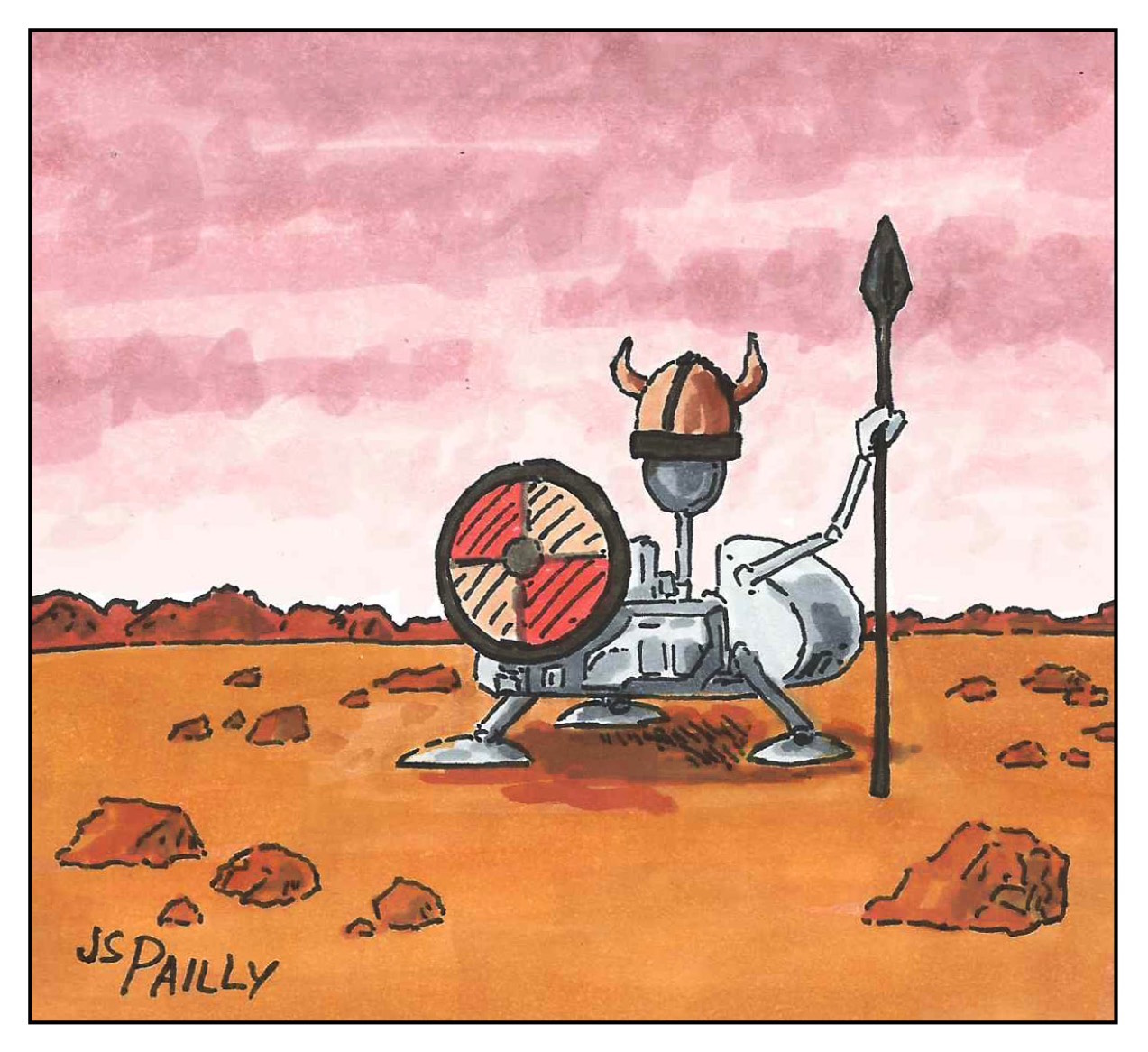
In the late 1960’s, NASA was putting together a mission to Mars, and they decided to name this new mission Viking.
As explained in this book on NASA’s history of naming things:
The name had been suggested by Walter Jacobowski in the Planetary Programs Office at NASA Headquarters and discussed at a management review held at Langley Research Center in November 1968. It was the consensus at the meeting that “Viking” was a suitable name in that it reflected the spirit of nautical exploration in the same manner as “Mariner” […].
In NASA’s early years, nautical exploration was the theme for naming all missions to other planets.
The Viking 1 and Viking 2 landers arrived on Mars in 1976. They were the first space probes to successfully land (as opposed to crash) on Mars, and they were the first to send back photos from the surface. They were also the first, and so far the only, space probes to conduct experiments directly testing for Martian life.
Except it may have been a false positive. It was probably a false positive.
This test was called the labeled release experiment, and here’s how it worked: the Viking landers scooped up some Martian soil and added a nutrient mix—in other words, we tried to feed the Martians. The nutrient mix was “labeled” with a radioactive carbon isotope, so if any Martian microbes were living in the soil, they’d take the food and then release gaseous waste that had this special isotope in it.
But there were some problems with this idea. How do we know what Martian microbes eat? How do we know what waste products they produce? And—here’s the biggest problem of all—given how little we knew about Mars at the time, how do we know our nutrient mix wouldn’t react with some previously unknown chemical in the Martian soil, giving us a false positive result?
These are the kinds of questions that were asked after the labeled release experiment took place (but apparently not before). As a result, there was wild disagreement about what that positive test result might actually mean. The general consensus today is that we got a false positive. Our nutrient mixture must have reacted with something in the soil, something that was not alive.
But while the Viking Mission could not give us a definitive answer about whether or not there is life on Mars, Viking still taught astrobiologists a valuable lesson. When exploring strange, new worlds, trying to tell the difference between chemistry and biochemistry can be really hard.
Next time on Sciency Words A to Z, wow… just, wow!
Welcome to a special A to Z Challenge edition of Sciency Words! Sciency Words is an ongoing series here on Planet Pailly about the definitions and etymologies of science or science-related terms. In today’s post, U is for:
THE UNKNOWN ABSORBER
If there’s one thing worth remembering from all this astrobiology stuff, it’s that life begins with chemistry. All life in the universe, no matter how strange and exotic it may seem to us Earthlings, must depend on chemistry. And I don’t know many places that are more chemically active than the planet Venus. So is Venus a good place to go looking for alien life.
To quote from David Grinspoon’s book Venus Revealed, “Where life is concerned, Venus is consistently voted ‘least likely to succeed.’” Sure, Venus is chemically active, but in a way that will violently tear apart complex organic molecules.
However, Grinspoon has the temerity to go ahead and speculate—and he makes it abundantly clear this is pure speculation—about the kinds of organisms that might call Venus home. And that speculation focuses on a mysterious substance found in the Venusian clouds, a substance that has long been called the unknown near-U.V. absorber, or simply the unknown absorber.
In the field of spectroscopy, every chemical is known to absorb very specific wavelengths of light. When light is spread out into a spectrum, as with a prism, you get a sort of unique barcode that you can use to identify chemicals.
A very simple “barcode” representing hydrogen.
If you’ve ever wondered how astronomers know which chemicals are found in space, or on other planets, this is how they do it.
In 1974, NASA’s Mariner 10 spacecraft sent us our first ever close-up photos of Venus. In the visible part of the spectrum, there were no real surprises, but photos taken in ultraviolet showed that something was absorbing U.V. light like crazy, producing a spectroscopic barcode that nobody recognized.
In his speculation about life on Venus, Grinspoon mentions another chemical with a complex, hard-to-identify spectral barcode: chlorophyll, the chemical that makes photosynthesis possible here on Earth. I say hard-to-identify… it’s not hard for us to identify, because we already know what it is. But if extraterrestrial observers were studying Earth’s spectrum, chlorophyll would have them very confused—almost as confused as we were by Venus’s unknown absorber.
So could the unknown absorber be a chlorophyll-like molecule? Could this be the first evidence of air-born bacteria, drifting around in Venus’s cloudbanks, performing their own version of photosynthesis? Maybe, Grinspoon tells us in Venus Revealed. But that book came out in 1997. In 2016, this paper was published identifying Venus’s unknown absorber as disulfur dioxide.
On a personal note, I wrote a blog post about Venus’s formerly unknown absorber before, and my post got the attention of the lead author of that 2016 paper.
But even though the mystery of Venus’s unknown absorber may have been laid to rest, I think this still served as a valuable lesson about what we should be looking for out there in the cosmos. Someday, another unknown absorber, with another weird spectral barcode, may be the thing that leads us straight to the discovery of alien life.
Next time on Sciency Words A to Z, the Martians better watch out. The Vikings have landed on their planet!
Welcome to a special A to Z Challenge edition of Sciency Words! Sciency Words is an ongoing series here on Planet Pailly about the definitions and etymologies of science or science-related terms. In today’s post, T is for:
THOLIN
Have you ever been stuck trying to say something, but you just don’t have the right words to say it? In the 1970’s, planetary scientists Carl Sagan and Bishun Khare had that problem.
They’d conducted a series of experiments using gaseous chemicals that were known to be common in outer space, chemcials like ammonia, methane, water, hydrogen sulfide… they mixed all these chemicals together and zapped them with either an electric spark or ultraviolet light. Then they studied the orangey-brown gunk that formed as a result.
Initially, this gooey gunk was thought to be a polymer, but as reported in this 1979 paper, Sagan and Khare soon determined that wasn’t what it was.
It is clearly not a polymer—a repetition of the same monomeric unit—and some other term is needed.
Sagan and Khare propose the word “tholin,” which is sort of a pun. It’s taken from two Greek words that are spelled the same, except for an accent mark that’s shifted from one vowel to another. One word means “muddy,” the other means “dome” or “vault,” as in the great dome or vault of the sky. Sagan and Khare go on to mention that they were “tempted by the phrase ‘star-tar.’”
Tholin may be present on some asteroids and comets, and tholin or tholin-like material has been observed on several moons in the outer Solar System, most notably Titan. We may have even found tholin on Pluto, and several other red-hued dwarf planets could have it too.
So what specifically is this stuff? Well, I can’t really say. Tholin is not a specific substance but rather a general category of organic matter. As planetary scientist Sarah Hörst explains in this article:
The best analogy I have been able to come up with is “salad.” Salad, like tholin, is a mixture of a number of different compounds and spans a fairly broad range of materials. Most of us would agree on a case by case basis whether or not something is a salad, but the definition is not at all specific and the material itself depends on the starting materials, temperature, etc.
So there are many different tholins out there. The tholin we might find inside a comet is probably different from the tholin we find on Pluto, which is different from the tholin we find on Titan. What all these tholins have in common is that they’re the kind of yucky gunk you’d expect life to make, except life didn’t make it.
However, while life doesn’t make tholin, tholin could, in theory, be used to make life. Or at least, once life gets started, tholin can serve as a source of food for primitive microorganisms.
Titan has long been the poster child for tholin chemistry, simply because Titan has so much of this stuff. More than enough, you’d think, for some sort of biological activity to get started—assuming it hasn’t already! However, with all that tholin lying around, sending astronauts to explore Titan properly may prove to be a sticky proposition.
Next time on Sciency Words A to Z, there’s no way we’ll find life on Venus… right?
Welcome to a special A to Z Challenge edition of Sciency Words! Sciency Words is an ongoing series here on Planet Pailly about the definitions and etymologies of science or science-related terms. In today’s post, S is for:
SETI
In September of 1959, Italian physicist Giuseppi Cocconi and American physicist Philip Morrison published this paper, titled “Searching for Interstellar Communications.” That paper is essentially the founding document for SETI, the search for extraterrestrial intelligence, which is now considered a subfield of astrobiology.
The SETI Institute, on the other hand, was established in 1984 by Thomas Pierson and Jill Tarter. As stated in this report on the proper use of SETI nomenclature:
SETI should not be used as a shorthand for the SETI Institute, which is an independent entity and should be referred to by its full name to avoid confusion.
And let me tell you, this SETI vs. SETI Institute distinction… that really can cause a lot of confusion.
A few years back, I saw a report on the news. SETI (the Institute, I presumed) had picked up a signal form outer space, from a star located 94 light years away. According to the news lady on TV, a SETI spokesperson had this to say, and that to say, and some more stuff to say about this amazing discovery. “Oh cool,” I thought, and I quickly went to the SETI Institute’s webpage to learn more.
There was nothing—absolutely nothing—about it.
Another day or two went by, and then this article was posted on the SETI Institute’s website. Some Russian radio astronomers had picked up what they thought was a SETI signal (it eventually turned out to be a satellite). Somehow the media picked up on this story and ran with it, apparently without contacting the SETI Institute—or speaking with any actual SETI Institute spokesperson—to find out if any of this were true.
I should probably mention that in my day job, I work in the T.V. news business. This sort of sloppy journalism infuriates me, but I’ve found that it’s quite typical of how the popular press handles science news.
However, to be fair, prior to that misleading news report, I didn’t know to make a clear distinction between SETI and the SETI Institute myself. But I’ve tried to be more careful about this ever since. Language can be a messy way to communicate, so it’s important to try to be clear about what we mean. Otherwise, someone (perhaps even someone from the media) will get the wrong idea and run with it.
Next time on Sciency Words A to Z, the first astronauts on Titan may find themselves in a very sticky situation.
Welcome to a special A to Z Challenge edition of Sciency Words! Sciency Words is an ongoing series here on Planet Pailly about the definitions and etymologies of science or science-related terms. In today’s post, R is for:
THE RARE EARTH HYPOTHESIS
Once upon a time, it was believed that the Sun, Moon, planets, and all the stars revolved around the Earth. This was known as the geocentric theory.
Copernicus, Galileo, Kepler, and others set us straight about our planet’s physical location in space. However, it is still sometimes asserted that Earth is special or unique in other ways. Such assertions are often referred to in a derogatory sense as “geocentrisms.”
It’s tempting to dismiss the Rare Earth Hypothesis as just another geocentrism. The idea was first presented in 2000 in a book called Rare Earth: Why Complex Life is Uncommon in the Universe by Peter Ward and Donald Brownlee. In that book, Ward and Brownlee go through all the conditions they say were necessary for complex life to develop on this planet. Crucially, they point out all the ways things could have gone wrong, all the ways complex life on Earth could have been prematurely snuffed out.
In other words, we are very, very, very lucky to be here, according to Ward and Brownlee, and the odds of finding another planet that was as lucky as Earth must be astronomically low. Sure, there might be lots of planets where biology got started. Simple microorganisms may be quite common. But complex, multicellular life like we have here on Earth—that’s rare. And intelligent life forms like us are rarer still. Perhaps intelligent life is so rare that we’re the only ones.
My favorite response to the Rare Earth Hypothesis comes from NASA astronomer Chris McKay. In All These Worlds Are Yours, McKay’s argument is described as the Rare Titan Hypothsis.
Perhaps a pair of Titanian scientists then decide to publish a book. They list all the conditions required for complex life to develop on Titan, point out all the ways Titanian life could have been snuffed out prematurely, and argue that the odds of finding another Titan-like world must be astronomically low.
Personally, I think there’s some validity to the Rare Earth Hypothesis, but McKay’s point is worth bearing in mind. There could be many different ways for life to develop in our universe. Earth is but one example. Planets that are just like Earth may indeed be rare—extremely rare—but there’s no reason to conclude that Earth-like life is the only kind of complex life out there.
Next time on Sciency Words A to Z… oh my gosh, we’ve finally made it to S! It’s finally time to talk about SETI!










 Planet Pailly