Available Now: The Medusa Effect

Hello, friends!

Today is the day.  The Medusa Effect: A Tomorrow News Network Novella is available now.  Click here to buy, or you can read it for free with Kindle Unlimited.
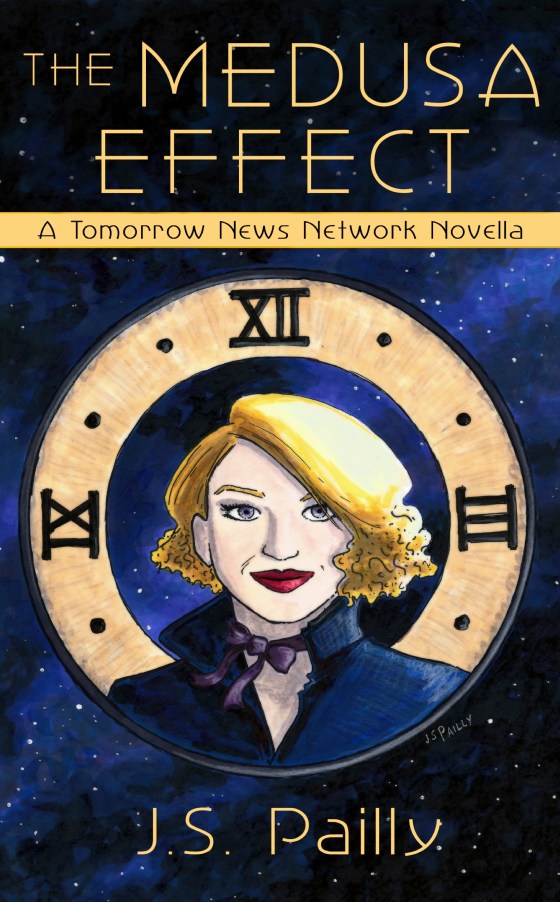
Litho is a peaceful, isolated colony world on the frontier of space.  Nothing bad ever happens there.  So when a reporter from the Tomorrow News Network shows up, nobody takes much notice.  Nobody except a young colonist named Milo.

Milo is a bit of a news junkie.  He knows all about the Tomorrow News Network, a news organization run by time travelers, and he knows all about Talie Tappler, the reporter they’ve sent to Litho.  Talie has a reputation for covering war, chaos, and galactic devastation.

So why has Talie come to Litho Colony?  What big, breaking news event has attracted her attention?  Milo doesn’t know, but he’s determined to find out, because whatever Talie Tappler’s big story is, it cannot be good news.

In yesterday’s posting of the Insecure Writer’s Support Group, I admitted to feeling a bit of anxiety over this whole “published author” thing.  I’m dealing with a touch of imposter syndrome.  However, when I think about the larger universe of Tomorrow News Network and all the stories yet to be told, my anxiety fades, and my eagerness to keep writing takes control.

So dear reader, there are a few things I’d like you to know about the Tomorrow News Network series going forward:

  • First off, you won’t have to read the stories in any particular order.  This is a series about time travel.  Be a time traveler.  Feel free to dip in and out of the timeline whenever and wherever you please.
  • As the series progresses, you may notice minor (or not so minor) inconsistencies in the story universe.  Pay attention to these inconsistencies.  They are not mistakes.
  • Don’t skip the bonus story at the end of The Medusa Effect.  That little bonus story will give you a clue about where the universe of Tomorrow News Network is heading.

Earlier this week, I had a phone conversation with my primary editor.  She told me I can finally breathe a sigh of relief.  The book is done.  It’s finished!  I told her no.  I appreciate the sentiment, but no.  The universe of Tomorrow News Network is huge and weird and complicated. I’m not finished. I’m just beginning.

† Well, I’m not perfect.  Some mistakes may be actual mistakes, but the most obvious inconsistencies—was Earth destroyed or not?—those are deliberate.

#IWSG: I Wish I Were a Cyborg

Hello, friends, and welcome to another meeting of the Insecure Writer’s Support Group.  Do you feel insecure about your writing?  Are you looking for support?  Then this might be the right group for you!  Click here to learn more!

Each month, the Insecure Writer’s Support Group offers an optional question, something to help get these I.W.S.G. posts started.  This month’s question has to do with secrets.  What secrets do we writers have that our readers would never know based on our work?

At the moment, my biggest secret is that I’m suffering from a bad case of imposter syndrome.  My first book is coming out pretty soon.  In fact, it comes out tomorrow.  I worked really hard on it, and… well, I just hope people like it.

But what if they don’t!?!  Oh no!  People will think I’m a hack writer, a fraud, or something equally reprehensible!!!

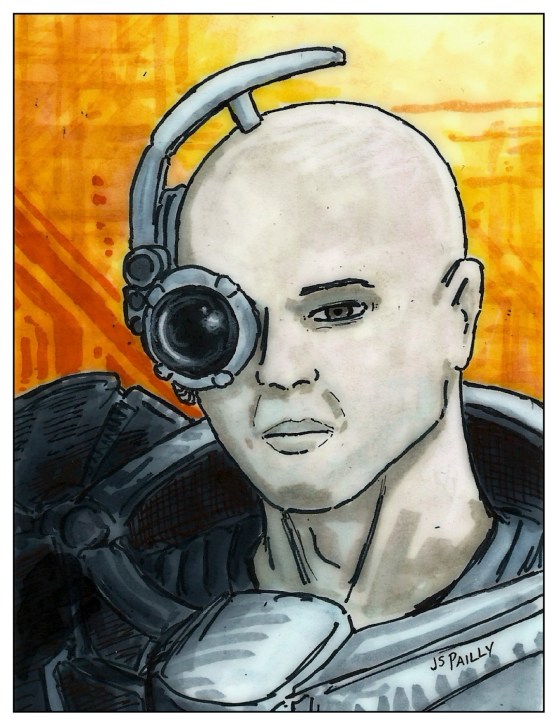
A lot of my friends, both online and in real life, have been congratulating me and telling me how excited I must feel.  And yes, I do feel excited.  But I’m feeling other emotions as well.  There’s a cyborg character in my book who can select which emotions he wants to experience and which emotions he does not.  He can turn his emotions on and off with the flick of a switch.

I wish I could do that.  I’d leave my excitement running and switch everything else off.  But I’m no cyborg.  I’m only human, and being human is not so easy.  The best I can do is set those other emotions aside with the promise that I will deal with them later.  In the meantime, I need to keep blogging.  I need to keep marketing my work.  And above all else, I need to keep writing, because this book that comes out tomorrow—that book is just the beginning.

P.S.: For those of you who may be interested, my book is a novella-length Sci-Fi adventure story entitled The Medusa Effect.  It’s the first in a series of novella-length Sci-Fi stories about a journalist who travels through time, covering the galaxy’s biggest news stories before they happen.  Click here to buy the book on Amazon, or you can read it for free with Kindle Unlimited.

Unplanned Mental Health Break

Hello, friends!

Last week, I ended up needing a bit of a mental health break.  I stopped writing and drawing.  I stopped blogging, and I basically unplugged from the Internet for a few days.  Some stuff was happening in my personal life.  I won’t go into any details.  I’ll just say that my stress level got way too high for a while there.

But things are more or less settled now, and I’m back to my regular writing and blogging schedule this week.  So I’ll see you at Wednesday’s meeting of the Insecure Writer’s Support Group.  Then on Thursday, The Medusa Effect: A Tomorrow News Network Novella comes out (click here to preorder!).  And on Friday, of course, I’ll have a Sciency Words post for you.  So stay tuned, my friends!

Quantum Physics is Weird (Reblog from SelfAwarePatterns)

Hello, friends!

Quantum physics is weird.  It overturns all our silly human notions about common sense.  Atoms and photons and mass vector bosons—and all sorts of other particles and/or waves like that—exist in this mystical world where anything is possible and nothing makes sense.

But while while world of quantum physics may defy common sense, the way scientists study the quantum world is highly logical and methodical.

Today, I want to share a post that Mike Smith did over on SelfAwarePatterns.  It’s a great introduction to the most common “interpretations” of quantum theory—in other words, the most popular schools of thought about what all that quantum mumbo jumbo actually means.

So before you throw up your hands and declare that quantum physics is nonsensical science voodoo, please check out Mike’s post.  It’s really good!

With quantum physics, we have a situation where a quantum object, such as a photon, electron, atom or similar scale entity, acts like a wave, spreading out in a superposition, until we look at it (by measuring it in some manner), then it behaves like a particle. This is known as the measurement problem. Now, […]

The measurement problem, Copenhagen, pilot-wave, and many worlds — SelfAwarePatterns

Need a New Role Model? Meet Mercury! — My Hubble Abode

Hello, friends!

Venus is my favorite planet, and it probably always will be. In my mind at least, Venus is the planet with the most personality. But Fran from My Hubble Abode makes a pretty compelling case for Mercury, and I can at least agree that Mercury deserves a lot more love than it currently gets. So to anyone who hasn’t picked a favorite planet yet, please take the following into consideration:

What’s your favourite planet? Saturn? Jupiter? Earth? It’s probably not Mercury, so here are 3 reasons that it should be your favourite planet! Mercury flaunts his natural face A poreless face has been all the rage, but there’s nothing about Mercury’s surface that says smooth. Mercury has the most cratered surface out of all the […]

Need a New Role Model? Meet Mercury! — My Hubble Abode

Sciency Words: Syzygy

Hello, friends!  Welcome to Sciency Words, a special series here on Planet Pailly where we take a closer look at the definitions and etymologies of scientific terms.  Today on Sciency Words, we’re talking about the word:

SYZYGY

We’ve all seen pictures like this, with all eight planets lined up in a row:

And sometimes, on extra special occasions, the planets really do line up like that, or at least they come very close to it.  When this happens, we call it a grand syzygy.

The word syzygy traces back to ancient Greek.  It originally meant “yoked together,” as in: “The farmer yoked together his oxen before plowing the field.”  According to my trusty dictionary of classical Greek, the word could also mean “pair” or “union.”

Some closely related words in Greek referred to balance, teamwork, sexy times, etc.  And our modern English words synergy and synchronized have similar etymologies.  Basically, what all these words have in common is a sense of people or things coming together, in one manner or another.

For modern astronomers, syzygy means three or more celestial bodies coming together to form a straight line.  The most commonly cited example of this is the alignment of the Sun, Earth, and Moon that occurs during either a new moon or full moon, as observed here on Earth.

But an alignment doesn’t have to be perfectly straight to be called a syzygy, especially when we’re dealing with more than three objects.  According to this article from The New York Times, a syzygy of the Sun, Venus, Earth, Mars, Jupiter, and Saturn occured between March 25 and April 7, 1981.  The Sun and five planets came “within 2 degree of arc from a perfect straight line.”  Apparently that’s close enough.

But while that 1981 syzygy was pretty grand, it was not the grandest of grand syzygies.  The planets Mercury, Uranus, and Neptune were left out.  According to another article from The News York Times, a truly grand syzygy will happen on May 19, 2161, “[…] when eight planets (excluding Pluto) will be found within 69 degrees of each other […].”

So mark your calendars, friends!  You don’t want to miss the grand syzygy of 2161!

P.S.: And if you’re a Star Trek fan, you may recall that 2161 will be an auspicious year for another reason.  That’s the year when the United Federation of Planets will be founded—a political syzygy, one might say, occurring at the same time as an astronomical syzygy.

What’s Wrong with Hate?

Hello, friends!

This is sort of off topic for this blog, but it’s something that’s been on my mind lately.  I don’t know why.  Maybe it’s because of politics.  Anyway, have you ever noticed that hate is kind of fun?  Or if it’s not fun, then it can at least feel satisfying, in its own way?

Some people are just the worst, right?  Maybe they’re simply annoying, or maybe they cause us actual harm.  Either way, it feels good to point a finger, to lay down some thick and heavy criticism, to really tear apart the people responsible for our troubles.  So if it feels so good, then what is wrong with hate?  Some people deserve to be hated, right?

Maybe.  But I have a theory.  This isn’t a scientific theory, but I suspect it is still a useful model of human psychology nonetheless.  I think the human heart is only so big.  There’s only so much space in there, and if you fill your heart with hate you will leave less room for the people and things that you love, for everything that brings you joy.

Yes, hate does feel satisfying, at least at first.  But by dwelling on the people you hate—even if those people really do deserve to be hated—you may find that you are missing out on some of the other things that life has to offer.

Just my two cents.

Next time on Planet Pailly, I should have some fresh news about Tomorrow News Network.

Sciency Words: Supermoon

Hello, friends!  Welcome to Sciency Words, a special series here on Planet Pailly where we talk about the definitions and etymologies of science or science-related terms.  Today’s Sciency Word is:

SUPERMOON

I was recently part of a comment thread over on Scott’s Sky Watch.  We were talking about the term supermoon, along with other weird moon names like wolf moon, blood moon, harvest moon, corndog moon, flower power moon, gingivitis moon… you get the idea.  After that, I thought a Sciency Words post on “supermoon” was in order.

The term supermoon was coined by American astrologer (repeat: astrologer, not astronomer) Richard Nolle.  The term first appeared in an article Nolle wrote in 1979 for Horoscope magazine.  To quote Nolle himself from this 2011 webpage article, the term supermoon describes:

[…] a new or full moon which occurs with the Moon at or near (within 90% of) its closest approach to Earth in a given orbit.  In short, Earth, Moon and Sun are in a line, with Moon in its nearest approach to Earth.

This particular alignment of the Sun, Moon, and Earth is also known as a syzygy-perigee.  Perigee means the point when as object orbiting Earth comes closest to Earth, and syzygy refers to the straight line alignment of three celestial objects.

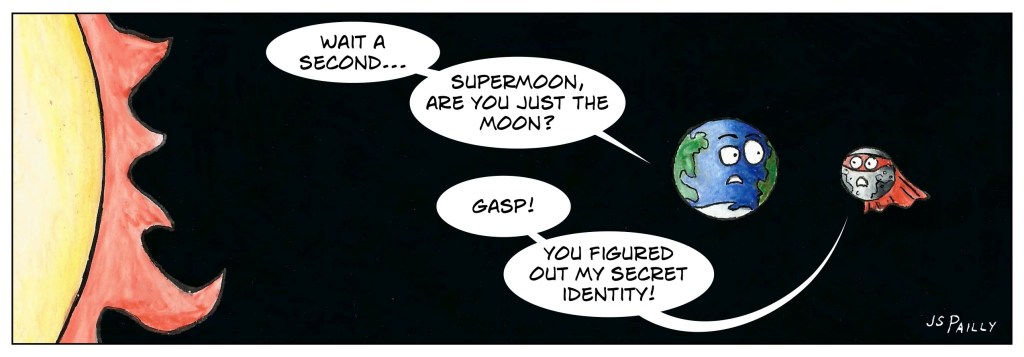
A syzygy-perigee has a marginal effect on Earth’s tides, and if the Sun and Moon are on opposite sides of the Earth (as depicted in the highly technical diagram below), then the Moon will appear to be slightly larger and slightly brighter than normal in our night sky.  Astrologers would have more to say about supermoons, but from an astronomy perspective we’re pretty much done here.

Personally, I don’t really have a problem with the term supermoon.  When the full moon or new moon happens to be 90% closer to Earth than usual, that’s kind of neat.  Sure, the term started as an astrology thing, but there’s a long history of astrology concepts and terminology being borrowed by astronomers.  Supermoon is no different.

And supermoons do tend to get a lot of attention in the popular press.  I’ve had a lot of awesome conversations with people about the Moon and space and science in general that started because of a news report about the latest supermoon.  I think that’s great.  Anything that gets people to take an interest in science is a positive thing in my book.

On the other hand, a few of those conversations have ended with people asking me about their horoscopes, which is a bit disappointing.

Next time on Planet Pailly, please don’t hate anybody, not even the people who deserve it.

A Rainy Day on the Sun

Hello, friends!

I was recently introduced to a new song by Jean Grae entitled “Stop Drawing Sunglasses on the Sun” (click here).  The song raises some valid points.  As an artist who frequently draws sunglasses on the Sun, I guess I have some soul-searching to do.

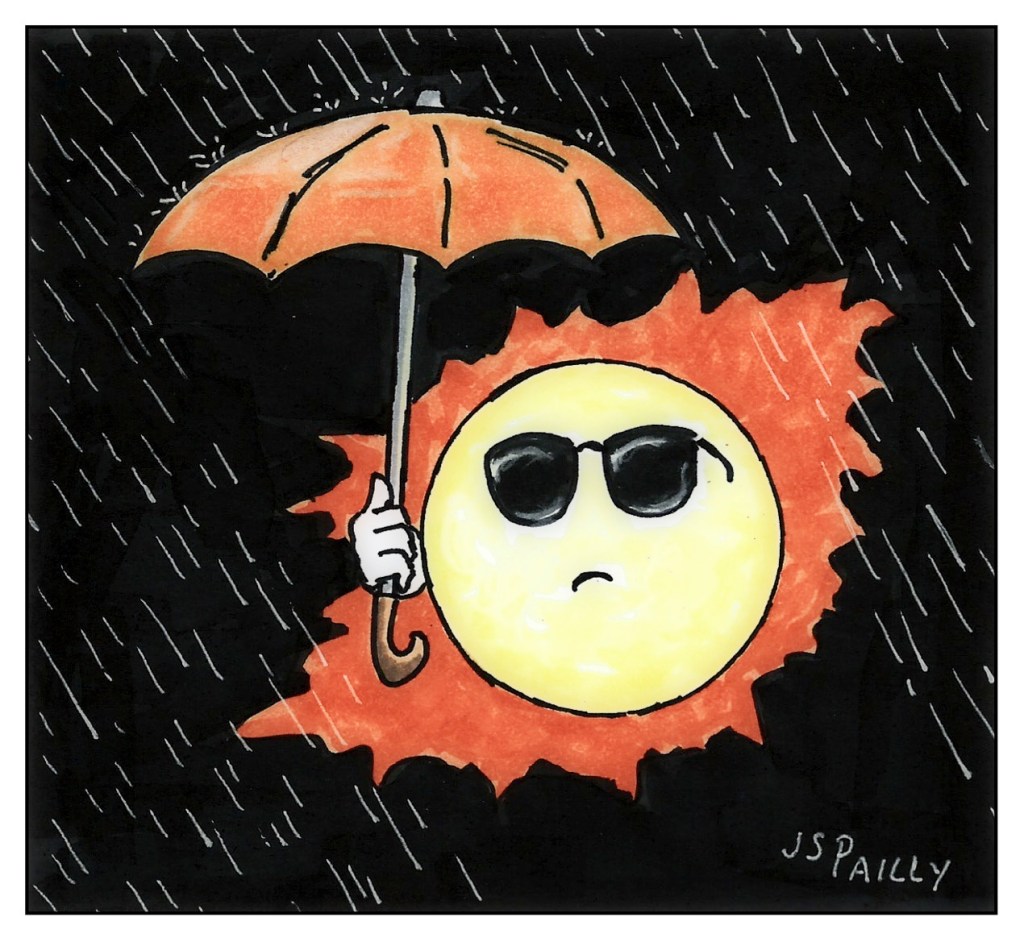
In the meantime, I recently saw a report on spaceweather.com that said it was raining on the Sun.  So naturally, I drew this:

Pretty much everything associated with the Sun it extremely big, extremely hot, and relates somehow to the Sun’s extremely powerful magnetic field.  The Sun’s coronal rain (no relation to the coronavirus) is no exception.

First, let’s talk about the role of the magnetic field.  Ionized gas (a.k.a. plasma) rides up the Sun’s magnetic field lines to form solar prominences: those arch-like or loop-like structures that are often seen suspended above the Sun’s surface.

These prominences are extremely hot, at least by Earth standards, but they’re not quite as hot as the Sun’s surface.  According to this paper from Astrophysical Journal Letters, there are at least two possible explanations for how solar prominences loose their heat.  Whatever the cause of the heat loss, the result is that the cooling plasma begins to condense, much as cooling water vapor condenses in Earth’s atmosphere.  And then rain drops start to form.

But of course, these rain drops are extremely big, more like “rain blobs.”  Due to the technical limitations of Earth-based and space-based solar observatories, we can’t say for sure how big these rain blobs get, but some appear to be “on the order of 5000 km in radius,” according to that same paper from Astrophysical Journal Letters.

So in summation, it rains on the Sun.  Seriously, it rains a lot!  And like pretty much everything else relating to the Sun, this coronal rain is extremely big, extremely hot (by Earth standards), and is associated with the Sun’s extremely powerful magnetic field.  So maybe the Sun doesn’t need sunglasses, but an umbrella seems appropriate.

Next time on Planet Pailly, what is so super about a supermoon?