Sci Friday

I’m very excited about this week’s links.  Any one of them could easily inspire a good science fiction story, or at least an interesting sci-fi world.

  • Sperm Whales May Have Names from Wired Science.  If true… that’s pretty cool.  No comment yet from the dolphins.
  • Atom Smasher Finds Possible New Force of Nature from Cosmos Magazine.  Fermilab’s Tevatron particle accelerator may have discovered a fifth fundamental force in the universe… just before running out of federal funding.
  • Science Publishes Multiple Critiques of Arsenic Bacterium Paper from Science Insider.  Last year, NASA announced the discovery of Arsenic-based life in California.  Almost immediately, the experiment was attacked for possible errors.  The debate continues with huge implications for our definition of life.
  • Living in a Quantum World from Scientific American.  Sadly, this link does not provide the full article unless you have a paid subscription.  But it does give a good hint about what’s happening in quantum research.  I highly recommend stopping by a bookstore or library and checking the June issue of Scientific American; the full article will blow your mind.

Sci Friday

Here are this week’s sciency links.

Carbon vs. Silicon

It’s often suggested that the aliens from the Aliens movies, sometimes referred to as xenomorphs, are silicon based rather than carbon based like us.  There are a lot of silicon based aliens in science fiction, but no one knows if such a thing is really possible.

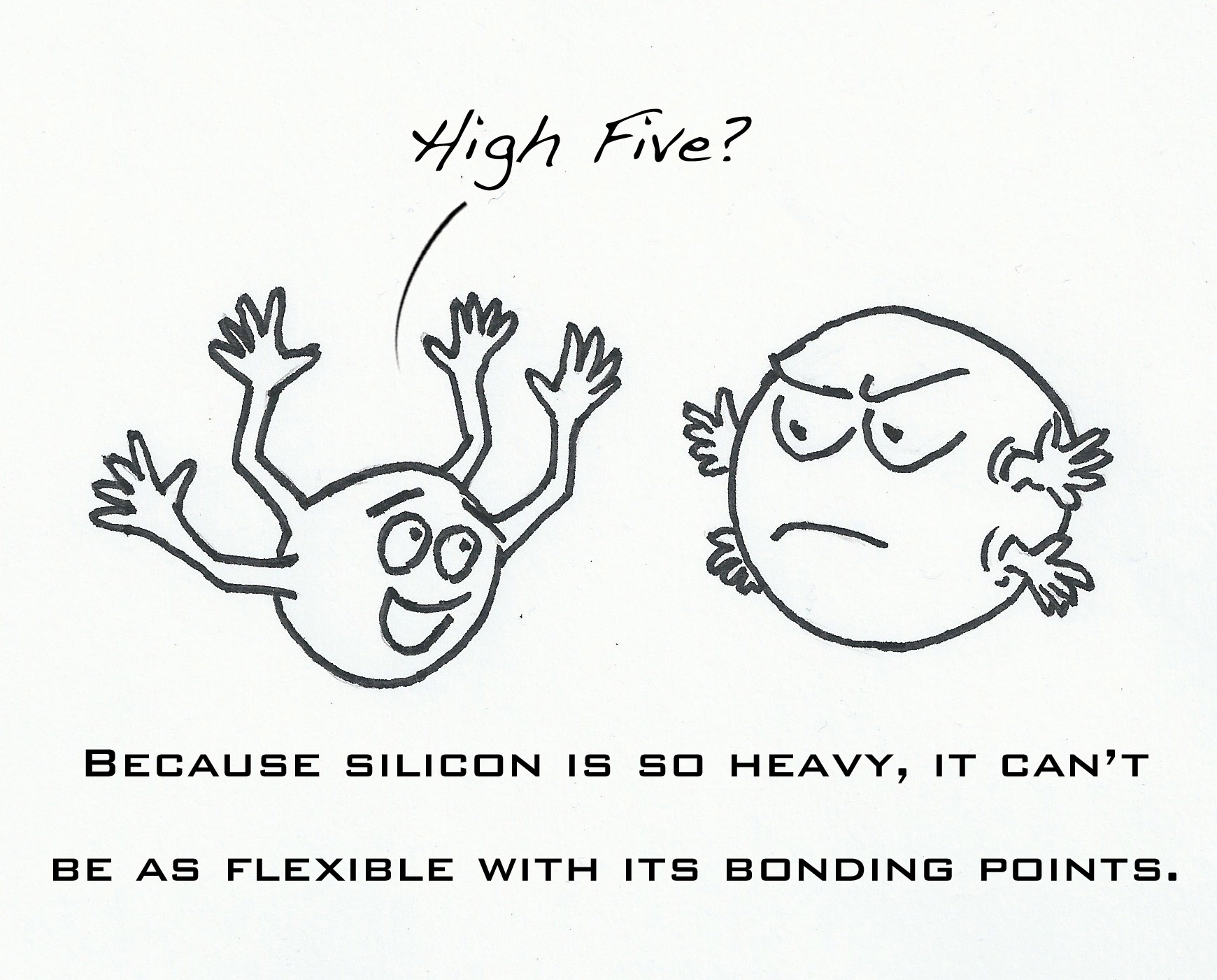
Carbon and silicon have one thing in common: they both have four bonding sites, meaning they can bond with up to four other atoms when making a molecule.  Other than that, they’re completely different.  Silicon is a metalloid; carbon is a nonmetal.  Carbon is much lighter and more flexible, and it’s ten times more abundant in the universe.

If the idea of silicon based life is simply to replace carbon atoms with silicon, it wouldn’t work.  Take breathing for example.  We breath oxygen in, and exhale carbon dioxide.  When a silicon based alien breaths in oxygen, it will have a hard time exhaling silicon dioxide; silicon dioxide is better known as quartz crystal.

I don’t remember any xenomorphs hacking up quartz crystals in the movies, but maybe they use silicon for something else.  Carbon has to be part of their biochemistry anyway, or they wouldn’t be able to grow inside human hosts.

Humans are not only carbon based.  We also depend on oxygen, nitrogen, hydrogen, phosphorus, and sulfur.  Not only that, but we need traces of iron, sodium, potassium, etc as well.  So maybe the xenomorphs can be carbon based and silicon based at the same time.

Sciency Words

I don’t have any sciency words to share myself today, but I recently found another blog that does.  This post, from a blog run by the Clarion Foundation, is about the various terms used to describe the parts of a spaceship.  It’s a great resource for science fiction writers, and I have it saved as a favorite on my browser for easy future reference.

Click here.

Fictional Elements, Part 2

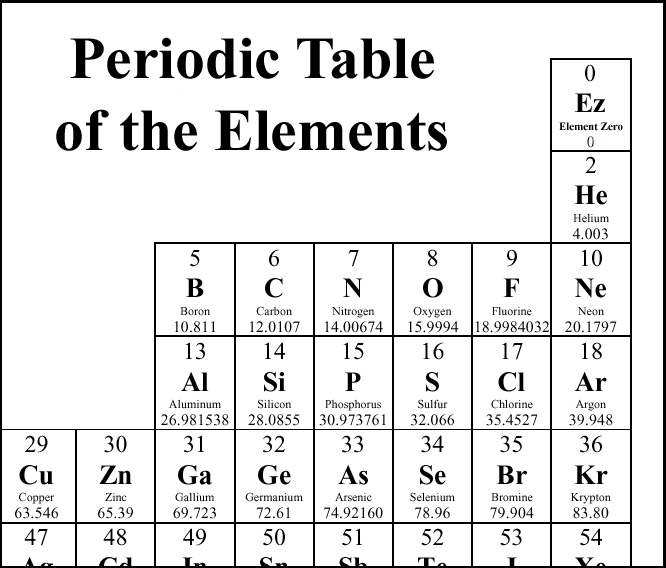
On the periodic table of elements, every element has a number corresponding to the number of protons in its nucleus.  Hydrogen is #1, helium #2, and so forth.  In the video game Mass Effect, scientists have discovered an element with no protons, making it #0.

That’s an interesting idea, and certainly element zero has some qualities which make it a useful plot point, but what’s the difference between an atom with no protons and nothing?

Almost a century ago, a real scientist named Andreas von Antropoff suggested adding an element zero to the periodic table.  He called it neutronium, and it consisted of a single neutron with no proton and no electron cloud.  Since neutronium wouldn’t interact with other elements, it would probably belong with the noble gases and be placed above helium.

Nuetrons, when they’re alone, are unstable and tend to break apart into a proton and electron (and an electron antineutrino).  So neutronium would rapidly decay into hydrogen.  Also, unlike the element zero in the game, neutronium would have mass (preventing it from canceling out the mass of physical objects as described in the game).

I suppose neutronium could be an unstable isotope of element zero.  But then we’re still left with an atom with no proton, no electron cloud, and no neutrons.  So what is it?  Maybe the new Alpha Magnetic Spectrometer will figure it out.

Fictional Elements, Part 1

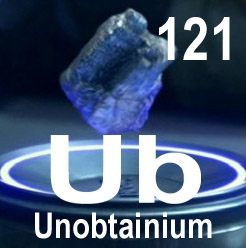
Do you remember the movie Avatar?  Do you remember the precious metal the humans were mining for?  They called it unobtainium, which is the stupidest name any precious metal could have.  I mean… you’re never going to obtain it!

You'll never obtain it.

But lately I’ve been studying the periodic table of elements, and it turns out there are a bunch of elements with names like ununseptium or ununoctium.  And scientists are searching for elements 119 and 120, to be named ununennium and unbinilium.

Suddenly, the name unobtainium seems almost believable.  Then I did a little more research, and to my surprise found that unobtainium is a real thing!  Or at least a real term.

When scientists or engineers need a special material with specific properties, but the material does not exist, they call it unobtainium.  It’s the stuff that will magically solve whatever problem they’re working on.  They name is a placeholder until the required material is discovered or invented.

Science if full of stupid and inaccurate names, but once people get used to those names it’s hard to change them.  Planetary nebulae have nothing to do with planets.  Gluons and glueballs have nothing to do with glue.  Maybe Avatar’s unobtainium is another example.  They discovered a material that fit some specific purpose (like levitating mountains), and the placeholder name stuck.

Tomorrow, Mass Effect’s Element Zero.

Sci Friday

Here are this week’s sciency links.

Quantum Kitty

"What are you doing?"

Awhile back, my friend’s cat interrupted me while I was writing a story about quantum mechanics.  I think I know why.

Quantum mechanics is a difficult subject, full of rules that defy common sense.  A scientist named Erwin Schrödinger proposed a thought experiment to help explain it.

You put a cat in a box with a small device that will either release a deadly poison, killing the cat, or do nothing at all, sparing its life.  The cat has a 50-50 chance of surviving the experiment, but until someone opens the box both possible outcomes exist simultaneously.  The cat is both alive and dead at the same time.

As odd as this seems in the real world of cats and boxes, it is true of atoms and subatomic particles.  They exist in all possible positions, doing all the things they could be doing, until someone observes them.

"Why aren't you looking at me?!"

This is the reason my friend’s cat interrupted my writing.  He was concerned that, since no one was observing him, he might turn out to be dead.  That’s why cats crave attention so much.  They understand quantum mechanics… maybe better than we do.

P.S.: I don’t know much about Erwin Schrödinger, but I really hope he didn’t own any cats.