Final (Regular) Post

I’ve enjoyed writing this blog.  I’ve learned a lot and met a lot of cool people.  I am sorry to bring this to an end, but the reality is I have too muck work to do for the Tomorrow News Network series and I just don’t have the time to keep up with both projects.

At the beginning of this year, I promised to write ten short stories featuring time traveling journalist Talie Tappler.  The first seven are complete, and you can read them for free at the Tomorrow News Network website (click here).

The final three will bring this year’s series to an epic conclusion, and one of Talie’s most closely guarded secrets will be revealed.  They will also set the stage for another set of stories next year.

In addition to that, content for the Tomorrow News Network website is expanding.  I’ll be writing a lot more posts profiling aliens, technology, and time travel.  And yes, I’ll still write about the science behind science fiction­­­­–just on the TNN site rather than this one.

So I hope you’ll join me for Talie’s next time travel adventure.  If nothing else, it’s bound to be sciency.

Update: This blog will remain active after all.  I just won’t be updating it as regularly.

The World is Flat

If you’ve been wondering why the universe is restricted to only three dimensions, then I have news for you.  It’s not.  I’ve just finished reading a book called Flatland: A Romance of Many Dimensions by Edwin Abbott, originally published in 1880.  It’s a story set in a world of two-dimensional people who find it completely impossible to imagine a third dimension.

The first half of the book is incredibly boring.  It details at length the two-dimensional world and its population of geometric shapes.  But the second half of the book will blow your mind.  The main character, a square, encounters a being he cannot comprehend: a circle that, in his limited field of vision, appears to change his size.  In other words, he meets a sphere.

What follows is an almost messianic revelation: there is a third dimension.  Reading this story of a square struggling to understand a world beyond his everyday existence and then struggling to explain to his fellow polygonal shapes what he’s learned, I am forced to wonder what it would be like to meet a four-dimensional being and how pathetic would I look to him struggling to understand something that is, to him, so simple.

If only the author could have gotten to the point a bit sooner, I wouldn’t have spent the first half of this book being so bored.  However, it is important to set the stage, to make the two-dimensional point of view as clear as possible, before getting into the real story of our multidimensional universe.  Also, since the book is so short (in printed form it’s less than 100 pages) you can get through that part fairly quickly.  Best of all, the ebook version is free on Amazon.

This book is an example of what great science fiction can do.  I sat through some lectures on multidimensional physics once hoping to learn something useful for my writing, but there was way too much complex math and I came away disappointed.  This book makes its points clearly.  You don’t have to know any math except how to count.  It works because the science is presented as a story, something anyone can understand.

Higgs Party!

Yesterday, July 4th, scientists at CERN announced they had discovered the Higgs boson.  This boson, sometimes referred to as the “God Particle” or the “God Damn Particle” because it was so damn hard to find, was pure theory until yesterday.  The standard model of quantum physics predicted it would exist, but many were skeptical about it.  Even the esteemed Stephen Hawking once offered a bet that it would never be found.

The Higgs boson is part of a larger energy field called the Higgs field, which gives mass to all matter in the universe.  The Higgs field surrounds us and penetrates us… it binds the galaxy together… in other words, scientists have discovered the Force.  Now we just have to learn how to manipulate it with our minds.

Since July 4th is Independence Day here in the United States, I was too busy celebrating America to also celebrate the new particle, so I’ll celebrate today instead.  I’ve gone so far as to buy the Higgs boson a cake.  It seems appropriate.  Since cake is known to add lots of mass to people, surely it contains a great many Higgs bosons.

How are you celebrating the Higgs boson discovery?

Alien Mermaids

So far, we’ve discovered hundreds of exoplanets, planets outside our Solar System, and of those exoplanets we’ve found at least three that may be able to support life.  But our search for extraterrestrials doesn’t have to go as far as other star systems.  The odds of finding alien life right here in our Solar System are increasing.

Water is essential for life.  You and I are made of about 60% water, yet water in liquid form is extremely rare.  Even here on Earth, there isn’t as much as you might think, as illustrated by a recent image on Astronomy Picture of the Day (click here to see it).  Liquid water is almost nonexistent in other parts of the Solar System.

Yet scientists have found evidence of liquid water on the surface Mars, melting from the polar ice caps during the warmer seasons.  There’s evidence of subsurface oceans on Jupiter’s moon Europa and Saturn’s moon Enceladus.  Now the Cassini spacecraft has reportedly found another subsurface ocean on Titan, one of Saturn’s other moons (click here for more information).

I don’t know if Titan has life, but if we keep finding sources of liquid water we are bound to find life somewhere.  This life would probably be bacterial.  There could also be some kind of fish.  Or maybe one of these subsurface oceans supports a civilization of alien mermaids.

What? It’s possible.

Birthday

Today is my birthday.  You may be wondering how old I am.  To quote Mr. Worf when asked the same question, “I am… old enough.”

Sadly, the one thing I really want—to celebrate my birthday in space—is still not possible.  At least not at any price I can afford.  So I’m counting on you, SpaceX, and you, Virgin Galactic, and you other private space tourism companies to make my birthday wish come true some day if not today.  Keep building your spaceships, keep improving your technology, and as your industry booms keep your promises to gradually lower your prices.  If you guys really want to spoil me, you should look at ways to get me to the Moon or Mars within my lifetime.

I suppose if I can’t go to space this year, an acceptable alternative would be the discovery of the Higgs Boson.  The Higgs Boson is a theoretical particle, sometimes called the God particle, which would explain why other subatomic particles have mass.  CERN, the European nuclear research agency currently leading the search for the elusive boson, has hinted that they’ve found something.  They’re planning to make an announcement in early July.

If nothing else, I am happy I was born in an era with so many exciting advancements in science and technology.  That alone is worth celebrating.

Zombie Apocalypse

CNN’s Erin Burnett recently compared the strange, cannibalistic behavior of a man in Miami to that of zombies.  He was reportedly savage like an animal, attacked another man and ate human flesh, and when police came they had to shoot him multiple times to stop him as though he possessed super human strength.  According to police, the man was on synthetic drugs commonly referred to as “bath salts.”

Zombie novels, movies, and video games have explained the zombie apocalypse in many different ways.  It can be caused by a virus, nanotechnology, or even drugs.  Usually these drugs are manufactured by the government or some powerful corporation, but it turns out the people who make bath salts—whoever they are—are the real danger.

If bath salts don’t start the zombie apocalypse, there are plenty of other things that could.  For example, ants with a certain fungal infection have exhibited zombie-like behavior.  According to researchers, the fungus infects the ant, grows into the brain, and takes control of the insect’s whole body.  It then directs the ant to a cool, dry location where the fungus can grow and spread its spores.  According to scientists, there is no reason why a similar fungus couldn’t infect other organisms.  For more on this, click here.

The good news is that when the Zombie apocalypse comes, we will have the laws of physics to protect us.  The first law of thermodynamics tells us that matter and energy cannot be created or destroyed, but the second law says they can be—and inevitably must be—wasted.  Nothing can use energy with 100% efficiency, not even a zombie.  So as they claw at your door trying to get in, be assured that they’ll eventually wear themselves out, the energy slowly draining from their mutilated bodies, and then they’ll die.

So before the bath salt epidemic goes too far or before zombie ant fungus spreads to humans, stock up on food, find a secure shelter, and be prepared to wait the zombies out.  They can’t go on forever.

My Trip to Mars

A new Tomorrow News Network story comes out tomorrow, and this one’s set on Mars.  To prepare for writing this story, I had to make a quick trip to Mars to familiarize myself with the place, and thanks to Google Earth that is possible.

For those of you who already have Google Earth on your computers, you know how cool it is.  For those of you who don’t have it, click here.  It’s free, and it’s awesome.  Not only do you get a complete map of Earth, but also Mars, the Moon, and the constellations.  Furthermore, using topographical information, Google Earth can create virtual simulations of Terran, Martian, or Lunar landscapes.

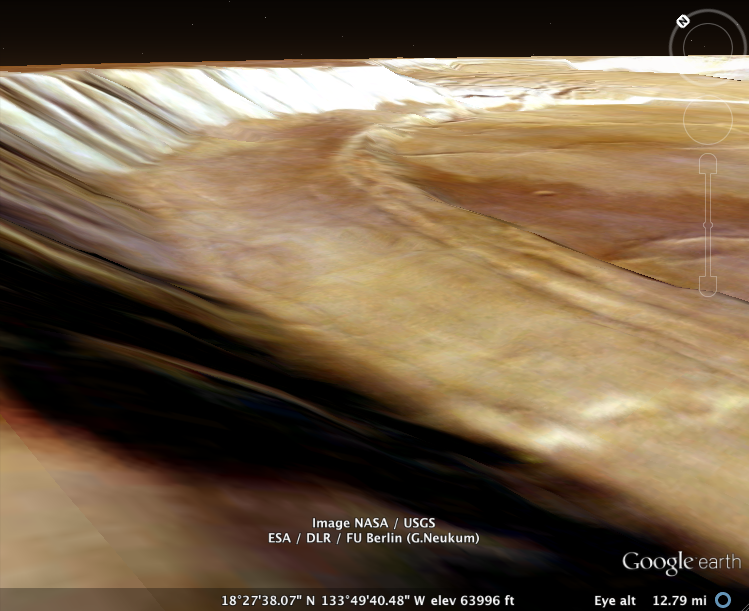
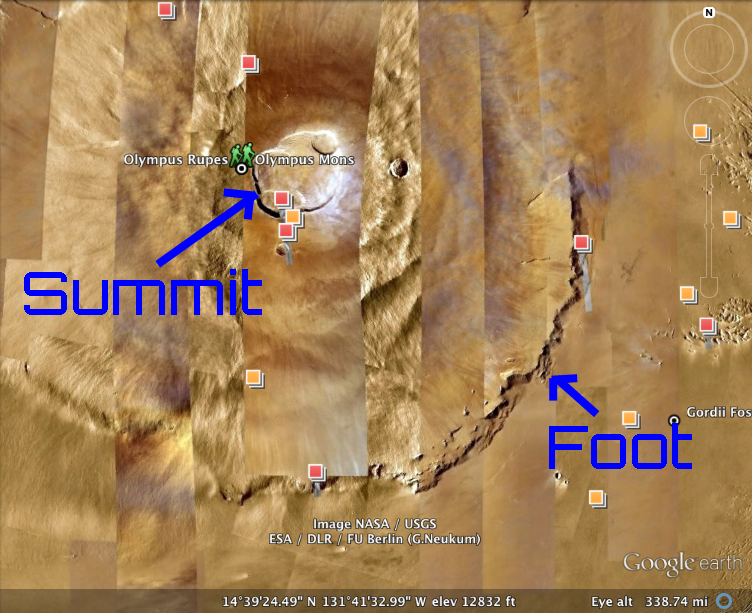
Most of this month’s Tomorrow News Network is set in a colony near Olympus Mons, the largest mountain on Mars.  In fact, it’s the largest mountain in the Solar System.  So my first stop was the summit of the mountain.

Olympus Mons is actually a volcano. What you see here is part of the crater.

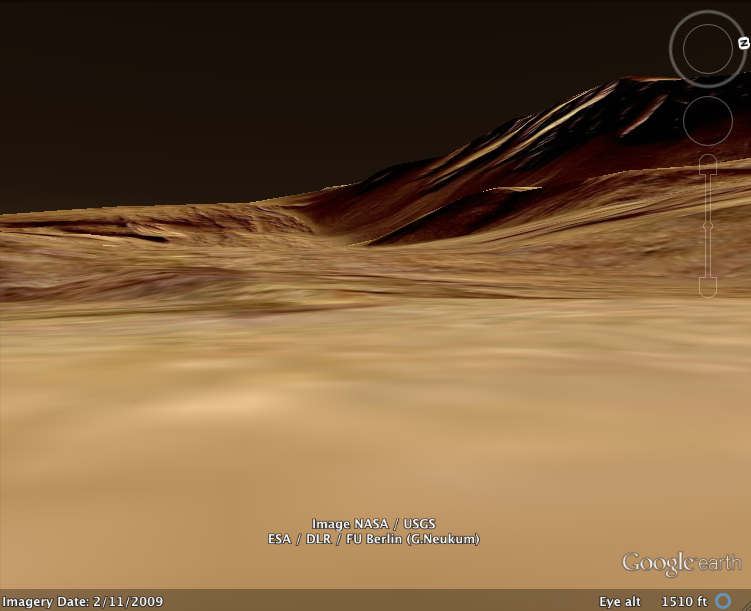
Next I went to the foot of the mountain.  It’s hard to see just how huge Olympus Mons is in these screenshots.  The mountain is so big it wraps around the curvature of the planet, so from the bottom you can’t see the top because the top is beyond your horizon line.

This is a steep slope near the foot of the mountain. The rest of the mountain is too big to see from ground level.

I don’t spend a lot of time talking about Olympus Mons in the story coming out tomorrow.  We have too many other things to talk about, but as a writer I like to know as much as possible about the places I write about.  Google Earth is a surprisingly good way to do that.  I used it to explore Roswell Army Air Field for another story (much of the original base is still there and still in use), and now I’ve used it to explore Mars.

The view from above.

So thank you, Google.  You guys have made one science fiction writer’s job a little bit easier.

All images in this post are © 2012 Google.

Update: The Tomorrow News Network story for June is now posted.  Click here to start reading “Death to History.”

Versatile Blogger Award

Last week, fellow blogger Spacerguy nominated me for the Versatile Blogger Award.  Spacerguy writes an excellent blog about Star Trek, which I encourage you to check out by clicking here.  He recently participated in the A to Z Challenge, writing a series of blog posts starting with successive letters of the alphabet.

As for the award, I’m really honored.  Apparently with the Versatile Blogger Award (or VBA), being nominated is the same as winning, and as a winner I have certain responsibilities.  First of all, I have to spread the love, so here are fifteen other blogs that, in my opinion, also deserve VBAs.

  1. An Englishman in New Jersey
  2. Biology in Science Fiction
  3. Centauri Dreams
  4. Clarion Blog
  5. Fiction Flurry
  6. Gurney Journey
  7. Help!  I Need A Publisher!
  8. I Make Up Worlds
  9. Lawyer?  I Hardly Know Her
  10. Reality Skimming
  11. Science in My Fiction
  12. Sci Fi Chick
  13. Space Business Blog
  14. The Skeptical Teacher
  15. The Website at the End of the Universe

Secondly, I’m supposed to tell the person who nominated me seven things about myself.  So to Spacerguy (and everyone else), here we go.

  1. I’m a book collector.  I own hundreds of books, a few of them signed first editions.  The pride of my collection is a signed copy of Dinotopia by James Gurney.  (James Gurney’s blog is in the list above, by the way)
  2. I think octopi are going to take over the world.  They have amazing dexterity with those tentacles of theirs, and they’re a lot smarter than people give them credit for.
  3. I have mixed feelings about private corporations taking over human space exploration.  It seems like a good idea right now, given the state of the federal government and the deficit, but I worry about corporate greed gobbling up our Solar System.
  4. This past weekend, I got Patrick Stewart and Avery Brooks’ autographs at Philadelphia Comic Con.
  5. SPAAAAAAAAAACE!!!! (Fans of Portal 2 know what I’m talking about.)
  6. I don’t believe religion and science are mutually exclusive.  I’m a Christian who believes in evolution and global warming, and as a Christian I am in constant awe of the beauty of God’s creation.
  7. I’m writing a short story called “Dinosaurs vs. Astronauts” for my Tomorrow News Network series.  It comes out in July, and—in case you were wondering—it’ll be about dinosaurs fighting astronauts.

By the way, I won this award for a specific post entitled “What is Science Fiction.”  Click here to read it.

SpaceX Boldly Goes Where No Private Company Has Gone Before

Last week, SpaceX successfully launched its Dragon Capsule and docked it at the International Space Station.  They are the first private company to ever send a spacecraft to the ISS.  It’s a historic moment, a definite cause for celebration.  This marks the beginning of a new era of corporate space exploration.  But is the corporate take over of space a good thing?

Space exploration should be motivated by our sense of wonder.  We should do this not because of greed but because we want to learn more about the universe we live in, want to see it and experience it in all its beauty.  As humanity spreads across the stars, I hope we retain the romantic ideals espoused by science fiction like Star Trek.

Elon Musk, the CEO and Chief Designer at SpaceX, reportedly wants his company to someday take people to Mars and other planets in the Solar System.  I’d love nothing more than to see him succeed.  But I remember a science fiction movie where the first spaceship to land on Mars was plastered with ads like something out of NASCAR.  American commercialism has a way of cheapening things, and I worry about that.

Money is what makes our society work.  Maybe by turning space exploration over to the private sector, we can return to the Moon, go to Mars, and eventually leave our Solar System a little sooner.  After all, Congress has cut NASA’s budget so much they can’t even afford their own Space Shuttle.  If NASA can’t do this, someone else has to take their place.

What do you think?  Are you glad the private sector is taking over space exploration?