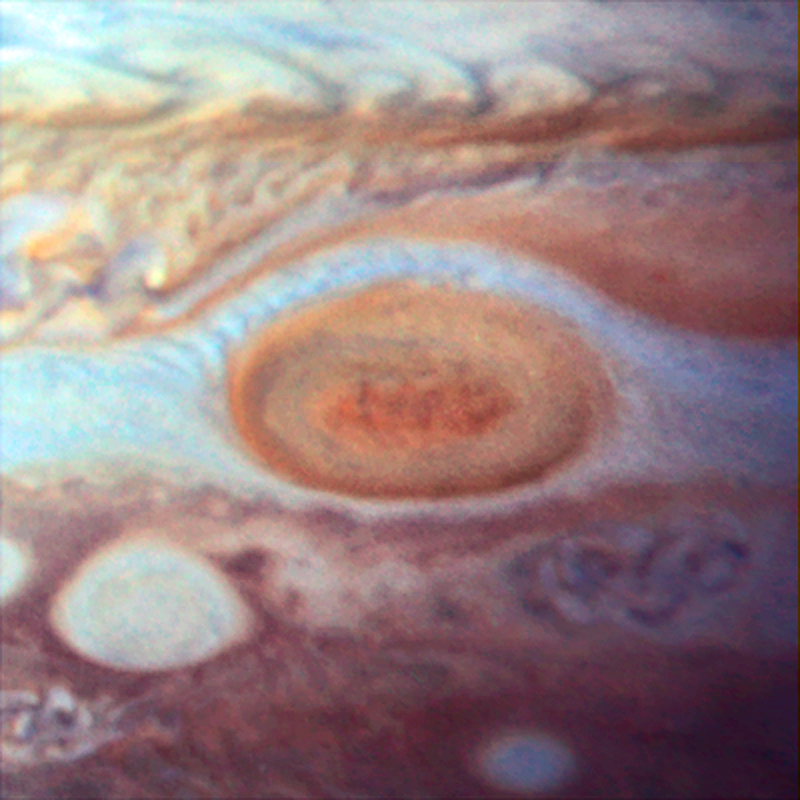
The ignominy of losing Pluto as a planet will be nothing compared to losing the Great Red Spot on Jupiter. Pluto still exists. It may not be considered a planet, but it still exists. Unfortunately, the Great Red Spot, astronomers tell us, is shrinking. Perhaps in a century or so, it will dissipate completely, and Jupiter will just be that big, stripy planet with no other interesting features.
Long ago, in the time of Isaac Newton, everyone assumed the heavens were permanent and unchanging, planets and stars forever locked in their circular pathways through the sky. Even today, most predictions of future space events seem to forecast changes millions or billions of years in the future. Sadly, some things can change much more quickly.
The Great Red Spot is sort of like an enormous hurricane, possibly the most beloved hurricane in the Solar System. Let us hope that the weather on Jupiter takes a sudden turn for the worse, allowing the Red Spot to return to its former glory.
Today’s post is part of a special series here on Planet Pailly called Sciency Words. Every Friday, we take a look at a new and interesting scientific term to help us all expand our scientific vocabularies together. Today’s word is:
THE LONGITUDE PRIZE
300 years ago, the British Empire faced a major problem: how can a ship at sea accurately determine its position. Finding your latitude was easy and involved measuring the distance of the Sun or North Star from the horizon, but what about longitude? No one knew, so Parliament offered 20 thousand pounds to anyone who could figure it out.
A British “man of war,” the backbone of the British Navy from the 16th to 19th Centuries.
Today, the Longitude Prize is back. 10 million pounds will be offered to help solve one of six challenges currently facing humanity. Those challenges are:
Antibiotics: What can we do to prevent bacteria from becoming resistant to our antibiotic medications?
Dementia: People live a lot longer than they used to, and that means we’re seeing more cases of Alzheimer’s and dementia. What can we do to help the elderly maintain healthy, independent lifestyles?
Food: How will we feed over 9 billion people in the coming decades?
Flight: Can we build commercial aircraft with zero carbon emissions?
Paralysis: Could new medications and/or cybernetic technology make it so the paralyzed can walk again?
Water: Only a tiny percentage of the water on Earth is safe to drink. Again, the world population is expected to exceed 9 billion in the coming decades, so how will we provide clean drinking water to all those people?
Anyone who has a BBC iD can vote on which of these six projects should get Longitude Prize funding (click here for details). My choice would be either for flight, since I’d love to travel without feeling guilty about the environment, or water, a problem which I suspect affects the greatest number of people worldwide.
So what about you? Which project would get your vote?
P.S.: The original winner of the Longitude Prize was John Harrison who found a way to calculate longitude by comparing the position of the sun (or other astronomical object) to the time of day.
Today’s post is part of the Insecure Writer’s Support Group, a blog hop hosted by Alex J. Cavanaugh. It’s a way for insecure writers like myself give each other advice and encouragement. Click here to see a full list of participating blogs.
* * *
Michelle Joelle, author of the blog Soliloquies, recently wrote a post about what’s in her pensieve. For those of you who aren’t familiar with Harry Potter, a pensieve is a large cauldron in which you can deposit thoughts, ideas, or memories, which then take on the appearance of a weird, sparkling liquid. Dip your head in this liquid, and it will let you relive the past and help you sort through your thoughts.
So today, I thought I’d share a few of the things I’ve put into my pensieve.
Myths, Lies, and Half-Truths of Language Usage: I recently completed this lecture series from the Great Courses on how the English language actually works (as opposed to the blackboard grammar we were forced to learn in school). I’ve purchased several lecture series from the Great Courses before to help with my research, but this one was by far the most useful. It opened my eyes to how beautiful English is despite its purported faults.
Kerbal Space Program: I write science fiction. That means I need to know something about space travel, and the educational video game Kerbal Space Program is teaching me everything I need to know. So far, I’ve learned how to design a basic rocket and achieve orbit. Next, I’m heading for the Moon. Each lesson the Kerbals teach me goes straight into my pensieve to help shape my next Sci-Fi story.
Royalty Free Music: The point of royalty free music is to allow people to include it in their audio/video projects without having to worry about paying royalties to the original musicians. I listen to it because it’s created to evoke specific moods, so it makes the perfect soundtrack for writing time. I’m particularly fond of Kevin MacLeod (and I couldn’t help but notice some of his work is in Kerbal Space Program!)
A few other random things have fallen into my pensieve as well: an adorable, plush piglet, a certain friend’s wedding, the Thesaurus Rex app I just downloaded on my phone… The next time I immerse my head in that cauldron of sparkly liquids, I look forward to seeing what story might have blended together from all this stuff.
As human astronomers scan the heavens, trying to locate alien life, they generally assume they know what they’re looking for: a planet similar to Earth. They’ve confirmed the discovery of hundreds of worlds, but none are quite like our little, blue planet. So astronomers keep searching, but what if they’ve overlooked something? What if Earth is not typical of life-bearing planets?
To get a better sense of what astronomers should be looking for, I reached out to a few extra-terrestrial friends to ask what they think of life on Earth. Here’s what they said:
Eiol of the planet Sisip: Life on Earth? How could it get by with all the planet’s water sloshing around in liquid form? Ice is far more convenient. It’s easier to transport, it’s harder for contaminates to mix in, and it makes a satisfying crunch sound when you chew it.
Dr. Ullumon of Cygnus: Carbon-based life is impossible. Complex organisms can’t develop from an element as plain and ordinary as carbon. Perhaps one day we might find silicon-based life with carbon impurities, but no living thing could truly be based on carbon.
Globitarto of the Tartonians: All life forms require the nourishment of cosmic radiation, but Earth is enveloped in a magnetic field which blocks most of that radiation from reaching the planet’s surface. Stories about intelligent life on Earth make good science fiction, but I’m afraid it’s scientifically implausible for anything to survive in that radiation-poor environment.
Vivi Gol of the planet Poxx: If there’s life on Earth, surely the Martians would have discovered it by now. Why haven’t they said anything?
When I told my extra-terrestrial friends that I am from Earth, most of them laughed, and Dr. Ullumon suggested I seek medical attention for all the carbon contamination he found in the blood samples I provided. Just goes to show how difficult it is for some people to imagine life forms that are different from themselves.
Today’s post is part of a special series here on Planet Pailly called Sciency Words. Every Friday, we take a look at a new and interesting scientific term (or in today’s case, four terms) to help us all expand our scientific vocabularies together.
* * *
Space travel really isn’t complicated once you understand the terminology. Words like left, right, up, and down don’t mean much in zero gravity, nor do words like forward or backward. If you’re aboard a ship that uses centrifugal force to simulate gravity, even the terms port and starboard might cause confusion. So in order to navigate in space, we need to use a whole new vocabulary.
As I discussed on Wednesday, I’ve started playing Kerbal Space Program as a way to learn more about space travel. Thanks to the game and various game F.A.Q.s I’ve found online, I’ve picked up four new sciency words every space navigator needs to know.
Apoapsis: the highest point in your orbital path.
Periapsis: the lowest point in your orbital path.
Retrograde: if you fire your rockets in the opposite direction to your movement, you’re firing them retrograde. This will cause you to slow down.
Prograde: if you fire your rockets in the same direction as your movement, this is prograde, and it will cause you to speed up.
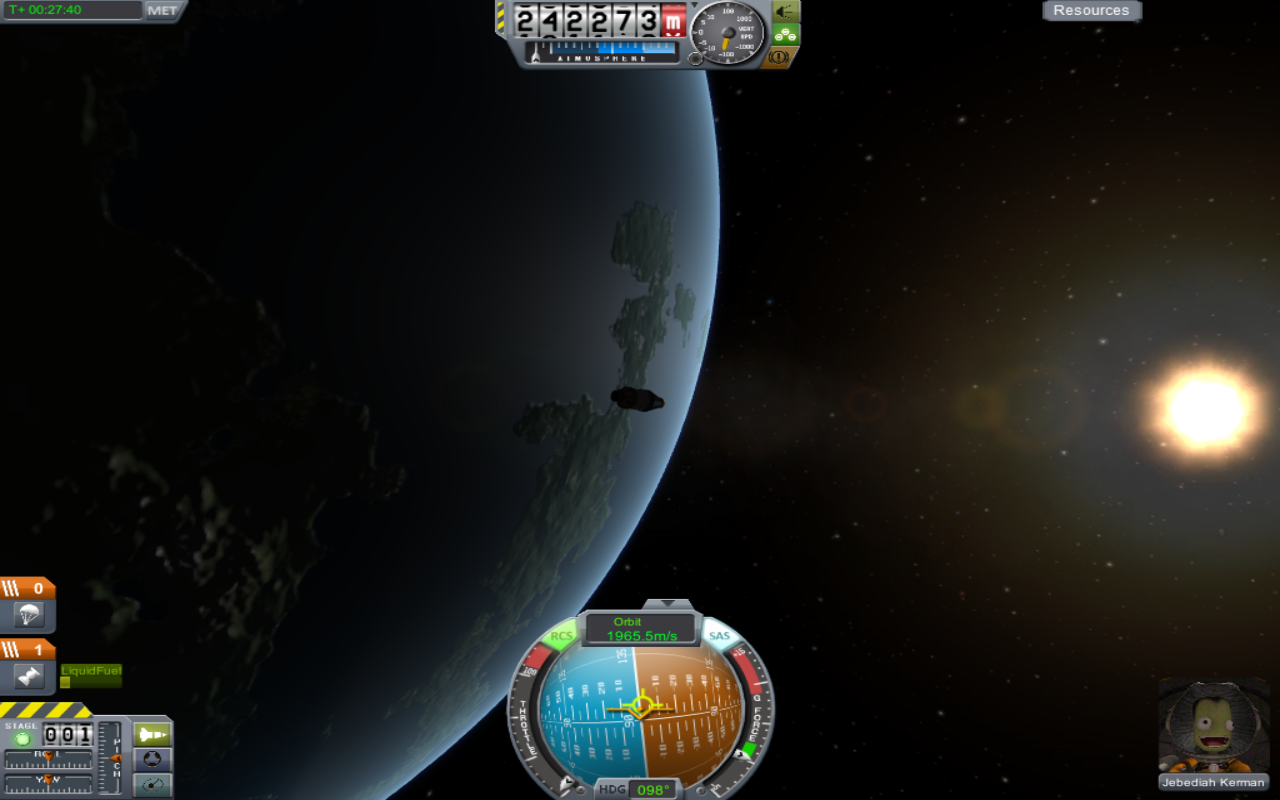
A shot of my first K.S.P. spacecraft to successfully achieve orbit! This was perhaps one of the proudest moments in my life (don’t judge me).
When you want to move your spaceship to a higher orbit, fire your rockets prograde. If you want to lower your orbit, fire your rockets retrograde. According to my research and my experience in Kerbal Space Program, lowering your orbit from your apoapsis (highest point) is the most fuel-efficient option. The same is true for increasing your orbit from your periapsis (lowest point).
These four terms are still new to me. I’ve only been playing Kerbal for a little over a week now. So if anything I’ve written here is mistaken, either in regards to Kerbal Space Program or real life, please let me know in the comments below.
P.S.: Today’s post is related to a series here on Planet Pailly about sciency video games. To find out more, click here.
Today’s post is part of a series of posts profiling sciency video games. These are educational games, most available for free online, that can really help you gain a deeper understanding of science. Click here to find out more about this series.
* * *
If I ever get the opportunity to go to space, I’m pretty sure I’ll be this guy:
The best way to learn how to do something is to actually do it, and preferably to do it repeatedly. In Kerbal Space Program, you are in charge of your own space program with an infinite number of squishy, green volunteers who are so eager to get to space they don’t care what crazy, new spaceship design you’ve come up with. This game will teach you about space travel by making you do it over and over again.
That might sound tedious and dull, but it’s not. When you sit down to build your first spaceship, I recommend reading the descriptions of the various spaceship parts. We’re told that some pieces of highly advanced equipment came from the local junkyard. Others were found lying by the side of the road. Still others are described as “dishwasher safe” or “unsuitable for children under the age of 4.” If you’re still not convinced this is an educational video game with a sense of humor… watch the video again. Or watch this one:
The only downside to Kerbal Space Program is that you don’t receive much guidance. You basically have to figure out what you want to do and how you want to do it through trial and error. My first launch ended in spectacular failure because, among other things, I didn’t know to include a parachute on my space capsule. But I learned, and now I’m better at this game, and none of my Kerbals have died since!
As a science fiction writer, I doubt I’ll ever write a highly technical description of how to launch a spacecraft into orbit—I wouldn’t want to bore my readers—but even though I may never include such information in a story, I still need to know it. What differentiates great science fiction from the mediocre variety are authors who can write about science with confidence, as opposed to authors who can only make timid guesses about futuristic technology. With the help of my Kerbal friends, I hope to become more confident about the science part of my storytelling.
Sadly, Kerbal Space Program is the only game on my list of sciency video games that isn’t free, but if you’re interested, please click here to find out how you can get the free demo version, or click here to buy the game.
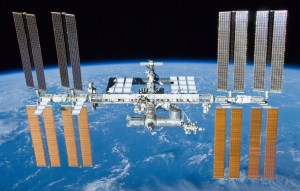
Let’s say you don’t own a car, so you carpool to work. You have a nice arrangement with a friend: he drives, you pitch in for gas, and everybody’s happy. Then you and your friend get into a fight, and all of a sudden you can’t get a ride to work. This is now the situation between the United States and Russia after our dispute over Ukraine. The Russians are no longer willing to give American astronauts rides to the International Space Station.
Image courtesy of NASA
Now I don’t write a blog about politics, and I don’t want to go into a discussion about the Ukrainian situation. It sounds to me like there are good guys and bad guys on both sides, and the whole thing is a complicated mess. But now this mess is affecting the one issue that I and my blog care about most: space.
The plan was that, following the termination of the space shuttle program, private companies like SpaceX or Virgin Galactic would pick up the slack. After my initial skepticism, I came to see this as a good thing if only because it meant American space exploration would no longer be totally beholden to the whims of Congress. But those private space companies aren’t ready yet. They need at least a few more years before they can start launching astronauts into space.
One Russian official suggested that, in the meantime, NASA could try using trampolines to send its astronauts into space. We can only hope this quarrel with Russia will provide the impetus private space companies need to prevent further delays and get their fleets into orbit. Otherwise, the future of the International Space Station is in jeopardy.
Today’s post is part of a special series here on Planet Pailly called Sciency Words. Every Friday, we take a look at a new and interesting scientific term to help us all expand our scientific vocabularies together. Today’s word is:
ECCENTRICITY
According to the dictionary, eccentricity means deviating from the established norms, especially in an odd or whimsical manner. I’m sure we’ve all met eccentric people at some point in our lives. In high school, I was involved in musical theatre, so I got to see eccentricity up close and personal. But did you know actors and actresses aren’t the only ones who behave eccentrically? The term can also be applied to the behavior of planets.
The established norm for a planet’s behavior is to orbit a star. To be more specific, planets are supposed to circle stars, as in their orbits should be perfect circles. The less circular a planet’s orbit is, the more eccentric it is said to be. In fact, a planet’s eccentricity can be quantified by measuring just how un-circular its orbit is.
One of my planets in Super Planet Crash has a highly eccentric orbit. Can you guess which one?
The thing is, according to Kepler’s laws, no planet has a perfectly circular orbit. The “established norm” is a myth. They all travel along slightly ovular paths, sometimes coming a little closer to the Sun, sometimes moving a little farther away. So it turns out that, just like people, all planets are at least a little eccentric.
P.S.: Today’s post is related to a series here on Planet Pailly about sciency video games. To find out more, click here. To start playing Super Planet Crash, a game where you can see eccentric planets in action, click here.
Today’s post is part of a series of posts profiling sciency video games. These are educational games, most available for free online, that can really help you gain a deeper understanding of science. Click here to find out more about this series.
* * *
The Solar System is fragile. The orbits of all the planets are affected not only by the gravity of the Sun but by the gravity of their fellow planets. Not only that: the combined gravitational pull of all the planets affects the Sun, causing it to wobble in place. Our Solar System is like a big, complicated machine with lots of moving parts, vibrating and shuddering, ready to burst into a million pieces at the slightest disturbance.
Lots of planets packed into a relatively small space. This won’t end well.
So with that in mind, it’s time you tried to make your own solar system. In the game Super Planet Crash, you drop planets into orbit around a star. The larger the planet, the more points you’ll score, assuming you can keep all those celestial spheres from colliding or hurling each other into deep space. If you manage to keep your solar system stable for 500 rotations, you win the game (FYI: I have yet to win the game).
If you’re not careful, you might create some dangerously weird orbits, like the orbit of that little pink planet pictured above.
It’s one thing to know intellectually that the Solar System exists in this delicate balance; it’s another to see how easily that balance can be disrupted. That is ultimately the lesson this game is trying to teach. In fact, astronomers have discovered rogue planets out there, drifting through space without a star to orbit. Presumably this happens because of people like me trying to play Super Planet Crash.

.jpg#mediaviewer/File:Het_Kanonschot_-_Canon_fired_(Willem_van_de_Velde_II,_1707).jpg)



 Planet Pailly