Don’t Panic: It’s Just Another Asteroid

People ask me all the time: “Hey, did you hear about that asteroid?” These people then tell me about some asteroid that’s supposed to “just barely miss us” is the next day or so. Sometimes, they also ask, “Aren’t you worried?”

There are certain kinds of space news that I simply can’t get excited about anymore. This is one of them. Why?
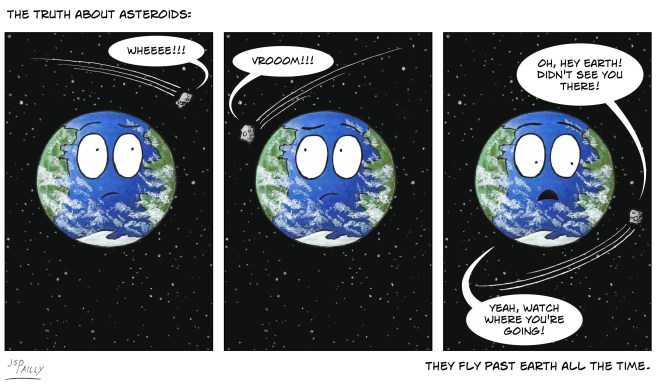
nv23-asteroid-flybys

There’s actually a newsletter about asteroid flybys. It’s called Daily Minor Planet, and I have a subscription (it’s free). Every day in my inbox, I’m notified of the latest asteroid or other object skimming past Earth. Every day. Sometimes there are more than one per day.

Occasionally, one of these objects will pass within the radius of the Moon’s orbit. That’s not an everyday thing, but still… it happens more often than you might think.

So when people ask if I’ve heard about the latest asteroid flying past Earth, the only thing I can really say is, “Which one?” And if someone asks me if I’m worried, my answer is no. The asteroids that make headlines on the news and the asteroids that appear in Daily Minor Planet… those are asteroids we know about. It’s all the asteroids we don’t know about that scare the bejesus out of me.

Stronger Together

Last Wednesday, the day after the election, my muse may or may not have wanted to write. I’m not really sure.

nv15-day-after-the-election

A few years back, I saw Jonathan Maberry at a writing conference, and he gave out some advice to new writers, particularly writers new to blogging and social media. One of the things he said was don’t talk about politics.

So I don’t talk about politics, at least not on this blog, not unless there’s some direct relevance to the kind of science or science fiction I write about. But after doing some soul searching this past week, I’ve decided that I do need to say something about the election, because it is relevant to my writing.

For me, this election was about the future. What sort of future do we want? What sort of future do we believe in? I happen to be white and male. Over the last year, certain other white males looked at me and seemed to presume that I was “one of them” and that I’d be receptive to the vision of the future they wanted.

But I do not believe in a future where everyone looks like me, nor do I believe in a future where people who are different than me are safely cordoned off. I believe in a future where people of all races, religions, sexual orientations, and genders or gender identities are united in our common humanity. I do not see our diversity as a problem. I do not think our differences make us threats to each other.

Now I’m given to understand that not everyone saw this election the way I did. For some, economic anxieties or national security or corruption in Washington took priority. That’s okay. I’ve made my peace with that, and I hope that over the next four years those issues are addressed in a productive manner.

It will probably be awhile before I blog about politics again because I agree with Jonathan Maberry. Political posts just alienate readers. Besides, when was the last time the major issues of the day were resolved in a comment thread?

But as my muse and I get back to work, I have to acknowledge to myself and others that this election has changed me. Whether I intend it or not, those changes with affect my writing. Right now, the only thing I can say for certain is this: as a science fiction writer, I have a renewed commitment to depict a future that is not populated by white men only and to tell stories in which humanity is stronger together.

All These Worlds Are Yours: A Book Review

In his book All These Worlds Are Yours: The Scientific Search for Alien Life, author Jon Willis gives you $4 billion. How many authors do that? Okay, it’s imaginary money, and you’re only allowed to spend it on astrobiological research. But still… $4 billion, just for reading a book!

If you’re new to the subject of astrobiology, All These Worlds is an excellent introduction. It covers all the astrobiological hotspots of the Solar System and beyond, and unlike most books on this subject, it doesn’t gloss over the issue of money.

There are so many exciting possibilities, so many opportunities to try to find alien life. But realistically, you can only afford one or maybe two missions on your $4 billion budget. So you’ll have to pick and choose. You’ll have to make some educated guesses about where to look.

Do you want to gamble everything on Mars, or would you rather spend your money on Titan or Europa? Or do you want to build a space telescope and go hunting for exoplanets? Or donate all your money to SETI? Willis lays out the pros and cons of all your best options.

My only complaint about this book is that Enceladus (a moon of Saturn) didn’t get its own chapter. Instead, there’s a chapter on Europa and Enceladus, which was really a chapter about Europa with a few pages on Enceladus at the end.

oc11-enceladus-is-angry

I agree, Enceladus. On the other hand, Enceladus is sort of like Europa’s mini-me. So while I disagree with the decision to lump the two together, I do understand it.

In summary, I’d highly recommend this book to anyone interested in space exploration, and especially to those who are new or relatively knew to the subject of astrobiology. Minimal prior scientific knowledge is required, although some basic familiarity with the planets of the Solar System would help.

P.S.: How would you spend your $4 billion? I’d spend mine on a mission to Europa, paying special attention to the weird reddish-brown material found in Europa’s lineae and maculae.

Taking Things Easy

Typically, I like to write three blog posts per week, but I think I’m going to be taking things easy for a while. I’m not stopping or taking a break or anything. It’s just that I’m not doing much serious research at the moment, so I don’t have a whole lot of material to blog about.

There are a few topics I’m interested in covering in the near future, such as:

  • A Trip to Pluto: Maybe something in a similar vein to my recent trip to Titan.
  • The Alien Mega-structure: I’ve been reading up on this “discovery.” If you can get past the hype, there seems to be some genuine science going on.
  • A Tour of the Exoplanets: Not all of them; that would be crazy. I just want to visit a select few.

But that stuff will have to wait, because right now I’m diving into some heavy revisions for Tomorrow News Network. I’m basically rebuilding the T.N.N. universe from the ground up: reinventing physics, religion, and the whole future of human civilization. You know, the kind of stuff every humble science fiction writer does.

I’m also making Talie a little more Talie-like, and her cyborg cameraman a smidge less cyborg-y. These revisions are taking me in some unanticipated directions. I feel like it’s the best writing of my life, and I’m excited for the day when I can put it out there for people to read.

Okay, so that’s what I’m up to right now. That’s what I mean when I say I’m “taking things easy for a while.”

Weather Report from Jupiter

Juno has completed its second flyby of Jupiter, skimming close to the atmosphere and managing to get some interesting pictures of Jupiter’s polar regions.

sp12-juno-polar-flyby

Apparently we’ve never gotten a good look at Jupiter’s poles before. I imagine there’s a lot of frantic technical analysis going on right now at NASA, but not a whole lot of info has been released to the public so far.

We do have a press release, which I’m taking as a small preview of the real science that’s still to come. From the press release, we’ve learned that:

  • There’s a heck of a lot of storms, sort of clustered together. It’ll be interesting to find out which way they rotate. Are we looking at cyclones or anticyclones? (The Great Red Spot is an anticyclone, by the way).
  • Apparently cast-shadows are visible, suggesting clouds of varying altitudes. I’m guessing we’ll learn something about regional temperature and pressure variations from that.
  • The clouds have a bluish tint. In my inexpert opinion, that might indicate elevated concentrations of methane (the gas that makes Uranus and Neptune look so blue). That would be a change from the ammonia clouds we’re used to seeing in Jupiter’s upper atmosphere.

In short, it sounds like Jupiter’s polar regions have a whole separate ecosystem of clouds and storms. Do these storm systems function independently from the belts and zones observed at other longitudes, or could there be some complex relationship at work?

The Juno spacecraft has a little less than two years to find out. Good luck, Juno. We’re all counting on you.

Enjoy Juno While You Can

In case you haven’t guessed, I am super excited about the Juno Mission. I’m looking forward to writing (and drawing) about it a lot over the coming years.

Jy26 Jupiter and Juno 1

But for the moment, we’re sort of stuck in a holding pattern.

Juno successfully entered orbit of Jupiter on July 4, 2016; however, it will have to complete a second engine burn, scheduled for October 19, before the science mission really begins.

In the meantime, I thought I’d run through some of Juno’s equipment and some of the mission objectives I’m most excited about.

  • Juno Cam: It’s a camera. It takes pretty pictures. Nothing to get too excited about, except Juno’s orbit takes it extremely close to Jupiter. We should be getting some stunning close-ups.
  • JEDI and JADE: Juno has two instruments, named JEDI and JADE, which will detect ionized particles in Jupiter’s magnetosphere. JADE will focus on low-energy particles; JEDI will cover the high-energy stuff. As a science fiction writer, I’m looking forward to knowing precisely what sort of radiation dangers my characters will face near Jupiter specifically and gas giant planets in general.
  • UVS and JIRAM: Juno can see in ultraviolet (using its UVS instrument) and infrared (using JIRAM). So yes, Juno can “see right through” Jupiter, or at least it can see through some of the topmost layers of clouds. Also, observations in UV and IR will help us identify the chemical composition of the clouds. Maybe we’ll finally find out what makes the Great Red Spot red.
  • Gravity Science: By monitoring subtle variations in Jupiter’s gravity, Juno can determine how matter is distributed in the planet’s interior. There are a lot of hypothetical new states of matter that might exist in the interiors of gas giants (like metallic hydrogen); Juno’s gravity experiments could tell us if our hypotheses are correct.

Juno is scheduled to make a suicide dive into Jupiter’s atmosphere on February 20, 2018.

Jy26 Jupiter and Juno 2

I’d hoped there might be a possibility for a mission extension. The Cassini mission got an extra nine years to study Saturn. But NASA doesn’t want to risk contaminating any of Jupiter’s moons (especially Europa).

So over the next two years, we better make the most of Juno while we still have her.

P.S.: JEDI stands for Jovian Energetic particle Detection Instrument. The Star Wars reference is surely a coincidence; it’s not like there are any nerds working at NASA.

Juno: What’s in a Name?

Why is NASA’s current mission to Jupiter called Juno? The answer might seem obvious to anyone with even a passing familiarity with Roman mythology. Jupiter was the king of the gods, and Juno was his queen. Except NASA was a bit cleverer than that.

In this press release from 2011, NASA reminds us that the legendary Jupiter (a.k.a. Zeus) would hide his mischief from his wife, Juno (a.k.a. Hera), by concealing himself and said “mischief” in a veil of clouds.

Jy19 Mythical Juno

By mischief, of course, NASA means mistress, and the veil of clouds routine didn’t work one bit. I believe NASA is specifically referring to the story where Jupiter seduces Io, one of Juno’s own high priestesses!

As for the planet Jupiter, NASA would really like to take a peek beneath the thick clouds of the upper atmosphere. That is precisely what the Juno spacecraft is designed to do, using a variety of techniques from gravity mapping to infrared spectroscopy.

Jy19 Scientific Juno

Also, Juno will not be approaching or interacting with any of Jupiter’s moons (not even Io). In fact, Juno’s mission plan was designed to avoid any close encounters with the moons (most of which are named after Jupiter’s other “mischiefs”) due to planetary protection concerns.

This too strikes me as symbolically appropriate in light of the ancient mythology.

I’m Back from My Recovery Experience

I have returned from my vacation! I mean, my recovery experience. You may be wondering where I went.

  • I went to space! (By which I mean I visited the Griffith Observatory in Los Angeles and saw a bunch of cool space exhibits.)
  • I went back in time! (By which I mean I visited the La Brea tar pits, also in Los Angeles, and saw the remains of many long extinct creatures.)
  • I survived a futuristic dystopia! (By which I simply mean I was in Los Angeles.)

Joking aside, it was a great vacation. My “recovery experience” has left me feeling thoroughly recovered and eager to get back to writing.

Obviously I have a lot of Tomorrow News Network to work on, but I’m not sure yet what I’ll be writing about for this blog. I feel like it’s been awhile since I said anything about Jupiter. I wonder if any Jupiter news happened while I was away.

Space Harpoons: They’re a Real Thing

If the future of space exploration requires an economic incentive, look no further than asteroid mining. All the rare and valuable minerals and metals contained in a single asteroid (except those lousy S-type asteroids) could be worth billions.

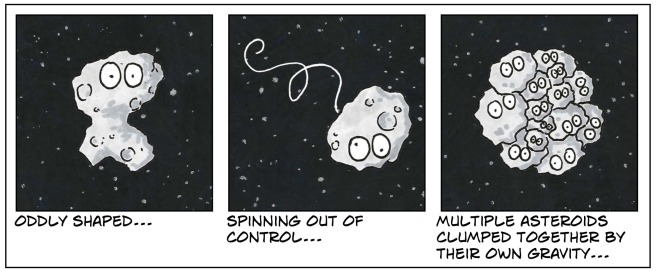
But catching an asteroid and landing on it for mining purposes… that’s much easier said than done. You see, no two asteroids are exactly alike, and they each present a host of challenges for asteroid hunters of the future.

Jn22 Crazy Asteroids

There are several ideas for how to catch an asteroid. You could throw a net around it, assuming the asteroid isn’t too big. Or you could latch on with magnets, assuming the asteroid has a high enough metal content.

But the most common idea that I’ve seen is the shoot the asteroid with a harpoon. It makes the whole endeavor feel oddly reminiscent of old timey whaling. You know, like in Moby Dick. Or Star Trek IV.

As I understand it, the harpoon has a cable attached, so once you’ve harpooned yourself an asteroid you can reel your spacecraft in to a secure landing. Or in the case of those wildly spinning asteroids, the asteroid will reel you in by wrapping the cable around itself (what could go wrong?).

So the next time you’re in space trying to grab billions of dollars worth of asteroid, remember to bring a harpoon. And a really strong cable.

P.S.: Also, if an asteroid somehow manages to bite off your leg, maybe it’s best to let it go. As Mission Commander Ahab will tell you, vendettas against whales and asteroids never lead to happy endings.

Lego Mars Rover

I have a new hobby. When I’m not reading about space or writing about space or drawing pictures of space, you can probably find me in my basement building Lego things. Specifically, I’m building Lego space things.

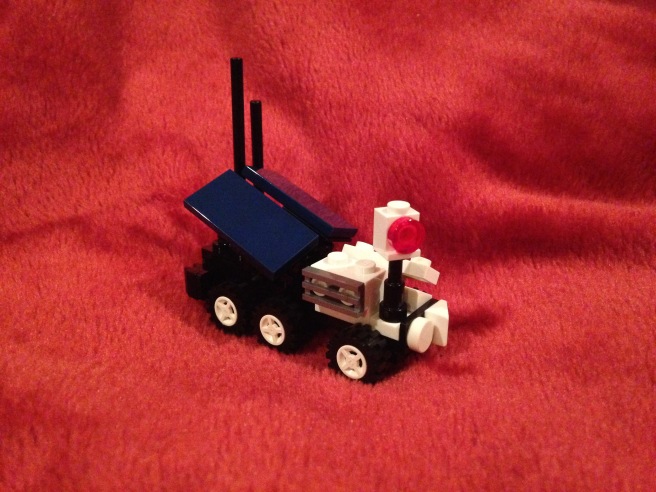
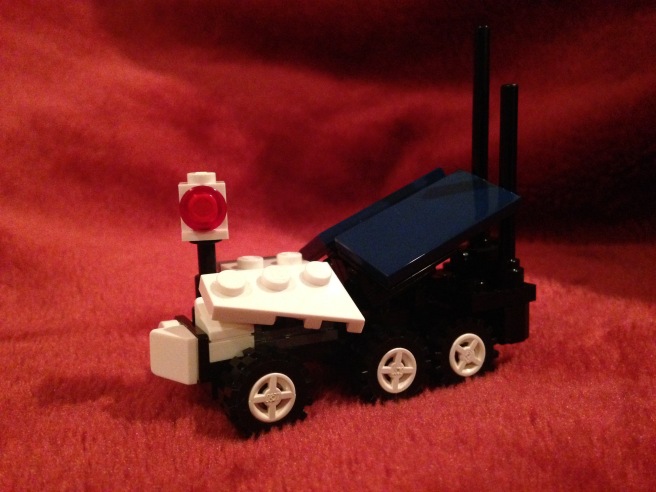
This is my first official creation for my new Lego space program: a Mars rover.

Rover begins exploring Martian landscape.

In real life, there have been a total of four Mars rovers: Sojourner, Spirit, Opportunity, and Curiosity. I did not design mine to look specifically like any of them.

Rover reports the surface of Mars is soft and fuzzy.

As a result, I don’t have a name for this little guy.

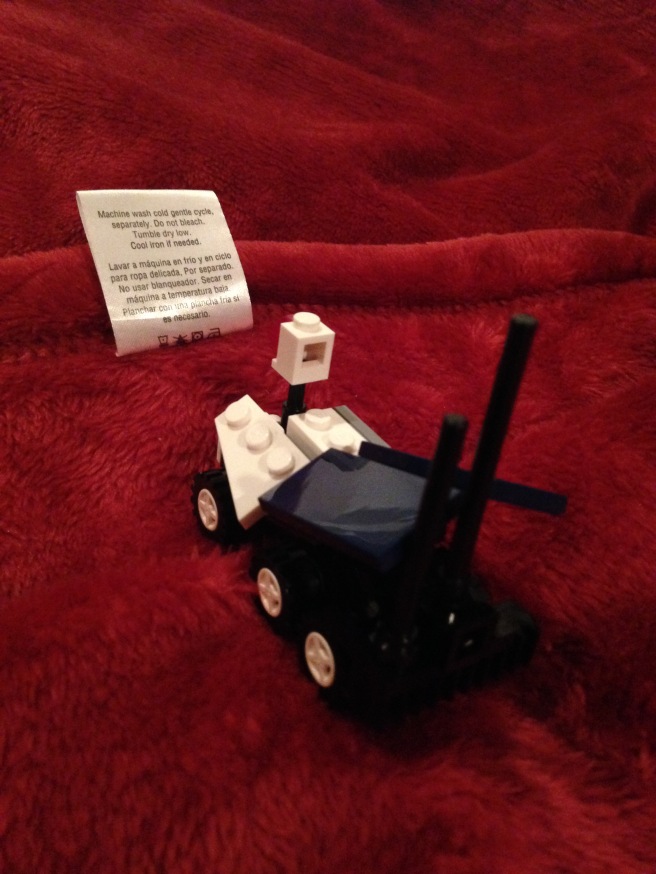
Jn08 Lego Rover 3
Rover determines that the surface of Mars is composed of 100% polyester and is “machine washable.”

So before I send my Lego rover to Lego Mars (which will surely take me a while to build), I want to get some suggestions. I’m asking for input from the public, as NASA might say.

So what do you think my Mars rover should be named?