Sci Friday

Here are this week’s sciency links.

Praying for a Spiracle

From the 1954 movie Them!

Holy f***!  That was a giant ant!  Nuclear radiation caused ants to grow into giant ants terrorizing the country!  If the special effects weren’t so cheesy, this would be a terrifying movie.

I mean, real giant insects are bad enough (click here for examples).  If I ever found a bug larger than my own hand in my apartment, I’d run screaming through the streets.  Now imagine an ant as tall as a human coming straight for you with the many parts of its mandible working hungrily.  You’d run screaming through the streets too (don’t lie; you know you would).

And if this giant ant caught you… have you ever seen an ant cut through a blade of grass?  Imagine it doing that to your arm!

Thank God this can’t actually happen.  Not because of the radiation part; radiation can cause mutations, and I suppose it could cause an animal to grow larger than normal.  But ants… in fact all insects… are limited by their passive respiratory system.  Instead of drawing air into the body, like we do with our lungs, ants depend on little holes called spiracles.  Oxygen passes through these spiracles, entering a series of hollow tubes that deliver it to the body cells.

Spiracles work fine so long as an ant is small, but giant ants like the ones in that movie wouldn’t get enough air circulating through their bodies.  They’d suffocate.  Thus, the human race is saved!

P.S.: You might be wondering what would happen if you raised the oxygen content of the air.  According to this article from Science Daily, some insect species would grow larger (no radiation required) and some would not.

Sci Friday: Quantum Weirdness

On Wednesday, I wrote about how quantum mechanics, the science of incredibly small things, is now expanding into the world of things we can see and touch.  This could completely change our understanding of science, and in time lead to all kinds of new technology.  This week’s Sci Friday links focus on quantum mechanics and how the field is changing.

Weirdness

Science fiction is weird.  Sometimes it gets very weird, but that’s only because real science is weirder.  Here are some examples.

  • Light is both a particle and a wave.  That’s pretty weird, but it gets worse.  Protons and electrons and basically everything in the universe are both particles and waves.
  • These particle/waves can exist in more than one place at the same time so long as no one is observing them.  In fact, so long as no one’s observing them they can do all kinds of crazy things.  The subatomic world is throwing one wild party, but you and I aren’t invited.
  • Two particle/waves can become entangled, meaning whatever one does the other does the opposite.  Albert Einstein called this “spooky action at a distance” because there is no speed of light delay, not even if the particles are light-years apart.  How can one possibly know what the other is doing?

Fortunately, quantum mechanics, the branch of science that covers this weird stuff, only applies to things that are really, really small.  You don’t have to worry about it in your everyday life… yet.

In the last decade or two, scientists have made major breakthroughs, proving that quantum weirdness can affect objects large enough to see.  Work has already begun on quantum computers, computers with parts existing in two places at once, allowing them to do more simultaneous calculations.  One company claims to have already built a quantum computer, but their claim is open to debate.

Thanks to our knowledge of atoms and molecules, we can study DNA, make plastic, and find the best materials to conduct electricity.  I should also mention nuclear power and nuclear weapons.  Imagine what our world will be like if quantum weirdness becomes just as ordinary.  It would be much stranger than science fiction.

Not convinced quantum mechanics is taking over the world?  Come back for Friday’s post.  I’ll provide links to several articles on quantum mechanics and how it applies to the world you can see and touch.

Sci Friday

I’m very excited about this week’s links.  Any one of them could easily inspire a good science fiction story, or at least an interesting sci-fi world.

  • Sperm Whales May Have Names from Wired Science.  If true… that’s pretty cool.  No comment yet from the dolphins.
  • Atom Smasher Finds Possible New Force of Nature from Cosmos Magazine.  Fermilab’s Tevatron particle accelerator may have discovered a fifth fundamental force in the universe… just before running out of federal funding.
  • Science Publishes Multiple Critiques of Arsenic Bacterium Paper from Science Insider.  Last year, NASA announced the discovery of Arsenic-based life in California.  Almost immediately, the experiment was attacked for possible errors.  The debate continues with huge implications for our definition of life.
  • Living in a Quantum World from Scientific American.  Sadly, this link does not provide the full article unless you have a paid subscription.  But it does give a good hint about what’s happening in quantum research.  I highly recommend stopping by a bookstore or library and checking the June issue of Scientific American; the full article will blow your mind.

Sci Friday

Here are this week’s sciency links.

Carbon vs. Silicon

It’s often suggested that the aliens from the Aliens movies, sometimes referred to as xenomorphs, are silicon based rather than carbon based like us.  There are a lot of silicon based aliens in science fiction, but no one knows if such a thing is really possible.

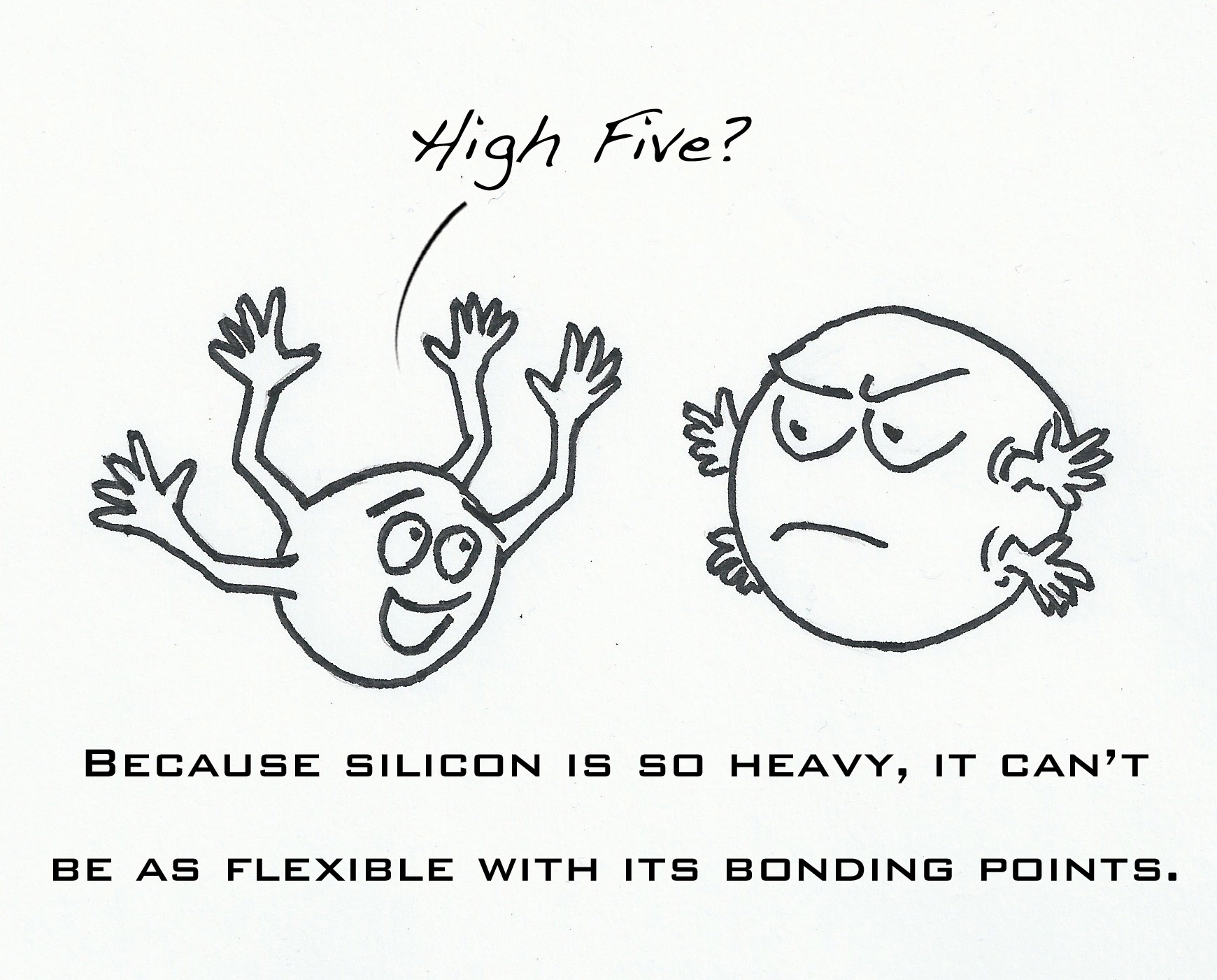
Carbon and silicon have one thing in common: they both have four bonding sites, meaning they can bond with up to four other atoms when making a molecule.  Other than that, they’re completely different.  Silicon is a metalloid; carbon is a nonmetal.  Carbon is much lighter and more flexible, and it’s ten times more abundant in the universe.
If the idea of silicon based life is simply to replace carbon atoms with silicon, it wouldn’t work.  Take breathing for example.  We breath oxygen in, and exhale carbon dioxide.  When a silicon based alien breaths in oxygen, it will have a hard time exhaling silicon dioxide; silicon dioxide is better known as quartz crystal.

I don’t remember any xenomorphs hacking up quartz crystals in the movies, but maybe they use silicon for something else.  Carbon has to be part of their biochemistry anyway, or they wouldn’t be able to grow inside human hosts.

Humans are not only carbon based.  We also depend on oxygen, nitrogen, hydrogen, phosphorus, and sulfur.  Not only that, but we need traces of iron, sodium, potassium, etc as well.  So maybe the xenomorphs can be carbon based and silicon based at the same time.
Fictional Elements, Part 2

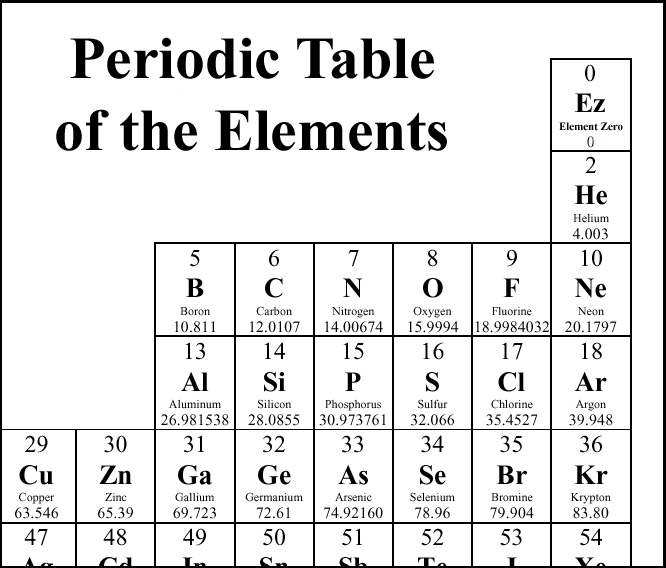
On the periodic table of elements, every element has a number corresponding to the number of protons in its nucleus.  Hydrogen is #1, helium #2, and so forth.  In the video game Mass Effect, scientists have discovered an element with no protons, making it #0.

That’s an interesting idea, and certainly element zero has some qualities which make it a useful plot point, but what’s the difference between an atom with no protons and nothing?

Almost a century ago, a real scientist named Andreas von Antropoff suggested adding an element zero to the periodic table.  He called it neutronium, and it consisted of a single neutron with no proton and no electron cloud.  Since neutronium wouldn’t interact with other elements, it would probably belong with the noble gases and be placed above helium.

Nuetrons, when they’re alone, are unstable and tend to break apart into a proton and electron (and an electron antineutrino).  So neutronium would rapidly decay into hydrogen.  Also, unlike the element zero in the game, neutronium would have mass (preventing it from canceling out the mass of physical objects as described in the game).

I suppose neutronium could be an unstable isotope of element zero.  But then we’re still left with an atom with no proton, no electron cloud, and no neutrons.  So what is it?  Maybe the new Alpha Magnetic Spectrometer will figure it out.