Dr. Xbox

One day, your psychologist might give you a prescription not for drugs but for a video game.  According to a post on kotaku.com, researchers at the Rochester Institute of Technology and St. John Fisher College are developing a game that uses biofeedback to help treat anxiety disorder.  This could become the first of many games designed to improve your mental health.

Biofeedback technology reads signals from your body to control the game.  Think of the Kinect for Xbox, where a camera watches the player’s movements and the character in the game mirrors them.  Another game, this one for PC, uses a webcam to monitor the player’s breathing, turning the player’s lungs into a video game controller.  Using electrodes on the head, a video game system could even be controlled with brainwaves.

The video game designed at Rochester is customizable, meaning a psychologist could program features into the game specifically tailored for their patients.  Patients could then face their fears in a safe, consequence free environment and learn to overcome them.  The biofeedback technology—especially the kind using brainwaves—could also record the patient’s reactions to each virtual situation, giving the psychologist more information to further improve and refine that patient’s treatment.The science fiction novel Ender’s Game included a psychological video game, one in which a computer determined what challenges each player most needed to face.  As a result, each player entered a different virtual labyrinth representing his or her unique psychological issues.  The game was a useful tool not only for psychological health but also for manipulating young boys and girls, turning them into good soldiers (it’s important to remember than any technology can be used for good or evil).

Although the field of psychological gaming is in its infancy, I believe it has tremendous potential to do some good.  With more research and new technology, something similar to the game envisioned in Ender’s Game could become a reality.

Sci Friday

It’s been another big week for science.  The Opportunity Rover has reached a new milestone, traveling further than anyone ever expected it to, and researchers in Iceland might have a solution for all that global warming you’ve been hearing about.  Here are this week’s sciency links.

Compressed Carbon is a Girl’s Best Friend

In 2061: Odyssey Three, one of the sequels to 2001: A Space Odyssey, the human race discovers an endless supply of diamonds on Jupiter.  Carbon, being one of the most common elements in the universe, probably is abundant on Jupiter, and Jupiter, along with the other gas giants, would exert such tremendous amounts of pressure on that carbon that it could form diamonds.

By the end of the Space Odyssey series, diamonds are so common that they’re used as an ordinary construction material.  Not for decoration, but for strength.  Diamond windows, for example, are far less breakable than old-fashioned glass.

A recent study has shown that Uranus and Neptune really could produce diamonds.  In fact, these planets have the right internal pressures and temperatures to form vast oceans of liquid diamond, with solidified chunks floating like icebergs on the surface.  Far stranger and more wonderful than what Arthur C. Clark envisioned in his books.

Now we just have to figure out how to get there and how to extract these diamonds safely.  It might even be possible, if these diamond oceans really exist, to collect the liquid, mold it, and produce diamonds in any shape we want.

In other news, scientists have discovered a planet 4000 light years away that is one giant diamond.  This planet was once a star, but all it’s stellar material has burned off, leaving a huge lump of compressed carbon—there for the taking.

One thing is clear: when the day comes that space travel is safe and cheap, diamonds will not be quite as valuable as they are today.  The universe has lots of carbon and lots of places where that carbon is under extreme pressure.  Diamonds are everywhere.

A Cure for Cancer

Sometime in the early 21st Century, humanity was plagued by not one but two incurable diseases.  That was until a group of brilliant scientists realized they could use one to fight the other.

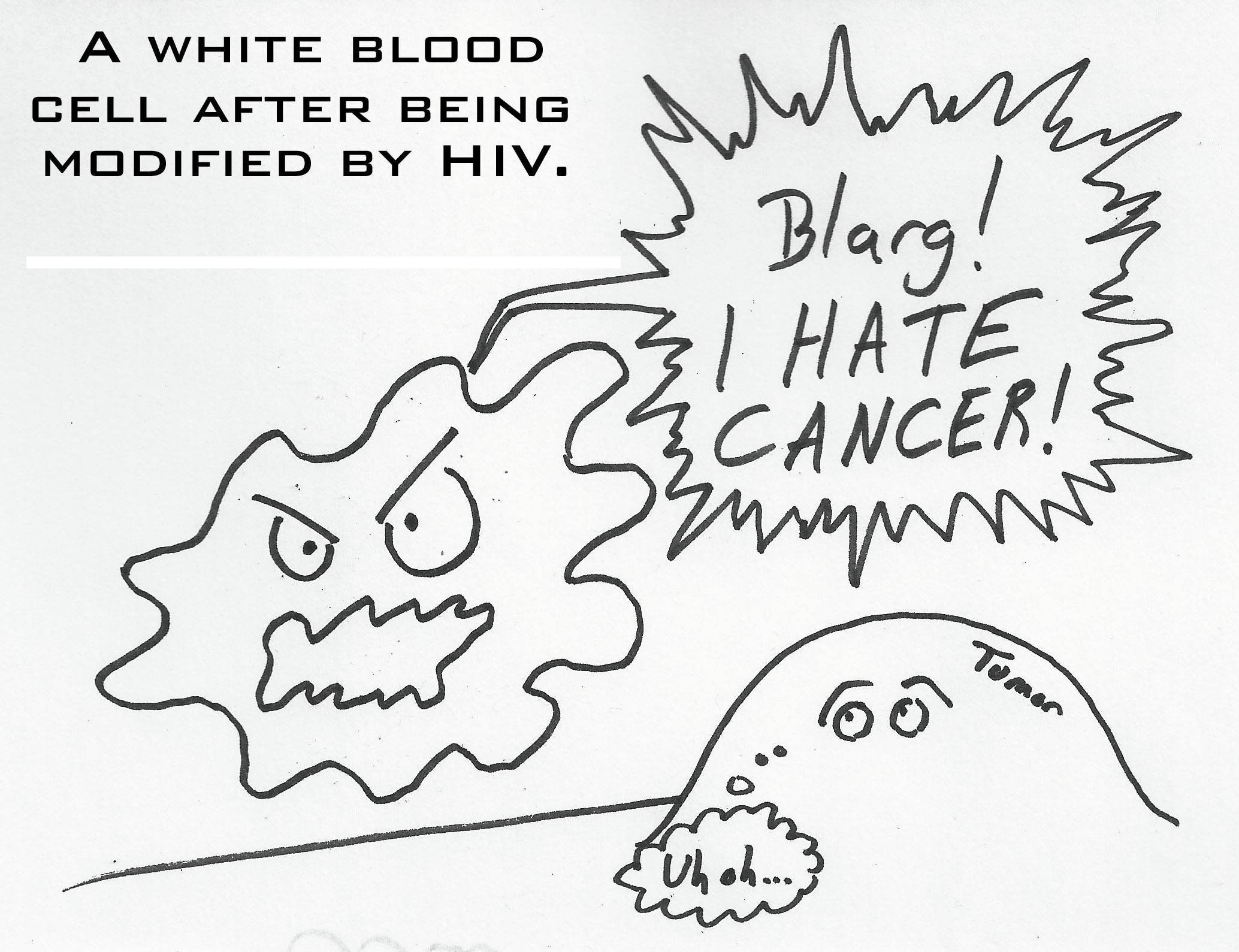
That’s right: they’re trying to cure cancer with HIV.  Basically, modified HIV infects T-cells (white blood cells) and reprograms them to target cancer cells.  The reprogrammed white blood cells go crazy, slaughtering every cancer cell they find.  In at least one test patient, five pounds worth of cancer was destroyed!

If we’re living in a science fiction novel, this is one plot twist I never saw coming.  Click here for the full story.

Sci Friday

You may or may not be aware of this, but one of the crew aboard the International Space Station is a robot.  He even has his own Twitter feed.  Here’s that and this week’s other sciency links.

You Won’t Remember This Post

Apparently a third Men in Black movie comes out in May of 2012.

Do you remember the little flashy light thingie from Men in Black?  The thing that erased people’s memories so the secret of aliens living on Earth could remain secret?  Well, if you don’t remember it, I guess it worked.

Anyway, neuroscientists are developing new methods to make people forget things.  Not with flashy lights, but with drugs.  Experiments on rats show that, by injecting a chemical directly into the brain, scientists can make the rats forget to associate a specific sound with an electrical shock.  Click here for more on these experiments.

Other drugs and chemicals are already known to alter or erase short-term memory in humans.  With continued research, scientists hope to find new treatments for posttraumatic stress disorder and addictions to various legal and illegal substances.

But imagine what would happen if that flashy light thing from Men in Black got into the wrong hands.  If organized crime ever learned of its existence, I’m sure they’d pay a lot of money to get one.  Somehow I suspect they’d find getting memory-erasing drugs much easier than hunting down the Men in Black.  If it were available with a prescription, they’d only need a crooked doctor or a burglar willing to hit a pharmacy.

Supporters of memory-erasing or memory-dampening drugs say there are already laws to protect us from the misuse of these drugs.  However, if someone doesn’t remember being the victim of a crime how can the law be enforced?

Personally, I don’t know what to think about this.  A memory-erasing drug could help a lot of people dealing with posttraumatic stress disorder, but there is also a lot of potential for misuse.  What do you think?  Should research of this nature be allowed or banned?

For more information, click on the following links.

The Ethics of Forgetfulness Drugs from Neuroskeptic.

Why We Need Memory-Altering Drugs from Io9.

Living in the Future

It’s going to be the future soon, and you may be wondering what your everyday life will be like when it’s finally here.  These three videos take a look at how our vision of the future has changed over the years.

First is the House of the Future, part of the Tomorrowland theme park at Disneyland.  This video of from the late 1950’s.

Next, we have the House of Tomorrow, built by a group of architects called “Living Tomorrow.”  The video is from 1991.

Lastly, we have a video from Corning Glass Company showcasing futuristic products that can be made using glass.  It includes not only a house of the future but the workplace of the future, the bus stop of the future, and the shopping mall of the future.

Sadly, these visions of the future never seem to turn out as cool as they seem in the videos.  But still, that roll-up computer screen is pretty awesome, and it looks like it’s smartphone compatible!

Sci Friday

This has been an interesting week in the world of science.  SpaceX moved up plans to send a capsule to the International Space Station, Russia announced plans to build a hotel in space, and IBM says they’ve made a new computer chip that imitates the human brain.  At this rate, science fiction won’t be science fiction anymore; it’ll just be fiction.

The Cyborg with the Dragon Tattoo

When you hear the word cyborg, you probably picture a man with various electronic prosthetics.  If you’re a Trekkie, you might think of the Borg, people with machines all over and inside their bodies, walking around like zombies, forcing other people to become just like them.  Cybernetics is scary.  It’s dehumanizing, but maybe there’s another way.

We are the Teddy Borg. Resistance is futile. Your stuffed animals will be assimilated.

Researchers have developed a new cybernetic technology similar to something we’re more familiar with: tattoos.  They can apply thin layers of electronic circuits to the skin.  Even transistors and semiconductors are now flat enough to lay smoothly on human skin.  The trick is making the whole thing flexible enough to keep up with everyday human movement.

The cybernetic tattoo is not even a real tattoo but more like a temporary tattoo.  You can peel it off when you’re done with it.  This has many possible uses, from medical devices to cell phone technology to MP3 players.  A tattoo on your neck could serve as a microphone.  On your hand or arm, it could be a control switch.  In your ear, a speaker.

In science fiction, cyborgs often represent our deep-rooted fears of technology.  Star Trek’s Borg literally invade our bodies to transform us into machines.  But for many people, getting a tattoo is normal, and getting a cybernetic tattoo might seem cool.  If people get used to that, they may someday feel comfortable with other cybernetic technologies too.

Or maybe not.  It’s still a little scary, at least to me.

For more on “electronic skin,” click here.  For more on the Borg, click here.

Love Machine

Ever notice how some people get emotionally attached to their smart phones?  It’s not new.  People get emotionally attached to all kinds of inanimate objects, from cars to furniture to lucky Super Bowl shirts.  There’s a new exhibit at MoMA, the Museum of Modern Art, which explores this phenomenon, specifically how people fall in love with technology.

In a sense, designing a computer program or a gadget or some other device to be user friendly is an art.  When it’s done right, it almost feels like the machine knows us and knows exactly what we want it to do.  Whereas machines with bad user interfaces tend to do exactly what we don’t want them to.  Those are the ones we get mad at and shout at like a pet that keeps peeing on the carpet.

But when technology works right, when it’s easy to understand and easy to use, we openly talk about how much we love it.  I for one love my iPhone.  I know it’s an illusion; the phone doesn’t know me or what I’m thinking.  It doesn’t know what I want or need.  It’s the people who designed it who put a lot of thought into what their customers would want and need.   That makes them artists in a way, and that’s why technology deserves a place at MoMA.

(Now for the science fiction part.)  I love my iPhone.  Maybe you love your smart phone, or your computer, or some other gadget you own.  Maybe that’s not a bad thing.  If someday machines develop emotions of their own, they might discover that humans already love them.  Maybe, if humans and machines love each other, we’ll never have to live through the Terminator or Matrix movies in real life.

Click here to see a more detailed description of the “Talk to Me” exhibit at MoMA.