Sci Friday – Solar System Monopoly

Space entrepreneurs have a lot of big dreams.  There’s money for space tourism and contracts with NASA, now that the space shuttle program has ended.  There are also valuable resources in space.

One entrepreneur predicts that the 21st Century will become a game of “Solar System Monopoly”—something already envisioned by writers like Ben Bova and Arthur C. Clarke—and warns that the Chinese government is ready to make the first move.  See “China Will Own the Moon” for more on that.

Here are this week’s sciency links.

Also, the world is ending today.

Light Speed Vision

The video game Mass Effect goes into great detail on how the Doppler Effect changes what you see when traveling faster than light.  Wavelengths of light are stretched or compressed, altering the color of stars, even shifting your vision into infrared or ultraviolet.  But the Doppler Effect is not the only thing that distorts what you see at such ridiculous speeds.

I recently found this video on Astronomy Picture of the Day which demonstrates what you would see if you traveled near the speed of light, taking into account the Doppler Effect, relativistic aberration, and the so-called headlight effect.  The world becomes increasingly distorted from that point of view, mainly because you are no longer seeing the world as it is but as it was.

For the purposes of the video, light travels at one meter per second (as opposed to 300 million meters per second).  Thanks to the Theory of Relativity, it’s not the speed of light that really matters here but your speed relative to it, so the demonstration is still accurate.

Traveling faster than light is not possible except in science fiction (and maybe for neutrinos) and in the video the car or spaceship or whatever never travels faster than light.  But we SF fans and SF writers can imagine, based on this video, how much stranger the universe would really look at warp 9.

Wow… That’s a Big Virus

Scientists say they’ve discovered a new virus, one that is bigger than any other.  It’s so big it can be seen with a regular microscope, rather than an electron microscope.  Fortunately it is not as big as the Macrovirus from Star Trek: Voyager (pictured above).

The newly discovered “Megavirus” is only a little bit bigger than the previous record holder, “Mimivirus.”  It has a ridiculously long DNA chain with special enzymes to repair any damage caused by UV light or radiation.  Some elements of its genetic code are similar to single celled organisms, leading researchers to believe this virus evolved from cellular life.

Don’t worry.  Megavirus does not infect humans.  It only attacks single celled organisms like amoebas.  Whereas Voyager’s Macrovirus tended to assault people in corridors, stabbing them with it’s giant DNA injector thingie.

For more information about Megavirus and Mimivirus, click here.

Sci Friday – Send James Cameron into Space

I enjoyed the movie Avatar and I look forward to seeing the sequel, but until reading the first article for this week’s Sci Friday links I had no idea James Cameron was such an interesting man.  He’s done a great deal more than direct movies.  He’s helped invent new cameras, new submarines, and new spacecraft.  At one time, he tried to get 3D cameras into space and expressed interest in going to space himself to make a movie.  That’s one movie I’d definitely go see.

Are You Safe from the Plague?

According to researchers, the infamous Black Death is still out there and it hasn’t changed since the Middle Ages.  Using the skeletal remains of people who died from the Plague, scientists were able to reconstruct the DNA of the bacteria that killed them.  Aside from a few minor mutations, the genetic structure of the Medieval Plague is nearly identical to that of its modern descendant.

However, since the 14th Century human beings have changed.  Our immune systems have adapted to fight this and others diseases, and we’re much more conscious of hygiene than our ancestors in 14th Century Europe.  We’ve developed better medicine and better methods of containing dangerous outbreaks when they happen, and we don’t tolerate rats running around our homes spreading infections like we once did.

The Bubonic Plague may be stalking the streets of Europe right now, searching for some unsuspecting merchant or cobbler to infect, but this time we’re ready with wonderful, new technologies like soap.  The Black Death doesn’t stand a chance.

The return of the Black Death could be a good science fiction story, but the bacteria would have to evolve—something it apparently hasn’t done for a while.  We’re only safe until it develops a resistance to antibiotics or our economy gets so bad our standard of living drops back to Midieval levels (both are plausible).

For a disease to really have the impact of the original Plague, it would probably have to be completely new, something our immune systems wouldn’t know how to deal with, something our medicine has never had to fight before and our society doesn’t know how to contain.  Maybe something from space, like the Andromeda Strain.  The next round of Swine Flu could be pretty bad too.

For more on the reconstruction of Plague DNA, click here.  Experts say the ability to reconstruct the DNA of historical diseases, including the Black Death, could help us understand how modern infections begin and spread.

Neutrino Engines

In science fiction, traveling faster than light is no big deal.  Everybody’s doing it.  The details of how they do it are… a bit vague.  But scientists at CERN, an international research facility in Europe, say they’ve discovered something that really can travel faster than light: the neutrino.

So does this mean science fiction writers should start building spaceships with neutrino engines?  Not quite yet.  Many physicists are not convinced by the CERN scientists’ claim.  The equipment in the experiment could have been faulty, leading to a false measurement of the neutrinos’ speed.  More tests are required to confirm these findings.

And now we’re learning that some of the scientists involved in the experiment did not want the results published.  Though most of their colleagues felt confident, a few still worried that the measurement was somehow in error.

There are precious few particle accelerators in the world, but I expect scientists will try to replicate the experiment at another location soon.  In the meantime, science fiction writers should stay away from neutrino engines.  In a year or two, we might find out the whole think was a fluke.

For more on CERN’s recent neutrino experiment and the controversy around it, click here.

Sci Friday – And the Nobel Prize Goes To…

The winners of the 2011 Nobel Prizes were announced this week.  The awards will be given out at a ceremony in December.  Each of this week’s Sci Friday links concern the winners and the discoveries or achievements that earned them their prizes.

I’m particularly excited about this year’s Nobel Prize in Chemistry not only because of Dan Shechtman’s impossible crystals but because of the struggle he went through to get his discovery accepted by the scientific community.  The one for physics is also pretty cool.

Update: The Nobel Prize for Economic Science went to Thomas J. Sargent and Christopher A. Sims for their research on how government policy affects the economy.

Are Dolphins Smarter Than You?

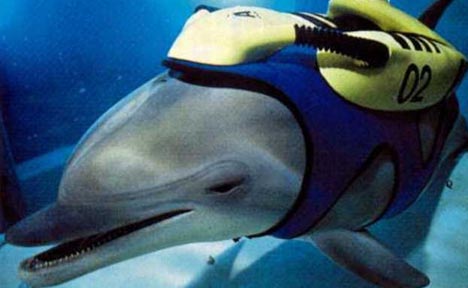
Darwin the Dolphin was a member of the crew on SeaQuest DSV.  Through some highly advanced technology similar to Google Translate, he was able to talk to his human crewmates, and occasionally he was sent on missions wearing a specially designed scuba suit.

Darwin from SeaQuest DSV

While we still haven’t found a way to talk to dolphins, researchers in Australia say they’ve observed a surprising, new dolphin behavior.  Only a few years ago, they noticed a few dolphins using conch shells to help them fish.  The dolphins catch fish in the shells then bring them to the surface and dump the fish into their mouths.

Since then, researchers have noticed more and more dolphins using conch shells.  It’s as though one clever dolphin invented a new technique and the others imitated it.  Or perhaps this clever dolphin told his friends what he’d done and showed it to them, and the news spread through the dolphin community.  Whatever happened, it’s the first time we’ve seen another species invent a new tool.

Obviously, the dolphins didn’t invent conch shells.  They don’t have opposable thumbs, so we can’t expect them to make bows and arrows any time soon.  But in the beginning, our ancestors probably used objects they found in nature as tools.  Early humans didn’t invent small rocks and wooden sticks, but they found ways to use them.  Dolphins may be at a similar early stage of technological development.

Of course, fans of the Hitchhiker’s Guide know dolphins are only the second smartest species on Earth, and humans are the third.  Mice are the real masters of this planet.

For more on what these clever dolphins are up to, click here.

Atom Smashers

The United States’ largest atom smasher is smashing atoms no more.  I’m sure atoms are very happy about this, but most of the scientific community is disappointed.  In many ways, shutting down the Tevatron Particle Accelerator is like ending the space shuttle program.

The Tevatron had been in service for nearly thirty years and was responsible for many important discoveries in particle physics.  Most people never even heard of it and have no idea why this matters, but without particle physics (a.k.a. quantum mechanics) we wouldn’t have wireless communications, plastic, or most modern drugs.  We wouldn’t even understand DNA if we didn’t know how atoms and the particles inside them work.

The Tevatron cost millions of dollars to build and millions more to operate.  The Department of Energy says they could not secure funding from the federal government to keep it running.

Before the Tevatron closed, it was tantalizingly close to either discovering the Higgs Boson or proving it does not exist—which would change everything we know about physics.  The Large Hadron Collider (LHC) in Europe is also close.  And another particle accelerator in Europe, run by the same people who run the LHC, recently found evidence that one particle, the neutrino, can travel faster than light—which would also change everything we know about physics.

As an American, I wish the United States still had a large particle accelerator of its own so we could participate in these experiments, but at the same time I’m too excited to worry about patriotism.  One way or another, atom smashers are about to change physics, and when they do all kinds of new technologies will be possible.  The world of tomorrow is coming.

Sci Friday – Neutrino Week

The big news this week was that neutrinos might be able to travel faster than light.  This discovery still has to be confirmed, and some of the scientists involved in the experiment didn’t want their names associated with it.  Whatever happened with those neutrinos, it’s sure to be a big controversy for quite some time.

Here are this week’s sciency links.