Alkali Extraction Incorporated (Tomorrow News Network: A to Z)

Hello, friends!  For this year’s A to Z Challenge, I’ll be telling you a little about my upcoming Sci-Fi adventure series, Tomorrow News Network.  In today’s post, A is for:

ALKALI EXTRACTION INCORPORATED (A.E.I.)

Faceless mega-corporations are everywhere in science fiction.  We see them in the Alien movies.  We see them in RoboCop, we see them in Blade Runner.  So when I started writing the first story in my Tomorrow News Network series, including a faceless mega-corporation just felt right.

In early drafts, I wanted to say as little about this faceless mega-corporation as possible.  I didn’t even give it a name.  The good people of Litho Colony all work for “the Company,” and whenever somebody mentioned “the Company,” everyone else would know which company they were talking about.  There was no need to be more specific.

My thought was that the Company was so big and so faceless that it didn’t need a name.  My critique group disagreed.  I got a lot of feedback from people asking who this giant corporate entity was.  What did they do?  What products or services did they sell?  And thus Alkali Extraction Incorporated (better known as A.E.I.) was born.
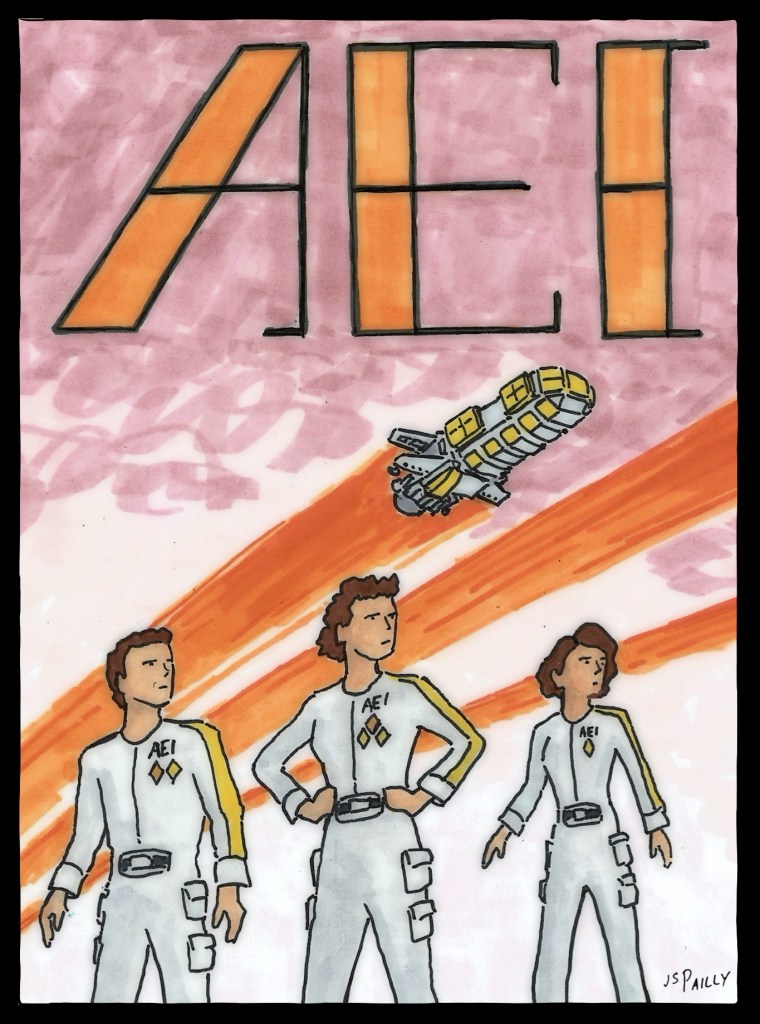
A.E.I. is a mining company specializing in the mining of rare chemical resources from planets along the galactic frontier.  They’re one of the leading suppliers of lithium for the Earth Empire, and they’ve recently expanded into the market for mesotronic elements—chemical elements that are stuck in a quantum state between matter and antimatter.

Litho Colony is the property of A.E.I.  The colonists do sometimes refer to A.E.I. as “the Company,” but they also sometimes refer to the Company by its actual name.  How could they not?  The letters “A.E.I.” are stamped everywhere, a constant reminder to the colonists of who their employers are.

Looking back on those early drafts of Tomorrow News Newtwork, book one, I get what I was trying to do with my faceless and also nameless mega-corporation.  But my critique group was right, and I’m glad I listened to them.

Next time on Tomorrow News Network: A to Z, the planet Berzelius has five moons.  Wait, let me count again.  Sorry, the planet Berzelius has six moons.

#IWSG: Ulterior Motives

Hello, friends, and welcome to this month’s meeting of the Insecure Writer’s Support Group.  If you’re a writer, and if you feel in any way insecure about your writing life, click here to learn more about this amazingly supportive group!

I don’t know about you, but my writing productivity crashed and burned toward the end of March.  Right now, I’m feeling insecure because I’ve done virtually nothing to prepare for this year’s A to Z Challenge.  I’m also feeling insecure because the timeline for publishing Tomorrow News Network, book one, has totally fallen apart.

I have no one to blame but myself.  Wait, no, that’s not true.  The coronavirus deserves a lot of the blame too.  Not all of the blame, but a lot of it.

So here’s my plan.  Even though I’m as ill-prepared for the A to Z Challenge as I could possibly be, I’m doing the challenge anyway.  My theme is the story universe I created for Tomorrow News Network.  Obviously, I have an ulterior motive for doing this.  It’s my way of saying: “Buy my book!”

Except the first book of the Tomorrow News Network series isn’t out yet. It won’t be released until (checks timetable, mutters curse at the coronavirus)—okay, I still have to figure out what my new release date will be.  But it’s coming soon!

I have a second ulterior motive as well.  You see, book one is more or less finished, but I still have to write books two, three, four, five (etc, etc, etc).  So as I tell you all about this fictional universe I’ve created, your feedback, dear reader, will be invaluable as I plan out the rest of the Tomorrow News Network series.

And lastly, my third ulterior motive may be the most important of all, given my current mental state during the coronavirus crisis.  As I said at the beginning of this post, my writing productivity crashed and burned near the end of March, and I’m having a tough time getting back into my creative groove.  I’m hoping that by participating in the A to Z Challenge—and by writing, specifically, about my own story universe—I’ll jumpstart my writing brain.  I guess we’ll have to wait until the end of April to know if that works.

In the meantime, please click here to check out the first Tomorrow News Network: A to Z post.  Today, A is for Alkali Extraction Incorporated, a faceless mega-corporation that’s mining alien planets for their resources.

Tomorrow News Network: A to Z

Hello, friends!  At long last, I’m ready to announce my theme for this year’s A to Z Challenge.  And that theme is:

Tomorrow News Network is my own Sci-Fi adventure series, featuring time traveling journalist Talie Tappler, her cyborg cameraman Mr. Cognis, and the many high-profile news stories they cover across the space-time continuum.

Robot uprisings?  Alien invasions?  Mass extinction events?  Talie and Cognis will be there.  In fact, being time travelers, Talie and Cognis tend to show up before such cataclysmic events occur.

For the A to Z Challenge, I’ll introduce you to some of the characters (M is for Milo Marrero) and settings (L is for Litho Colony) that will appear in Tomorrow News Network, book one.  We’ll also explore some of the big concepts (J is for journalistic integrity) and small details (D is for digi-stream downloads) that will feature prominently in the Tomorrow News Network series going forward.

So on Wednesday, April 1st, we’ll kick things off by meeting a faceless mega-corporation that’s mining alien planets for their resources.  Also on Wednesday, it’ll be Insecure Writer’s Support Group day, and I’ll reveal my secret ulterior motives for picking my own story universe for this year’s A to Z Challenge.

A to Z Reflections

You don’t really understand something until you can explain it to somebody else.  There are lots and lots of quotes out there to that effect, sometimes attributed (or misattributed) to Einstein, sometimes attributed (or misattributed) to other great scientists.  Regardless of where all those quotes really came from, that sentiment has long been the guiding philosophy of this blog.

For this year’s A to Z Challenge, my theme was the scientific search for alien life.  Obviously I’ve written about that topic before, many times over, but I still felt a bit shaky in my knowledge.  So I wanted to dive deep into the science of astrobiology and the closely related field of SETI.  I wanted to double check the things I thought I already knew, and of course I wanted to add to that knowledge.

Writing those 26 blog posts was the final step, the final test. Have I learned this stuff well enough to explain it clearly and concisely?  I suppose only you, dear reader, can be the judge of that. But based on the responses I’ve gotten so far and the conversations I’ve been having with people in the comments, I feel like I must’ve done a decent enough job.

With this year’s A to Z Challenge now behind me, I certainly feel more confident talking about astrobiology and SETI than I did before. More importantly, I feel a whole lot more comfortable incorporating what I’ve learned into my science fiction. After all, I started this blog with one purpose in mind: to force myself to do the kind of research that, in my opinion, a science fiction writer ought to do.

If any of you came away from my A to Z series feeling like you learned something, or even if you just have a newfound sense of wonder for the stars—for all the things that might be out there in the cosmos—I consider that a bonus.  Thank you for reading, and thank you especially to those of you who commented.

On Monday, I’ll be back to my regular blogging schedule.

Sciency Words A to Z: The Zero-One-Infinity Rule

Welcome to a special A to Z Challenge edition of Sciency Words!  Sciency Words is an ongoing series here on Planet Pailly about the definitions and etymologies of science or science-related terms.  In today’s post, Z is for:

THE ZERO-ONE-INFINITY RULE

All month, we’ve been talking about astrobiology, SETI, and the possibility that we are not alone in the universe.  I’d like to end this series with a prediction for the future, and conveniently my prediction is related to a Z-word: the zero-one-infinity rule.

The zero-one-infinity rule was originally created by Dutch computer scientist Willem Louis Van Der Poel.  For the purposes of computer programming, the rule has to do with how many times a user is allowed to do a thing (whatever that thing might be).

It makes sense for a user to never be allowed to do a certain thing (zero), or it makes sense for a user to do a thing only once (one).  But if you’re going to allow a user to do a thing more than once, you may as well let the user do that thing as many times as the user wants.  As a rule of thumb, the zero-one-infinity rule means there’s no reason to impose arbitrary limits on what users can do.

The zero-one-infinity rule has been adapted to many other scientific fields, including the field of astrobiology.  How many places can life exist in the universe?

  • Zero: the universe might not allow life to exist at all.  Of course we already know this isn’t  true, otherwise we wouldn’t be here.
  • One: the universe might only allow life to develop once.  In this view, Earth is a crazy exception, a one-time fluke in a universe that otherwise does not allow life to exist.
  • Infinity: the universe allows life to exist anywhere and everywhere it can.  Life might still be rare in this view, but there are no arbitrary limits imposed on life.

I remember in the 80’s and early 90’s there were a lot of people (including one of my science teachers) who honestly believed our Solar System might be unique.  No other star except our Sun was known to have planets. Maybe that was because there were no other stars with planets.  In short, our Solar System was a “one” in the zero-one-infinity rule.

Then in 1992, astronomers announced the discovery of the first known exoplanets—planets orbiting a star other than our Sun. At the time, we still had no idea just how many exoplanets we might find, but if the universe had allowed two solar systems to form, why not three?  Why not a dozen, or a thousand, or a million?  As soon as the case for “one” crumbled, the possibilities were suddenly limitless.

I predict the same thing will happen when we finally discover alien life.  Maybe it will be microorganisms on Mars, or sea monsters on Europa, or ham radio enthusiasts in the constellation Sagittarius.  It won’t matter which kind of life we find, specifically. Any alien life will do.

In this special edition of Time Magazine, there’s a brief mention of the zero-one-infinity rule.  In that article, NASA scientist Chris McKay sums up the whole field of astrobiology by saying, “So what we’re searching for is two.”  Because once we know that life developed on not one but two worlds… why not three?  Why not a dozen, or a million?  The possibilities will be truly limitless.

Sciency Words A to Z: Young Surface

Welcome to a special A to Z Challenge edition of Sciency Words!  Sciency Words is an ongoing series here on Planet Pailly about the definitions and etymologies of science or science-related terms.  In today’s post, Y is for:

YOUNG SURFACE

Imagine a nice, smooth, clean sheet of asphalt: a parking lot, maybe, with no cracks or potholes or blemishes of any kind.  Just looking at it, you would know, with a reasonable degree of certainty, that this asphalt had been laid down recently. It’s new.  It is, in effect, a young surface.

In much the same way, planetary scientists can look at the surface of a planet or moon and infer, with a reasonable degree of certainty, how young or old that surface must be.  Look at the Moon or Mercury; they’re covered in craters, showing that their surfaces must be very, very old.  Or look at Mars, where some regions are more heavily cratered than others, implying (intriguingly) that some surfaces are relatively old and some are relatively young.

And then there’s Europa, one of Jupiter’s moons. Europa may be covered in weird, orangey-red cracks, and it may have a few other orangey-red blemishes, but overall it’s surprisingly smooth, and there are very few craters.  This makes Europa look a whole lot younger than it actually is.  In fact, Europa is said to have the youngest-looking surface in the whole Solar System.

Europa’s surface is made of ice, specifically water ice.  This is not so uncommon for a moon in the outer Solar System.  It’s so cold out there that water behaves like a kind of rock.

But unlike most other icy moons, Europa must be doing something to get rid of old, crater-y surface ice and replace it with new, clean, smooth ice.  And once you really start thinking of water as a kind of rock, you might be able to guess what Europa’s doing.  As stated in this paper from Nature Geoscience: “[…] Europa may be the only Solar System body other than Earth to exhibit a system of plate tectonics.”

Except unlike Earth’s techtonic plates, which float atop a layer of magma (liquid rock), Europa’s plates would be floating atop “magma” that is actually liquid water—twice as much liquid water as we have here on Earth, according to some calculations.

And while liquid water may or may not be necessary for life, we do have good reason to suspect that any place that has liquid water might also have life.  Personally, based on everything else I’ve learned about Europa, I’d be more surprised if we didn’t find something living there.

Next time on Sciency Words A to Z, I have a prediction for the future.

Sciency Words A to Z: Xerophile

Welcome to a special A to Z Challenge edition of Sciency Words!  Sciency Words is an ongoing series here on Planet Pailly about the definitions and etymologies of science or science-related terms.  In today’s post, X is for:

XEROPHILE

You can’t have life without water.  Everybody knows that, right?  Right?  Well, apparently there are some microorganisms on this planet who didn’t get the memo.

The Atacama Desert in Chile is one of the most un-Earth-like environments on Earth.  It is severely dry.  It almost never rains there, and even when it does it’s a pathetic trickle. And it’s been like this for over a hundred millions years, making the Atacama Desert the oldest continuously arid region in the world.

At this point, the Atacama Desert has been so dry for so long that, chemically speaking, it has more in common with the surface of Mars. Most notably, in my opinion, the toxic perchlorate salts found on Mars are also present in the Atacama—0.4 to 0.6 wt% for Mars compared to 0.3 to 0.6 wt% for the Atacama, according to this article.  A near perfect match!

It was once thought the sands of the Atacama Desert were sterile, and experiments on soil samples seemed to prove it.  However, thanks to “improved extraction protocols,” we now know better.  As reported in this paper, titled “Bacterial diversity in hyperarid Atacama Desert soils,” it seems a great many bacterial species have found their way into the Atacama and adapted to the harsh environment.

In general, organisms that can survive in extreme conditions are known as extremophiles.  The term applies especially well to organisms that actually thrive in environments that should kill them.  There are many subcategories of extremophile, such as:

  • Thermophiles: organisms that love extreme heat.
  • Barophiles: organisms that love extreme pressure.
  • Acidophiles: organisms that love acid.
  • Halophiles: organisms that love salt.

Any organism that can survive in the Atacama Desert would be considered a xerophile, which comes from a Greek word meaning dryness.  They’d also probably be halophiles, given the presence of those perchlorate salts.  As noted in this article: “Xerophilic organisms are often also halophilic, some of them occurring in hypersaline solutions.”

So what does all this mean for our chances of finding life on Mars?  I think that should be obvious.  However, it’s worth noting that even xerophiles require some water.  Remember, even in the Atacama Desert it rains a little. Fortunately for any xerophiles who might be eeking out an existence on Mars, there seem to be a few rare trickles of water there too.

Next time on Sciency Words A to Z, have you seen Europa, the moon of Jupiter?  She looks a whole lot younger than she really is.  So what’s her secret?

Sciency Words A to Z: Wow! Signal

Welcome to a special A to Z Challenge edition of Sciency Words!  Sciency Words is an ongoing series here on Planet Pailly about the definitions and etymologies of science or science-related terms.  In today’s post, W is for:

THE WOW! SIGNAL

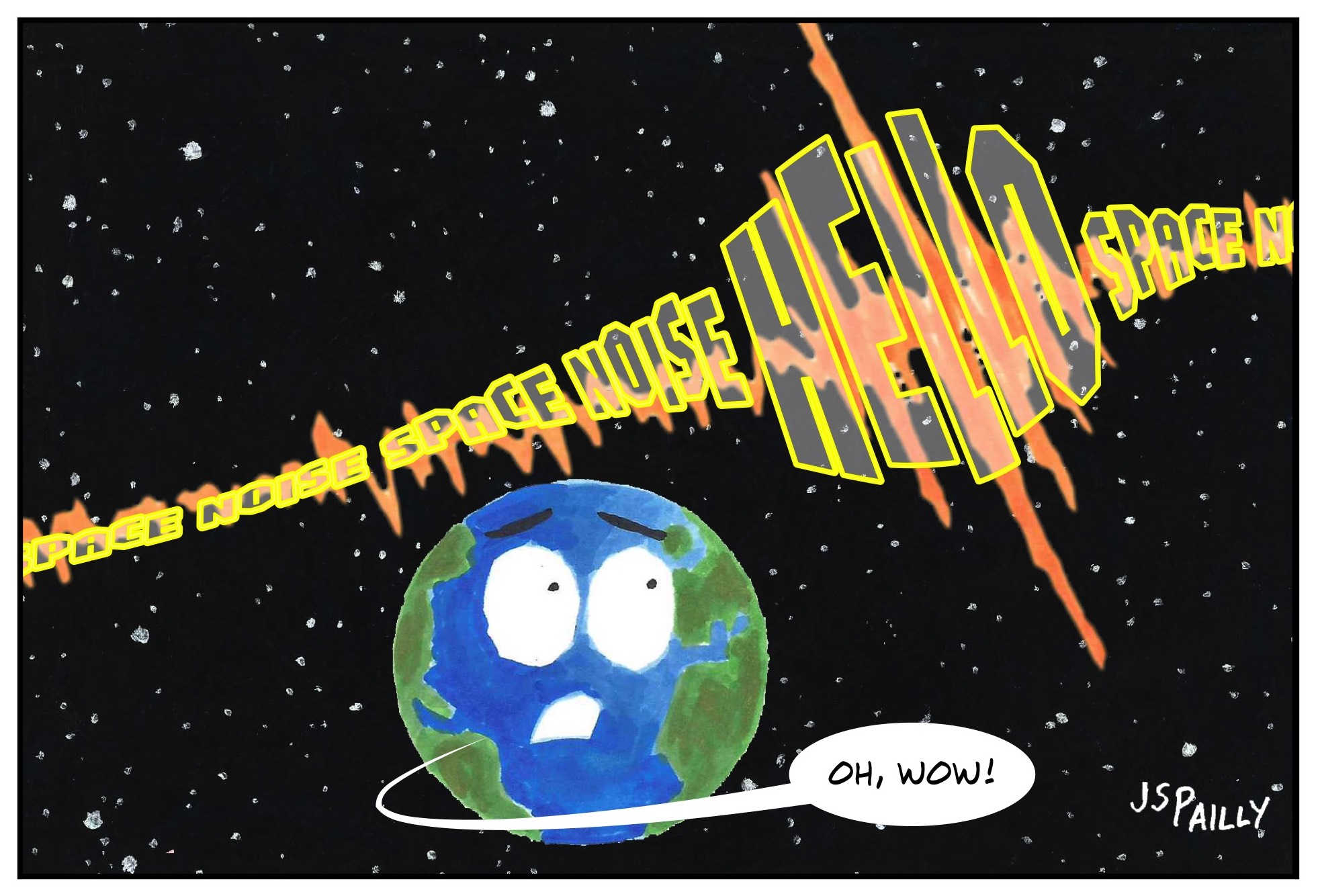
There’s a ton of radio noise in space, coming from stars and nebulae and black holes and so forth.  There’s so much radio noise that it can easily drown out the relatively weak radio and television broadcasts that might be coming from a planet like Earth.

So if aliens want to talk to us, they’re going to have to send a much stronger transmission, something that will come through loud and clear over all that other space noise.  And in 1977, astronomers at Ohio State University picked up exactly that kind of signal.

As the story goes, Ohio State was conducting a SETI search with their “Big Ear” radio telescope.  The telescope recorded electromagnetic emissions coming from space, reporting the strength of those emissions on a scale from 0 to 9. If Big Ear happened to pick up anything stronger than a 9, it represented that with a letter—A represented a 10, B represented 11, and so forth.

On the morning of August 18, 1977, astronomer Jerry Ehman was reviewing Big Ear’s latest data when he saw a bunch of large numbers, and even a few letters.  Famously, Ehman circled those letters and numbers and wrote one word next to them: Wow!

Image courtesy of Wikipedia

Appropriately, this is now known as “the Wow! Signal” (the exclamation point is usually included in the name).

In one sense, the Wow! Signal is exactly what SETI scientists were hoping to find.  Even the radio frequency—approximately 1420 megahertz—was consistent with expectations.  In this 1959 paper, physicists Giuseppi Cocconi and Philip Morrison singled out 1420 MHz as the frequency extraterrestrials were most likely to use.

But in another sense, the Wow! Signal was not what we wanted it to be, because it only happened one time, and it has never repeated since. Despite many follow-up searches of the constellation Sagittarius (like this one or this one), where the Wow! Signal originated from, we’ve never picked up a signal like it again.

As I’ve said several times this month, in our search for alien life, we have to hold ourselves to the same standards as a court of law: proof beyond a reasonable doubt.  The Wow! Signal very well might have been aliens… it might have been anything… and that’s the problem.  Unless and until we pick up the Wow! Signal again, we can’t prove one way of another what it was.

Next time on Sciency Words A to Z, you can’t have life without water.  Or can you?

Sciency Words A to Z: Viking

Welcome to a special A to Z Challenge edition of Sciency Words!  Sciency Words is an ongoing series here on Planet Pailly about the definitions and etymologies of science or science-related terms.  In today’s post, V is for:

VIKING

You know, I’ve noticed something about those early pioneers in the field of astrobiology.  They thought they knew an lot about what aliens would be like, how aliens would behave.  It seems awfully presumptuous in hindsight.  People even thought they knew how alien microorganisms would behave.

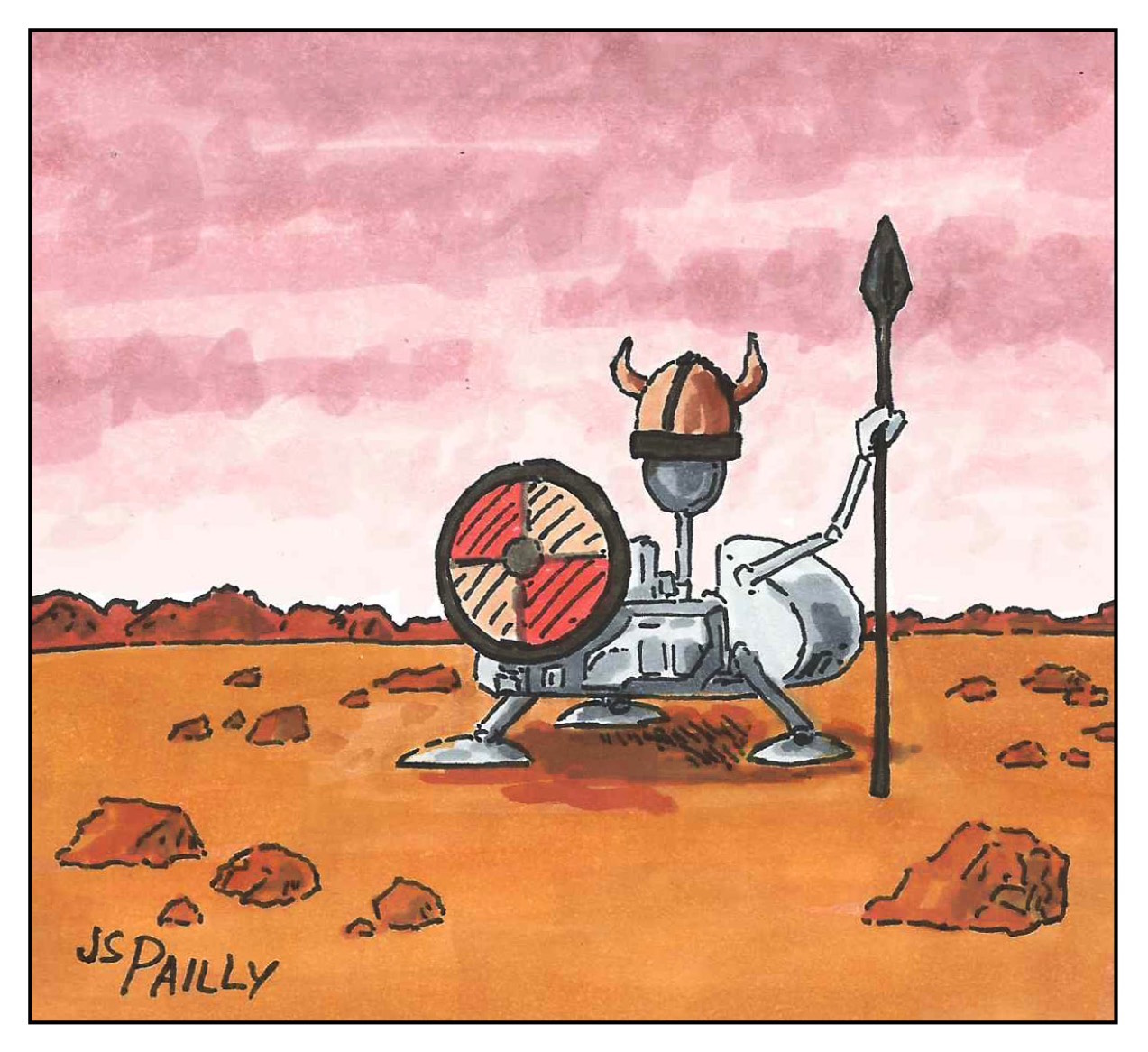
In the late 1960’s, NASA was putting together a mission to Mars, and they decided to name this new mission Viking.

As explained in this book on NASA’s history of naming things:

The name had been suggested by Walter Jacobowski in the Planetary Programs Office at NASA Headquarters and discussed at a management review held at Langley Research Center in November 1968.  It was the consensus at the meeting that “Viking” was a suitable name in that it reflected the spirit of nautical exploration in the same manner as “Mariner” […].

In NASA’s early years, nautical exploration was the theme for naming all missions to other planets.

The Viking 1 and Viking 2 landers arrived on Mars in 1976. They were the first space probes to successfully land (as opposed to crash) on Mars, and they were the first to send back photos from the surface.  They were also the first, and so far the only, space probes to conduct experiments directly testing for Martian life.

And one of those tests came back positive!!!

Except it may have been a false positive.  It was probably a false positive.

This test was called the labeled release experiment, and here’s how it worked: the Viking landers scooped up some Martian soil and added a nutrient mix—in other words, we tried to feed the Martians.  The nutrient mix was “labeled” with a radioactive carbon isotope, so if any Martian microbes were living in the soil, they’d take the food and then release gaseous waste that had this special isotope in it.

But there were some problems with this idea.  How do we know what Martian microbes eat?  How do we know what waste products they produce?  And—here’s the biggest problem of all—given how little we knew about Mars at the time, how do we know our nutrient mix wouldn’t react with some previously unknown chemical in the Martian soil, giving us a false positive result?

These are the kinds of questions that were asked after the labeled release experiment took place (but apparently not before).  As a result, there was wild disagreement about what that positive test result might actually mean.  The general consensus today is that we got a false positive.  Our nutrient mixture must have reacted with something in the soil, something that was not alive.

But while the Viking Mission could not give us a definitive answer about whether or not there is life on Mars, Viking still taught astrobiologists a valuable lesson.  When exploring strange, new worlds, trying to tell the difference between chemistry and biochemistry can be really hard.

Next time on Sciency Words A to Z, wow… just, wow!

Sciency Words A to Z: Unknown Absorber

Welcome to a special A to Z Challenge edition of Sciency Words!  Sciency Words is an ongoing series here on Planet Pailly about the definitions and etymologies of science or science-related terms.  In today’s post, U is for:

THE UNKNOWN ABSORBER

If there’s one thing worth remembering from all this astrobiology stuff, it’s that life begins with chemistry.  All life in the universe, no matter how strange and exotic it may seem to us Earthlings, must depend on chemistry.  And I don’t know many places that are more chemically active than the planet Venus.  So is Venus a good place to go looking for alien life.

To quote from David Grinspoon’s book Venus Revealed, “Where life is concerned, Venus is consistently voted ‘least likely to succeed.’”  Sure, Venus is chemically active, but in a way that will violently tear apart complex organic molecules.

However, Grinspoon has the temerity to go ahead and speculate—and he makes it abundantly clear this is pure speculation—about the kinds of organisms that might call Venus home.  And that speculation focuses on a mysterious substance found in the Venusian clouds, a substance that has long been called the unknown near-U.V. absorber, or simply the unknown absorber.

In the field of spectroscopy, every chemical is known to absorb very specific wavelengths of light.  When light is spread out into a spectrum, as with a prism, you get a sort of unique barcode that you can use to identify chemicals.

A very simple “barcode” representing hydrogen.

If you’ve ever wondered how astronomers know which chemicals are found in space, or on other planets, this is how they do it.

In 1974, NASA’s Mariner 10 spacecraft sent us our first ever close-up photos of Venus.  In the visible part of the spectrum, there were no real surprises, but photos taken in ultraviolet showed that something was absorbing U.V. light like crazy, producing a spectroscopic barcode that nobody recognized.

In his speculation about life on Venus, Grinspoon mentions another chemical with a complex, hard-to-identify spectral barcode: chlorophyll, the chemical that makes photosynthesis possible here on Earth.  I say hard-to-identify… it’s not hard for us to identify, because we already know what it is.  But if extraterrestrial observers were studying Earth’s spectrum, chlorophyll would have them very confused—almost as confused as we were by Venus’s unknown absorber.

So could the unknown absorber be a chlorophyll-like molecule? Could this be the first evidence of air-born bacteria, drifting around in Venus’s cloudbanks, performing their own version of photosynthesis?  Maybe, Grinspoon tells us in Venus Revealed.  But that book came out in 1997.  In 2016, this paper was published identifying Venus’s unknown absorber as disulfur dioxide.

On a personal note, I wrote a blog post about Venus’s formerly unknown absorber before, and my post got the attention of the lead author of that 2016 paper.

But even though the mystery of Venus’s unknown absorber may have been laid to rest, I think this still served as a valuable lesson about what we should be looking for out there in the cosmos. Someday, another unknown absorber, with another weird spectral barcode, may be the thing that leads us straight to the discovery of alien life.

Next time on Sciency Words A to Z, the Martians better watch out.  The Vikings have landed on their planet!