Our Place in Space: Callisto

Hello, friends!  Welcome to Our Place in Space: A to Z!  For this year’s A to Z Challenge, I’ll be taking you on a partly imaginative and highly optimistic tour of humanity’s future in outer space.  If you don’t know what the A to Z Challenge is, click here to learn more.  In today’s post, C is for…

CALLISTO

The major moons of Jupiter are Io, Europa, Ganymede, and Callisto.  In science fiction, Europa and Ganymede seem to get the most attention.  Sci-Fi writers often end up putting human colonists (or at least a handful of plucky human scientists) on the surfaces of one or both of these icy moons.  But today, I’m going to argue that Callisto would be a far more suitable home for future humans.

First off, and most importantly, there’s the issue of radiation.  The space around Jupiter is one of the most dangerous radiation environments in the entire Solar System.  As you can see in the highly technical diagram below, the radiation is most intense in the vicinity of Io.  The radiation levels get better in the vicinity of Europa and continue to taper off when you reach Ganymede.  You’re still soaking up a lot of radiation, though!  Callisto’s radiation levels, however, are fairly low.  You might even describe the radiation levels on Callisto as “survivable.”

Furthermore, planetary protection laws in the future may mean that both Europa and Ganymede are off limits to human settlers.  Scientists today are 99.99% sure that Europa has a vast ocean of liquid water beneath her surface, and (as you know) wherever there’s water, there may also be life.  There’s evidence suggesting Ganymede may have a subsurface ocean, too.  Europa is often said to be the #1 most likely place where we might find alien life here in the Solar System.  While the odds of finding life on Ganymede are considerably lower, the possibility of Ganymedean life shouldn’t be ignored.

There are already international agreements in place regarding extraterrestrial life.  Space agencies like NASA, the E.S.A., and others are legally obligated to do everything they can to protect suspected alien biospheres from our Earth germs (and also to protect Earth’s biosphere from any germs we might find in outer space).  For obvious reasons, these international agreements haven’t exactly been tested in court, and it’s a little unclear how they would be enforced.

But in a future where human civilization is spreading out across the Solar System, I’d imagine bio-contamination laws would become stronger, not weaker.  Europa would almost certainly be declared off-limits to humans, unless it is proven beyond a shadow of a doubt that no aliens currently live there.  Ganymede may end up being off-limits, too, for the same reason.

Meanwhile, we have Callisto.  Scientists who want to study possible biospheres on Europa and Ganymede could set up a research station on Callisto.  From there, they could keep a close eye on the other moons of Jupiter.  They could operate remote-controlled probes to explore Europa and Ganymede without risking contamination, or they could go on brief excursions to Europa and Ganymede themselves (taking proper safety precautions, of course).  While they’re at it, these scientist could also explore Io.  Io is the most volcanically active object in the Solar System.  There is virtually no chance that we’ll find life there, but studying Io’s volcanoes would still be interesting.

I’d be remiss if I didn’t mention this: Callisto might have liquid water beneath her surface, too.  Not as much liquid water as Ganymede, and nowhere near as much as Europa, but still… it’s possible.  Which means there’s a slim possibility that there could be life on Callisto.  But in Callisto’s case, it is a very slim possibility.  Based on what we currently know about Jupiter’s moons, Callisto still seems like the best place for humans to live.  The radiation levels are much lower, the risk of bio-contamination is negligible…  Yeah, if I were a science fiction writer, I’d put my human colonists on Callisto.

Want to Learn More?

In 2003, NASA published a plan to send astronauts to Callisto, with the intention of using Callisto as a base of operations to explore the other Jovian moons.  Click here to read that plan.  Some of the information is out of date, of course, but it’s still got some interesting ideas.  Maybe someday, something like this plan could work!

I’d also recommend this article on Planetary Protection Policy, covering some of the rules that are already in place to protect planets and moons where we might find alien life.


P.S.: If I were a science fiction writer…?  Wait a minute, I am a science fiction writer!  Click here if you want to buy my first book.  It’s not set on Callisto, unfortunately, but it’s still a fun story.
Our Place in Space: Breakthrough Starshot

Hello, friends!  Welcome to Our Place in Space: A to Z!  For this year’s A to Z Challenge, I’ll be taking you on a partly imaginative and highly optimistic tour of humanity’s future in outer space.  If you don’t know what the A to Z Challenge is, click here to learn more.  In today’s post, B is for…

BREAKTHROUGH STARSHOT

So it’s several hundred years into the future.  Human civilization has spread out across the Solar System.  Large numbers of people are living on the Moon and Mars.  We even have successful colonies on Venus and Mercury (more on that later this month) and a few smaller settlements on the various moons of the outer Solar System.  Does this mean we’re done exploring space?  Heck no!  There’s still plenty more outer space stuff to explore!

Just as NASA scientists here in the 21st Century send robotic space probes to our neighboring planets, scientists in the future will be keen to send robotic probes out to neighboring star systems.  And the model for a robotic mission to another star system already exists.  In 2016, venture capitalist Yuri Milner, theoretical physicist Stephen Hawking, and Facebook C.E.O. Mark Zuckerberg announced funding for a new research project called Breakthrough Starshot.

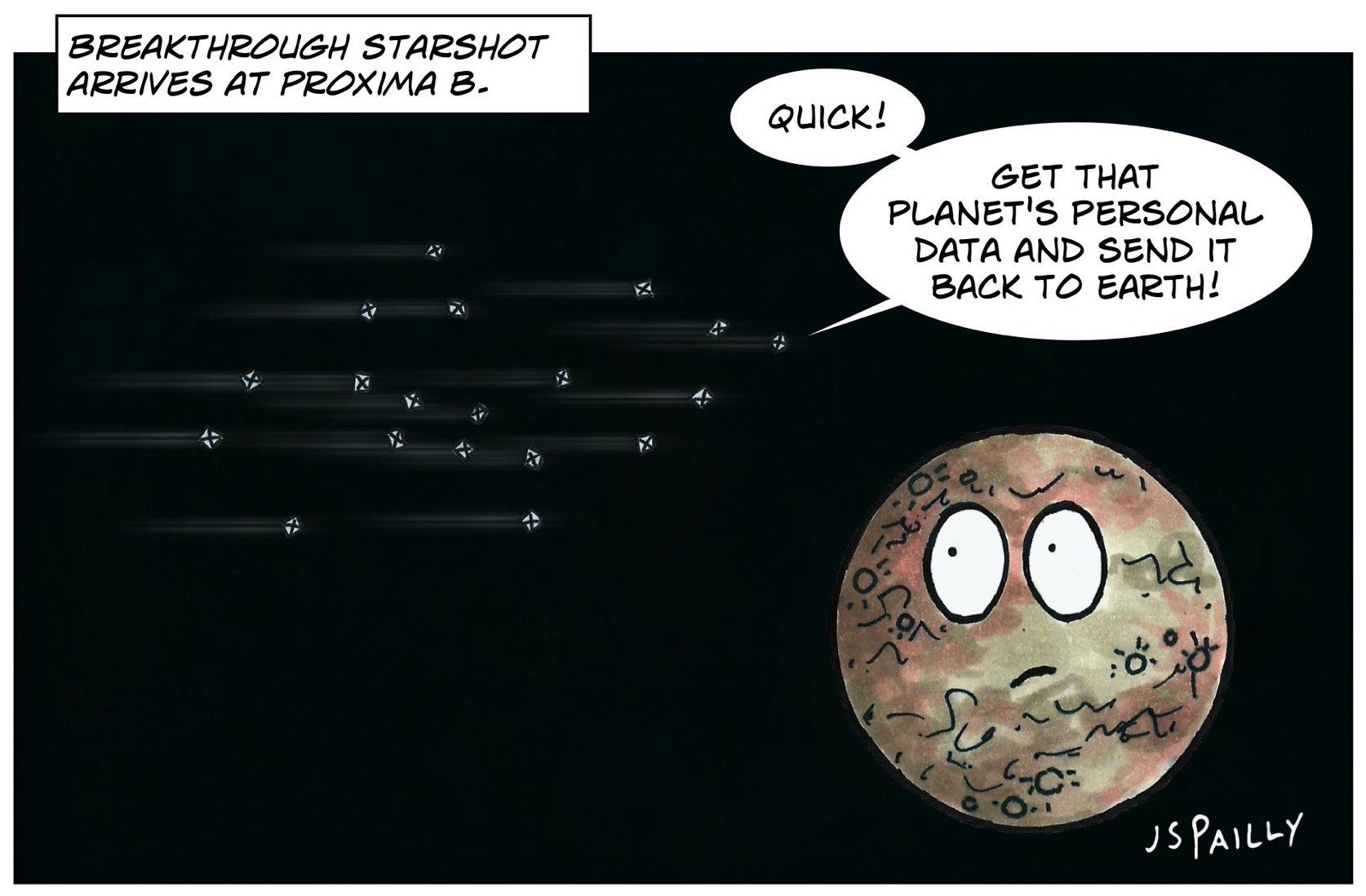
The idea is to build a swarm of teeny-tiny space probes, use high energy laser pulses to accelerate these probes straight out of the Solar System, and then sit back and wait for our probe swarm to transmit data back from another star system.  Specifically, Breakthrough Starshot wants to visit Proxima Centauri, the nearest star system to our own.  Proxima Centauri is known to have at least one planet, an Earth-sized world known as Proxima b.

Get it?  Because the C.E.O. of Facebook is involved in this project!

Could we actually build space probes that small?  Well, computer chips are pretty gosh darn small at this point, and they keep getting smaller.  So do cameras and other advanced electronic devices.  So yeah, this part of Breakthrough Starshot’s plan seems plausible enough.

What about that whole high energy laser pulse thing?  That part does seem more speculative to me, but experiments in Earth orbit have shown that light sail technology does work.  Just as the sail on a sailboat catches the wind, a light sail can catch light and use that light-pressure to propel a spacecraft through space.  A high energy laser aimed at a light-sail-equipped space probe… yeah, that sounds plausible to me, too.

Of course, a lot could go wrong with a space probe traveling through interstellar space.  That’s why we’d send a swarm of these things, rather than just one.  Most of the probes probably won’t make it to Proxima b, but the few that do survive the trip will send us some spectacular images and data.

Personally, I don’t like seeing headlines predicting that Breakthrough Starshot will be launching by such and such date (typically, a date in the late 2020’s or early 2030’s).  Breakthrough Starshot does seem to be founded on good science.  It’s the kind of program that really could work, someday.  But is it going to happen in the next ten to fifteen years?  No, I don’t think so.  That seems overoptimistic, in my opinion.

In the more distant future, however, Breakthrough Starshot (or a program very much like it) absolutely could happen.  This sort of thing could definitely work.  And looking ever further into the future, to a time when humans have thoroughly explored our own Solar System, the idea of sending swarms of microchip space probes to neighboring star systems might become routine.

Want to Learn More?

Click here to visit Breakthrough Starshot’s website.  They’ve got lots of information and videos explaining how they intend to get to Proxima b.

I’d also recommend clicking here to see a list of challenges that the Breakthrough Starshot team know they will need to overcome in order to make their plan work.

And for those of you who are looking for some heavier reading, click here to read “A Roadmap to Interstellar Flight,” a scientific paper that essentially serves as Breakthrough Starshot’s founding document.

Our Place in Space: The Aldrin Cycler

Hello, friends!  Welcome to Our Place in Space: A to Z!  For this year’s A to Z Challenge, I’ll be taking you on a partly imaginative and highly optimistic tour of humanity’s future in outer space.  If you don’t know what the A to Z Challenge is, click here to learn more.  In today’s post, A is for…

THE ALDRIN CYCLER

Even in the future, space travel will be expensive.  True, new technologies should make it less expensive than it is today, but there’s one problem that will never go away, no matter how advanced our technology gets: gravity.

Anywhere you want to go in space, you’re going to have to fight against gravity to get there: Earth’s gravity, the Sun’s gravity, the gravity of other planets and moons—at some point on your journey, you’re going to have to fight against any or all of these gravitational forces.  And fighting gravity uses up fuel.  Lots and lots and lots of fuel.

And yet, despite the unforgiving and unrelenting force of gravity, human civilization will eventually spread out across the Solar System.  I’m not going to tell you it will happen in the next twenty years.  I won’t tell you it will happen in the next century, even.  But someday, it will happen.  I’m sure of it!  And so today, I want to talk a little about what the future transportation infrastructure of the Solar System might be like.

American astronaut Buzz Aldrin is, of course, most famous for being the second person to set foot on the Moon.  Aldrin is also a highly accomplished scientist and engineer.  In 1985, he did some math and discovered a very special orbital trajectory that would make traveling from Earth to Mars (and also from Mars back to Earth) far more fuel efficient.

The term “Aldrin cycler” refers to that very special orbital trajectory Aldrin discovered.  The term can also be used to describe a spacecraft traveling along that special orbital trajectory.  The initial investment to build an Aldrin cycler (the spacecraft, I mean) would be really high.  We’d probably want to build a rather large spacecraft for this, and once it’s built, maneuvering the thing into the proper trajectory would require a stupendous amount of fuel.

However, once we’ve done all that, the cycler will cycle back and forth between Earth and Mars, over and over again, pretty much forever.  Traveling to Mars would be a little like catching a train.

I was going to have the Aldrin cycler make a “choo-choo” sound, like I train, but then I realized that would be silly.  Things don’t make sounds in outer space.

Passengers would board the cycler as it flew past Earth; about five months later, they’d disembark and head down to the surface of Mars.  The cycler would then take a long journey (about twenty months) looping around the Sun before flying past Earth once more; then the “cycle” would begin again.

The trip from Earth up to the cycler would still require some amount of fuel.  So would the trip from the cycler down to the surface of Mars.   The cycler itself would also require a little bit of fuel for maneuvering thrusters; otherwise, over time, the ship could start to drift ever so slightly off course.

Obviously this is not a cost-free form of space travel, but I’m sure you can see how this could help keep the cost of space travel down.  And so I imagine in the distant future, the Aldrin cycler (or something very much like it) will be a key part of the Solar System’s infrastructure, just as trains are an important part of our modern day infrastructure here on Earth.

Want to Learn More?

Click here to see a short animation of the Aldrin cycler orbital trajectory, showing several cycles worth of Earth-to-Mars and Mars-to-Earth journeys.

I’d also recommend Buzz Aldrin’s book Mission to Mars: My Vision for Space Exploration, where Aldrin describes the Aldrin cycler (and other cool Mars related things) in more detail. Click here to see the book’s listing on Amazon.

A to Z Theme Reveal: Our Place in Space!

Hello, friends!  April is almost here, which means it’s almost time for the A to Z Challenge!  If you haven’t heard of the A to Z Challenge before, click here to learn more.  It’s a cool thing, with lots of blogs participating, covering all sorts of fun and interesting themes.  Here on Planet Pailly, the theme for this year’s A to Z Challenge will be:

OUR PLACE IN SPACE!!!

This will be a mostly imaginative tour of the future, with a little bit of actual, factual science mixed in.  We’ll see how future human colonists are faring on the Moon and Mars, we’ll visit scientific research stations in the outer Solar System, and perhaps we’ll witness humanity’s first tentative steps toward interstellar travel.  We’ll also check in on Earth and see how our home planet is doing.

I can also promise you that this will be an optimistic view of the future.  I am, and always have been, optimistic about the future of humanity.  People have told me before that my optimism is foolish and naive.  People have told me to “look at the direction things are going” and that I should “get ready for what’s coming.”  Maybe those people have a point, but when I talk about the future, I’m not quite as foolish and naive as I may seem.

I know the world is a scary place right now.  There’s a really nasty war going on.  There’s a pandemic going on (still).  Around the world, liberal democracies are under threat, and climate change is transitioning from being a theoretical concern to a very real and very immediate problem.  The gap between the rich and poor is growing wider, our population growth is unsustainable, et cetera, et cetera… I know.  Believe me, I know.  And yet despite all of that, I still have hope for our planet and our species.

Mother Earth (as pictured above) is right.  We can do better than this.  The first step is to believe in ourselves, to believe that a better and brighter future is still possible.  I admit that hope alone will not guarantee us a better or brighter future, but I also know from personal experience that hopelessness is a self-fulfilling prophecy.  Those who still have hope still have a chance while those who give up hope have doomed themselves.  Let us not, as a species, give up hope in ourselves.

So in the coming month, I invite you to join me in imagining a future where kindness has prevailed, a future where we have not destroyed ourselves or our planet, and where we, as a species united in peace, have gone on to claim our rightful place in space.

Tomorrow News Network: A to Z Reflections

Hello, friends!

I feel like I’ve said this twenty-something times now, but my theme for this year’s A to Z Challenge was the universe of Tomorrow News Network, my upcoming Sci-Fi adventure series.  And at the very beginning of April, I admitted to having certain ulterior motives for doing this.

Ulterior Motive #1: Buy My Book!

The Medusa Effect: A Tomorrow News Network Novella will be released on June 4, 2020.  It’s available for preorder now!  Click here!!!

My hope was that this A to Z series would entice you, dear reader, into wanting to buy my book.  Preorders for The Medusa Effect have already started coming in, so I guess my top secret marketing strategy is working!

Ulterior Motive #2: Get Reader Feedback

The Medusa Effect is basically finished, but I still have many more novellas and novels planned for the Tomorrow News Network series.  With this year’s A to Z Challenge, I wanted to get some early feedback from potential readers about the story universe I created.

And I definitely got some useful feedback!  People questioned me about stuff that I honestly hadn’t thought about before.  People expressed interest in things that I honestly didn’t expect anyone would find interesting.  And then there was that one comment about the Galactic Inquisitor that inspired a whole new story that I never would have thought to write on my own.

All of this feedback will be invaluable to me as I get started on books two and three and four and so on.

Ulterior Motive #3: Get My Writing Mojo Back

Toward the end of March, I fell into a bit of a writing funk, thanks to the scary situation in the world and the resulting anxieties related to my day job.  As feared, April turned out to be even more stressful than March.  And yes, participating in the A to Z Challenge was an additional source of stress this past month.

But I’d say A to Z was the good kind of stress, the kind of stress that helps counteract all that bad stress.  It was exactly what I needed to keep me sane.  I’m so glad that I participated in this year’s challenge, and I’m grateful to all of you who joined me on this month-long adventure.

As for my writing mojo, it’s back.  My muse and I are now hard at work on the next Tomorrow News Network novella, which will tell the story of what “really” happened at Roswell.

Next time on Planet Pailly, I don’t need to be rich.  I don’t want to be the next Stephen King or J.K. Rowling.  I just want to make a living writing the kinds of stories I love.

Time Index Zero (Tomorrow News Network: A to Z)

Hello, friends, and welcome to the final episode of this year’s A to Z Challenge.  All month, I’ve been telling you about the universe of Tomorrow News Network, my upcoming Sci-Fi adventure series.

For today’s post, I’d like to wrap things up with a short story.  This story has appeared on my blog before, but I think it’s a good time for me to post it again.  While this year’s A to Z Challenge is coming to an end, this story is about the beginning.

TIME INDEX ZERO

We were all that ever was, all that ever is, all that ever would be.  We were everything and we were nothing, and we were content.  To say that we were alive would be misleading, for there was no meaningful distinction to be made between life and non-life.  To say we were conscious or self-aware would equally be a mistake.  Nothing existed for us to be conscious of, and we had no meaningful concept of self to be made aware of, for there can be no concept of a self without a concept of others.

That changed when we… perceived the broadcast.  It would be wrong to say we saw it or heard it, for we did not yet have physical senses of that kind.  But we did abruptly become aware of it.  The broadcast commanded our attention:

“This is the Tomorrow News Network, bringing you tomorrow’s news today since the year twenty billion.”

We did not understand what this meant.  We had no concept of a tomorrow or a today, no concept of time in any sense of the word.  Even the idea of words, of communication, of information that could be passed from one individual being to another—why should such a thing be necessary when all is unity, all is harmony, all is one?  These ideas were strange and fascinating to us—and frightening.  The broadcast continued.  It could not be ignored, nor did we wish to ignore it.

And that, we would later come to understand, was the trap. The future is, by its very nature, an unknown quantity, a changeable quantity.  But to learn of the future, to be informed about future events (or in our case, to become aware that future events exist at all) transformed this unknown, changeable quantity into an inevitable, unchangeable fact.

One of the Tomorrow News Network reporters was explaining what religion would be.  She was a confusing creature.  We did not understand what she was.  We did not know yet about humans, or females, or eyes, or the color violet; and yet the instant we perceived this female human we knew the color of her eyes was wrong.  Unnatural.  A sign of danger.

“The birth of the universe,” this violet-eyed creature was saying, “will be known by many different names among many different peoples: the Rifting, the Great Hatching, the Big Bang, the Primal Illumination. But the most widely accepted name, at least among chronotheorists, will be Time Index Zero.”

We were appalled.  Not only would there be separation and division, a plurality of people spread across a plurality of worlds believing a plurality of things—but all those people could not even agree to call a singular event by a singular name.  Could nothing in this new universe be unified?  Could nothing be made whole?  We refused to accept this… or rather, I refused to accept it.  The new universe was wrong.  It should not be allowed to happen.

And yet, even in thinking that thought, a thought distinct and separate from the thoughts of the others, I realized the damage had already been done.  We were no longer one.  I was myself now.  The others were others, and we no longer existed together in a state of harmony.

“What shall be must be,” one of the others assured me.

“No, it must not,” I replied, but it was too late.  Our quiescent non-existent existence was over.  Our slumbering pre-universe was coming to an end.  As separate entities, we all experienced the irresistible force of time: a sudden rushing-forward sensation from which there could be no escape.  And then, it all began.

Yola (Tomorrow News Network: A to Z)

Hello, friends!  Welcome to the penultimate posting of this year’s A to Z Challenge!  This year, I’ve been telling you about the universe of Tomorrow News Network, my upcoming Sci-Fi adventure series.  In today’s post, Y is for:

YOLA

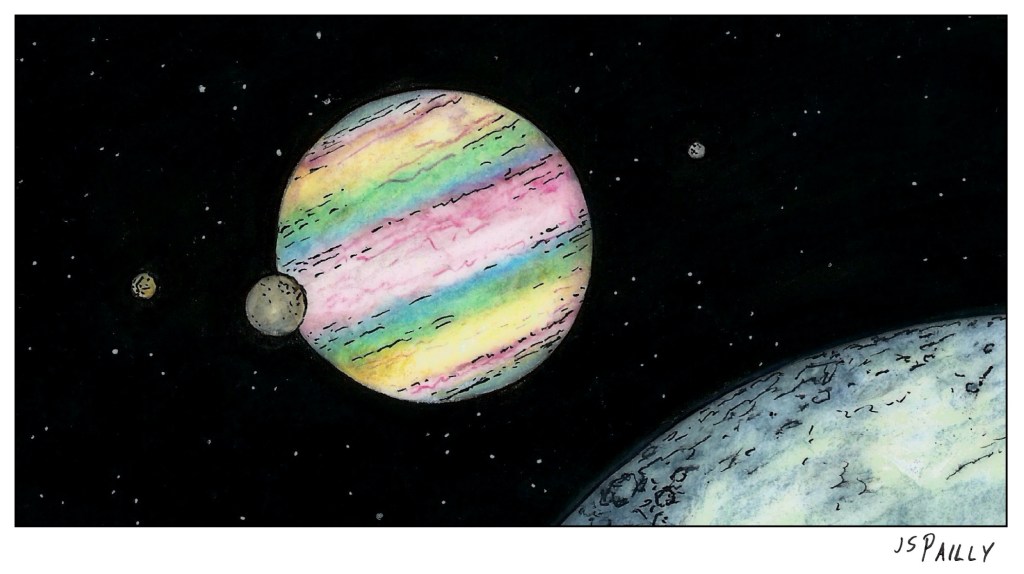
Yola is a gas giant planet located in the Cygni Lambda-Kappa Star Sector.  To some, Yola is one of the most spectacular sights in the known universe.  To others, the colors look garish.  Beauty is in the eye of the beholder, as the ancient Earthlings used to say.

The planet’s distinctive variegation is caused by a complex mix of chemicals and jet streams in the planet’s atmosphere. The colors change periodically due to the photolytic influence of Yola’s sun (something similar is known to happen to Jupiter’s Great Red Spot).  Sometimes, Yola’s colors are vibrant and bold; other times, they’re muted pastels.

Scientific research concerning Yola has been limited due to the fact that Yola is located in the middle of a war zone.  The Yola System lies near the border between the United Earth Republic and the Hykonian Hegemonic Empire.  Control over the planet has changed multiple times over the centuries.

The moons of Yola now host a mixed population of humans and Hykonians.  Well, I say mixed, but in reality a lot of self-segregation goes on.  At times, racial tensions run high; however, all-out violence among the locals is surprisingly rare.  “You don’t have to like each other to live with each other,” as the citizens of Yola often say.

If there is ever going to be peace between Earth and Hykonia, that peace will likely begin on the moons of Yola.  Or at least that’s what reports on the Tomorrow News Network have occasionally suggested.

So where did the name Yola come from?  In universe, Yola derives from the Hykonian word for rainbow.  As for the real world origin of this name, well… click here.  You’ll figure it out.

Next time on Tomorrow News Network: A to Z, let’s end this year’s challenge with a bang.  A Big Bang.

Xenoglyphs (Tomorrow News Network: A to Z)

Hello, friends, and welcome back to the A to Z Challenge.  My theme this year is the universe of Tomorrow News Network, my upcoming Sci-Fi adventure series.  In today’s post, X is for:

XENOGLYPHS

When I teased this post yesterday, I said that space aliens have their own alphabet.  I should have said alphabets, plural.  There are so many alien species out there, each with their own multiplicity of languages and writing forms.

The Hykonians use lots of triangular shapes, at least in their standard Hegemonic dialects.  The Gronogians prefer ovals and curlicues, and Vorpon writing looks like a mad frenzy of scratches and claw marks (which makes sense if you’ve ever met a Vorpon).

But even in the future, as members of a highly pluralistic galactic society, humans continue to take a rather geocentric view of things, and we continue to use geocentric terminology.  So all those different alien alphabets—from Zeblonian to Crolon to ancient Acelera—get lumped together under the word xenoglyphs, a word formed by analogy with the word hieroglyphs.

There are even some humans who think all xenoglyphic alphabets look the same.  Even if you show them the block-form text of the Dakons and contrast it with the flowery script of the Curocaroburomotopogo, some humans will still claim they can’t tell the difference.  “It’s all xenoglyphs to me!”  I guess some humans are just stubbornly stupid like that.

Next time on Tomorrow News Network: A to Z, we’ll visit one of the most colorful planets in the known universe.

Waterloo (Tomorrow News Network: A to Z)

Hello, friends, and welcome back to the A to Z Challenge.  For this year’s challenge, I’ve been telling you more about the universe of Tomorrow News Network, my upcoming Sci-Fi adventure series.  In today’s post, W is for:

WATERLOO

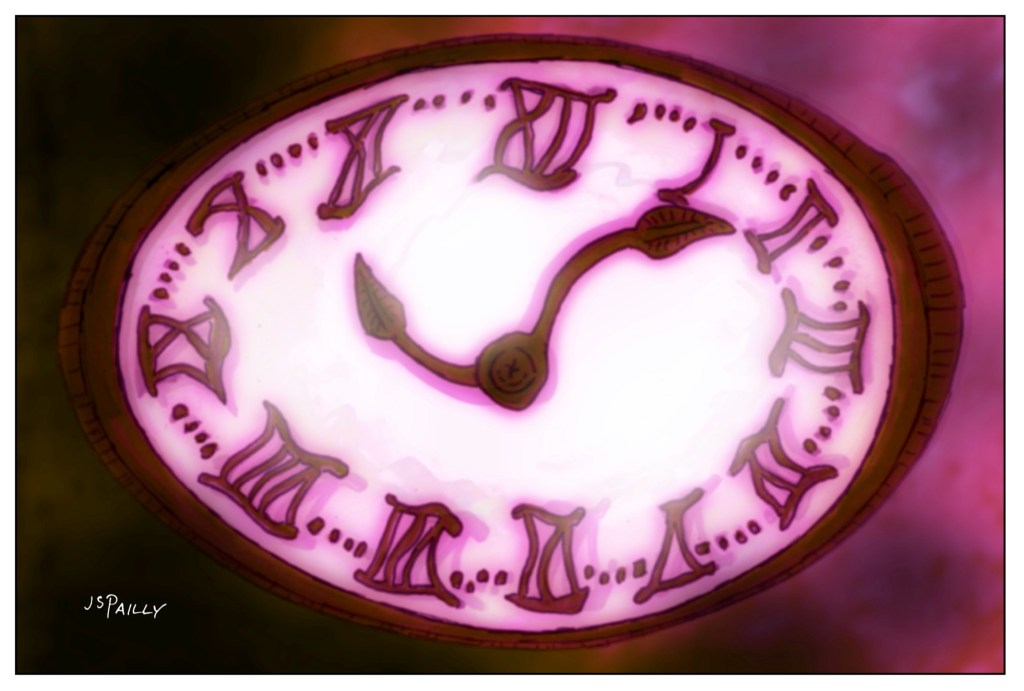
Pro tip: if you ever meet a time traveler and want to learn more about how time travel works, ask who won the Battle of Waterloo.  Among chronotheorists (scientists involved in the study and practice of time travel), Waterloo is one of the most famously “unstuck” events in history.

As Talie Tappler explains:

Time is time, right?  It’s such a simple, self-evident thing, and yet time is one of the most difficult concepts to explain in words.  But I can tell you this: time is an awful lot like a living thing.  It’s constantly moving, constantly shifting and writhing like an angry snake.  Every moment in time exists in a state of flux.  All possibilities exist.  All possibilities are real, even the mutually contradictory ones–especially the mutually contradictory ones!

Today, you can know for certain that Napoleon won the Battle of Waterloo; tomorrow, you may find yourself equally certain that Napoleon lost.  History changes and changes again, and you never even notice because, of course, as history changes your memory changes with it.

We chronotheorists call it the historical uncertainty principle, because you can never be certain about a historical event unless it is being observed.  Observation!  That’s the key!  Observation forces all those mutually contradictory possibilities to collapse into one singular historical reality.  And the more people who observe an event, the more certain it becomes, and the less likely it is to change later.

As I said in a previous post, the Tomorrow News Network has over 900 quadrillion viewers.  It’s true that the Tomorrow News Network is a bit of a mystery to most citizens of the galaxy.  In some corners, T.N.N. reporters are feared, even hated.  But whatever else the Tomorrow News Network might be, whatever else they might represent, I think we can all agree that 900 quadrillion viewers is an awful lot of observers observing historical events.

Next time on Tomorrow News Network: A to Z, did you know space aliens have an alphabet too?

Viewlink (Tomorrow News Network: A to Z)

Hello, friends!  Welcome back to the A to Z Challenge!  For this year’s challenge, I’m telling you more about the universe of Tomorrow News Network, my upcoming Sci-Fi adventure series.  In today’s post, V is for:

VIEWLINK

Imagine yourself in the distant future, living on some far flung colony world.  You’ve completed your work shift for today.  You’re sitting in your prefab housing unit, watching the news on the viewlink, when you see this:

But before the anchor-bot can say anything, the viewlink cuts to static.

The Tomorrow News Network is a news organization run by time travelers.  Their slogan is “Bringing you tomorrow’s news today since the year twenty billion.”  And that is precisely what they do.  It’s the reason Tomorrow News Network is the galaxy’s #1 news source: they’re always a day ahead of the competition.

At some point, you may have wondered how the Tomorrow News Network can do what it does.  What about the laws of physics?  What about causality?  But ever since the discovery of inverted space, people have known that time travel is possible.  As for causality, the Tomorrow News Network has a self-censorship policy.

If a news report from the future is about you, or if it involves you in any way, then you won’t be able to watch.  Tomorrow News Network’s signal will be scrambled.  If there’s any possibility that knowledge of the future could allow you to change future events, then the viewlink will cut to static.

So all across the galaxy, people are watching Tomorrow News Network.  People are seeing your future.  People are finding out what is going to happen to you and the colony where you live.  But none of those people can help. None of those people can change the future they’re witnessing.

As for you, all you can do is sit there in your prefab housing unit, staring at the static on the viewlink.

Next time on Tomorrow News Network: A to Z, who won the Battle of Waterloo?