Molecular Monday: Amorphous Ice

Welcome to Molecular Mondays! Every other Monday, we examine the atoms and molecules that serve as the building blocks of our universe, both in reality and in science fiction. Today we continue our investigation of:

WATER
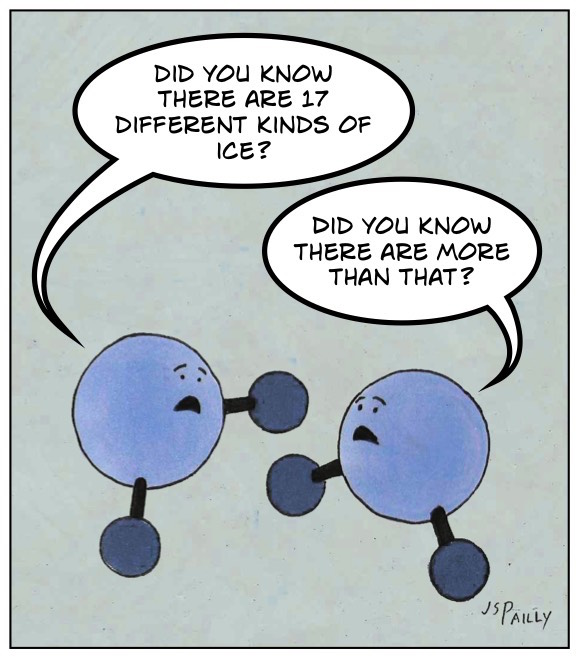
Nv12 Water Facts

In my previous Molecular Monday post, I told you about some of the exotic forms of water ice believed to exist on other planets, where pressures and temperatures are radically different than what we’re familiar with here on Earth.

But those seventeen forms of ice were only crystalline ices, ices where the water molecules line up to form neat geometric patterns. It takes energy (heat) for water to crystallize. That may seem counterintuitive, but consider that 0º C is a whole lot hotter than absolute zero.

In the darkest depths of space, it’s too cold for water to crystallize. Instead, water molecules freeze solid in a random, haphazard way. This is called amorphous ice, or sometimes porous ice, and it is believed to be the most common form of water in the universe (even though it hardly ever appears here on Earth, except under laboratory conditions).

When handling amorphous ice, be careful. For one thing, it can react violently to changes in pressure. Here’s a brief video where samples of high density amorphous ice transition into low density amorphous ice due to lowering the pressure.

Also, because amorphous ice has a random structure, microscopic cavities often form between water molecules. That’s why it’s also called porous ice. Other chemicals can get trapped inside these internal pores. Melting the ice (or even adding heat to crystallize the ice) could accidentally release those chemicals, or allow them to mix, with unpredictable results.

In the distant Sci-Fi future where humanity has spread throughout the Solar System and beyond, interplanetary travelers will be dependent on whatever sources of water they can find in space. Appropriate safety measures should be put in place for harvesting water from comets, asteroids, or even small icy moons like Europa or Enceladus. Amorphous ice can be full of unpleasant surprises.

Links

Goddard Lab Works at Extreme Edge of Cosmic Ice from NASA’s official website.

Why Comets Are Like Deep Fried Ice Cream from JPL’s official website.

Supercooled and Glassy Water from Physics Today.

Molecular Monday: Hot as Ice VII

Welcome to Molecular Mondays! Every other Monday, we examine the atoms and molecules that serve as the building blocks of our universe, both in reality and in science fiction. Today we continue our investigation of:

WATER

Water is basically everywhere in our universe. On Uranus and Neptune, most of the water is in the form of ice.

Nv06 Ice Ice Baby

But this ice isn’t cold. It’s hot. Like thousands of degrees Celsius hot.

The ice you and I are most familiar with is called ice Ih (pronounced ice one-h). The I is a Roman numeral one, and the h stands for hexagonal, because the water molecules form hexagon-shaped crystals.

Another form of ice is called ice Ic (ice one-c). In this case, the c stands for cubic.  The water molecules crystalize into cube shapes.

Nv06 Ice Cube

Ice Ic requires extremely cold temperatures (-50 to -140ºC) and is believed to form in the uppermost reaches of Earth’s atmosphere.

There are at least fifteen more crystalline forms of ice, ranging from ice II to ice XVI. Some have been created in the laboratory. Others remain purely hypothetical. Water molecules will line up to form ice crystals of wildly different shapes, sizes, and complexities depending on various combinations of pressure and temperature.

Nv06 Snowflake

Somewhere deep inside the planets Uranus and Neptune, water molecules probably “freeze” as ice VII and ice VIII. I’m not sure how to describe the geometry of these types of ice; just click the links to see some diagrams.

Pressures on Uranus and Neptune may even be great enough for ice X to form. In ice X, water molecules are so tightly packed that they lose their identities. It would be better to think of oxygen and hydrogen atoms squeezed together, not separate water molecules. For this reason, ice X is sometimes called non-molecular ice.

Of course, all of this seems very strange and exotic to us Earthlings. And yes, things like ice VII or ice X aren’t exactly common in our universe. But that doesn’t mean ice Ih is normal either.

In the next edition of Molecular Mondays (two weeks from today), we’ll meet yet another kind of ice. A kind of ice that doesn’t play by the rules and doesn’t need no Roman numerals.

Links

Is Salt the Key to Unlocking the Interiors of Neptune and Uranus? from Science Daily.

Phase Diagram of Water from Wikipedia.


Molecular Monday: Water on Neptune

Welcome to Molecular Mondays! Every other Monday, we examine the atoms and molecules that serve as the building blocks of our universe, both in reality and in science fiction. Today we continue our investigation of:

WATER

Meet Neptune, the other blue planet.

Nv01 Neptune Blues

Neptune may be named after the ancient god of the sea, but the planet’s striking blue color is caused by a high concentration of atmospheric methane, not water. Methane absorbs red light and reflects blue light back into space. So Neptune has nothing to do with that most precious commodity in space: water.

Except…

Okay, this sort of statement should no longer come as a surprise to me or anyone else, but the planet Neptune does in fact have water. In fact, water is sort of everywhere in space, which makes sense because the water molecule is made of two of the most common elements in the universe: hydrogen and oxygen.

Furthermore, water is the simplest possible combination of hydrogen and oxygen. So of course we’re going to find it everywhere. Even on Neptune. Why would anyone think water is somehow special to Earth? (Why did I think that for so long?)

But water on other planets rarely behaves the way it does here on Earth. As we’ve seen in two previous Molecular Monday posts (click here and here), the freezing and boiling temperatures of water change depending on pressure and salinity. At a certain point, known as the triple point, water’s freezing and boiling temperatures are the same, so water skips over its liquid phase, transitioning directly from gas to solid and vice versa.

Nv01 Water Water Everywhere

So the planet Neptune might actually live up to its sea god name. Not only does it have water, but there is a slim possibility that deep in the planet’s interior, the pressure and temperature are just right to support an ocean of liquid water. If Neptune were just a bit colder, the odds of such an ocean forming would improve dramatically.

Discovering liquid water on Neptune would be pretty cool, but there’s something even cooler (or perhaps hotter) about Neptune’s water. In the next edition of Molecular Monday (two weeks from today), we’ll take a closer look at Netune’s “icy” interior.

* * *

Today’s post is the beginning of Neptune month for the 2015 Mission to the Solar System. Click here to learn more about this series.

Molecular Monday: When Water Boils and Freezes at the Same Time

Welcome to Molecular Mondays! Every other Monday, we examine the atoms and molecules that serve as the building blocks of our universe, both in reality and in science fiction.

* * *

At some point, you may have heard in a science documentary or something that in the vacuum of space, liquid water boils and freezes at the same time. So what the heck does that mean?

Maybe it means water behaves something like this:

The chemical in that video is called cyclohexane, but it could just as easily have been any other chemical, including water, that has been brought to its triple point.

In a previous Molecular Monday post, we talked about how water’s freezing and boiling temperatures change as you raise or lower the pressure. At a certain point, when the pressure is low enough, the freezing and boiling temperatures are the same, causing water to freak out.

Oc05 Water's Triple Point

Since water is trying to be all three states of matter simultaneously, we call this the triple point.

The temperature and pressure in space are well below water’s triple point, precluding any possibility of a liquid state. So if you put liquid water in space, it starts changing into something else. Anything else.  As rapidly as possible.

According to astronauts who’ve watched this happen (i.e.: astronauts who’ve looked out the window after using the space toilet), liquids tend to turn into vapor first, and then the vapor turns into ice crystals. So all those science documentaries should really say that liquid water in space boils then freezes, or rather it boils then desublimates. Although given that these changes occur in a matter of seconds, I won’t be too nitpicky.

Molecular Monday: Life on Titan

For today’s Molecular Monday post, I had planned to continue my investigation of water. However, the 2015 Mission to the Solar System has just brought us to Titan, Saturn’s largest moon, and Titan’s potential biochemistry demands some special attention.

Sp11 Tholins

So we’ll continue studying water in the next Molecular Monday post.

Titan is a lot like Earth, except it’s also a lot different than Earth. Both have air and bodies of liquid on their surfaces, but on Titan, the air doesn’t contain oxygen, and the liquid is not water.

Titan’s atmosphere is 95% nitrogen, with methane constituting most of the remaining 5%. Exposure to sunlight causes the methane molecules to break apart and recombine into other, more complex hydrocarbons, which drizzle down to the moon’s surface.

Liquid methane and liquid ethane also exist on Titan’s surface, forming eerily Earth-like rivers and lakes. The largest, known as Kraken Mare, is located near the north pole.

Sp11 Titan's Kraken

It seems unlikely that Titan’s lakes are home to enormous sea monsters. The available chemicals would probably limit the size and complexity of Titanian life forms to microbes.

Sp11 Titan's Microorganisms

Compared to life on Earth, or even theoretical life on Mars, Europa, or Enceladus, Titan’s microbes would be weird. Really weird. They could still be carbon-based, but they’d have to substitute liquid methane and/or ethane for water. They’d also have to perform cellular respiration without oxygen, perhaps using hydrogen instead.

The breakdown of methane by sunlight produces, among many other things, molecular hydrogen (H2) and acetylene (C2H2). According to David C. Catling’s book Astrobiology: A Very Short Introduction, microbes on Titan could derive energy from these two chemicals via the following chemical formula.

C2H2 + 3H2 –> Energy + 2CH4

The 2CH4 byproduct is two molecules of methane. If true, this would conveniently explain how Titan replenishes the methane in its atmosphere, which is continuously being broken down and recombined by sunlight.

Whether or not life exists on Titan, the possibility of hydrogen-breathing aliens opens up some intriguing possibilities for science fiction. Especially since hydrogen is far more common in our universe than oxygen.

P.S.: Titan also apparently has a subsurface ocean of liquid water, just like Europa, Ganymede, or Enceladus, where more traditional organisms could exist. So Titan may have two viable habitats supporting two very different forms of alien life.

Molecular Monday: When Water Boils…

I started writing Molecular Mondays with the goal of teaching myself a little chemistry. Chemistry was always my worst subject, but as a science fiction writer, I need to know this stuff. I’ve found that while researching and writing this series, I’ve had to unlearn much of what I learned in school.

Here’s a good example: my teachers told me that the boiling point of water is 100 ºC (212 ºF). That’s it. End of story.

Except it isn’t.

Sp05 Boiling Water

Water boils at 100 ºC if it’s under one bar of pressure (equal to normal atmospheric pressure at sea level). Also, water boils at 100 ºC if it’s pure water. Lower the pressure, and the boiling point drops. Raise the pressure, and the boiling point rises. Adding impurities like salt will also drive the boiling point up. These factors can also affect water’s freezing point.

As a science fiction writer, I spend most of my time (metaphorically speaking) on other planets, with atmospheric pressures often much higher or lower than one bar. And for those rare worlds that do possess liquid water, like Europa, Enceladus, or maybe Mars, that water undoubtedly contains loads of impurities.

As a result, water freezes and boils at very different temperatures throughout the Solar System. In many cases, due to the low or no pressure environments often found in space, water just skips its liquid phase entirely, transforming straight from ice to vapor and vice versa.

Since we live on Earth, I might be willing to forgive my old science teachers for failing to mention any of this space stuff… except even on Earth, the boiling point of water can vary greatly.

At sea level, the boiling point is 100 ºC. Go to Kansas, with a mean elevation of 2,000 feet above sea level, and the boiling point is roughly 98 ºC. That may not seem like a huge difference, but it’s a difference. Climb the Rocky Mountains, reaching a maximum elevation in excess of 14,000 feet above sea level, and the boiling point drops to 85 ºC. Climb Mt. Everest (over 29,000 feet above sea level), and water will boil at only 72 ºC. (Click here for a chart showing water’s boiling point at various altitudes.)

So while 100 ºC may be water’s boiling point under certain specific conditions, it’s hardly the universal standard I was led to believe it to be.

In the next Molecular Monday post, I’ll continue my research on water. I’m pretty sure there are a few more old science lessons I need to unlearn.

Molecular Monday: Turning Water Into Rocket Fuel

Welcome to Molecular Mondays! Every other Monday, we examine the atoms and molecules that serve as the building blocks of our universe, both in reality and in science fiction.

* * *

Humans need water. Our spaceships, however, may need it more than we do.

Human space exploration will never succeed if we have to carry everything we need from Earth. Instead, we have to learn to exploit the material resources space provides.

The Electrolysis of Water

Electrolysis is the process of using electricity to trigger a chemical reaction. Stick a pair of electrodes in water and turn on the power. This will break the chemical bonds holding water molecules (H2O) together.

Hydrogen will then accumulate around the negatively charged electrode. Oxygen will gather around the positive electrode.

Jy09 Hydrogen and Oxygen

Hydrogen, the Ultimate Rocket Fuel

Hydrogen makes the best rocket fuel (in more technical lingo, hydrogen has the highest specific impulse of any known substance). All you need is an oxidizer for the hydrogen to react with… and oh look, you’ve got plenty of oxygen! Just put the two back together in a reaction chamber, and you’re good to go.

Ideally, you’ll want to store your hydrogen and oxygen fuel in liquid form, which means you’ll need a lot of refrigeration equipment to keep them both below their boiling temperatures (roughly 20 Kelvin for hydrogen and 90 Kelvin for oxygen).

Asteroid Hopping

Of course, you’ll have some trouble finding water in space. If you’re planning an extended voyage through the Solar System, plot a course that will take you near some asteroids, specifically carbonaceous asteroids. They tend to contain relatively large amounts of water in the form of ice.

So long as you can find a few places to refuel your spacecraft, and so long as you bring the appropriate equipment along with you, you should be free to travel wherever you like.

* * *

Today’s post is part of asteroid belt month for the 2015 Mission to the Solar System. Click here for more about this series.

Molecular Monday: Platinum Group Metals

Welcome to Molecular Mondays! Every other Monday, we examine the atoms and molecules that serve as the building blocks of our universe, both in reality and in science fiction. Today, we turn our attention to:

THE PLATINUM GROUP METALS

Not all atoms are created equal. Some have super powers.

Jy03 Awesome AtomsPictured above are the platinum group metals: ruthenium, rhodium, palladium, osmium, iridium, and of course platinum. All six can be found clustered together on the periodic table of the elements.

Jy03 Awesome Periodic Table

Why are the platinum group metals (or P.G.M.s) so special? Here are some of the reasons:

  • P.G.M.s have excellent catalytic properties, making them an important component in catalytic converters.
  • P.G.M.s also have excellent electrical properties, which we take advantage of in nearly all modern electronics.
  • Most of the P.G.M.s are highly resistant to oxidation, even at high temperatures, making them useful for all sorts of industrial applications.
  • P.G.M.s and P.G.M. alloys make great jewelry because they don’t tarnish easily.

Inconveniently, most of the platinum group metals on Earth sank into the planet’s core while the planet was still forming. The small quantities we have access to, which were for the most part seeded by meteor impacts after Earth’s crust had solidified, can be hard to find and difficult to extract.

How difficult? So difficult that some business people say it would be easier to go into space and try to mine this stuff from asteroids.

No seriously, there are actual businesses that want to do that. Some are already taking the first preliminary steps to figure out how. It’s one of the reasons the American space program became suddenly interested in asteroid capture missions a few years back.

On today’s market, one troy ounce of a platinum group metal (take your pick; this is true for all of them) can cost hundreds or even thousands of dollars. Our increasingly high-tech society depends upon this stuff, and sooner or later we will run out of places to find it here on Earth.

Maybe… just maybe… the search for platinum group metals will be enough to motivate investing serious money in space exploration. Just something futurists and Sci-Fi writers may want to think about.

Links

Asteroid Mining from Astronomy Source.

Properties of Platinum Group Metals from Johnson Matthey: Precious Metals Management.

The Evolution of NASA’s Ambitious Asteroid-Capture Mission from Space.com.

* * *

Today’s post is part of asteroid belt month for the 2015 Mission to the Solar System. Click here for more about this series.

Molecular Monday: Mars’s Hydrogen Peroxide

Welcome to Molecular Mondays! Every other Monday, we examine the atoms and molecules that serve as the building blocks of our universe, both in reality and in science fiction. Today, we turn our attention to:

Hydrogen Peroxide on Mars

The surface of Mars is covered with hydrogen peroxide, a strong oxidizing agent. Here on Earth, we use hydrogen peroxide (chemical formula H2O2) as a disinfectant, among other things.

Jn10 H2O2

So I guess that’s it. My hope that one day we’ll discover native Martian organisms is crushed. How could life survive on a planet covered in disinfectant?

The Office of Planetary Protection must be happy.

This could be good news for the Office of Planetary Protection (real thing, not kidding). The O.P.P.’s job is to ensure that NASA doesn’t accidentally contaminate other worlds with microorganisms from Earth.

They don’t worry about contaminating Venus because Venus is self-sterilizing (in many more ways than one). So with all that H2O2 lying around, is Mars a self-sterilizing planet too?

Turns out it isn’t. Researchers found that while microbes from Earth would probably struggle on Mars, enough could survive to cause problems. Despite all that H2O2, we could still contaminate Mars if we’re not careful.

And if Earthly microorganisms can survive, surely native Martians—which would have evolved in this peroxide-rich environment—would be okay as well.

Wait, did you say oxidizing agent?

Long ago, life on Earth was nearly wiped out by a certain oxidizing agent called oxygen. This event is known as the oxygen catastrophe.

Free oxygen can rip chemical bonds apart, to the detriment of most early organisms on Earth. And yet, life adapted. Not only that: life figured out how to take advantage of an otherwise bad situation.

Perhaps a similar story could have occurred on Mars. If Martian life forms exist, maybe they “breathe” hydrogen peroxide as we breathe oxygen, using it to power their bizarre, alien biochemistries.

Some experts would argue that Mars’s hydrogen peroxide is the final proof that life cannot exist anywhere near the planet’s surface. But perhaps, quite to the contrary, hydrogen peroxide might be the very thing that makes Martian life possible.

At the very least, it’s enough to give science fiction writers something to think about.

P.S.: Regular readers of this blog already know that Martians are convinced life cannot exist on Earth. After all, oxygen can be used as a disinfectant. How could life survive on a planet with an atmosphere full of disinfectant?

Molecular Monday: The Waters of Mars

Welcome to Molecular Mondays! Every other Monday, we examine the atoms and molecules that serve as the building blocks of our universe, both in reality and in science fiction. Today, we turn our attention to:

The Waters of Mars

If you ever find yourself on Mars, do not drink the water. And not just because of a certain episode of Doctor Who.

In real life, the waters of Mars probably won’t transform you into a space zombie, but they still might kill you or at least leave you severely dehydrated. That’s because Martian water is saltwater.

What’s So Dangerous About Saltwater?

Human beings need water. We also need salt. Given those two facts, you’d think drinking saltwater would be great! But introducing all that salt to your system all at once dramatically raises the salinity (salt content) of your blood. You don’t want that.

To lower your blood’s salinity, water molecules will start passing through your cell membranes in a valiant but futile effort to dilute the salt to more acceptable levels.

Jn04 Water Molecule

Ultimately, your body will flush all the excess salt AND excess water out through your urine. In the end, drinking saltwater causes you to lose more water than you gain.

What Do Saltwater Fish Do?

Most organisms here on Earth that live in saltwater environments do so by either actively pumping salt out of their bodies or constantly rehydrating (i.e.: drinking like a fish) to replenish all the water their cells are losing.

What About Life on Mars?

Some scientists here on Earth argue that life cannot exist on Mars because the water is just too salty, both now and in Mars’s past. As a counterpoint, Martian scientists have been quoted saying life couldn’t exist on Earth because the water isn’t salty enough.

P.S.: As you’re probably aware, the freezing point of saltwater is lower than that of regular water. Given how cold Mars is, the high salinity of Martian water is a big part of why Mars has liquid water in the first place.

Links

Mars Perhaps Too Salty for Life from Space.com.

Salt of the Early Earth from Astrobiology Magazine.

Surviving in Salt Water from American Museum of Natural History.

Do Fish Drink Water? from SciShow.

* * *

Today’s post is part of Mars month for the 2015 Mission to the Solar System. Click here for more about this series.