Molecular Monday: Basalt as a Sedimentary Rock

I had a rough week last week, which disrupted my regular posting schedule. But I’ll talk about that on Wednesday for IWSG.

Today I’ve returned to Mars and I’m ready to continue my exploration of the Martian surface. I considered calling today’s post Mineralogical Monday, but really minerals are just a special kind of molecule, so I’ll stick to the Molecular Monday series I already have going.

Before I was so rudely brought back down to Earth, I was visiting Gale Crater. I wanted to meet the Curiosity Rover and maybe get an autograph, but I got distracted by some peculiar rocks.

It’s hard to put into words what was so odd about these rocks. They have the look and feel of sedimentary rocks, but in terms of chemical composition they’re more like basalt. But basaltic sedimentary rock is a contradiction in terms.

Sedimentary rocks form (typically) when sediment accumulates at the bottom of a river, lake, or other body of water. Over time, the sediment becomes compacted or cemented together, and thus a new rock is born.

Basalt is an igneous rock, meaning it forms from cooling magma, and it is chemically vulnerable to water. Basalt tends to include a lot of iron, magnesium, and calcium; water tends to leech these elements out of basalt, leaving a silicon-rich clay behind. So as a sediment sitting at the bottom of a lake or river, basalt wouldn’t last long enough to turn into sedimentary rock.

Fortunately for me, I’m not the only one who’s struggled to find the right terms to describe these weird Martian rocks. Emily Lakdawalla, a well respected science journalist writing for the Planetary Society, wrote an article about this and summed up the inherent contradiction well: “Sedimentary rocks say ‘Mars was wet.’ Basaltic composition says ‘Mars was dry.’”

So how did these basalt-like sedimentary rocks form? I can think of three possibilities:

  • Windblown Sediment: Sedimentary rocks can be created by wind rather than water, but as Emily Lakdawalla shows in her article, not all of these Mars rocks can be explained that way.
  • Liquids Other Than Water: It’s possible the sediment was deposited by a liquid other than water. That explanation makes more sense to me on a super-cold planetoid like Titan, where water is a rock and rivers are full of methane; however on Mars, water still seems to be the most likely working fluid.
  • Flash Floods: Maybe basaltic sediment was only exposed to water for a short time, perhaps during the flash floods that seem to have occurred during Mars’s Hesperian Period.

Most of the rock formations in Gale Crater are already believed to be Hesperian-aged, so the flash flooding idea makes the most sense to me. But of course the Curiosity Rover has been here a lot longer than I have, so I’ll be eager to ask her opinion on the matter.

Molecular Monday: Why is Mars Red?

Today’s post is part of a bi-weekly series here on Planet Pailly called Molecular Mondays, where we take a closer look at the atoms and molecules that make up our physical universe.

Okay, so I took a little detour on my mission to Mars to visit Phobos, Mars’s largest moon. But now it’s time I headed down to the surface of the Red Planet itself. Which brings us to today’s Molecular Monday question: why is the surface of Mars red?

In ancient times, the answer would probably be something like Mars is drenched in the blood of his enemies. A more modern, more scientific explanation would involve iron oxide, specifically iron (III) oxide with the chemical formula Fe2O3, which is more commonly known as rust. As a mineral, it’s also known as hematite, which is what I’m choosing to refer to it as from now on.

But it’s a little too easy to just identify a chemical substance. A far more interesting question is this: where did all that hematite come from? No one knows for sure, but there are (as far as I can tell) three possibilities:

  • Ancient Water: Maybe Mars simply rusted the same way rust generally forms here on Earth. Martian hematite could have formed when iron and water mixed together, with hydrogen gas being released as a byproduct. This would have had to happen billions of years ago during a time when liquid water was more readily available on Mars.
  • Meteor Impacts: Back in the 1990’s, following the Mars Pathfinder Mission, a scientist at NASA’s Jet Propulsion Laboratory proposed that meteor impacts may be responsible for depositing all that iron on the Martian surface, and that carbon dioxide (split apart by solar UV radiation) provides the oxygen to oxidize that iron. Click here for more about that possibility.
  • Dust Storms: In 2009, researchers at the Aarhus Mars Simulation Laboratory in Denmark showed that the abrasion of grains of quartz (which contains oxygen) and magnetite (which contains both iron and oxygen) can produce hematite. Both quartz and magnetite are present on Mars, and Mars’s global dust storms might be enough to grind quartz and magnetite together. Click here for more about this process.

The Martian water hypothesis might seem like the obvious explanation. At least I assumed so until I started researching this post. But when the Curiosity Rover started drilling holes in the Martian ground, it found that the underlying layer is sort of grey, not red. This seems to be consistent with what the Mars Pathfinder Mission found: that iron and other metals are more present in the Martian topsoil than in the rocks.

That may suggest that Martian hematite formed only in the recent past, or perhaps that it forms continuously in the present. If so, that would cast doubt on the ancient water hypothesis and lend credence to either the meteor impact or dust storm hypotheses, or perhaps a combination of the two.

Molecular Monday: Making Rocket Fuel on Mars

Today’s post is part of a bi-weekly series here on Planet Pailly called Molecular Mondays, where we take a closer look at the atoms and molecules that make up our physical universe.

As most of you now know, I am on a totally-for-real, not-making-this-up mission to visit the planet Mars. Now if you’re planning a mission to Mars, one of the first things you need to figure out is how to get back to Earth. Unless you’re not planning to come back, which is apparently an option.

But if you do want to come home, you’ll probably need to refill the fuel tanks of your spaceship using only the natural resources Mars provides. Believe it or not, this is surprisingly easy to do using a process called the Sabatier reaction (discovered in the early 20th Century by French chemist Paul Sabatier).

In the Sabatier reaction, hydrogen and carbon dioxide mix together to produce methane, with water being produced as a byproduct. The chemical equation looks like this:

CO2 + 4H2 –> CH4 + 2H2O

Liquid methane makes a decent rocket fuel, but you still need an oxidizer. To get that, all you have to do is zap that byproduct water with electricity, creating oxygen and hydrogen.

2H2O –> 2H2 +O2

Liquid oxygen is pretty much the best oxidizer you can get, and the “waste” hydrogen can be put back to work keeping the Sabatier reaction going.

I first learned about the Sabatier reaction in Robert Zubrin’s book The Case for Mars, coming soon to my recommended reading series. The only problem, according to Zubrin, who was writing in 1996, is hydrogen. Mars’s atmosphere is almost completely CO2, but Mars is severely depleted of hydrogen. Zubrin’s solution in his book is to import hydrogen from Earth (still cheaper than trying to ship rocket fuel to Mars).

But since 1996, we’ve learned that Mars has more water than previously thought, most of it frozen just beneath the planet’s surface. So when I read about the Sabatier reaction again, this time in Elon Musk’s paper “Making Humans a Multi-Planet Species,” published in 2017, the hydrogen problem was no longer a problem. We can get it through the electrolysis of Martian water.

Of course for my own Mars mission, I don’t have to worry much about rocket fuel. My spaceship is fueled by pure imagination! But still, if something were to go wrong with my ship, it’s good to have a backup plan.

Better Atoms with Atom Smashing (Molecular Monday)

Atom smasher. If you ask me, there’s something deliciously primal about that term. I know we’re talking about particle physics, one of the most advanced and sophisticated and math-intensive branches of modern science, but still….

One of the reasons we do this incredibly barbaric thing to atoms is in the hope that, if we smash atoms together just so, their nuclei will fuse into new atoms. Bigger atoms. Better atoms? Possibly. We won’t know if we don’t try!

Unfortunately so far, all our bigger and possibly better atoms tend to fall apart before we can really experiment with them. They’re just too big and unwieldy for the strong nuclear force to hold them together. In most cases, our newly fused atoms undergo radioactive decay in a matter of seconds, or milliseconds, or sometimes even microseconds.

And yet we keep trying. Element 103 (lawrencium) was unstable, so we made element 104 (rutherfordium). That turned out to be unstable too, so we made element 105, then 106 and 107 and so on. At this point, we’re up to element 118 (oganesson) and we still haven’t found any of these super-heavy elements to be stable, despite predictions going back to the 1960’s that some of them should be.

But perhaps we’ve missed something. When element 117 (tennessine) was discovered, it was unstable. No surprise there. It existed for maybe a few milliseconds before it decayed. But when it decayed, according to this article from Scientific American, another element was produced as a byproduct: element 103, lawrencium. Which I told you just a paragraph ago was unstable, so who cares?

Except this was a different isotope of lawrencium than any previously seen, with a few extra neutrons in its nucleus. Enough extra neutrons to make lawrencium stable. Well, stable-ish. With a half-life of about eleven hours, it’s stable enough that we could conceivably do some experiments with this stuff, maybe start getting a sense of what its chemical properties are.

No doubt we’ll soon be hearing about elements 119 and 120, but the discovery of an almost stable isotope of element 103 suggests we may yet find other stable or semi-stable isotopes among the elements we’ve already identified. All we have to do is keep smashing atoms together.

* * *

Today’s post is part of a bi-weekly series here on Planet Pailly called Molecular Mondays, where we take a closer look at the atoms and molecules that make up our physical universe.

Molecular Monday: Boron Isn’t Boring

Welcome back to another edition of Molecular Mondays, a special biweekly series here on Planet Pailly combining two of my least favorite things: chemistry and Mondays.

At some point long, long ago, I read a book about the periodic table of the elements. Chapter five was about boron, and what I remember learning was that boron is kind of useless. Certain boron-containing compounds are used in cleaning detergents, and while boron is not particularly toxic to humans, it’s deadly to insects, so it makes a good insecticide.

And that was basically it. Nothing more to know. Time to move on to chapter six: carbon.

So when the news came out that the Curiosity rover had detected boron on the surface of Mars, my initial reaction was “who cares?” But then I read more, and I soon realized that I’d been grossly under-informed about the fifth element from the periodic table.

First off, finding boron on Mars posed a real challenge. The Curiosity rover used an instrument called ChemCam, which basically zaps rock samples with a laser and performs a spectroscopic analysis on the resulting rock vapor.

According to this paper published in Geophysical Research Letters, scientists were looking for two spectral lines, both in the ultraviolet part of the spectrum, which are characteristic of boron: 249.75 nm and 249.84 nm. Annoyingly, iron also produces a spectral line at 249.96 nm, so ChemCam can only confirm boron’s presence in samples that have low iron content, which are hard to come by on Mars. Iron oxide is basically everywhere.

But despite this difficulty, boron was detected. Why should I or anyone else care? Because it was detected in veins of sedimentary rock, meaning that at some point long ago when Mars still had lakes and rivers and oceans of liquid water, boron must have been mixed into that water (likely in the form of borate, a compound of boron and oxygen).

Again, why should anyone care? Because some of the fragile molecules necessary for life decompose in open water, but borate can help stabilize those molecules, allowing them to combine to form RNA. Boron itself is not incorporated into our modern DNA, but its presence here on Earth may have helped life get started—and if boron was present on Mars, mixed into ancient Martian waters, it could have helped life get started there too.

Could have. We still don’t know for sure, but as I’ve hinted previously I am planning a little trip to Mars aboard my imaginary spaceship. Stay tuned. I’ll be sure to let you know if I find anything.

Molecular Monday: The Four Elements

For some reason, I’ve been thinking a lot lately about the original elements, the four elements Aristotle wrote about many millennia ago: fire, water, wind, and earth. Of course we no longer think of these as elements in the chemical sense. Instead we have the periodic table of elements, with well over a hundred elements identified so far.

But just for fun, I thought I’d try to find a way to connect the old Aristotelian elements to the first four modern chemical elements: hydrogen, helium, lithium, and beryllium. Here’s what I came up with:

  • Hydrogen: Let’s start by associating hydrogen with “water.” The word hydrogen actually means “water maker.” It got its name because in 1783, Antoine Lavoisier demonstrated that the oxidation of hydrogen gas produced water (this experiment also proved that water is not elemental).
  • Helium: Helium was first detected in the solar spectrum in 1868 and was thus named after the Greek word for “sun.” The Sun is pretty fiery, so my first instinct was to make helium represent “fire.” But I’m going to go with “air” instead, because of helium’s use in balloons and airships.
  • Lithium: As I’ve written about previously, lithium was first discovered using a method called a flame test. When a chemical substance is burned, the color of the flame can be used to determine the chemical’s identity. Lithium burns with a characteristic bright crimson flame. Therefore, I’m choosing to associate lithium with “fire.”
  • Beryllium: Beryllium was first identified in 1798 as a component of the mineral beryl, specifically a form of green beryl we all know as an emerald. So I think I can safely wrap this little game up by connecting beryllium with “earth.”

So how did I do? Do you agree with the connections I came up with? Are there other connections we could think up that might work better?

Okay, maybe this was more of an exercise in creativity than science. I’m okay with that. And besides, in the half-hour I spent researching for this post, I learned a few things about the first four elements of the periodic table that I didn’t know before. That’s always a plus.

Anyway, next time on Molecular Monday, we’ll be talking about boron. Now I wonder if I can find some way to associate boron with the girl from The Fifth Element.

Molecular Monday: Lithium Brine

Welcome back to another edition of Molecular Mondays, a special biweekly series here on Planet Pailly combining two of my least favorite things: chemistry and Mondays.

These past few weeks, I’ve been reading a lot and learning a lot about lithium, because I’m a science fiction writer and I need to know stuff about this particular element for worldbuilding purposes. Except so far, I seem to be doing more world-destroying than worldbuilding.

Lithium is the kind of element that tends to form really strong chemical bonds—so strong that once lithium bonds to other elements, it can be really difficult to make it let go.

In fact Johan Arfwedson, the chemist who discovered lithium, was never able to isolate the element by itself. He could only infer its existence based on the unusually bright crimson color produced when a lithium-containing compound was burned (in other words, he was only able to identify it spectroscopically).

Given how hard it is to isolate lithium, I assumed lithium mining must be an arduous task. And it probably would be if we had to extract it directly from rock; but over three quarters of the world’s commercially available lithium does not come from rock. It comes from brine.

Pockets of water beneath the Earth’s surface can, over long periods of time, leech minerals like lithium out of the surrounding rock. The lithium intermingles with other elements in the water, creating lithium salts, and gradually as the water gets saltier and saltier it turns into lithium brine.

All we have to do is dredge that briny water up out of the ground, pour it into an artificial pool, and leave it out under strong sunlight. When the water part of the brine evaporates away, we’re left with lots and lots of lithium salts (and other kinds of salt too, but for our purposes we only care about the lithium salts). Apparently this is one of the easiest mining processes around, and also one of the least harmful to the environment.

I still have more research to do on this subject, but at least now I know my fictional lithium-rich moon would not necessarily burst into flames just because there’s water.

Molecular Monday: The Discovery of Lithium

Welcome back to another edition of Molecular Mondays, a special biweekly series here on Planet Pailly combining two of my least favorite things: chemistry and Mondays.

My current Sci-Fi work in progress is starting to turn into a bigger project than I originally anticipated, which means I need to learn more about lithium: the chemical element which I’ve unwisely scattered all over a certain alien moon.

Over the years, I’ve found that one of the best ways to learn about science (at least for me) is to take a historical approach. With that in mind, today I’d like to talk a little about the moment in history when lithium was first discovered.

It was 1817. Sweedish chemist Johan August Arfwedson was working in the laboratory of Jon Jakob Berzelius, on of the great “fathers of modern chemistry.”

Apparently it was common practice for chemists at that time (and also for chemists today) to light things on fire in order to see what color flames they’d get. Because different materials burn in different colors, the colors can tell you a great deal about what material you’re actually working with. Today this is known as a flame test.

Arfwedson was flame testing a kind of rock called petalite. When burned, petalite produced an intense crimson flame, like this:

Now when Arfwedson saw those bright crimson flames, he did not immediately conclude that he’d discovered a new element. Instead, he did what any good scientist would do: he thought up possible explanations for this crimson color and then systematically tested each possibility, ruling them out one by one.

In the end, Arfwedson was left with only one possibility: petalite must contain a previously unknown alkali metal. Arfwedson named this alkali metal lithium, after the Greek word for stone. “This name,” Berzelius, Arfwedson’s mentor, would later write, “recalls that it was discovered in the mineral kingdom, whereas the two others [sodium and potassium were the only other known alkali metals at the time] have their origin in the vegetable kingdom.”

At this point, you might be wondering what any of this has to do with my story. I’m kind of wondering that myself. Umm… I’ll get back to you about that. In the meantime, there are lots of other cool flame test videos to watch on YouTube.

Sources

Lithium from the Royal Society of Chemistry

Lithium from Elementymology & Elements Multidict

Alkali Metal from the Encyclopedia Britannica

Molecular Monday: Worldbuilding with Lithium

Once upon a time, long before I knew much about chemistry, I wrote a Sci-Fi story set on a moon orbiting some far-flung gas giant. For story reasons, I needed this moon to have some sort of valuable resource, and I picked lithium to be that resource. Again, I didn’t know much about chemistry at the time, but for some reason I guessed this lithium-rich moon would probably have a rust-red color to it, like Mars.

Fast forward to today. I’m currently in the process of revising this and other stories in the Tomorrow News Network series. One of the things I’m trying to do is apply a little more science to my storytelling. And regarding this rust-red moon, it turns out I sort of got this one right!

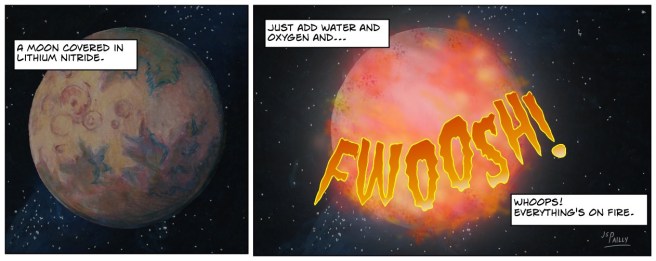
There is a compound of lithium and nitrogen called lithium nitride (chemical formula Li3N) which has the kind of dark red color that I wanted for my moon. Lithium nitride forms spontaneously wherever pure lithium comes into contact with atmospheric nitrogen, so it’s fairly easy to make. It doesn’t seem like much of a stretch to me that a lithium-rich moon would be covered in this stuff.

Of course the characters in my story need an otherwise Earth-like environment. That means Earth-like gravity, free oxygen, an active water cycle…

Okay, I’m not clear on just how rapidly everything would catch on fire in this situation, but based on a YouTube demonstration and some lab safety info I found online, it seems you should be careful about exposing lithium nitride to oxygen, and for God’s sake keep it away from water!

So yeah… it seems I have some to rethinking to do. Fortunately, there are other, less explosive lithium compounds I could work with.

Programming note: I’ve been doing Molecular Mondays as a once-per-month thing for a while now, but I feel like I’m starting to slip with my chemistry research. So Molecular Mondays will now return to its original biweekly schedule. So tune in two weeks from today when we’ll be talking about… I don’t know, probably lithium again.

Molecular Monday: Water Gets Freaky

After today’s post, you might never look at a glass of water the same way again.

The water molecule is made of two hydrogen atoms plus one oxygen atom, arranged in a Mickey Mouse shape, with the chemical formula H20. You already knew that, I’m sure. But you may not be aware of this: water’s chemical formula gives you a hint about water’s true nature.

Hydrogen ions play an important role in acid/base chemistry, so when you see hydrogen listed first in a chemical formula, that typically indicates that you’re looking at the chemical formula of an acid.

  • Acid: an acid is a chemical that can give up a proton (a.k.a. a hydrogen ion) to a base.
  • Base: a base is a chemical that can accept a proton from an acid.

Water can do both. It’s an acid. It’s also a base.

  • Acidic Water: a water molecule (H2O) can give up a proton to a base, transforming itself into a hydroxide ion (HO).
  • Basic Water: a water molecule (H2O) can accept a proton from an acid, transforming into a molecule called hydronium (H3O+).

Now this is where things get really freaky: because water is both an acid and a base, it can actually react with itself.

Autoionizacion-agua.gif
Image credit: Manuel Almagro Rivas – Own work, CC BY-SA 4.0, Link

In fact water is constantly reacting with itself. The result is that even “pure water” is really a mix of water, hydroxide, and hydronium in a proton-swapping party that never ends.

Something to think about the next time you drink a glass of water.

* * *

Today’s post is part of a special series here on Planet Pailly called Molecular Mondays.

On the first Monday of the month, we take a closer look at the atoms and molecules that make up our physical universe, both in reality and in science fiction.