Sciency Words: Silicosis

Sciency Words PHYS copy

Today’s post is part of a special series here on Planet Pailly called Sciency Words. Every Friday, we take a look at a new and interesting scientific term to help us all expand our scientific vocabularies together. Today’s word is:

SILICOSIS

What’s the scariest thing about the Moon? Moondust.

My10 MoondustI’m glad you asked, Mr. Moon!

  • First, moondust gets all over your spacesuit. During the Apollo missions, astronauts found it was practically impossible to get all the dust off their spaceboots and spacesuits, possibly due to a sort of static cling effect. So astronauts wound up tracking a lot of this stuff back into the lunar lander.
  • Next, it gets in your air supply. Once all that moondust got into the lander, the Moon’s low gravity meant dust particles could drift about in the air a lot longer than they would on Earth—just waiting for someone to breathe them in.
  • Finally, it gets in your lungs. Roughly half of moondust is composed of fine grains of silicon dioxide. Essentially, moondust has the consistency of powdered glass. You don’t want that in your lungs.

On Earth, the inhalation of silica dust can cause a respiratory disease called silicosis. Symptoms include coughing, shortness of breath, and swelling or inflammation of the lungs. Those most at risk include miners and quarry workers, as well as anyone working in the glass manufacturing industry.

At least one astronaut reported experiencing silicosis-like symptoms while on the Moon. Future Moon missions and possible lunar settlements will likely involve longer-term exposure and higher risks of respiratory diseases.

So while this may sound like an odd piece of advise, given that the Moon is airless, please be careful about the air you breathe on the Moon.

P.S.: Silicosis or similar respiratory conditions will also be problematic for Mars missions. The surface of Mars is covered in iron oxide dust (a.k.a. rust). I for one don’t want to breathe in flecks of rust any more than I want to inhale powdered glass. Martian soil may also contain other as-yet-unidentified chemicals that could be hazardous to human health.

Links

Silicosis from MedLine Plus.

Don’t Breathe the Moondust from NASA Science.

The Mysterious Smell of Moondust from NASA Science.

Occupational Health: Lunar Lung Disease from Environmental Health Perspectives.

* * *

Today’s post is part of Moon month for the 2015 Mission to the Solar System. Click here for more about this series.

I Like Big Moons and I Cannot Lie

Why is Earth so special? Why did life develop and thrive here and (as far as we know) nowhere else in the Solar System? These are questions scientists and science fiction writers alike must puzzle over. Part of the answer may involve Earth’s ginormous moon.

Please note: for the sake of clarity, I’ll refer to Earth’s moon as Luna in today’s post even though that is not the Moon’s official I.A.U. name.

Although Luna is not the largest moon in the Solar System (that honor goes to Ganymede), the mass ratio between Earth and Luna is way, way out of whack compared to other planet/moon combinations. A moon as large as Luna has no business orbiting a planet as small as Earth.

So what’s the effect of Luna’s relatively large size?

My09 Stability

Scientists have speculated that Luna’s gravity does more than create tides. It may also help stabilize Earth’s orbital axis.

According to at least some computer simulations, Earth could easily tilt sideways by as much as 85 degrees if not for Luna’s constant gravitational tug. This would lead to sudden and dramatic changes to the global climate. Changes that life might not be able to cope with.

If that’s true, then disproportionately large moons like Luna may be necessary for all life-bearing planets. Since Luna-like moons are surely rare, this drastically limits the chances of finding life elsewhere in the universe. Which totally sucks (not a scientific evaluation, just my opinion).

However, there may be other possibilities. For example, some simulations indicate that a moonless Earth could still keep itself balanced thanks to the gravitational influence of Jupiter.

The lesson for science fiction writers is that life-bearing planets probably need something to hold them steady. Whether that something is a Luna-like moon, a Jupiter-like planet, or some other large nearby object is up to the writer’s imagination. At least until science provides us with more conclusive data.

Links

Earth’s Stabilizing Moon May Be Unique Within Universe from Space.com.

The Odds for Life on a Moonless Earth from Astrobiology Magazine.

* * *

Today’s post is part of Moon month for the 2015 Mission to the Solar System. Click here for more about this series.

We Choose to Go to the Moon Again

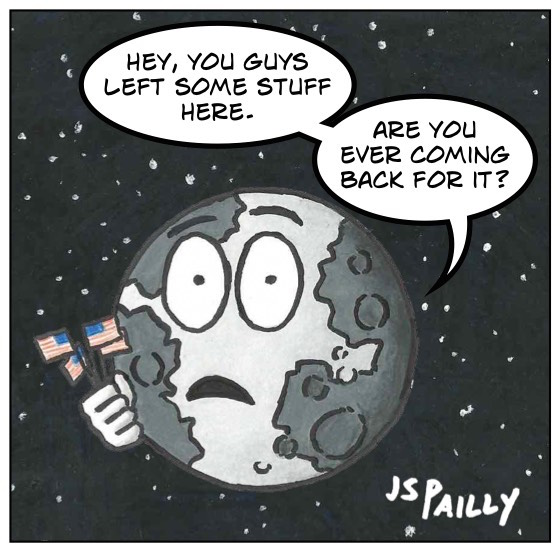
My06 Stuff on the Moon

Humanity will return to the Moon… eventually. We have a long list of reasons to do so. The most commonly cited reason is, of course, the mining of helium-3.

In nuclear fusion reactions, helium-3 can be used as a carbon-free, radiation-free fuel. So that would be awesome for the environment. Nuclear fusion also promises to generate more usable energy by far than any other currently available technology, thus solving the world’s energy crisis.

Although helium-3 is rare on Earth, it’s relatively common on the Moon. Once we establish lunar mining facilities, we could send this fuel back to Earth or use it to power spacecraft for further exploration of the Solar System.

But is this really the best reason to return to the Moon?

How Difficult Will This Be?

While helium-3 is more common on the Moon than on Earth, that doesn’t mean it’s easy to get. Lunar mining operations would have to sift through hundreds of metric tons of rock, heating that rock to temperatures in excess of 600 degrees Celsius, just to obtain a teeny-tiny sample of helium-3.

When you consider the total amount of energy needed to extract usable quantities of helium-3, combined with the cost of sending that helium-3 back to Earth, as well as the costs associated with shuttling astronauts and equipment to and from the Moon’s surface, you might find that you’re not getting much of a return on your investment.

Do We Really Need Helium-3?

At this time, nuclear fusion remains a promising but highly experimental technology. In theory, helium-3 is the idea fuel, but other fuels like hydrogen-2 could also work (although the fusion of hydrogen-2 nuclei would produce radiation in the form of free neutrons).

Since we can get hydrogen-2 right here on Earth, it may make more economic sense to use that instead.

The Future of Helium-3

In a more distant, Sci-Fi future, it’s a pretty safe bet that helium-3 will become a major energy source. Planetary economies will depend on it. Wars will be fought over it. Labor-class men and women will don spacesuit and go mining for it.

But I’m not convinced that this will be humanity’s top reason for returning to the Moon. Not when there are so many other, more achievable goals for our next Moon mission.

So what do you think will be the motivating factor when we finally do return to the Moon?

Links

Could Helium-3 Really Solve Earth’s Energy Problems? from io9.

How Nuclear Fusion Reactors Work from How Stuff Works.

* * *

Today’s post is part of Moon month for the 2015 Mission to the Solar System. Click here to learn more about this series.

Ice Skating in Shackleton Crater

There’s one thing I’ve always wanted to do: go ice-skating on the Moon. It’s a dream I’m sure we’ve all had at some point. The best place to make that dream become a reality is Shackleton Crater… maybe.

Shackleton Crater is a lunar cold trap situated at the Moon’s geographic south pole. The exact pinpoint location of the pole lies on the crater’s outer rim. And the inside of the crater contains water ice, or at least some scientists think so.

In the mid-1990’s, a space probe named Clementine beamed radio waves into Shackleton. The radio waves bounced back in a manner that could be interpreted as a reflection off water ice… or possibly reflections off exceptionally rough, rocky terrain.

Later, analysis of data from NASA’s Lunar Prospector and Lunar Reconaissance Orbiter revealed a higher than average concentration of hydrogen in Shackleton Crater and other nearby craters. Since hydrogen is part of the water molecule, this could be more evidence of water ice. Or it could be evidence of some other hydrogen-containing molecule.

In 2009, NASA’s LCROSS Mission made headlines for “bombing the Moon.” A large projectile crashed into Cabaeus Crater, not far from Shackleton, and the resulting debris plume was observed to contain, among other things, particles of water ice which must have lain buried underground for billions of years.

Although a lot remains open to interpretation, the pattern of evidence seems to suggest that water ice is spread throughout the Moon’s polar regions, with Shackleton Crater possibly containing one of the largest deposits.

But before we start lacing up our ice skates, we should note a few things. Any ice in Shackleton is likely buried under layers of rock, similar to what was observed in Cabaeus. Also, we might only be talking about a few hundred gallons spread thinly over an area of several hundred square kilometers.

My05 Shackleton Ice Skating

Fortunately, my dreams of one day ice skating on Mars seem far more realistic.

Links

The Mystery of Shackleton Crater from Air & Space.

Evidence for Water Ice near the Lunar Poles from The Journal of Geophysical Research.

An Explanation of Bright Areas Inside Shackleton Crater at Lunar South Pole Other Than Water Ice Deposits from the 2013 Lunar and Planetary Science Conference.

LCROSS Impact Data Indicates Water on Moon from NASA.

* * *

Today’s post is part of Moon month for the 2015 Mission to the Solar System. Click here for more about this series.


Sciency Words: Cold Trap

Sciency Words BIO copy

Today’s post is part of a special series here on Planet Pailly called Sciency Words. Every Friday, we take a look at a new and interesting scientific term to help us all expand our scientific vocabularies together. Today’s word is:

COLD TRAP

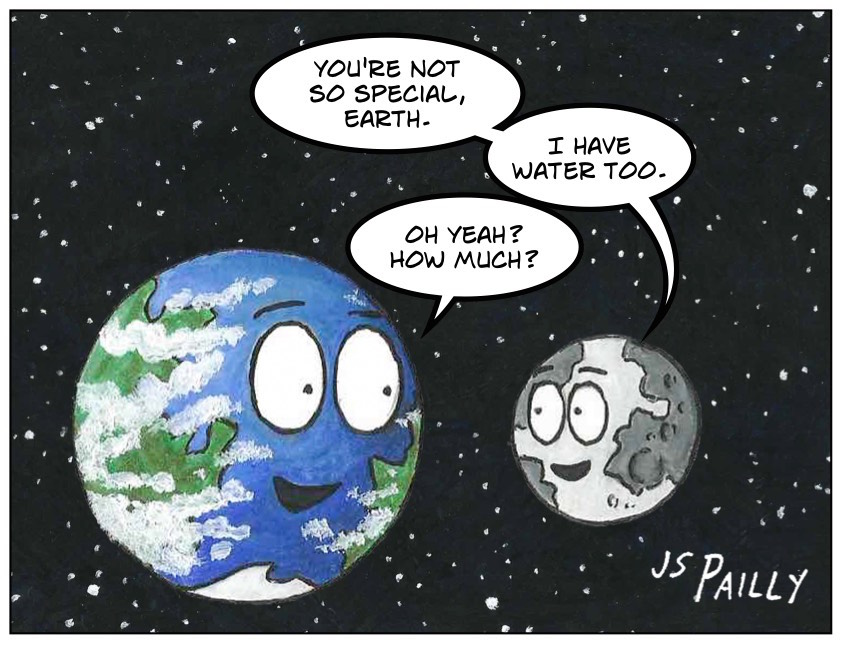
My04 Lunar Water 1The Moon has a lot in common with the planet Mercury, and just like Mercury, the Moon has trouble retaining its volatiles.

Water is a volatile, meaning it’ll spontaneously evaporate or sublimate at relatively low temperatures and/or pressures. Without the protection of an atmosphere or a magnetic field, volatiles like water tend to be swept off into space by the solar wind.

The only way the Moon can hold on to its water is to keep it well hidden from the Sun’s heat. Regions of the Moon (or Mercury) that are dark enough and therefore cold enough to retain water ice are informally known as cold traps.

The Moon’s best cold traps lie near its south pole, within the basins of large craters that remain in perpetual shadow, never seeing the Sun. Temperatures there hover around 100 Kelvin (a.k.a.: -170 degrees Celsius or -280 degrees Fahrenheit or simply “@&%$, that’s cold!”).

Similar craters exist near the Moon’s north pole, but they’re generally smaller and shallower and might not serve as effective cold traps.

My04 Lunar Water 2But just because the Moon has cold traps, that doesn’t prove it has water ice. On Monday, we’ll go exploring one of the Moon’s most famous and controversial cold traps: Shackleton Crater. Feel free to bring your ice skates, but I can’t guarantee you’ll get to use them.

* * *

Today’s post is part of Moon month for the 2015 Mission to the Solar System. Click here for more about this series.


Sciency Words: DSKY

Sciency Words PHYS copy

Continuing with the 2015 Mission to the Solar System, we now come to the Moon (Earth’s moon, in case there’s any confusion). The most important fact about the Moon is that human being have actually been there, so for this week’s edition of Sciency Words, let’s look at a term that was closely tied to the Moon Landings:

DSKY

Pronounced “dis-key,” this term is an acronym for “display and keyboard,” and it served as the main computer interface for astronauts during the Apollo Missions. And I cannot emphasize this enough: DSKY was not exactly “user-friendly.”

Apollo astronauts issued commands to their guidance computer by entering a “verb” followed by a “noun.” The computer would then perform the indicated verb on or with the indicated noun. Verbs included things like “display” or “enable” or “initiate.” Nouns could be parts of the spacecraft, countdowns, preprogrammed maneuvers, etc.

That seems simple enough until you see the interface itself. It’s just a number pad with a few extra buttons (note the two on the left labeled “verb” and “noun”).

My01 AGC_user_interface
You can land on the Moon using just nineteen buttons… assuming you know which buttons to push.

This system is not even a little bit intuitive. Turns out every noun and verb had specific two-digit numbers assigned to it. How did astronauts know which number combinations to use? They had to memorize them.

As user-unfriendly as it may seem, DSKY actually simplified the Apollo Missions by reducing the total number of keystrokes required to operate the guidance computer. If you’re trying to land on the Moon, would you want to type out “please perform landing and breaking phase” or would you rather just hit six buttons: “verb-5-0, noun-6-3”?

In fact, Apollo astronauts reported that DSKY was surprisingly easy to use. One astronaut compared it to playing the piano. Once you familiarize yourself with the keys, your fingers just know what to do.

But that’s only true after you’ve learned the interface. You need training. A lot of training. I’m willing to bet even experienced pilots from NASA’s Space Shuttle Program would not necessarily be able to figure out how to use the DSKY interface from the Apollo Missions.

This is one of my biggest pet peeves in science fiction: characters sitting down at unfamiliar control panels and somehow instantly knowing how to use them.

But maybe I’m wrong about this. Maybe computers on spacecraft will become more user-friendly over time (based on my research, that has not yet been the case). So what do you think? If we ever build something like the starship Enterprise, how easy or difficult will it be to learn the user interface?

Links

Apollo Flight Journal from NASA History Division.

Computers Aboard the Apollo Spacecraft from Computers in Spaceflight: The NASA Experience.


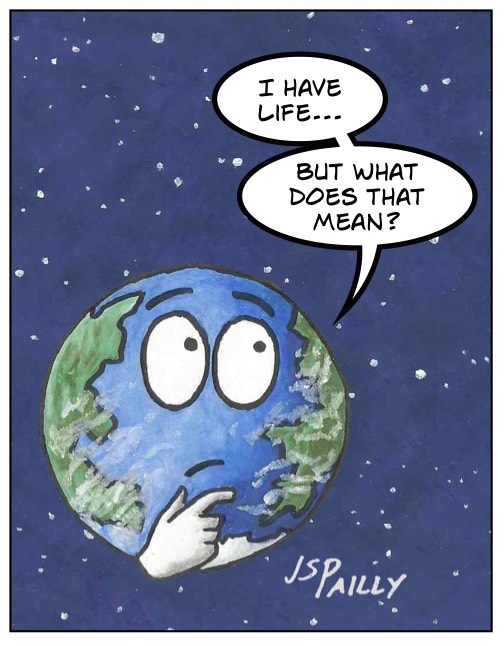
The Meaning of Life (on Earth)

Ap13 Meaning of Life

You may think science fiction writers don’t need to know much about Earth. Sci-Fi is (stereotypically) about exploring space, visiting alien planets, and leaving the homeworld’s cradle behind. So I almost skipped Earth for my Solar System series.

Then I realized that learning how Earth formed, how life evolved here, and why life continues to thrive on this one planet could help me understand what alien worlds might look like.

Studying Earth has left me with a lot to think about. Since this is my final post for Earth month, I thought I’d review some of my still germinating thoughts about life and the environments that might support it.

  • Life tends to develop only in chemically active environments. Earth shows plenty of chemical activity, most notably oxygen-based chemistry. As a comparison, the surface of Mercury has virtually no chemical activity, and therefore it’s unlikely life in any form could develop there.
  • More energetic chemical reactions allow for more complex organisms to evolve. Chemical reactions involving oxygen can provide far more energy than a single-celled organism needs, which allows for multi-cellular life forms to develop. Other chemical reactions, like those involving sulfur on Venus, might not provide enough excess energy for anything larger than a microbe.
  • Microbial life may be absurdly common in the universe, taking advantage of every chemically active niche it can find. Microbes of some kind could exist on Mars or even Venus. They could live on certain moons of Jupiter and Saturn. They might even be able to eek out an existence among asteroids and comets.
  • Complex life, on the other hand, may be exceedingly rare. It’s hard to find a chemical that is as profitable, from an energy production standpoint, as oxygen. I’m sure there are viable alternatives, but the list would be short, and this would limit opportunities for the evolution of multi-cellular organisms even in a universe teeming with microbes.

Of course, this is all speculation. Speculation that comes after months of exhausting, headache-inducing research—but still just speculation.

Until scientists can confirm the existence of life on Mars, Venus, or elsewhere, and until they collect more data on the environmental conditions of Earth-like planets orbiting other stars, this is the most realistic picture of life in the universe that I can invent.

So what do you think? Am I on the right track, or is there something I’ve overlooked? Any suggestions on other avenues of research I should pursue? Please leave your thoughts in the comments below. I look forward to getting other people’s perspectives on these questions.

* * *

Today’s post is part of Earth month for the 2015 Mission to the Solar System. Click here for more about this series.

Space Elevators: Crazy Enough to Work?

The biggest problem with rockets is that they have to carry their own fuel. How much fuel they need to, for example, lift off from Earth is modeled using the ideal rocket equation. Thanks in part to a pesky logarithm embedded in that equation, rockets departing from Earth need to be 80-95% fuel by mass. And thus, spaceflight is absurdly expensive.

It’s not surprising, then, that engineers all across the globe have tried to think up an alternative means to reach space. What is surprising is that many of these engineers, often working independently of each other, have all come up with basically the same wacky idea: space elevators.

Ap12 Space Elevator

How to build a space elevator

First off, don’t picture a traditional elevator. Many early proposals for space elevators were essentially really tall towers with really long elevator shafts up the middle. At this point, it’s pretty clear that won’t work.

Instead, the current scheme is to launch a spacecraft into orbit carrying a spool of sturdy but lightweight material, something like a ribbon of carbon nanotubes. Once in orbit, the ribbon would be unspooled and slowly lowered back to the ground.

After the unspooling process is complete, the ribbon would be held taught on one end by Earth’s gravity and on the other by a counterweight, which would exert an enormous amount of centrifugal force due to Earth’s rotation.

An orbital station would be positioned near the ribbon’s center of mass. Ideally, that point should be located approximately 36,000 kilometers above Earth’s surface (for perspective, Earth’s diameter is roughly 12,000 kilometers). This is the altitude required to maintain geostationary orbit.

How to use a space elevator

In a proof of concept test during the 2009 X-Prize competition, a miniature space elevator car climbed a 900-meter cable dangling from a helicopter. And it did it in less than eight minutes. All we have to do now is scale up!

Unfortunately, real space elevators will probably be much slower, mainly for safety reasons. According to an article from New Scientist, it looks like a trip all the way up a full-sized space elevator would take roughly two or three weeks. So bring something to read. You’ll also need snacks.

However, your elevator car will not need to carry its own fuel, meaning it is no longer constrained by the rocket equation! The most popular design at the moment involves high-powered lasers which transmit electricity to the car as it goes.  So fuel would constitute almost 0% of the total mass, rather than 80-95%.

Crazy enough to work?

So why haven’t we done this yet? We have the technology. Well, all but one component: the carbon nanotube ribbon. We can barely make carbon nanotubes longer than a few centimeters, so a 36,000+ kilometer ribbon is out of the question—for now.

Real life space elevators are decades or maybe centuries away. In the meantime, the construction, maintenance, and defense of these futuristic Towers of Babble could be fertile ground for new science fiction stories.

* * *

Today’s post is part of Earth month for the 2015 Mission to the Solar System. Click here for more about this series.

Links

The Space Elevator: “Thought Experiment,” or Key to the Universe? by Arthur C. Clark.

How Space Elevators Will Work from How Stuff Works.

LaserMotive Wins $900,000 from NASA in Space Elevator Games from NASA.

Space Elevator Trips Could Be Agonizingly Slow from New Scientist.

Earth Day and the Value of Planetary Science

What a fun coincidence that Earth day happens to fall in the middle of Earth month here on Planet Pailly! I thought we’d take a moment to see how some of the other planets in the Solar System have helped us better understand and appreciate the planet we call home.

Ap10 Earth Day


NASA’s original mission statement included the words “to understand and protect the home planet.” One of the best ways to learn about Earth is to compare and contrast it with its neighbors. We’re just beginning to locate Earth-like planets orbiting other stars, which will no doubt teach us even more.

And that is one of the big reasons why it’s worth celebrating planetary science on Earth Day.

Sciency Words: Ideal Rocket Equation

Sciency Words MATH

Today’s post is part of a special series here on Planet Pailly called Sciency Words. Every Friday, we take a look at a new and interesting scientific term to help us all expand our scientific vocabularies together. Today’s word is:

IDEAL ROCKET EQUATION

April is Earth month here on Planet Pailly, but after two weeks of blogging about the planet Earth, I’m ready to move on.

Ap08 Earth's Pull

Unfortunately, escaping Earth’s gravity is far easier said than done. The high, high cost of getting to space can be quantified using something called the ideal rocket equation (also known as Tsiolkovsky’s rocket equation or simply the rocket equation).

The equation is as follows:

∆v = vln(m0/m1)

Delta-v (∆v) represents the total change in velocity you’re aiming to achieve in any rocket-propelled maneuver, including liftoff. In order to reach low Earth orbit from the ground, your delta-v must equal at least 9.4 kilometers per second. To get that value, you’ll need to adjust the other variables in the equation.

  • Initial mass (m0): The total mass of your spacecraft plus the mass of your fuel and fuel tanks.
  • Final mass (m1): The total mass of your rocket after the maneuver is complete.
  • Effective exhaust velocity (ve): This is basically how much thrust your rocket can produce.

Increasing your rocket’s initial mass (by adding more fuel) will help increase your delta-v. Decreasing your final mass (by not only using up fuel but also shedding empty fuel tanks as you go) will also increase your delta-v. In fact, the greater the difference between the initial and final mass, the greater your delta-v will be, according to this equation.

However, increasing the difference between initial and final mass only creates a logarithmic increase in delta-v (the “ln” part of the equation is a natural logarithm). This means that adding more and more fuel produces diminishing returns. At some point, this is no longer a cost effective way to increase your delta-v.

Your other option is to use a more energetic fuel, increasing your effective exhaust (ve). Unfortunately, modern rockets already use some of the most effective chemical fuels available. With current technologies, the only way to significantly improve the ve part of the equation is with nuclear powered rockets, which might raise a few safety concerns, to say the least.

What Does All That Mean?

Due to the rocket equation, fuel constitutes 80 to 95% of a rocket’s mass at launch. Even a tiny satellite requires absurd amounts of fuel to reach space.  This means launching anything into space is expensive (sometimes prohibitively expensive).

The problems associated with the ideal rocket equation are usually glossed over or ignored in science fiction by invoking new technologies or new laws of physics. But embracing the rocket equation and world-building within its limitations could lead to an intriguing setting for a Sci-Fi story. More on that in next week’s edition of Sciency Words.

P.S.: It’s possible that somewhere in the universe, life has evolved on a planet with even higher surface gravity than Earth’s. If so, these aliens would have an even harder time reaching space than we do. In fact, for some alien civilization out there somewhere, the rocket equation may make it effectively impossible to leave their home planet at all.

Links

The Tyranny of the Rocket Equation by NASA astronaut Don Pettit.

Rocket Golf from What If?