Sciency Words: Astro-Paleontology

Today’s post is part of a special series here on Planet Pailly called Sciency Words. Each week, we take a closer look at an interesting science or science-related term to help us expand our scientific vocabularies together. Today’s term is:

ASTRO-PALEONTOLOGY

This may be a first for Sciency Words. Usually I discover new words to share with you during the normal course of my research, but this time I thought to myself, “astro-paleontology has got to be a thing by now,” and then went and found that it is.

Or at least it almost was. Back in the 1970’s, astronomer John Armitage wrote a paper titled “The Prospect of Astro-Palaeontology,” officially coining the term. And then it seems nobody followed up on the idea.

The word paleontology comes from several Greek roots and means the study (-logy) of that which existed (-onto-) in the past (paleo-). It think we’re all familiar with what this really means: digging up the fossilized remains of dinosaurs and other organisms that died long ago. By adding the Greek word for star into the mix (astro-), Armitage created a term for the search for and study of the fossilized remains of life on other worlds.

The blog Astro-Archeology did several posts about Armitage’s work. I recommend checking out all three of these posts:

To be honest, I don’t have a whole lot to add to what Astro-Archeology already wrote on this subject, except that the search for alien fossils on Mars is about to heat up.

None of our current Mars missions are equipped to search for life on the Red Planet, either living or dead. But NASA’s next rover, the Mars 2020 Rover, will be. Specifically, Mars 2020 will be designed to hunt for fossilized microorganisms.

So maybe the term astro-paleontology is due for a come-back.

P.S.: You may have noticed that John Armitage and Astro-Archeology spelled this term as astro-palaeontology and I’m spelling it as astro-paleontology, without the extra a. This is a British spelling vs. American spelling thing.

Molecular Monday: Basalt as a Sedimentary Rock

I had a rough week last week, which disrupted my regular posting schedule. But I’ll talk about that on Wednesday for IWSG.

Today I’ve returned to Mars and I’m ready to continue my exploration of the Martian surface. I considered calling today’s post Mineralogical Monday, but really minerals are just a special kind of molecule, so I’ll stick to the Molecular Monday series I already have going.

Before I was so rudely brought back down to Earth, I was visiting Gale Crater. I wanted to meet the Curiosity Rover and maybe get an autograph, but I got distracted by some peculiar rocks.

It’s hard to put into words what was so odd about these rocks. They have the look and feel of sedimentary rocks, but in terms of chemical composition they’re more like basalt. But basaltic sedimentary rock is a contradiction in terms.

Sedimentary rocks form (typically) when sediment accumulates at the bottom of a river, lake, or other body of water. Over time, the sediment becomes compacted or cemented together, and thus a new rock is born.

Basalt is an igneous rock, meaning it forms from cooling magma, and it is chemically vulnerable to water. Basalt tends to include a lot of iron, magnesium, and calcium; water tends to leech these elements out of basalt, leaving a silicon-rich clay behind. So as a sediment sitting at the bottom of a lake or river, basalt wouldn’t last long enough to turn into sedimentary rock.

Fortunately for me, I’m not the only one who’s struggled to find the right terms to describe these weird Martian rocks. Emily Lakdawalla, a well respected science journalist writing for the Planetary Society, wrote an article about this and summed up the inherent contradiction well: “Sedimentary rocks say ‘Mars was wet.’ Basaltic composition says ‘Mars was dry.’”

So how did these basalt-like sedimentary rocks form? I can think of three possibilities:

  • Windblown Sediment: Sedimentary rocks can be created by wind rather than water, but as Emily Lakdawalla shows in her article, not all of these Mars rocks can be explained that way.
  • Liquids Other Than Water: It’s possible the sediment was deposited by a liquid other than water. That explanation makes more sense to me on a super-cold planetoid like Titan, where water is a rock and rivers are full of methane; however on Mars, water still seems to be the most likely working fluid.
  • Flash Floods: Maybe basaltic sediment was only exposed to water for a short time, perhaps during the flash floods that seem to have occurred during Mars’s Hesperian Period.

Most of the rock formations in Gale Crater are already believed to be Hesperian-aged, so the flash flooding idea makes the most sense to me. But of course the Curiosity Rover has been here a lot longer than I have, so I’ll be eager to ask her opinion on the matter.

Sciency Words: Mars Direct

Today’s post is part of a special series here on Planet Pailly called Sciency Words. Each week, we take a closer look at an interesting science or science-related term to help us expand our scientific vocabularies together. Today’s term is:

MARS DIRECT

In November of 1989, NASA published the findings of a 90-day study on the future of the American space program. That report came to be known as the 90-Day Report and established a goal of putting humans on the surface of Mars within thirty years. The methods to achieve this goal were complicated. Very complicated. Stupidly complicated, or so thought aerospace engineer Robert Zubrin.

So in 1991, Zubrin and colleagues published a paper outlining an alternative plan which they called “Mars Direct.” Zubrin further elaborated on the Mars Direct plan in his book The Case for Mars.

Mars Direct means exactly what it says: astronauts would go directly to Mars. This is in contrast to the elaborate and expensive space infrastructure ideas proposed in the 90-Day Report, which involved enormous space stations and moon bases and orbital fuel depots and fleets of giant starships, all of which would have to be built before even one person could set foot on the Red Planet.

I won’t go through all the details of how Mars Direct is supposed to work (there’s a good reason Zubrin had to write a whole book about this); I’ll just cover the basics.

Launches would take place every twenty-six months, coinciding with the regular planetary alignments of Earth and Mars. Specifically, Zubrin advocates for launches during Earth/Mars conjunctions, when Earth and Mars are on opposite sides of the Sun. That may seem counterintuitive, but because of the math and the delta-v and the orbital mechanics and… you know what, let’s just say it’s because you end up using less fuel.

Once we get this plan started, the launch schedule would go as follows:

  • First Conjunction: A single, unmanned spacecraft heads to Mars. This will be used as the first Earth Return Vehicle (ERV-1) and it will spend the next twenty-six months making fuel for itself.
  • Second Conjunction: A pair of spacecraft head to Mars. One is another Earth Return Vehicle (ERV-2) and the other will carry a habitat module (HAB-1) and four astronauts (Expedition-1).
  • Third Conjunction: Expedition-1 returns to Earth aboard ERV-1, leaving HAB-1 and ERV-2 behind. Meanwhile HAB-2 and ERV-3 launch from Earth, along with the crew for Expedition-2.
  • Fourth Conjunction: Expedition-2 returns to Earth aboard ERV-2. HAB-1 and HAB-2, now connected together, are left behind. So is ERV-3. Meanwhile Expedition-3, HAB-3, and ERV-4 launch from Earth.

The cycle keeps going after that. With each expedition to Mars, the habitat complex grows a little bigger, laying the groundwork for full-scale colonization later on, and because of the way Earth Return Vehicles are staggered, each crew on Mars always has access to two ERVs, which seems like a wise precaution.

One of the key selling points for Mars Direct is that it’s cost-effective, at least in relative terms; it certainly costs a whole lot less than what was proposed in the 90-Day Report. Also, Mars Direct would only use currently available technology, so we could start doing this right now.

But for some reason, at least as far as I can tell, no government agency or private organization (aside from Zubrin’s own advocacy group, the Mars Society) has committed to Mars Direct. Oh yes, lots of people talk about it. Sometimes people borrow bits and pieces of the plan, but no one—not NASA, not Buzz Aldrin, not even Elon Musk—seems willing to adopt it in its entirety. And I’m not sure why.

Magnets on Mars

Today I’m continuing my totally-for-real, I’m-not-making-this-up exploration of Mars. I’m really here on the surface of Mars, walking around and doing science—or rather bouncing around in the low gravity and gawking at cool Mars things.

Last week we talked a bit about my efforts to grow potatoes in Martian regolith, based on experiments conducted by the International Potato Center back on Earth using a “Mars regolith simulant.” I ended up doing a bit of research about what, precisely, a Mars regolith simulant is. Turns out these’s a pretty long history to this stuff.

The earliest simulant appears to have been developed at NASA’s Johnson Space Center and is know as JSC Mars-1. It was made using volcanic ash from Hawaii and the recipe was based on data collected by NASA’s Viking and Pathfinder missions.

As we’ve learned more about Mars, there have been several newer generations of simulant, such as JSC Mars-1a, MMS-1 and MMS-2 (which have been made available for sale to the general public), and most recently JMSS-1, which was developed by the Chinese.

But going back to the original JSC Mars-1, I read something in this article that surprised me: “Approximately 25 wt% of the sample can be lifted with a hand magnet.” Since I’m here on the surface of Mars, that gave me an idea….

Given how much iron is contained in Martian regolith, what happened next shouldn’t have come as too much of a surprise. When I touched my magnet to the ground, most of the Mars-dust didn’t stick, but some of it did.

This is consistent, by the way, with the findings of the Spirit and Opportunity rovers. Magnets attached to the rovers’ Rock Abrasion Tools (R.A.T.) accumulated dust particles as the rovers chipped away at Martian rocks. It’s noteworthy that the R.A.T. magnets collected different colors of dust at different locations, indicating that there are many different kinds of magnetic particle on Mars. Spirit and Opportunity also conducted what’s known as the Magnetic Properties Experiments (M.P.E.), which used magnets to draw stray dust particles out of the Martian atmosphere.

It seems like you’ll find magnetic particles just about everywhere on Mars. Again, this shouldn’t come as much of a surprise. There’s a lot of iron, mostly in the form of hematite and magnetite, on the Martian surface. But still, this is a weird and awesome thing to see in action, at least from an Earthling’s perspective.

Sciency Words: Regolith

Today’s post is part of a special series here on Planet Pailly called Sciency Words. Each week, we take a closer look at an interesting science or science-related term to help us expand our scientific vocabularies together. Today’s term is:

REGOLITH

For a long time, I assumed this was another example of having one word for something here on Earth (soil) and a completely different term for the same thing on another planet (regolith). But no, we have regolith here on Earth too; however, other planets and moons do not appear to have soil, strictly speaking.

American geologist George Perkins Merrill is credited with coining the word regolith back in 1897. The term is based on two Greek words meaning “rock blanket.” I don’t know about you, but that conjures up a strange mental image for me. I mean, who’d want to snuggle up under a blanket of rocks?

But after doing further research, I think Merrill was being pretty clever with this one. Regolith is defined as a layer of loose gravel, sand, or dust covering a layer of bedrock.

As for the distinction between regolith and soil, I think it’s best to define soil as a special kind of regolith: regolith that contains enough organic ingredients to support plant life.

By that definition, Earth has both regolith and soil while places like the Moon and Mars only have regolith. That being said, a lot of people (including professional astro-scientists) go ahead and talk about Martian soil when they really mean Martian regolith.

Unless, of course, Martian regolith turns out to have more organic matter in it than we thought!

Dining on Mars, Part 1: Potatoes

Good news everybody! I’ve safely landed on the surface of Mars. I’d already constructed my habitat dome through the magic of telerobotics, so all I had to do when I got here was settle in and get comfy. The next order of business: what am I going to eat?

You may remember that fictional astronaut Mark Watney survived for over a year on Mars on a diet of potatoes and multivitamins. The potatoes provided Watney with the calories his body needed, and the vitamins provided everything else (well, almost everything else).

Watney grew his potatoes in a mixture of Mars dust and “fertilizer.”

So I guess the real question is: can this work in real life? Can potatoes grow in Martian regolith if the regolith is treated with some kind of fertilizer? According to the International Potato Center (C.I.P.) in Peru, yes. At least that’s what it says in this press release from earlier this year.

C.I.P. researchers used soil collected in a southern Peruvian desert, soil which is said to be the most Mars-like soil on Earth. This “Mars analog soil” was mixed with a bit of more traditionally Earth-like soil and then hermetically sealed in a test chamber that simulated Martian environmental conditions (O2 and CO2 levels, air pressure, and temperature).

Unfortunately I can’t find anything peer reviewed concerning this experiment, and I’ve learned to be skeptical of science-related press releases. However this press release refers only to “preliminary results,” so I have to assume a more substantive paper is on the way, and I’ll be eager to read it once it’s published.

In the meantime, I’ll do my best to grow my own potatoes here on Mars. Also I found this paper saying that sweet potatoes would make an ideal crop for long-term space missions. The sweet potato, according to the paper, “grows rapidly, has a higher yield, and greater nutritional values than other crops.”

That makes me even more excited about this Mars mission than ever. I love sweet potatoes!

Molecular Monday: Why is Mars Red?

Today’s post is part of a bi-weekly series here on Planet Pailly called Molecular Mondays, where we take a closer look at the atoms and molecules that make up our physical universe.

Okay, so I took a little detour on my mission to Mars to visit Phobos, Mars’s largest moon. But now it’s time I headed down to the surface of the Red Planet itself. Which brings us to today’s Molecular Monday question: why is the surface of Mars red?

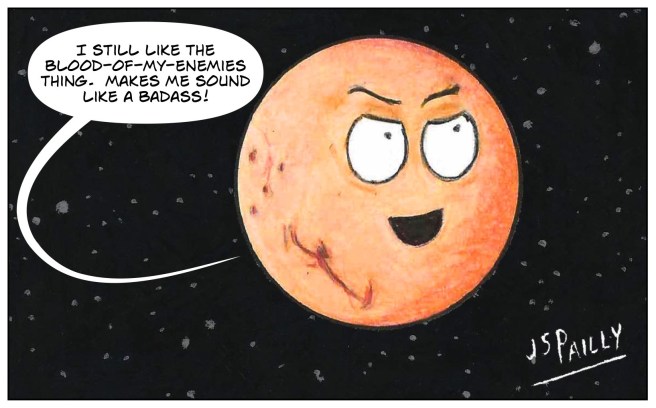
In ancient times, the answer would probably be something like Mars is drenched in the blood of his enemies. A more modern, more scientific explanation would involve iron oxide, specifically iron (III) oxide with the chemical formula Fe2O3, which is more commonly known as rust. As a mineral, it’s also known as hematite, which is what I’m choosing to refer to it as from now on.

But it’s a little too easy to just identify a chemical substance. A far more interesting question is this: where did all that hematite come from? No one knows for sure, but there are (as far as I can tell) three possibilities:

  • Ancient Water: Maybe Mars simply rusted the same way rust generally forms here on Earth. Martian hematite could have formed when iron and water mixed together, with hydrogen gas being released as a byproduct. This would have had to happen billions of years ago during a time when liquid water was more readily available on Mars.
  • Meteor Impacts: Back in the 1990’s, following the Mars Pathfinder Mission, a scientist at NASA’s Jet Propulsion Laboratory proposed that meteor impacts may be responsible for depositing all that iron on the Martian surface, and that carbon dioxide (split apart by solar UV radiation) provides the oxygen to oxidize that iron. Click here for more about that possibility.
  • Dust Storms: In 2009, researchers at the Aarhus Mars Simulation Laboratory in Denmark showed that the abrasion of grains of quartz (which contains oxygen) and magnetite (which contains both iron and oxygen) can produce hematite. Both quartz and magnetite are present on Mars, and Mars’s global dust storms might be enough to grind quartz and magnetite together. Click here for more about this process.

The Martian water hypothesis might seem like the obvious explanation. At least I assumed so until I started researching this post. But when the Curiosity Rover started drilling holes in the Martian ground, it found that the underlying layer is sort of grey, not red. This seems to be consistent with what the Mars Pathfinder Mission found: that iron and other metals are more present in the Martian topsoil than in the rocks.

That may suggest that Martian hematite formed only in the recent past, or perhaps that it forms continuously in the present. If so, that would cast doubt on the ancient water hypothesis and lend credence to either the meteor impact or dust storm hypotheses, or perhaps a combination of the two.

Sciency Words: Telerobotics

Today’s post is part of a special series here on Planet Pailly called Sciency Words. Each week, we take a closer look at an interesting science or science-related term to help us expand our scientific vocabularies together. Today’s term is:

TELEROBOTICS

This is a pretty easy one, I think. Telerobotics refers to controlling robots from a distance, usually a great distance. This is in contrast to robots that function autonomously or machines that require direct human control.

The word comes from the familiar Greek root tele-, meaning “far away,” and of course the word robot, which originally comes from Czech and means something like “forced labor.”

A wide variety of fields use telerobotics, but for the purposes of this blog we’re most interested in its use in space exploration. At this point most if not all spacecraft are telerobotic in nature. They receive instructions from mission control on Earth, carry out their instructions, and then transmit their status back to Earth so that mission control can decide what to make the spacecraft or space vehicle do next.

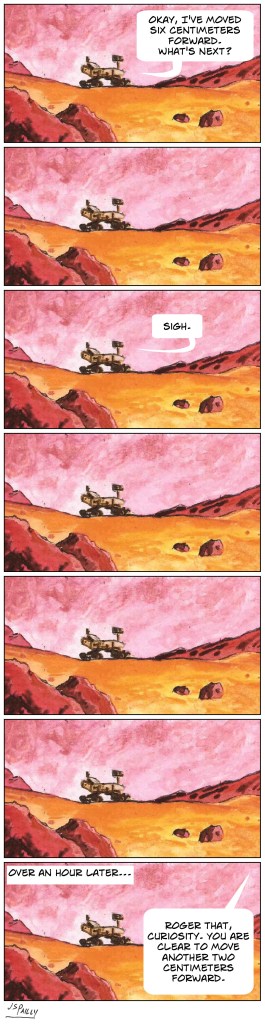
The problem, of course, is that this back and forth communication is restricted by the speed of light. In the case of the Mars rovers, this means that even performing the simplest tasks can take hours and hours. It’s very frustrating, especially for the rovers.

This is one of the biggest reasons Buzz Aldrin and others say we should send astronauts to Phobos (one of Mars’s moons) before sending anyone to Mars itself. From a small Phobos base, astronauts could telerobotically control the rovers in real time. The speed-of-light delay would be negligible.

The rovers could cover a lot more ground that way, dramatically speeding up our exploration of Mars. Also, when the time comes, the rovers could be used to quickly prepare a landing site and assemble habitat structures in advance of the first human colonists arriving on Mars.

The Monolith of Phobos

On Tuesday, I landed on the surface of Phobos, the largest and innermost moon of Mars. Today, I’m doing a bit of sightseeing. Yes, there are sights to see on this rocky, little moon. Or at least, there is one sight worth seeing: the Monolith of Phobos.

I’m kind of surprised that I hadn’t heard about this before: a mysterious, boxy-looking object estimated to be about 90 meters wide jutting out of the surface of Phobos. Apparently it’s something Buzz Aldrin talks about a lot.

Aldrin mentioned it in an interview on C-SPAN, saying that this is the kind of mystery that could really get the public interested in a mission to Phobos. Aldrin also wrote about the monolith in greater detail in his book Mission to Mars: My Vision for Space Exploration (which is where I first heard about it).

So I’m going to go check this monolith out. I mean, it’s probably just a big rock. I bet it doesn’t even look so monolithic when you see it up close. It certainly was not put there by aliens (as many conspiracy theorists insist that it was) or that it’s anything like the monoliths from 2001: A Space Odyssey.

Except… what is that noise? It’s like some kind of eerie music….

Welcome to Phobos (Watch Your Step)

So I know I’m supposed to be blogging about my totally for real trip to Mars, but I actually haven’t landed on Mars yet. Actually, I’ve read a lot of expert opinions suggesting that any long term mission to Mars should really start with a mission to Phobos, Mars’s largest and innermost moon.

It’s an idea that Buzz Aldrin advocates for in his book about Mars, and it’s something that’s spelled out in a little more detail in this NASA technical report. Basically, the delta-v required to travel from the surface of Earth to Phobos is less than the total delta-v to travel from Earth all the way down to the surface of Mars.

That means less fuel, which means lower costs, and once we’re there Phobos can be used as a sort of vanguard outpost to help prepare for the full scale exploration and colonization of Mars.

Unfortunately for me, landing on Phobos and taking my first steps on this very, very tiny world—well, it didn’t go the way I expected it too.

Don’t worry. I made it back to the ground. Eventually.

You see Phobos is more like an asteroid than what we’d typically think of as a moon. If fact Phobos may actually be an asteroid that Mars kidnapped from the asteroid belt. Anyway, the point is Phobos is small. Very small. And so it does not have a whole lot of surface gravity. If I did my math correctly, we’re talking about less than 0.1% the surface gravity of Earth.

So in order to land on Phobos and stay on Phobos, I recommend bringing grappling hooks or some sort of tethering system, or maybe something like the harpoon gun the Rosetta Mission tried (unsuccessfully) to use to latch onto comet 67P.

As for walking around on Phobos’s surface, I’d say tread lightly. If you put too much force into your footsteps, you’ll have several long, long minutes to think about your mistake as you drift slowly back down to the ground.