#IWSG: Being a Writer is Soooo Boring!

Welcome to the Insecure Writer’s Support Group!  If you’re a writer, and if you feel in any way insecure about your writing life, click here to learn more about this awesome group!

I, J.S. Pailly, stand accused of being a boring person.  Or at least that’s what a few well-meaning friends and acquaintences seem to think.  You see, all I ever do is write and read and do research.  Then I do more research, which is followed up with more writing.

Most people are willing to concede that all the art I do might be fun.  But otherwise my life is soooo boring.  Boring, boring, boring.  I need to get out more, travel, go to loud parties, eat at popular restaurants… or other stuff like that, I guess.

Anyway, I’ve been accused of being boring.  So in my defense, I’m going to talk about something that I find really interesting: space.  And perhaps the story I’m about to tell will serve as a nice little allegory about what it means to be boring or interesting.

In 1986, the Voyager 2 spacecraft became the first—and thus far the only—spacecraft to visit the planet Uranus.  As I’m sure you’re already aware (you may already be giggling), Uranus is a much-maligned planet, because of its name.  Voyager 2’s visit gave us yet another reason to malign our poor seventh planet.

Uranus turned out to be a featureless cyan-blue orb.  There was nothing like Jupiter’s Great Red Spot or Saturn’s polar hexagon.  There were no atmospheric zones or belts.  There was nothing interesting to look at at all! What a boring planet, scientists said.
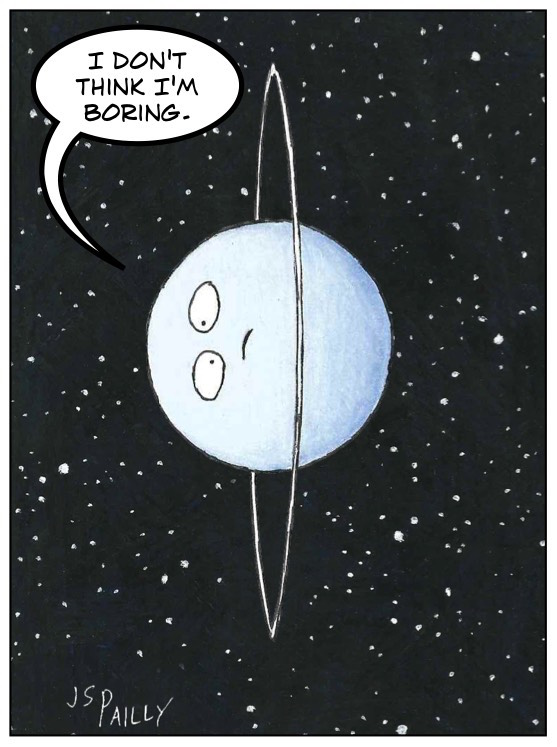
But of course, this was only true from our limited human perspective.  Our eyes can only see a range of approximately 400 to 700 nanometers on the electromagnetic spectrum (which we perceive as the colors violet to red).

If you observe Uranus only in this 400 to 700 nm range, there’s not much to see.  Switch to ultraviolet, however, and you’ll find a complex and dynamic atmosphere that’s every bit as interesting as Jupiter or Saturn’s.

Whether we’re talking about planets or people, what is boring versus what is interesting is all a matter of perspective.  Will this little anecdote change anybody’s mind?  I’m not sure.  I suspect if you already think I’m a boring person, me talking about sciency stuff only reinforces that belief. But I hope the rest of you get what I’m trying to say.

P.S.: Fun fact!  If you’ve ever wondered why Uranus got stuck with its giggle-inducing name, it’s because the guy who picked the name was German, and he probably didn’t realize what it would sound like in English.

#IWSG: Alphaburn Out

Welcome to the Insecure Writer’s Support Group!  If you’re a writer, and if you feel in any way insecure about your writing life, click here to learn more about this awesome group!

Umm, hi.  This is James’s muse.  My writer is… unavailable for writing today, so I’m just going to take care of writing this post myself.

The good news is that my writer finished the A to Z Challenge. His theme was the scientific search for alien life.  My writer has always been laser-focused on writing science fiction—he’s not interested in writing anything else—so it should be obvious why he wanted to dedicate so much time and effort to this topic.

My role in all this was, of course, to feed my writer inspiration.  But it’s also my job to help my writer manage his time and to give him that vital push to keep going when he needs it.  And getting through those last few letters of the alphabet… my writer needed a lot of help with that.  I had to push him really hard, and I had to make him give everything he’s got.

So now my writer’s kind of burned out.  He’ll probably need a few days off before he gets back to his regular writing routine.  Muses should not do this to their writers on a regular basis, but in this case I’d say it was worth it.  And whenever my writer wakes up from his nap, I’m pretty sure he’d agree with me.

#IWSG: Can You Trust Me?

Welcome to the Insecure Writer’s Support Group!  If you’re a writer, and if you feel in any way insecure about your writing life, click here to learn more about this awesome group!

So what am I feeling insecure about this month?  Well, I’m doing the A to Z Challenge.  To be honest, I’m not too worried about finishing it.  I’ve done A to Z before, and this year I feel like I’m well prepared for what’s coming.

But I do feel insecure about the theme I picked: astrobiology, one of the newest and awesome-est branches of science.  But here’s the thing: I’m no astrobiologist. I’m no scientist.  What authority do I have to talk about this stuff?

You see there’s a lot of misinformation out there about the search for alien life.  A lot of the actual science gets misreported in the popular press or coopted as “proof” by U.F.O. conspiracy theorists.  So I really, really, really do not want to spread any of that misinformation around.

Recently, I saw something that kind of surprised me: a bunch of well respected educational channels on YouTube have posted videos admitting their mistakes and promising to do better in the future. This one from Adam Ruins Everything is my favorite.

I don’t have the kind of research team behind me that Adam Ruins Everything has, or that Kurzgesagt has, or that SciShow has.  It’s just me.  I do a lot of reading, and I fact check myself as best I can; but even so, you probably shouldn’t trust everything you read on this blog.

But you can trust this: I love space, and I love science. I think the reality of our universe, as revealed to us by science, is way more interesting than anything our human imaginations might dream up.  And I’m really excited to share all the cool science stuff I’ve learned with you.

At the same time, I’m also eager to keep learning.  So if I make a mistake, or if there’s some important point you think I’ve missed, or some perspective you feel I’m overlooking, I absolutely do want to talk about that in the comments.

And now, I have more A to Z Challenge stuff to work on. In today’s A to Z post, C is for carbon chauvinism.

#IWSG: Tomorrow’s Writer Today

Welcome to the Insecure Writer’s Support Group!  If you’re a writer, and if you feel in any way insecure about your writing life, click here to learn more about this awesome group!

Gosh, 2012 seems like such a long time ago….

Way, way back in 2012, I wrote a series of short stories about a time traveling news reporter.  A few of you have been Internet friends with me long enough to remember that project.  It was called Tomorrow News Network.

I say these were short stories, but actually they were kind of long, more like novelettes.  The challenge for myself was to produce ten of these stories in a year.  It would have been twelve stories, but I wanted to give myself a little leeway in case anything went wrong.

And things did go wrong.  I missed my self-imposed deadlines on several occasions, and there were a few stories that really didn’t turn out the way I wanted.  But still, by the end of 2012, I’d learned a lot about myself and my writing process, and I felt really proud of my accomplishment.

Now here we are in 2019, and I am officially rebooting the story universe I created for myself way back in 2012.  I’ve had a lot of time to think about how I could make Tomorrow News Network better. Also, I’ve had a lot of time to think about the continuity problems I wrote myself into in the original run of the series.  And of course, my muse is here, providing me with all her wisdom and guidance, as she always does.

So now I’m really excited to get the ball rolling again.  I’m also kind of scared.  I still remember how hard 2012 was and how emotionally drained I felt by the end of it. This time the plan is different, easier in some ways, harder in others.  Perhaps much harder.

So in conclusion, wish me luck.  I’m going to need it!

P.S.: I realize how busy everyone is on these Insecure Writers’ Support Group days, but if you have a few minutes to spare, please click here and check out the first little piece of the revamped story universe I’ve created.  Thank you!

#IWSG: Pesky, Unreliable Muses!

Welcome to the Insecure Writer’s Support Group!  If you’re a writer, and if you feel in any way insecure about your writing life, click here to learn more about this awesome group!

For these Insecure Writer’s Support Group posts, I usually like to turn the floor over to my muse.  You probably know the spiel: she has something to say, maybe it’s something your muse would like to hear, blah blah blah….

But my muse didn’t show up for work today, and I’m not really sure what to do.  I guess… I guess I have to write this post on my own.  So… umm… I’m not really sure how to do that.

You know, this is so typical.  I’ve known my muse for over a decade now.  She first introduced herself by having me write her into a story, and I’ve gotten to know her better through various character development and world building exercises she’s had me do since then.  She seems nice enough for a fairy person. At least she’s not one of those Puc-like prankster fairies.  She’s warned me about them.

But still, she gets on my nerves sometimes.  Our writer/muse relationship has always been super one-sided.  When she has a story idea, I have to drop everything I’m doing and go write it down for her.  It doesn’t matter if I’m in bed trying to sleep, or if I’m at my day job trying to work, or if I’m out with friends trying to have a social life.  I’ve convinced her to wait and be patient if I’m driving, because safety is important; but otherwise if the muse calls, she expects me to answer.  No excuses.

But does my muse pay attention to my needs as a writer? No.  Does she show up when I need to get a blog post done, or when some other writing deadline is looming, or when I just want to finish up my word count quota for the day?  No.  Honestly, I don’t often use this kind of language, but my muse can be an insensitive—

Uh oh, here she comes.

#IWSG: Rewriting Writing Rules

Welcome to the Insecure Writer’s Support Group!  If you’re a writer, and if you feel in any way insecure about your writing life, click here to learn more about this awesome group!

Life is complicated.  Writing is even more complicated than that.  Maybe that’s why writing rules are so popular, because they make writing sound so much easier.  Just follow these simple rules and your writing will be good, guaranteed!

When I first started writing, I took these rules very seriously.  I used to agonize over my work.  Did I break a rule here?  What if I broke a rule there?  What should I do if two rules seem to contradict each other?

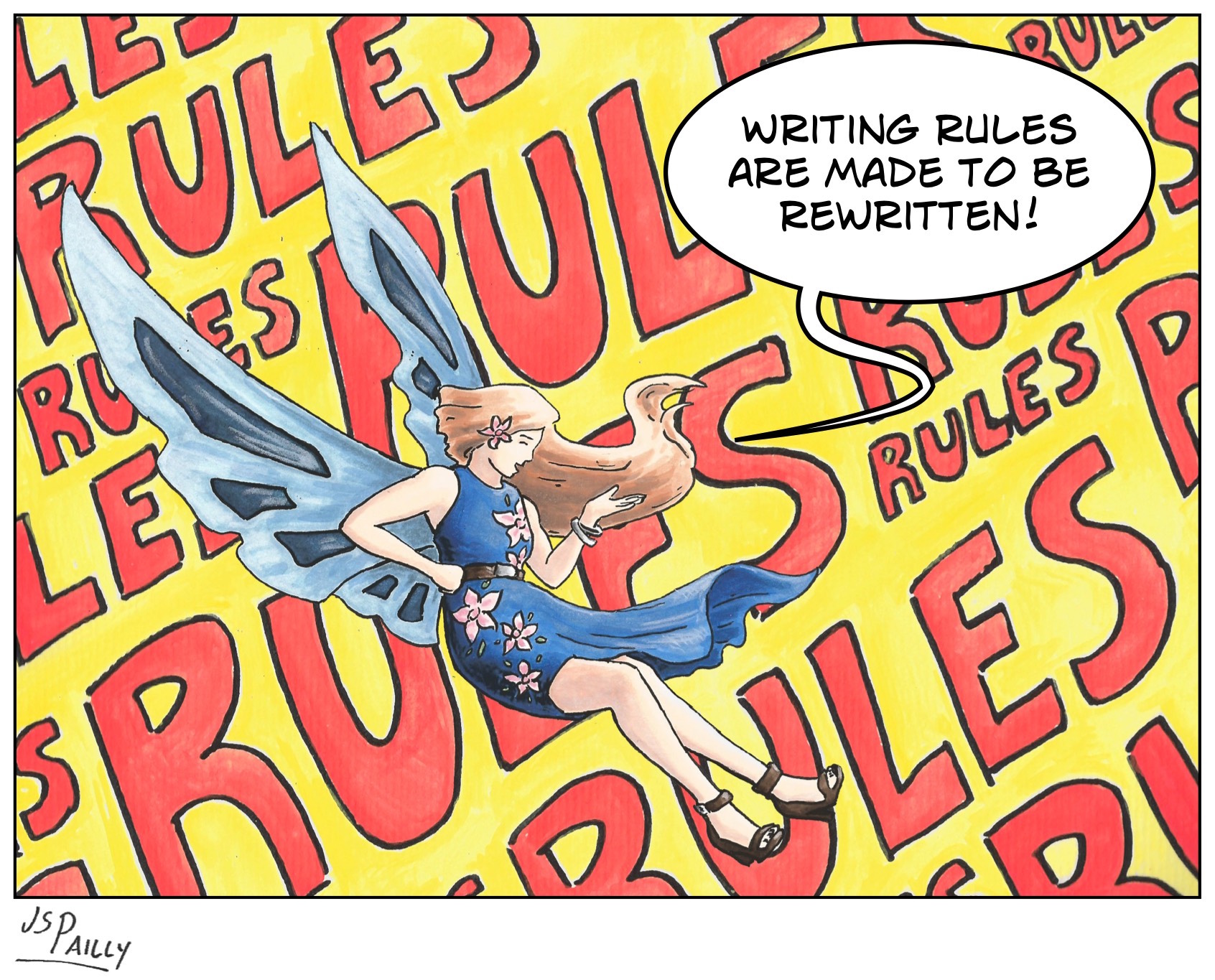
I actually had a notebook full of all the rules I’d read about or heard about.  There was a lot of stuff in that notebook.  But then my muse came along.  For those of you who haven’t met my muse before, she’s the little fairy person who hovers over my shoulder and nags me whenever I’m not writing.     For a while, my muse liked to tell me that writing rules are made to be broken.  Then she thought of a cleverer way to phrase it:

So it’s with some trepidation that I’ve decided to start the New Year by setting some new writing rules for myself. But really, these “rules” are more like lessons learned from bad writing experiences.  They’re meant to keep me from repeating the same mistakes that I’ve made over and over again in my writing life.

  • When a new idea pops into your head, stop everything and write it down, because good ideas don’t stick around in the brain for long.
  • Don’t talk about currently active writing projects with anyone, at least not until the editing phase, because you never really know what it is you’re writing until it’s finished.
  • Don’t try to fix every flaw you see (or think you see) in your work, because perfect writing is dull and the occasional flaw can provide its own unique charm.

Are these good writing rules?  Maybe.  If not, as my muse likes to say, I can always rewrite them! So what writing rules have you written—or rewritten—for yourself?

IWSG: Shiny New Idea Syndrome

Today’s post is part of the Insecure Writer’s Support Group, a blog hop where insecure writers like myself can share our worries and offer advice and encouragement.  Click here to find out more about IWSG and see a list of participating blogs.

As I said in a recent post, I have a lot on my mind right now.  Good stuff.  Writing-related stuff. But still, it’s hard to focus on actual writing when I’m so distracted by writing-related ideas.

So for today’s episode of the Insecure Writer’s Support Group, I going to turn the floor over to my muse.  She has something she’d like to say, and maybe it’s something your muse would like to hear.

* * *

Hello, I’m James’s imaginary friend, also known as his muse. It’s totally normal for adults to have imaginary friends, especially when those adults are writers.

It seems that I have created a problem for myself and my writer.  I recently brought him a new idea.  What is this idea?  That’s not important right now.  It’s a new idea, and it’s a really good idea (if I do say so myself), and that’s all that matters right now.

That was not the reaction I was hoping for. It’s one thing for a writer to be excited about a new idea, but quite another for a writer to get overexcited. Overexcited writers are a danger to themselves, their muses, and every single character in their story worlds.

As a muse, obviously you have to bring your writer great ideas, the best ideas you can find lurking in the depths of the subconscious. I do want my writer to use this new idea.  I wouldn’t have brought it to him otherwise.  But it’s a tricky thing, getting my writer to keep things in perspective, making sure he does not neglect all his other writerly duties.

So, my fellow muses, what do you do to keep your writers in line when a shiny new idea gets them a little too excited?

IWSG: Why Writing Isn’t Easy

Today’s post is part of the Insecure Writer’s Support Group, a blog hop where insecure writers like myself can share our worries and offer advice and encouragement.  Click here to find out more about IWSG and see a list of participating blogs.

You could call this a writing exercise, or you could say it’s a way of flexing the imagination’s muscles.  Every once in a while, I stop whatever I’m doing and ask my muse a question.  I may even write the question down, to make sure she understands it clearly. Then I wait and try to imagine how my muse might answer.  Sometimes, surprising flashes of inspiration come.

If I ask a story related question, my muse tends to get back to me pretty quickly.  Muses are good at figuring out story stuff.  But sometimes I ask bigger questions—real life questions. With those sorts of questions, it takes my muse a little longer to respond.  Sometimes a whole lot longer.

Recently, I asked my muse: “If I was born to be a writer, why is writing so hard for me?”  You see, I’ve always believed that God made me to be a writer, or at least to be a creative person of some kind.  While my feelings about organized religion have changed a lot in recent years, that core belief is still there: writing is my purpose in life.

And yet writing is so absurdly difficult!  Why does it have to be that way?  Just motivating myself to pick up a pen and get started each morning is such a struggle.  I have to wonder why I keep forcing myself to do it.  I feel like Sisyphus pushing a boulder up a mountain only to watch it roll all the way back to the bottom at the end of the day.

Yes, I may be making progress in the sense that I’m getting words down on paper.  Yes, my current WIP is creeping ever closer to completion.  But it doesn’t matter.  Each night, that boulder (which represents my motivation to write) rolls back down the mountain, and each morning my motivation starts at zero once again.

My muse spent a long time pondering my question.  I suspect she may have fluttered off, leaving me alone for a time while she consulted with the High Council of Muses, or maybe she embarked on some other epic quest, fighting dragons and seeking out forbidden muse knowledge.  Days went by.  It was over a week before she came back.  And then she said to me: “Nothing worthwhile is ever easy.”

And of course my muse is right.  There are many things that have come easily in my life; I don’t value those things the way I value the things I had to fight for, or struggle for, or sacrifice for.  Writing is hard work.  It will always be hard work.  And that’s okay because if it weren’t hard work, it would not feel so rewarding when I get my writing done.

IWSG: My Best Coping Mechanism

Today’s post is part of the Insecure Writer’s Support Group, a blog hop where insecure writers like myself can share our worries and offer advice and encouragement.  Click here to find out more about IWSG and see a list of participating blogs.

I don’t usually answer the optional IWSG question each month, but this month’s question sort of relates to what I wanted to write about anyway:

How do major life events affect your writing?  Has writing ever helped you through something?

I can answer these questions fairly easily, or at least I could until recently.

  • In 1993, I lost my father. Books helped me cope with that, especially Frank Herbert’s Dune.  This is the reason why I decided to become a writer.
  • In 2008, I discovered that my girlfriend, the only woman I’ve ever truly loved, was cheating on me. So I wrote a cheesy Sci-Fi love story, and that helped me cope.
  • For well over a decade now, I’ve worked in the news business. It’s a high stress job that often exposes me to some of the worst that humanity has to offer. So I’ve been writing a series of short stories and novellas about a journalist who travels through time. That helps me cope.

Throughout my life, writing has always been my best coping mechanism.  But there have been times when I’ve been too stressed, too traumatized, or too emotionally drained to write.  So what do you do when your best coping mechanism fails?

2018 has been an all-around troublesome year for me. Minor and major life events seem to keep piling up.  Witnessing a murder back in July was obviously the worst, but even before that happened I was struggling.  I spent much of this year dealing with financial problems, health concerns, and a work-related issue that took an agonizingly long time to resolve.

The latest crisis has been family drama.  I have a couple relatives who do not have the foggiest idea what’s wrong with me but who apparently know exactly what I should be doing to fix it.  Admittedly, this is not the worst thing that’s happened to me this year. But still, it is so irritating.

Through this whole pileup of problems, my writing has been inconsistent.  Some days, some weeks, I go into a writing frenzy unlike anything I’ve experienced in the past.  But other times, I feel so worn out that I can’t write anything at all. This is understandable, I think, but it’s also a problem because when I have so much stuff to cope with, I really need my #1 best coping mechanism to work.

IWSG: True Muses Never Leave

Today’s post is part of the Insecure Writer’s Support Group, a blog hop where insecure writers like myself can share our worries and offer advice and encouragement.  Click here to find out more about IWSG and see a list of participating blogs.

For last month’s IWSG, I wrote about a traumatic experience I recently went through.  It was a difficult thing to write about, and I’m sure it was a difficult thing to read as well.  Thank you to all of you who did read that post and left such kind comments. I realize this is an odd thing to say, but the love and support I received from “strangers” on the Internet meant a lot to me.

I still have some raw emotions about what happened, but I’ve gotten back to writing.  To be honest, I got back to it a whole lot sooner than I expected. I’m not sure how to explain why that happened, so I’ve asked someone else to write a post explaining it for me.  She’s written IWSG posts for me before.  At this point, I’m sure many of you know her well.  She’s the magical fairy person who helps me write: my muse.

My writer has been plagued by a secret fear. This has been going on for years now, but he’s been too afraid to talk about it or write about it.  He’s even tried to conceal certain dark thoughts from me (in case you weren’t aware, muses have mind reading powers). But of course I still sensed this fear stirring in the depths of the subconscious.

So what is this secret fear?  Here’s an easy answer: the fear that I would leave, that I might never come back, that maybe I’d go be a muse for someone else—some new writer who’s more disciplined and talented than the writer I already have. But like all easy answers, this answer is not the full truth.

What really frightened my writer was the thought that maybe, deep down inside, he didn’t really want me around in the first place, that maybe he didn’t really want to be a writer at all, and that maybe he’d be happier doing something else with his life, something that didn’t involve a muse like me constantly pestering him to do his writing.  No matter how much my writer insisted that he wanted to keep writing, there was always that nagging fear that whispered: “you’re wrong, you want to give up.”

Then came the traumatic events that occurred a little over a month ago.  My writer’s been through some painful experiences before—the loss of a parent, a nasty break up—but nothing compares to witnessing a murder.  In the aftermath of what happened, my writer lashed out at me and at writing in general.  He told me to go away.  He told me to never come back because the things I made him write about—death, violence, various other atrocities—suddenly hit way too close to home.

Of course I didn’t leave.  True muses never leave.  It’s not in our nature.  I guess my writer didn’t know that, but he knows it now.  And I didn’t have to wait long before my writer picked up the pen again and asked for my forgiveness (which was easily given).

To my surprise, my writer chose to dive straight back into the story we’d been working on before all this happened—one of those violence and destruction stories.  But that’s what he wanted to do, and with a renewed sense of urgency too, because the casual disregard for human life that would lead one person to kill another—my writer has some things to say about that, things that he only knows how to express in one way: through fiction.

And that’s the secret truth about writers: they may think they can give up on writing, until they actually try to do it. But writers need to write as badly as other humans need to eat or breathe.  It’s in their nature.  I guess my writer didn’t know that either, but he knows it now.

So much for that secret fear.