Sciency Words: Photolysis

Sciency Words PHYS copy

Things have been a bit hectic lately, so welcome to a rare Saturday edition of Sciency Words.

Every Friday (normally), we take a closer look at an interesting science or science-related term to help us all expand our scientific vocabularies together. Today’s term is:

PHOTOLYSIS

Last year, when I did my special Mission to the Solar System, I fell in love with one planet in particular: Venus. I guess I’ve always had a soft spot for sciency girls, and Venus is about as sciency as they get. She’s really, really into chemistry.

Jy30 Venus Does Chemistry

Photolysis (also known as photo-dissociation) is one of Venus’s favorite chemistry tools. Photolysis occurs when high-energy photons ram into chemical bonds, causing those bonds to break.

By high-energy photons, of course, I mean light. Specifically ultraviolet light, X-rays, and gamma rays. On Venus, UV rays from the Sun cause the photolysis of sulfur compounds, contributing to the sulfur cycle that causes Venus’s infamous sulfuric acid rain.

Jy30 Photolysis on Venus

The same process breaks apart oxygen molecules in Earth’s stratosphere, allowing them to recombine as ozone, thus generating the ozone layer. Photolysis is also probably responsible for the chemical changes on Jupiter that make the Great Red Spot look red (or sometimes other colors).

And speaking as an artist, photolysis is something I have to guard against. Paints are just a mix of chemicals, and the photolytic break down of those chemicals can, over time, cause paints and other pigments to fade or change color.

Photolysis by any other name…

The term photolysis is sometimes used as a blanket term for similar kinds of chemical bond breaking. For example, very little sunlight reaches the surface of Venus, but sulfur compounds still vigorously break apart and recombine due to the intense heat.

Some academic sources I’ve read still call that photolysis, though I prefer the term thermal dissociation. Calling a chemical reaction that occurs in a near pitch-black environment “photolysis” feels awkward.

Just my opinion.

Photolysis here, photolysis there, photolysis everywhere…

When I first learned about photolysis, I didn’t fully appreciate its significance. I understood only that it (and also thermal dissociation) played key roles in Venus’s extra special chemistry projects.

Then I encountered the word again while researching other planets. And then it popped up in an art textbook I was reading. I’ve gradually come to understand that it is a fundamental concept in science, or at least in chemistry.

Next week, I’ll be revisiting Saturn’s largest and orangest moon: Titan. I have a sneaking suspicion that we will once again see photolysis in action.

Links

Photolysis of Sulphuric Acid as the Source of Sulphur Oxides in the Mesosphere of Venus from Nature Geoscience.

The Sulfur Cycle on Venus: New Insights from Venus Express from the 2009 Lunar and Planetary Science Conference.

Enjoy Juno While You Can

In case you haven’t guessed, I am super excited about the Juno Mission. I’m looking forward to writing (and drawing) about it a lot over the coming years.

Jy26 Jupiter and Juno 1

But for the moment, we’re sort of stuck in a holding pattern.

Juno successfully entered orbit of Jupiter on July 4, 2016; however, it will have to complete a second engine burn, scheduled for October 19, before the science mission really begins.

In the meantime, I thought I’d run through some of Juno’s equipment and some of the mission objectives I’m most excited about.

  • Juno Cam: It’s a camera. It takes pretty pictures. Nothing to get too excited about, except Juno’s orbit takes it extremely close to Jupiter. We should be getting some stunning close-ups.
  • JEDI and JADE: Juno has two instruments, named JEDI and JADE, which will detect ionized particles in Jupiter’s magnetosphere. JADE will focus on low-energy particles; JEDI will cover the high-energy stuff. As a science fiction writer, I’m looking forward to knowing precisely what sort of radiation dangers my characters will face near Jupiter specifically and gas giant planets in general.
  • UVS and JIRAM: Juno can see in ultraviolet (using its UVS instrument) and infrared (using JIRAM). So yes, Juno can “see right through” Jupiter, or at least it can see through some of the topmost layers of clouds. Also, observations in UV and IR will help us identify the chemical composition of the clouds. Maybe we’ll finally find out what makes the Great Red Spot red.
  • Gravity Science: By monitoring subtle variations in Jupiter’s gravity, Juno can determine how matter is distributed in the planet’s interior. There are a lot of hypothetical new states of matter that might exist in the interiors of gas giants (like metallic hydrogen); Juno’s gravity experiments could tell us if our hypotheses are correct.

Juno is scheduled to make a suicide dive into Jupiter’s atmosphere on February 20, 2018.

Jy26 Jupiter and Juno 2

I’d hoped there might be a possibility for a mission extension. The Cassini mission got an extra nine years to study Saturn. But NASA doesn’t want to risk contaminating any of Jupiter’s moons (especially Europa).

So over the next two years, we better make the most of Juno while we still have her.

P.S.: JEDI stands for Jovian Energetic particle Detection Instrument. The Star Wars reference is surely a coincidence; it’s not like there are any nerds working at NASA.

Sciency Words: Hot Spots of Jupiter

Sciency Words MATH

Today’s post is part of a special series here on Planet Pailly called Sciency Words. Each week, we take a closer look at an interesting science or science-related term to help us all expand our scientific vocabularies together. Today’s term is:

HOT SPOT

This is Jupiter.

Ag05 Great Red Spot

And this is Jupiter in infrared.

Jy22 Infrared Jupiter

In 1995, the Galileo spacecraft dropped a small probe into Jupiter’s atmosphere. It was supposed to sample the chemicals in Jupiter’s clouds, but in a case of extraordinary bad luck, the probe fell into an empty gap between cloudbanks and collected virtually no data.

I like to imagine the clouds separating before the probe, like Moses parting the Red Sea, but I’m sure that’s not how it actually happened.

These gaps in the Jovian clouds are called hot spots. The thin atmospheric gases in these regions are actually quite cold, but when viewed in infrared, they appear hot due to the intense heat of Jupiter’s interior shining through.

The hot spots form—they always form—about seven degrees north of the equator. Eight to ten of them will appear at a time, evenly spaced along that seven degrees north longitude line, wrapping all the way around the planet.

This has led scientists to conclude that Jupiter’s hot spots are caused by a standing wave (more technically, a Rossby wave) in Jupiter’s atmosphere. The peaks and troughs of the wave correspond to the thickening and thinning of the surface clouds.

The Juno spacecraft’s JIRAM instrument (Jovian InfraRed Auroral Mapper) is specifically designed to study Jupiter’s aurorae (as the name implies) and also the hot spots. By staring straight down into a hot spot with an infrared spectrometer, scientists hope to identify the chemical composition of the deeper atmospheric layers. Among other things, they believe they’ll find a layer of water clouds.

Of course the Great Red Spot is a weird and mysterious phenomenon too. It deserves the high level of scrutiny it gets. But of all the spots on Jupiter, the hot spots may turn out to be the most interesting and revealing of the planet’s features.

Links

Jupiter’s Atmosphere Has Weird Hot Flashes from Space.com.

“Hot Spots” Ride a Merry-Go-Round on Jupiter from NASA.gov.

Juno: What’s in a Name?

Why is NASA’s current mission to Jupiter called Juno? The answer might seem obvious to anyone with even a passing familiarity with Roman mythology. Jupiter was the king of the gods, and Juno was his queen. Except NASA was a bit cleverer than that.

In this press release from 2011, NASA reminds us that the legendary Jupiter (a.k.a. Zeus) would hide his mischief from his wife, Juno (a.k.a. Hera), by concealing himself and said “mischief” in a veil of clouds.

Jy19 Mythical Juno

By mischief, of course, NASA means mistress, and the veil of clouds routine didn’t work one bit. I believe NASA is specifically referring to the story where Jupiter seduces Io, one of Juno’s own high priestesses!

As for the planet Jupiter, NASA would really like to take a peek beneath the thick clouds of the upper atmosphere. That is precisely what the Juno spacecraft is designed to do, using a variety of techniques from gravity mapping to infrared spectroscopy.

Jy19 Scientific Juno

Also, Juno will not be approaching or interacting with any of Jupiter’s moons (not even Io). In fact, Juno’s mission plan was designed to avoid any close encounters with the moons (most of which are named after Jupiter’s other “mischiefs”) due to planetary protection concerns.

This too strikes me as symbolically appropriate in light of the ancient mythology.

Space Harpoons: They’re a Real Thing

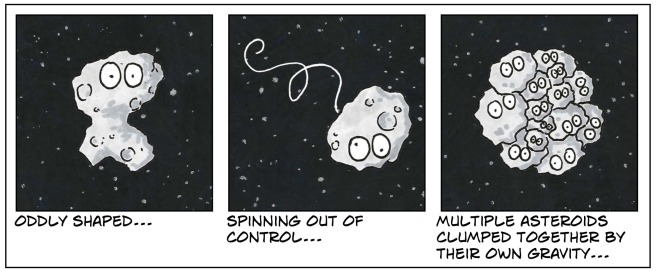
If the future of space exploration requires an economic incentive, look no further than asteroid mining. All the rare and valuable minerals and metals contained in a single asteroid (except those lousy S-type asteroids) could be worth billions.

But catching an asteroid and landing on it for mining purposes… that’s much easier said than done. You see, no two asteroids are exactly alike, and they each present a host of challenges for asteroid hunters of the future.

Jn22 Crazy Asteroids

There are several ideas for how to catch an asteroid. You could throw a net around it, assuming the asteroid isn’t too big. Or you could latch on with magnets, assuming the asteroid has a high enough metal content.

But the most common idea that I’ve seen is the shoot the asteroid with a harpoon. It makes the whole endeavor feel oddly reminiscent of old timey whaling. You know, like in Moby Dick. Or Star Trek IV.

As I understand it, the harpoon has a cable attached, so once you’ve harpooned yourself an asteroid you can reel your spacecraft in to a secure landing. Or in the case of those wildly spinning asteroids, the asteroid will reel you in by wrapping the cable around itself (what could go wrong?).

So the next time you’re in space trying to grab billions of dollars worth of asteroid, remember to bring a harpoon. And a really strong cable.

P.S.: Also, if an asteroid somehow manages to bite off your leg, maybe it’s best to let it go. As Mission Commander Ahab will tell you, vendettas against whales and asteroids never lead to happy endings.

Lego Mars Rover

I have a new hobby. When I’m not reading about space or writing about space or drawing pictures of space, you can probably find me in my basement building Lego things. Specifically, I’m building Lego space things.

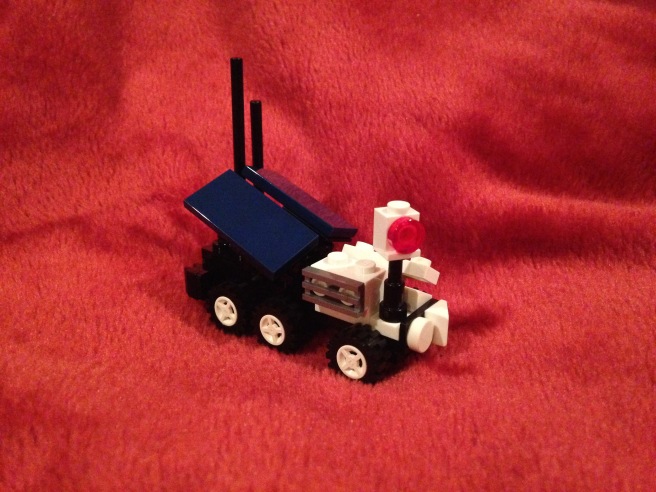
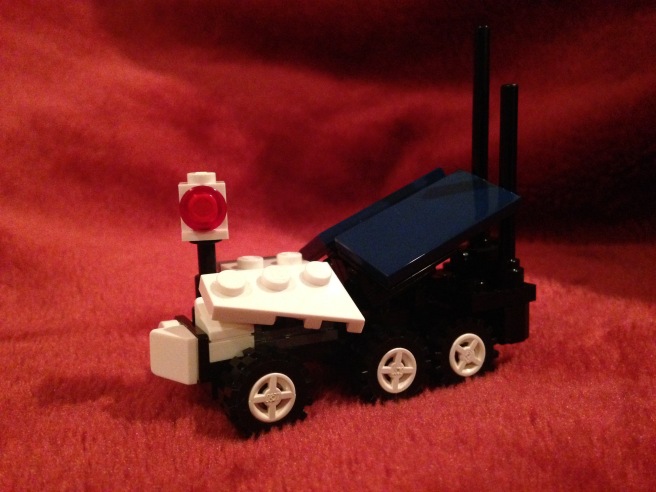
This is my first official creation for my new Lego space program: a Mars rover.

Rover begins exploring Martian landscape.

In real life, there have been a total of four Mars rovers: Sojourner, Spirit, Opportunity, and Curiosity. I did not design mine to look specifically like any of them.

Rover reports the surface of Mars is soft and fuzzy.

As a result, I don’t have a name for this little guy.

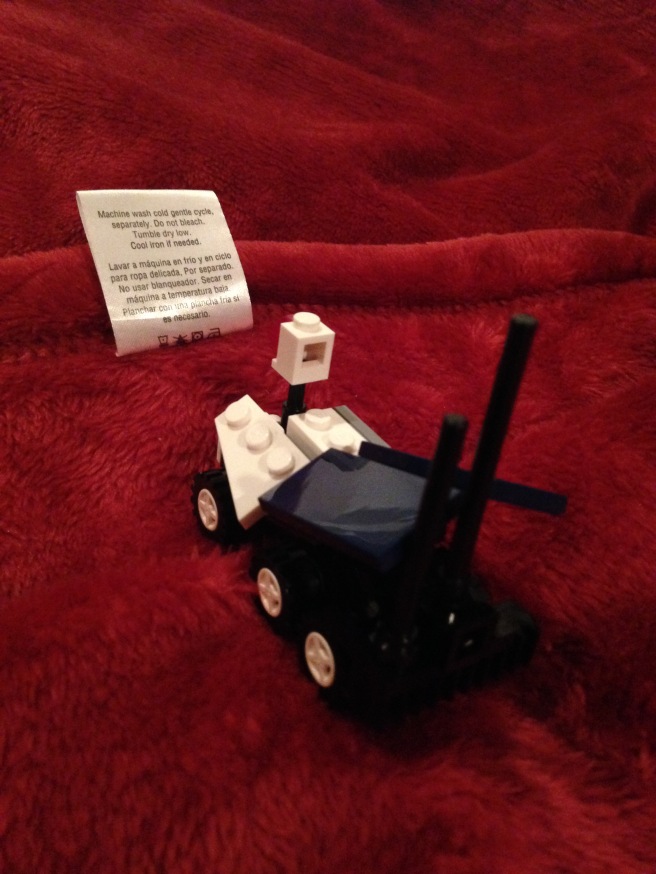
Jn08 Lego Rover 3
Rover determines that the surface of Mars is composed of 100% polyester and is “machine washable.”

So before I send my Lego rover to Lego Mars (which will surely take me a while to build), I want to get some suggestions. I’m asking for input from the public, as NASA might say.

So what do you think my Mars rover should be named?

Sciency Words: Equilibrioception

Sciency Words PHYS copy

Today’s post is part of a special series here on Planet Pailly called Sciency Words. Each week, we take a closer look at an interesting science or science-related term to help us all expand our scientific vocabularies together. Today’s term is:

EQUILIBRIOCEPTION

The best writing engages all the senses. That’s worthwhile advise most writers will get at some point in their careers, but how many senses do we humans have?

Thousands of years ago, Aristotle concluded that we have five senses: sight, hearing, taste, smell, and touch. That seems reasonable enough, and five continues to be the traditional number of senses. But depending on whom you ask, you might get a different answer.

Equilibrioception is a sense we rarely have to think about, unless something goes wrong with it. It’s governed by the vestibular system, which is located in your inner ear.

Basically, equilibrioception is your perception of up and down. It’s your ability to orient yourself in relation to gravity so that you can keep your balance while standing or walking.

If you’re writing science fiction—especially hard Sci-Fi—this is a sixth sense you may want to think about (telepathy just got bumped to seventh sense!). The experience of zero-G, or fractional Gs, or Gs greater than one, could really screw with your characters’ heads.

Jn03 Which Way is Up

Even experienced astronauts are known to have equilibrioception-related problems from time to time.

As for artificial gravity, it might “feel” a bit off too. If you’re simulating gravity by rotating your spaceship, as seen in movies like 2001: A Space Odyssey, you might experience a gravity-like pull that is skewed slightly relative to the floor. Or your feet might experience slightly more Gs than your head (especially on smaller spacecraft).

So science fiction writers, remember to engage all the senses in your writing, even senses like equilibrioception that we don’t normally think about. And if you manage to give your readers a bit of vertigo, you’ve done your job well.

Links

How to Pronounce Equilibrioception

Humans Have a Lot More than Five Senses from Today I Found Out

You Don’t Actually Have Five Senses from Modern Notion.

Sciency Words: Pixie

Sciency Words BIO copy

Today’s post is part of a special series here on Planet Pailly called Sciency Words. Each week, we take a closer look at an interesting science or science-related term to help us all expand our scientific vocabularies together. Today’s term is:

PIXIE

The Future

It is the year 2217. The mining vessel Belvedere approaches a large, rocky body in the outer Solar System. The object is dark in color, barely visible against the inky blackness of space. It has every appearance of being a carbonaceous asteroid, no doubt rich in volatiles. It may even contain that most precious of substances in space: water.

The crew of the Belvedere stand to make a substantial profit, but the science officer reports that she’s getting a lot of strange readings. The asteroid may not be what it seems. “I recommend keeping our distance,” she says.

The Present

“Pixies” are part of the whole commercialization of space thing that’s going on right now. They’re made by a company called Asteroid Initiatives LLC, and they’re intended for use in asteroid prospecting and, ultimately, asteroid mining.

Basically, pixies are a new kind of space probe. As you might guess from the name, they’re really small. They’re sometimes referred to as femto-spacecraft, though they’re not actually femto-scale (that would make them smaller than atoms).

In terms of size, they’re often compared to credit cards, cell phones, or TV remote controls. In other words, a pixie spacecraft could fit in the palm of your hand.

Pixies may be going on their first mission soon. They’re under consideration to be part of the AIDA mission to the asteroid Didymos and its moon, Didymoon. If approved, a swarm of forty pixies will either surround Didymoon or land on its surface.

Granted, pixies are too small to carry much sensor equipment, but there will be forty of them. That’s forty extra data feeds, forty extra points of view, forty extra perspectives on how Didymoon responds during AIDA’s impact experiments. That’s a lot of additional information without putting any expensive hardware at risk.

The Future

The captain of the Belvedere steeples his fingers. He can’t pass up the opportunity to mine such a large carbonaceous asteroid, but if his science officer is right… if there’s any danger….

On the view-screen, the large, rocky object drifts through space. The captain comes to a decision. There’s a way to get more data without putting the ship at risk.

The captain issues the order: “Release the pixies!”

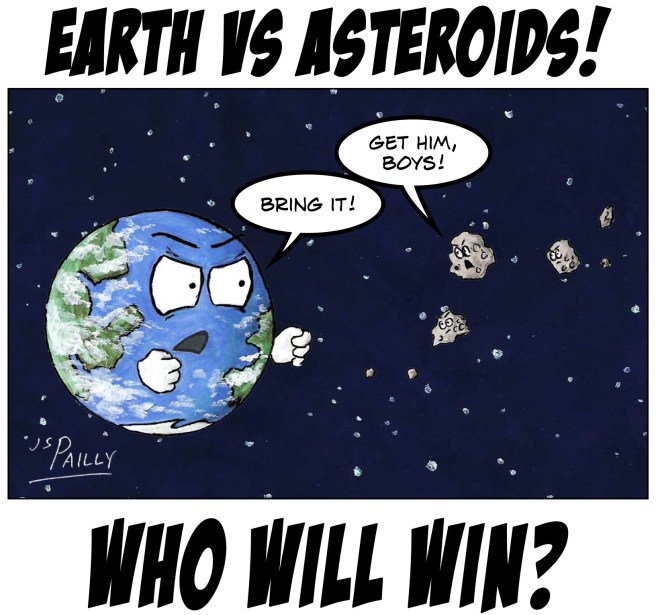
Earth vs. Asteroids

My25 Earth vs Asteroids

Is your planet safe? Nobody wants another Tunguska Event. Certainly we don’t want another K-T Event. So what are we doing to protect ourselves?

Thanks to grant money from NASA, the University of Hawaii has started setting up a series of telescopes specially designed to hunt for Near Earth Objects (N.E.O.s). These are objects, such as asteroids, with orbital paths that approach or cross Earth’s orbit.

The University of Hawaii’s new telescopes are collectively known as ATLAS (Asteroid Terrestrial-impact Last Alert System). Once fully operational, ATLAS promises to provide us with several weeks notice for large, incoming asteroids. For smaller, though still hazardous asteroids, ATLAS should give us at least a few hours warning.

So is our planet safe?

As more and more programs like ATLAS come online, we should get better coverage of the night sky and longer warning times for incoming objects. But there will still be a problem—a huge problem.

You see, you can’t really do astronomy during the day. That means asteroids coming at us from a sunward direction will go completely undetected. You may remember back in 2013 when a significantly-sized asteroid exploded over Russia, shattering windows and injuring over a thousand people. That asteroid came from a sunward direction.

No amount of ground-based telescopes could have detected that 2013 asteroid. But perhaps a space telescope, similar to the SOHO telescope we use to monitor solar flares, could help plug this gap in our planet’s defenses.

Sciency Words: The K-T Event

Sciency Words MATH

Today’s post is part of a special series here on Planet Pailly called Sciency Words. Each week, we take a closer look at an interesting science or science-related term to help us all expand our scientific vocabularies together. Today’s term is:

THE K-T EVENT

You already know this story. It was 65 million years ago. There were dinosaurs, there was an asteroid…

It’s easily the most famous asteroid impact in Earth’s history, and it’s called the K-T Event, or sometimes the K-Pg Event.

In geology shorthand, the letters stand for:

  • K: the Cretaceous period, which is spelled with a K in German. This was the last period of geological history in which dinosaurs roamed the Earth.
  • T: the Tertiary period, which immediately followed the Cretaceous. According to the International Commission on Stratigraphy (ICS), we’re not supposed to use this name anymore, but people still do. It’s sort of like how some people keep calling Pluto a planet, no matter what the International Astronomy Union (IAU) says.
  • Pg: the Paleogene period, which is the period immediately following the Cretaceous according to the ICS’s new list of geological periods. Please note, the Tertiary and Paleogene are not really interchangeable terms. They have the same starting point, but different end points.

Geologists and paleontologists puzzled for decades over a layer of clay separating Cretaceous and Tertiary (or Paleogene) rock. They called it the K-T boundary. There were several competing hypotheses about what might have caused this boundary and how it related to the mass extinction event that killed off the dinosaurs.

Then in 1980, a paper came out entitled “Extraterrestrial Cause for the Cretaceous-Tertiary Extinction.” This paper reported the discovery that the K-T boundary contained abnormally high levels of the element iridium.

Platinum group metals like iridium are extremely rare on Earth (except in the planet’s core) but common in asteroids. So whenever you find lots of iridium in Earth’s crust, you can justifiably assume an asteroid put it there.

The most likely scenario is that a large asteroid, about 10 km in diameter, smashed into Earth, flinging dust and debris high into Earth’s atmosphere. Enough to block out the sun worldwide for several years. This global dust cloud would have included plenty of material from the asteroid itself, which would have been partially vaporized by the heat of the impact.

A major problem with the original 1980 paper was that, at the time, no known impact crater of the appropriate age was sufficiently large. But of course, that was back in 1980. The crater has since been found in the Yucatan Peninsula, and now just about everybody knows the story of the K-T Event (even if they don’t know it’s called that).

P.S.: The K-T Event is not to be confused with the Katie Event. You know, that time your BFF Katie had waaaaay too much to drink and threw a temper tantrum of apocalyptic proportions.

Addendum: While there does seem to be general, widespread consensus that the K-T asteroid impact either caused the extinction of the dinosaurs or contributed significantly to their demise, there is not universal agreement. As Planetary Defense Commander notes in the comments, there are other possibilities worth considering.