How to Fly on Titan

My trip to Titan is almost over. Soon, I’ll have to find some other planet or moon to blog from. But before I leave, there’s one last thing I want to do: fly.

Titan’s atmosphere is about 50% denser than the atmosphere on Earth. Combine that with the low surface gravity (a mere 14% of Earth normal) and it should be possible, theoretically, for me to put on some wings and flap around in the sky like a bird.

Taking my cue from the myth of Icarus, my artificial wings will not be made of wax, although it’s cold enough here on Titan that there’d be no danger of wax wings melting.

So with my non-wax wings strapped to my arms, I leap into the air, and….

Ag31 Flight on Titan 1

Okay, that didn’t go according to plan, so I turn to the Internet for help (the wifi on Titan is surprisingly good, by the way). I soon find this helpful article from the Journal of Physics Special Topics.

One option is that I try to get a running start. I’m really going to have to sprint here; average human running speed (6 m/s) won’t cut it. I need to reach a minimum of 11 m/s. And…

Ag31 Flight on Titan 2

… nope. I’m a nerd, not an athlete. Sprinting isn’t my thing.

So my next option is to build bigger wings. According to the paper from Physics Special Topics, the total area of my wings needs to be at least 4.7 m2. I’ll go for 5 m2, just to be safe.

The good news is that once I’m off the ground, I won’t need to use much energy to stay aloft. Flying on Titan should be “effortless and relatively easy […] without any sort of propulsion device.” Sounds like just a little light flapping should do the trick.

Okay, so here we go.

Ag31 Flight on Titan 3

P.S.: The Journal of Physics Special Topics may be my new favorite scientific periodical, with articles covering topics like cows jumping over the Moon, the effects of general relativity on Santa Claus, and the atmospheric loss caused by opening a portal between Earth and the Moon (as depicted in the video game Portal 2).

Sciency Words: Flare Star

Sciency Words BIO copy

Today’s post is part of a special series here on Planet Pailly called Sciency Words. Each week, we take a closer look at an interesting science or science-related term to help us all expand our scientific vocabularies together. Today’s term is:

FLARE STAR

Good Star Trek fans will remember the Battle of Wolf 359, when the Borg came to assimilate us all. Thirty-nine Federation starships were lost. Nearly 11,000 people were killed. #NeverForget

Good Trekkies may also be aware of the fact that Wolf 359 is a real place. It’s a red dwarf star in the constellation Leo, located within a mere eight light-years from Earth.

Also, Wolf 359 is a UV Ceti variable star, or what is more commonly called a flare star. Flare stars experience dramatic, unpredictable increases in brightness across the EM spectrum, including increases in highly destructive X-ray and gamma ray emissions.

And when a flare star starts to flare up, it can happen quickly. In 1952, the star UV Ceti (for which the UV Ceti variable star category is named) became about 75 times brighter in a period of only twenty seconds.

It’s believed that the flare activity of flare stars is similar to the kind of solar flares we’ve observed on our own Sun. Except the Sun’s solar flares are usually not so intense. And when it comes those X-rays and gamma rays, our Sun doesn’t even come close to what spews out of flare stars.

So perhaps parking thirty-nine starships next to a flare star wasn’t the smartest thing Starfleet could have done. Maybe… just maybe… what happened at Wolf 359 wasn’t the Borg Collective’s fault.

Ag26 Battle of Wolf 359

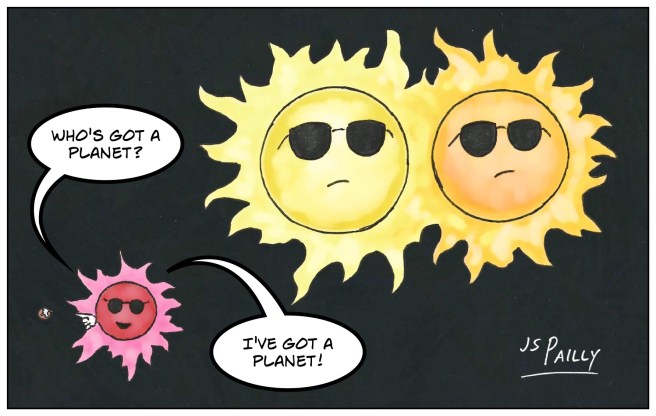
P.S.: Another flare star has been in the news a lot lately: Proxima Centauri. We now know, thanks to the European Southern Observatory, that Proxima does have an Earth-like planet in orbit. So the next question is just how thoroughly that planet has been cooked by Proxima’s violent flare-ups.

Do Not Go Swimming on Titan

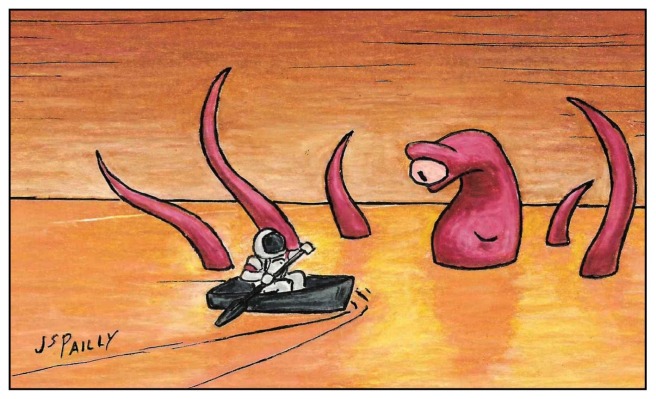
I’ve made a friend on Titan: a giant, multi-tentacled monster that swims around in Titan’s lakes of liquid methane. Today, my new friend invited me to go swimming with him. While that does sound like fun, there are a few problems with that idea:

  • I can’t exactly change into my swimming trunks. There’s no oxygen in Titan’s atmosphere, so I need my bulky spacesuit. But even if that weren’t a problem….
  • Liquid methane is a cryogenic fluid. It’s not quite as cold as liquid nitrogen, but still… If I stick my toe in the methane, my toe will probably flash freeze and shatter. But even if that weren’t a problem….
  • I would sink straight to the bottom of the lake. Liquid methane is significantly less dense than water and significantly less dense than the human body. I wouldn’t be able to float, and I certainly wouldn’t be able to swim.

However, I didn’t want to disappoint my new friend, and I did come prepared for a possible excursion over a methane lake. So I hurried back to my spaceship and grabbed my boat.

Ag24 Lake Monster of Titan

Life on Titan: Infrared Eyes

I’ve been exploring the surface of Titan for several weeks now. During my time here, I have not discovered alien life, but alien life sure has discovered me. Fortunately, the Titanian lake monster I met on Friday is friendly, and he was super excited about meeting someone “from the stars.”

“Wait,” I said, “you know about the stars?”

“Oh yes,” the lake monster said. “I look up at them, twinkling in the night, and also the great orb with the rings around it.”

This really left me flummoxed. I can’t see Saturn at all from the surface of Titan (and I was pretty upset about it too). I certainly can’t see the stars. I can’t even see the Sun through all the tholin haze layered up in Titan’s atmosphere.

However, the tholin haze does allow certain wavelengths of light to pass through, mostly in the infrared part of the spectrum. The haze is almost completely transparent at a wavelength of 2000 nanometers (nm), which is how the infrared camera on the Cassini spacecraft has been able to photograph Titan’s surface.

The human eye can only detect light between roughly 400 and 700 nm. That’s because humans evolved on a planet where the 400 to 700 nm range is dominant, while life on Titan evolved in an environment where infrared light shines the most clearly.

So my new lake monster friend sees in infrared, possibly right around the 2000 nm range, and when he looks up into the sky he can see the Sun and stars and even Saturn, while all I see is gloomy orange haze.

Sciency Words: In Situ

Sciency Words PHYS copy

Today’s post is part of a special series here on Planet Pailly called Sciency Words. Each week, we take a closer look at an interesting science or science-related term to help us all expand our scientific vocabularies together. Today’s term is:

IN SITU

Today I’m continuing to blog from the surface of Titan, Saturn’s largest and most mysterious moon. No more reading about Titan in books and journals or on the Internet. Right now, I can do my Titan research “in situ,” as the real scientists would say.

Ag19 Life on Titan

“In situ” basically means “on location.” It comes from the Latin words for “on” and “location.” Alternative translations include “in the place” or “situated in,” but I think “on location” works best for our purposes.

Just about any time you find the phrase “in situ” in a scientific text, you can mentally substitute the words “on location” without changing the meaning of the sentence one bit.

  • The Mars rovers conduct in situ experiments to identify Martian geological features.
  • In the future, colonists cannot depend on supply missions from Earth for all their needs. They’ll have to make use of in situ resources.
  • Triton (Neptune’s largest moon) probably didn’t form in situ, but was captured by Neptune’s gravity after forming elsewhere.

Regarding in situ planetary science, contrast it with the observational science done using telescopes or laboratory experiments that attempt to recreate conditions on other worlds. Or you could contrast in situ research against something like a sample return mission, where material is brought back to Earth rather than analyzed on location (I mean, in situ).

Meanwhile on Titan

While in situ research has its advantages, it’s still only as good as the human doing the research. If life exists on Titan, it’s bound to be very different from life on Earth, with biochemistry totally unlike our own.

I can’t just look into a methane lake and see if any alien microbes are swimming around. I have to know what to look for before I look. I have to know which experiments to do before I do them. Which is why I still have to read books and journals and Internet articles about Titan. Otherwise, I might miss something important.

P.S.: Ah! It’s got my leg! Send help!

Proxima Centauri Has a Planet!

Ohmigod, ohmigod, ohmigod!

Okay, calm down, James. Breathe. Breathe.

Okay. Let’s take a look at Alpha Centuari, a binary star system located within a mere 5 light-years from Earth. In the bottom corner of the image, you can see a red dwarf star called Proxima Centauri, which is believed to be a companion to the Alpha Centauri pair. And in orbit of Promixa, you can see… you can see… ohmigod!

Ag16 Alpha Centauri

Apparently the European Southern Observatory (ESO) has discovered a planet orbiting Proxima. Not only that, it’s an Earth-like planet. And furthermore, it’s within Proxima’s habitable zone. This according to an unnamed source in a German newspaper.

The ESO is a highly respected, extremely trustworthy astronomical institution. As for unnamed sources… okay, let’s put our skeptical hats back on.

Let’s also remember that Earth-like planets are not necessarily all that Earth-like. For the last few weeks, I’ve been blogging from the surface of Titan, which is often described as one of the most Earth-like worlds in the Solar System. And let me tell you, it is miserable here. I guess there could be life on Titan, but not life as we humans understand it.

Mars is also sometimes described as Earth-like, and believe it or not, so is Venus.

Ag16 Earth-like Worlds

Supposedly the ESO will release its official findings at the end of August. Until then, we’ll just have to sit back, wait patiently, and stay skeptical.

P.S.: Ohmigod! Proxima Centauri might have… might… I can’t even! OH MY GOD!!!

Link

Earth-like Planet Around Proxima Centauri Discovered from Universe Today.


Can You See Saturn from Titan?

As I continue my exploration of Titan, there’s something I was really hoping to see.

Ag10 Saturn in the Sky

Like Earth’s moon, Titan is tidally locked. That means as Titan orbits Saturn, the same side of the moon is always oriented toward the planet.

So in theory, all I have to do is make my way to the Saturn-facing hemisphere, look up in the sky, and behold the majesty of the Ringed Planet.

I’m sorry to report that today science has crushed my dreams. Titan is shrouded in a haze of aerosol particles called tholins. The tholin haze is not as dense as you might assume (which is why I thought I might be able to see Saturn).

But this diffuse haze extends from the surface all the way up to an altitude of approximately 300 km. For the sake of comparison, typical Earth clouds form at altitudes between 3 and 12 km, and the unofficial boundary between Earth’s atmosphere and space is about 100 km up. So you could say that Titan’s haze is 200 km taller than Earth’s entire atmosphere (and Titan still has a few more atmospheric layers above the haze too).

Dense or not, there’s more than enough tholin haze overhead to block my view of Saturn. In fact, it’s enough that I can’t tell which way the sun is.

Ag10 Saturn Not in the Sky

Of course, Titan does experience seasonal changes which can affect the tholin haze. Maybe if I came back at a different time of year (Titan’s year equals almost 30 Earth years), I might be able to see something. But I doubt it.

First Steps on Titan

Your first steps on a new world should be an auspicious occasion. With that in mind, I have just landed on Titan. I’ve opened the hatch of my spaceship. I’m descending the ladder. I’m taking my first step….

Ag08 First Steps on Titan

I should have expected this. Titan may be too cold for liquid water, but it’s the right temperature and pressure for liquid methane.

There’s enough liquid methane (and also liquid ethane) to form lakes and rivers. It rains liquid hydrocarbons, and the ground is saturated with this stuff. Add tholins to the mix, and you’ve really got yourself in a sticky situation.

When the Huygens probe landed on Titan in 2005, it found surface conditions that the Huygens team compared to crème brûlèe: a layer of soft, gooey material with a thin, hardened crust on top.

No one can say for sure if the Huygens landing site is truly representative of the entire surface of Titan, but still… I should have expected to get my space boots dirty.

And here’s another thing I should have expected. You see, Titan has an atmosphere (approximately 95% nitrogen, less than 5% methane). In fact, Titan’s atmosphere is slightly denser than the atmosphere on Earth, so sound waves travel pretty well. Which means that as I trudge across the Titanian landscape, I can actually hear my space boots squishing in the mud.

P.S.: One more thing I should’ve thought about sooner. I’m going to have to figure out a way to clean my spacesuit before getting back into my spaceship. All this hydrocarbon gunk is going to become a real fire hazard once I’m back in an oxygen-rich environment.

Sciency Words: Tholin

Sciency Words BIO copy

Today’s post is part of a special series here on Planet Pailly called Sciency Words. Each week, we take a closer look at an interesting science or science-related term to help us all expand our scientific vocabularies together. Today’s term is:

THOLIN

My travels through the Solar System have once again brought me to Titan, Saturn’s largest moon. My spacecraft has commenced landing procedures, and I am currently descending through a haze of aerosol particles called tholins.

The term tholin was coined in a 1979 paper co-authored by Carl Sagan. The word comes from two similar sounding Greek words, one meaning vault (as in the great vault of the heavens) and the other meaning mud. Apparently Sagan toyed with the idea of naming this stuff “star-tar.”

Back on Earth, tholins can be created in the lab. Just take some simple organic compounds like methane and ethane and zap them with UV light or an electric current. You’ll end up with this yucky, orange gunk all over the bottom of your test chamber.

Here on Titan, the same thing is happening due to photolysis. When chemicals like methane (CH4), ethane (C2H6), ammonia (NH3), and formaldehyde (CH2O) get irradiated by sunlight, they break apart and recombine as new, more complex structures.

Ag05 Tholins on Titan

Tholins fill the air as a dense, orange haze. They cover the ground below as orange sludge. They’re also starting to coat the viewport of my spaceship with an orangey film that, I suspect, will be a real pain to scrub off.

While tholins have been notoriously difficult to analyze in the lab, they seem to be a mishmash of organic molecules. It’s hard to say which organic molecules are present, but some of them appear to be extremely large, extremely complicated organic compounds.

It’s easy to imagine amino acids, peptide chains, or even some sort of proto-DNA emerging from tholins, provided the tholins are allowed to dissolve in some sort of aqueous solution (note to self: double check Titan’s liquid methane lakes for dissolved tholins).

I can’t say for certain if there’s life on Titan, but I have to admit with all these tholins lying around, conditions are ripe for some sort of biochemistry to get started.

Links

What in the World(s) are Tholins? from the Planetary Society.

How Titan’s Haze Help Us Understand Life’s Origins from Astrobiology Magazine.

Molecular Monday: Are There Amino Acids on Titan?

Molecular Mondays Header

Welcome to Molecular Monday! On the first Monday of the month, we take a closer look at the atoms and molecules that make up our physical universe. Today, we’re looking at:

AMINO ACIDS ON TITAN

Captain’s Log

Stardate 8116.3

My spaceship has completed orbital insertion at Saturn. During last year’s Mission to the Solar System, I missed the opportunity to explore Saturn’s largest moon, Titan, in any detail. I intend to correct that error.

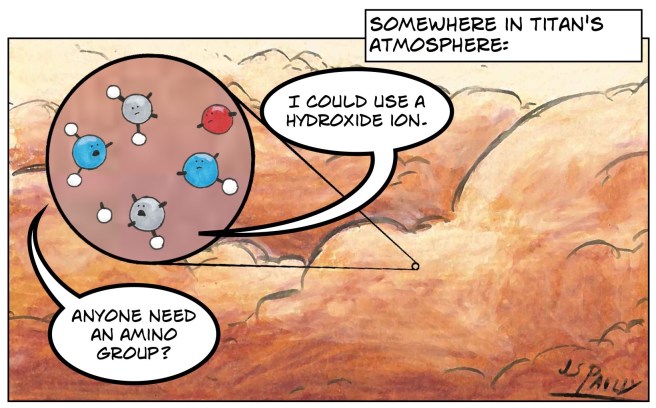
Titan may or may not support life, but one thing is certain: it is a chemically active world. And that chemical activity is vaguely reminiscent to the biochemistry found on Earth.

While my spaceship is still on approach to Titan, this seems like a good time to review what I’ve learned so far about amino acids.

Anatomy of an Amino Acid

  • Amino Group: a structure on one side of an amino acid that can serve as a base in acid/base chemistry.
  • Carboxyl Group: a structure on the opposite side of the amino acid that can serve as an acid for acid/base chemistry.
  • Alpha Carbon: A single carbon atom separating the amino and carboxyl groups, preventing them from accidentally reacting with each other. Some amino acids also include a beta carbon, a gamma carbon, or even a delta carbon, further separating the amino and carboxyl groups.
  • The Side Chain: A chain of atoms dangling from the alpha carbon. These side chains vary in composition and complexity, giving each amino acid its own unique flavor (sometimes literally).

Functionality of Amino Acids

  • Peptide Bonds: The amino group of one amino acid can link up with the carboxyl group of another, forming a peptide bond (a water molecule is produced as a byproduct). This process can be repeated over and over, forming incredibly long peptide chains.
  • Proteinogenic Amino Acids: While there are hundreds (perhaps thousands) of different amino acids, life on Earth uses only twenty-three of them in the formation of proteins. We humans use only twenty-one.
  • Chirality: Side chains can be attached to one side of an alpha carbon or the other. Life on Earth only uses amino acids with side chains on the “left” side. Right-sided side chains are incompatible with our DNA, and we can’t use them for the construction of proteins (though our bodies can use some of them for other purposes).

When I arrive on the surface of Titan, I do not know what I will find. Amino acids? Probably. Peptide bonding? Maybe. Long peptide chains, like some sort of proto-DNA? It’s possible.

We’ll just have to wait and see what happens when I get there.