Sciency Words: Spectroscopy

Welcome to a special Saturday edition of Sciency Words, because sometimes life gets in the way of regular blogging schedules. Each week (normally on Fridays) we take a closer look at some science or science-related term so we can all expand our scientific vocabularies together! Today’s term is:

SPECTROSCOPY

What color is it? It sounds almost like a childish question, but as we look out into space, trying to study the Sun and other stars and distant planets, we can learn a great deal just by figuring out what color things are.
The science of spectroscopy has a long history, beginning with Isaac Newton. In the late 1600’s, Newton demonstrated that pure white light can be split apart into a rainbow of color using a prism. Newton called this a spectrum, from the Latin verb specto, meaning “I observe” or “I see.” (According to my trusty Latin-English dictionary, the noun spectrum also meant “apparition” or “ghost.”)

Over the decades and centuries to come (click here for a detailed timeline), scientists used increasingly sophisticated combinations of lenses, mirrors, and prisms to study Newton’s spectrum in greater detail. They also experimented on a wide variety of light sources: sunlight, starlight, firelight, and even electrical sparks.

An especially noteworthy experiment in 1752 showed that burning a mixture of alcohol and sea salt produced an unusually bright yellow band in the middle of the spectrum (we now know this to be a emission line for sodium). And in 1802, another experiment on sunlight revealed multiple dark bands in the Sun’s spectrum (which we now know are absorption lines for hydrogen, helium, and other elements in the Sun’s photosphere and corona).

All the colors of the rainbow, except a few are missing. This is an absorption spectrum.

It wouldn’t be until the early 20th Century, with the development of quantum theory and, specifically, Niels Bohr’s model of the atom, that anyone could explain what caused all these spectral lines.

No rainbow, just a few specific colors. This is an emission spectrum.

In Bohr’s atom, the electrons orbiting an atomic nucleus can only occupy very specific energy levels. When electrons jump from one energy level to another (the true meaning of a quantum leap), they either emit or absorb very specific frequencies of light. The light frequencies are so specific that they act as a sort of atomic fingerprint.

And so today, as we look out into the universe, seeing the glow of stars and the absorption patterns of planetary atmospheres, it’s possible for us to identify the specific chemical elements we’re seeing, even across the vast distances of space, simply by asking what color is it?

One Last Thing About the Eclipse

This hasn’t been much of a research week for me. I’m more focused on the fiction side of my writing at the moment, rather than the science stuff.

So today I’m just sharing some artwork, something I didn’t quite get done in time for the eclipse.

You know, we are kind of lucky that we have these total solar eclipses. By some amazing coincidence, our large Sun and small Moon appear to be the same size in Earth’s sky, allowing the Moon to perfectly cover up the Sun.

That doesn’t happen anywhere else in the Solar System. That perfect planet-moon-star alignment is likely rare, perhaps even unique in our galaxy. So whenever we make first contact with aliens, and they start bragging about their luminous forests or crystal waterfalls or whatever, we Earthlings will have a unique and beautiful thing to brag about to: we have total solar eclipses.

Eclipse Day 2017 and Hermione Granger

One of my favorite fictional characters—one of the characters I most strongly identify with—is Hermione Granger from the Harry Potter series. She’s depicted as extremely bookish, and at one point we’re told she’s nervous about flying because it’s “something you couldn’t learn by heart out of a book.”

Yup, that sounds like me. I’ve spent an enormous amount of time studying science, but almost everything I know comes out of books rather than from hands on experience.

And so as the Great American Eclipse of 2017 approached, I felt increasingly nervous, just like Hermione going out for her first flying lesson. I’d read a lot about the eclipse, done pretty thorough research about the kinds of glasses I’d need to buy, and yet… I still felt horribly unprepared.

To make matters worse, the eclipse glasses I’d ordered online seem to have gotten lost in the mail. On the day of the eclipse, they still hadn’t arrived. I had a backup plan, but I wasn’t sure if it was going to work. I’d read online that you can use a pair of binoculars to project an image of the Sun onto a piece of paper. Again, I’d read about this, but I’d never tried to do it, and I wasn’t 100% convinced this was going to work for me. Some of the instructions I’d read sounded kind of complicated.

And yet to me extraordinary delight, it worked! My hands were a bit shaky, but I was able to project the Sun onto a page of my sketchbook and watch as the Moon slowly moved across the image.

My hastily improvised eclipse observatory.

Watching the eclipse turned out to be a highly emotional experience for me. I’ve been going through some things in my personal life, and this was a powerful reminder that no matter what happens, the universe keeps turning. Also, I realized at one point that the binoculars I was using originally belonged to my Dad, so in a sense it was like I got to share the experience with him.

And lastly, for a Hermione Granger-type person like me, this was one of those rare moments when something I read about became real to me. Maybe it wasn’t as exhilarating as learning to fly on a broomstick, but still… Eclipse Day 2017 was a magical experience for me.

Sciency Words: Brown Dwarf

Today’s post is part of a special series here on Planet Pailly called Sciency Words. Each week, we take a closer look at an interesting science or science-related term to help us expand our scientific vocabularies together. Today’s term is:

BROWN DWARF

In 1962, Indian astronomer Shiv S. Kumar theorized that there could be objects out there in space too big to be considered planets but too small to become stars. Since main sequence stars are referred to as dwarfs of various colors (our own Sun is a yellow dwarf), Kumar called his theoretical objects “black dwarfs.”

It turned out that the term “black dwarf” was already taken, so in 1975 American astronomer Jill Tarter (best known for her work with the SETI Institute) suggested the name “brown dwarf” instead. In an article from Universe Today, Tarter is quoted as saying: “it was obvious that we needed a color to describe these dwarfs that was between red and black.”

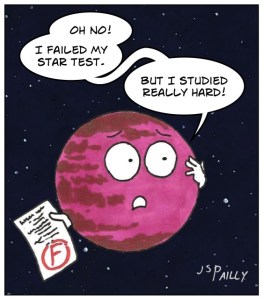
The term stuck, despite the fact that “brown” is a very misleading description. It’s not clear to us what color these objects are or would appear to be to the human eye. They do radiate light, but it’s mostly infrared light. In the visible spectrum, they might appear to be purple or magenta, or perhaps a rather dull red or orange. In fact they may come in all sorts of colors, depending on their metallicity. But astronomers do seem to agree about one thing: brown dwarfs are definitely not brown.

Today, brown dwarfs are typically described as failed stars.

Stars are defined scientifically as objects massive enough to cause nuclear fusion in their cores—specifically, to be classified as a star an object must be able to fuse hydrogen into helium. Brown dwarfs can’t do that.

But while this distinction between stars and brown dwarfs is fairly straightforward, the distinction between brown dwarfs and planets can get pretty murky. We actually don’t know enough yet about either brown dwarfs or exoplanets to be sure where to draw the line separating one from the other.

One of the leading proposals would define brown dwarfs based on their formation. If an object coalesces from a molecular cloud, as a star would, but fails to initiate hydrogen fusion, that object would be a brown dwarf. If an object forms in the accretion disk surrounding a star, the way planets form, then that object would not be a brown dwarf.

Another leading proposal would define brown dwarfs based on their internal physics. If an object can’t fuse hydrogen but can fuse other elements like lithium or oxygen, then that object would be a brown dwarf. (For more about these two competing proposals, click here.)

Eventually the International Astronomy Union will have to step in and set an official definition. But they’re not ready to do that. Not yet. Not until we’ve learned a lot more. In the meantime, ongoing observational research of objects like Gliese 504b (which I’ve nicknamed “Pinkie Pie”) may help the I.A.U. figure out which definition makes the most sense.

Exoplanet Explorer: Gliese 504b “Pinkie Pie”

Continuing our exploration of the exoplanets, today we’re visiting a planet called Gliese 504b.

Gliese 504b isn’t the kind of alphanumeric gobbledygook we usually get for exoplanet designations, but still… I prefer actual names, or at least nicknames. I think it’s easier to write about a planet when it has a name, and names help give us a sense of a planet’s personality.

So as of today, I’m officially renaming Gliese 504b Pinkie Pie.

Wait, I shouldn’t have used the word “officially.” I’m just some guy with a blog. Only the International Astronomy Union has the authority to…

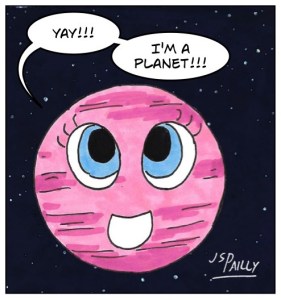
“Pinkie Pie” was discovered in 2013 orbiting a Sun-like star about 57 lightyears away in the constellation Virgo. This was one of those rare cases where astronomers were able to directly image a planet orbiting another star, and they could even identify the planets color. This made headlines, because the planet turned out to be pink. Glorious, fabulous bright hot pink!

The pink color is apparently due to the planet’s age. It’s only a few hundred million years old, which is young for a planet, and it’s still glowing from the heat of its formation. It appears to be a gas giant, several times more massive than Jupiter.

Also, it seems the topmost layers of clouds aren’t there. Perhaps the kinds of swirling, opaque clouds we’re accustomed to seeing on giant planets like Jupiter or Saturn will form later on as Pinkie Pie grows older and cools off. In the meantime, as telescope technology improves, Pinkie Pie may offer us an unprecedented opportunity to see how gas giants are structured on the inside.

Before I end this post, there is one more thing that you should know about Pinkie Pie. It’s rather important. There’s an ongoing mystery as to how a planet so young could be orbiting so far away from its parent star. According to our current understanding of planetary formation, gas giants like Pinkie Pie should be much closer in. Unless maybe Pinkie Pie isn’t a planet after all!

Yes, Pluto isn’t the only one to have its planet status called into question. Except while Pluto is essentially too small for planethood, Pinkie Pie might be too big. Some astronomers suggest that Pinkie Pie should be classified as a brown dwarf.

Of course that depends on how the term brown dwarf is defined. More about that in Friday’s edition of Sciency Words.

Recommended Reading: Earth in Human Hands

Welcome to another edition of Recommended Reading here on Planet Pailly, a special series devoted to books that I think you should read. Today I’m recommending Earth in Human Hands: Shaping Our Planet’s Future by David Grinspoon.

If you’re a fan of Star Trek, especially if you’re one of those fans who takes Gene Roddenberry’s vision of a utopian future for our planet seriously, then you really need to read this book. 24th Century Earth, according to Star Trek, will be a paradise; Earth in Human Hands tells the story of how we could make that fictional paradise a reality.

Now I should make it clear that this is not explicitly a book about Star Trek (though as I read it, I couldn’t help but notice the parallel). This is actually a book about the Anthropocene, which is something of a controversial term. I’ve written about it previously here and here. The basic idea is that human activies have already had such a dramatic impact on our planet that we’ve initiated a new epoch of Earth’s geological history. The Holocene is over; the Anthropocene has begun.

Up until now, the changes we’ve caused have been, for the most part, inadvertent. We might even be forgiven for our mistakes, since we didn’t realize for a long time what we were doing. But Grinspoon’s premise is that the time is coming when we will stop making inadvertent changes and start making changes that are deliberate and intentional. First, we’ll want to undo some of the damage we’ve caused, and then we’ll start to reengineer our environment to make our lives more comfortable and secure the planet’s biosphere against natural disasters.

To be clear, Grinspoon is not saying we’re there yet. We do not have the knowledge or technology to reengineer our planet—but we may be heading in that direction. If so, the Anthropocene might not be an age of ecological disaster but rather a golden age for planet Earth, under the wise and benevolent stewardship of the human species.

Admittedly this is a hyper-optimistic vision for our future, but then again so was Star Trek. So if Star Trek’s utopian Earth is something you believe in, something you’d like to see become a reality, then David Grinspoon’s Earth in Human Hands is the book for you.

What Am I Researching?

I have a fun special project in the works for this blog. I don’t want to say too much yet, but some of my research materials arrived last week and I’m getting pretty excited about it.

As you can see, I have some reading to do. Add to that a few other books which were already in my possession…

Also, I picked up something special at the grocery store.

So can you guess where I’m planning to take my imaginary spaceship next?

Molecular Monday: Worldbuilding with Lithium

Once upon a time, long before I knew much about chemistry, I wrote a Sci-Fi story set on a moon orbiting some far-flung gas giant. For story reasons, I needed this moon to have some sort of valuable resource, and I picked lithium to be that resource. Again, I didn’t know much about chemistry at the time, but for some reason I guessed this lithium-rich moon would probably have a rust-red color to it, like Mars.

Fast forward to today. I’m currently in the process of revising this and other stories in the Tomorrow News Network series. One of the things I’m trying to do is apply a little more science to my storytelling. And regarding this rust-red moon, it turns out I sort of got this one right!

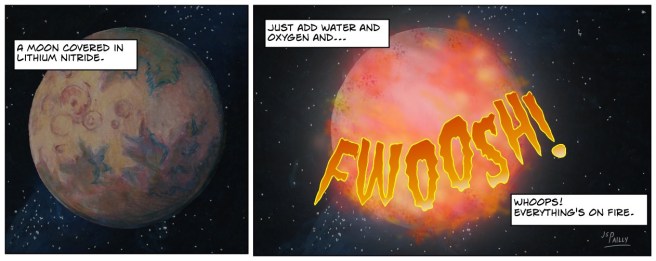
There is a compound of lithium and nitrogen called lithium nitride (chemical formula Li3N) which has the kind of dark red color that I wanted for my moon. Lithium nitride forms spontaneously wherever pure lithium comes into contact with atmospheric nitrogen, so it’s fairly easy to make. It doesn’t seem like much of a stretch to me that a lithium-rich moon would be covered in this stuff.

Of course the characters in my story need an otherwise Earth-like environment. That means Earth-like gravity, free oxygen, an active water cycle…

Okay, I’m not clear on just how rapidly everything would catch on fire in this situation, but based on a YouTube demonstration and some lab safety info I found online, it seems you should be careful about exposing lithium nitride to oxygen, and for God’s sake keep it away from water!

So yeah… it seems I have some to rethinking to do. Fortunately, there are other, less explosive lithium compounds I could work with.

Programming note: I’ve been doing Molecular Mondays as a once-per-month thing for a while now, but I feel like I’m starting to slip with my chemistry research. So Molecular Mondays will now return to its original biweekly schedule. So tune in two weeks from today when we’ll be talking about… I don’t know, probably lithium again.

Sciency Words: Tardigrade

Today’s post is part of a special series here on Planet Pailly called Sciency Words. Each week, we take a closer look at an interesting science or science-related term to help us expand our scientific vocabularies together. Today’s term is:

TRADIGRADE

Tardigrades, a.k.a. water bears… there’s just something lovable about them. They’re kind of cute for microorganisms (or kind of horrifying, depending on which picture you’re looking at). And they’re absurdly tough. They can survive almost anything. They can even survive in space.

There have been several experiments now where tardigrades were taken to low Earth orbit and exposed to the vacuum of space for prolonged periods of time. Most of them survived the experience. In the absence of food, water, or oxygen, tardigrades can enter a state of suspended animation, and their cells have the ability to repair their D.N.A. if it gets damaged by solar or cosmic radiation.

In fact tardigrades seem to be so well adapted to the hazards of space that it’s sometimes suggested (usually not by serious scientists) that these little guys might come from space.

German pastor and zoologist Johann August Ephraim Goeze is credited with discovering tardigrades in 1773. Goeze called them Kleiner Wasserbär, which is German for “little water bear,” because the way they walk on their eight pudgy, little legs reminded Goeze of the plodding movements of bears.

In 1777, Italian biologist/Catholic priest Lozzaro Spallanzani made further observations of these creatures. Spallanzani called them il Tardigrado, meaning “slow walker,” again because of the slow, plodding manner in which they walk. The English words tardy and tardiness are closely related, etymologically speaking.

Today we’ve retained both tardigrade and water bear as common names for these creatures. Apparently some people also call them moss piglets, which is just adorable. Over a thousand species of tardigrade have been identified, all classified under the phylum Tardigrada.

As for the question about where tardigrades came from—are they native to this planet, or did they immigrate to Earth from someplace else?—I can only say this: if tardigrades do have an extraterrestrial origin, they must have arrived on Earth a very, very long time ago. The oldest known tardigrade fossils date back to over 500 million years ago (meaning they may have been here since the Cambrian explosion).

The Titan Mission That Could’ve Been

This is a follow-up to my recent post about NASA’s next flagship-class mission. There seemed to be a lot of interest in the comments about a possible mission to Titan and/or Enceladus, Saturn’s most famous moons.

The competition for flagship mission funding can get pretty intense. The Titan Saturn System Mission (or T.S.S.M.) was a strong contender last time around, as was a proposed mission to Europa, the most watery moon of Jupiter.

According to Titan Unveiled by Ralph Lorenz and Jacqueline Mitton, things got a little nasty when the Europa team started calling Titan “Callisto with weather,” the implication being that Titan was geologically boring.

Callisto, by the way, is a large by often overlooked moon of Jupiter.

Ultimately Team Europa won. NASA deemed their proposal to be closer to launch-readiness. Now after a few years delay due to a certain global financial meltdown, the Europa Clipper Mission appears to be on track for a 2022 launch date (fingers crossed).

As excited as I am for Europa Clipper, the mission to Titan would’ve been really cool too. It actually would have included three—possibly four—spacecraft.

  • A lake-lander to explore Titan’s liquid methane lakes.
  • A hot air balloon to explore the organic chemical fog surrounding Titan.
  • A Titan orbiter to observe Titan from space and also relay data from the lander and balloon back to Earth.
  • And a possible Enceladus orbiter, built by the European Space Agency, which would have tagged along for the ride to Saturn.

It’s a shame T.S.S.M. didn’t get the green light from NASA. Just think: we would’ve had so many cool things going on at once in the Saturn System, enough to almost rival the activity we’ve got going on on Mars!

But now once Europa Clipper is safely on its way (again, fingers crossed), Team Titan will have another shot at getting their mission off the ground.