Dining on Mars, Part 1: Potatoes

Good news everybody! I’ve safely landed on the surface of Mars. I’d already constructed my habitat dome through the magic of telerobotics, so all I had to do when I got here was settle in and get comfy. The next order of business: what am I going to eat?

You may remember that fictional astronaut Mark Watney survived for over a year on Mars on a diet of potatoes and multivitamins. The potatoes provided Watney with the calories his body needed, and the vitamins provided everything else (well, almost everything else).

Watney grew his potatoes in a mixture of Mars dust and “fertilizer.”

So I guess the real question is: can this work in real life? Can potatoes grow in Martian regolith if the regolith is treated with some kind of fertilizer? According to the International Potato Center (C.I.P.) in Peru, yes. At least that’s what it says in this press release from earlier this year.

C.I.P. researchers used soil collected in a southern Peruvian desert, soil which is said to be the most Mars-like soil on Earth. This “Mars analog soil” was mixed with a bit of more traditionally Earth-like soil and then hermetically sealed in a test chamber that simulated Martian environmental conditions (O2 and CO2 levels, air pressure, and temperature).

Unfortunately I can’t find anything peer reviewed concerning this experiment, and I’ve learned to be skeptical of science-related press releases. However this press release refers only to “preliminary results,” so I have to assume a more substantive paper is on the way, and I’ll be eager to read it once it’s published.

In the meantime, I’ll do my best to grow my own potatoes here on Mars. Also I found this paper saying that sweet potatoes would make an ideal crop for long-term space missions. The sweet potato, according to the paper, “grows rapidly, has a higher yield, and greater nutritional values than other crops.”

That makes me even more excited about this Mars mission than ever. I love sweet potatoes!

Molecular Monday: Why is Mars Red?

Today’s post is part of a bi-weekly series here on Planet Pailly called Molecular Mondays, where we take a closer look at the atoms and molecules that make up our physical universe.

Okay, so I took a little detour on my mission to Mars to visit Phobos, Mars’s largest moon. But now it’s time I headed down to the surface of the Red Planet itself. Which brings us to today’s Molecular Monday question: why is the surface of Mars red?

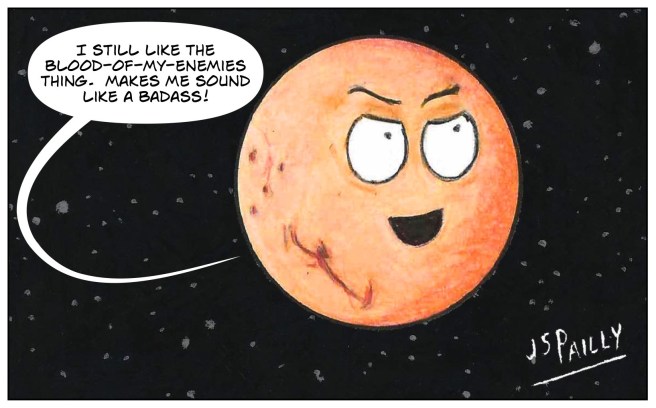
In ancient times, the answer would probably be something like Mars is drenched in the blood of his enemies. A more modern, more scientific explanation would involve iron oxide, specifically iron (III) oxide with the chemical formula Fe2O3, which is more commonly known as rust. As a mineral, it’s also known as hematite, which is what I’m choosing to refer to it as from now on.

But it’s a little too easy to just identify a chemical substance. A far more interesting question is this: where did all that hematite come from? No one knows for sure, but there are (as far as I can tell) three possibilities:

  • Ancient Water: Maybe Mars simply rusted the same way rust generally forms here on Earth. Martian hematite could have formed when iron and water mixed together, with hydrogen gas being released as a byproduct. This would have had to happen billions of years ago during a time when liquid water was more readily available on Mars.
  • Meteor Impacts: Back in the 1990’s, following the Mars Pathfinder Mission, a scientist at NASA’s Jet Propulsion Laboratory proposed that meteor impacts may be responsible for depositing all that iron on the Martian surface, and that carbon dioxide (split apart by solar UV radiation) provides the oxygen to oxidize that iron. Click here for more about that possibility.
  • Dust Storms: In 2009, researchers at the Aarhus Mars Simulation Laboratory in Denmark showed that the abrasion of grains of quartz (which contains oxygen) and magnetite (which contains both iron and oxygen) can produce hematite. Both quartz and magnetite are present on Mars, and Mars’s global dust storms might be enough to grind quartz and magnetite together. Click here for more about this process.

The Martian water hypothesis might seem like the obvious explanation. At least I assumed so until I started researching this post. But when the Curiosity Rover started drilling holes in the Martian ground, it found that the underlying layer is sort of grey, not red. This seems to be consistent with what the Mars Pathfinder Mission found: that iron and other metals are more present in the Martian topsoil than in the rocks.

That may suggest that Martian hematite formed only in the recent past, or perhaps that it forms continuously in the present. If so, that would cast doubt on the ancient water hypothesis and lend credence to either the meteor impact or dust storm hypotheses, or perhaps a combination of the two.

Sciency Words: Telerobotics

Today’s post is part of a special series here on Planet Pailly called Sciency Words. Each week, we take a closer look at an interesting science or science-related term to help us expand our scientific vocabularies together. Today’s term is:

TELEROBOTICS

This is a pretty easy one, I think. Telerobotics refers to controlling robots from a distance, usually a great distance. This is in contrast to robots that function autonomously or machines that require direct human control.

The word comes from the familiar Greek root tele-, meaning “far away,” and of course the word robot, which originally comes from Czech and means something like “forced labor.”

A wide variety of fields use telerobotics, but for the purposes of this blog we’re most interested in its use in space exploration. At this point most if not all spacecraft are telerobotic in nature. They receive instructions from mission control on Earth, carry out their instructions, and then transmit their status back to Earth so that mission control can decide what to make the spacecraft or space vehicle do next.

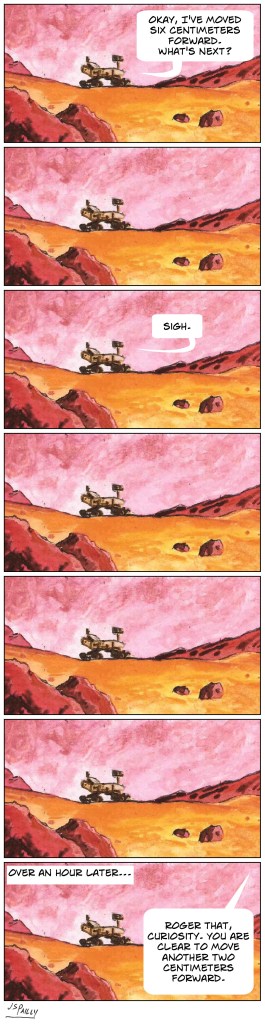
The problem, of course, is that this back and forth communication is restricted by the speed of light. In the case of the Mars rovers, this means that even performing the simplest tasks can take hours and hours. It’s very frustrating, especially for the rovers.

This is one of the biggest reasons Buzz Aldrin and others say we should send astronauts to Phobos (one of Mars’s moons) before sending anyone to Mars itself. From a small Phobos base, astronauts could telerobotically control the rovers in real time. The speed-of-light delay would be negligible.

The rovers could cover a lot more ground that way, dramatically speeding up our exploration of Mars. Also, when the time comes, the rovers could be used to quickly prepare a landing site and assemble habitat structures in advance of the first human colonists arriving on Mars.

The Monolith of Phobos

On Tuesday, I landed on the surface of Phobos, the largest and innermost moon of Mars. Today, I’m doing a bit of sightseeing. Yes, there are sights to see on this rocky, little moon. Or at least, there is one sight worth seeing: the Monolith of Phobos.

I’m kind of surprised that I hadn’t heard about this before: a mysterious, boxy-looking object estimated to be about 90 meters wide jutting out of the surface of Phobos. Apparently it’s something Buzz Aldrin talks about a lot.

Aldrin mentioned it in an interview on C-SPAN, saying that this is the kind of mystery that could really get the public interested in a mission to Phobos. Aldrin also wrote about the monolith in greater detail in his book Mission to Mars: My Vision for Space Exploration (which is where I first heard about it).

So I’m going to go check this monolith out. I mean, it’s probably just a big rock. I bet it doesn’t even look so monolithic when you see it up close. It certainly was not put there by aliens (as many conspiracy theorists insist that it was) or that it’s anything like the monoliths from 2001: A Space Odyssey.

Except… what is that noise? It’s like some kind of eerie music….

Welcome to Phobos (Watch Your Step)

So I know I’m supposed to be blogging about my totally for real trip to Mars, but I actually haven’t landed on Mars yet. Actually, I’ve read a lot of expert opinions suggesting that any long term mission to Mars should really start with a mission to Phobos, Mars’s largest and innermost moon.

It’s an idea that Buzz Aldrin advocates for in his book about Mars, and it’s something that’s spelled out in a little more detail in this NASA technical report. Basically, the delta-v required to travel from the surface of Earth to Phobos is less than the total delta-v to travel from Earth all the way down to the surface of Mars.

That means less fuel, which means lower costs, and once we’re there Phobos can be used as a sort of vanguard outpost to help prepare for the full scale exploration and colonization of Mars.

Unfortunately for me, landing on Phobos and taking my first steps on this very, very tiny world—well, it didn’t go the way I expected it too.

Don’t worry. I made it back to the ground. Eventually.

You see Phobos is more like an asteroid than what we’d typically think of as a moon. If fact Phobos may actually be an asteroid that Mars kidnapped from the asteroid belt. Anyway, the point is Phobos is small. Very small. And so it does not have a whole lot of surface gravity. If I did my math correctly, we’re talking about less than 0.1% the surface gravity of Earth.

So in order to land on Phobos and stay on Phobos, I recommend bringing grappling hooks or some sort of tethering system, or maybe something like the harpoon gun the Rosetta Mission tried (unsuccessfully) to use to latch onto comet 67P.

As for walking around on Phobos’s surface, I’d say tread lightly. If you put too much force into your footsteps, you’ll have several long, long minutes to think about your mistake as you drift slowly back down to the ground.

Sciency Words: Geologic Periods of Mars

One of the reasons I write this Sciency Words series is to introduce you to terms that I know (or at least suspect) we’ll be talking about in upcoming blog posts. Right now, I’m just getting started with my special mission to Mars series, so I think this is a good time to introduce you to not one but four interesting scientific terms.

Today, we’re looking at the four major periods of Mars’s geological history (based primarily on this article from ESA and this article from the Planetary Society).

PRE-NOACHIAN MARS (4.5 to 4.1 billion years ago)

This would have been the period when Mars, along with the rest of the Solar System, was still forming.

NOACHIAN MARS (4.1 to 3.7 billion years ago)

This period was characterized by heavy asteroid/comet bombardment, as well as plenty of volcanic activity. Most of the major surface features we see today formed during this time: the Tharsis Bulge, Valles Marineris, several of the prominent impact basins in the southern hemisphere, and also the vast northern lowlands—or would it have been the northern oceans? Also valley networks that formed during this time look suspiciously like river channels.

HESPERIAN MARS (3.7 to 3.0ish billion years ago)

Around 3.7 billion years ago, it seems asteroid and comet impacts on Mars died down, and volcanic activity kicked it up a notch. We also see a lot of surface features called “outflow channels” corresponding to this time, rather than the river-like valleys that appeared during the Noachian. These outflow channels may have been created by sudden and violent floods, which may have been caused by melting ice dams releasing lake water.

AMAZONIAN MARS (3.0ish billion years ago to today)

The Amazonian Period began when the northern lowlands, specifically a region called Amazonis Planitia, was “resurfaced,” covering up any impact craters or other surface features that may have been there before. Mars experts disagree about when this happened, but most estimates seem to be in the neighborhood of three billion years ago. Any obvious volcanic or geologic activity ceased during the Amazonian, and for the most part all of Mars’s water has either frozen solid or evaporated into space.

On Earth, if you want to talk about the age of the dinosaurs, what you’re really talking about is the Mesozoic Era, which is subdivided into the familiar Triassic, Jurassic, and Cretaceous Periods. And so if you’re looking for dinosaur fossils, you need look for Mesozoic Era rocks.

At this point we only have a rough sketch of the geologic history of Mars. We don’t know enough to make the kinds of divisions and subdivisions that we’ve made for Earth. But if you want to go looking for Martian dinosaurs (by which I mean fossilized Martian life of any kind, even if its only microbial) then I can tell this much: look for Noachian and Hesperian aged rock formations. Those are the rocks that would have formed back when Mars still had oceans and lakes and rivers (or at least random, violent floods).

At least, landing near some Noachian and/or Hesperian rocks seems to be a high priority for NASA’s Mars 2020 rover.

IWSG: Setting Elon Musk-Style Goals

Today’s post is part of the Insecure Writer’s Support Group, a blog hop where insecure writers like myself can share our worries and offer advice and encouragement. Click here to find out more about IWSG and to see a list of participating blogs.

This is going to be another of those IWSG posts where I talk about space exploration, but really I’m talking about writing. Just bare with me. I think you’ll see why this is relevant, especially right now in the beginning of November.

If you’re a space enthusiast like me, you’ve had your heart broken many times over the years about Mars. NASA has made big promises about a Mars mission, but everything keeps getting postponed, and it sometimes seems unlikely NASA will ever follow through. A few years ago, a private group called Mars One made some really big promises, but it sounds like they really, really won’t be able to follow through.

And then there’s Elon Musk and his company, SpaceX. Musk has made a lot of promises about SpaceX, the Red Dragon spacecraft, and a Mars colony populated by hundreds of thousands of people. All of this is supposed to start happening in the next decade, maybe sooner. Or so Musk keeps telling us.

Musk does this with all of his grand endeavors, like Tesla, Open AI, and Solar City. Big promises are made. Ambitious deadlines are set. And then those deadlines are missed, and those promises are broken. It would seem that Musk is nothing more than a pipedreamer. A very wealthy pipedreamer, but still… just a pipedreamer.

Except while Musk’s publically stated goals rarely if ever seem to come to fruition, his companies still make tremendous progress; so much so that they continue to be attract investors even as they appear to be failing spectacularly at everything they set out to do.

I wasn’t sure what to make of this until a year or two ago when I read a short article about Musk. It may have been this article, or possibly this one (unfortunately I didn’t save the original link).

Apparently Elon Musk believes that it’s better to set your goals a little too high and just barely miss than to set your goals low so you can achieve them easily. One way pushes you to try harder, and even if you don’t succeed at the goal you set for yourself you still make progress—more progress than you would have made otherwise, perhaps more progress than you honestly thought was possible. The other way—the low, easy goals way—gives you permission to become stagnant and allows you to call that success.

I’m not much of a businessman. I don’t know if this is a good way to run a company, though it does seem to be working for Musk. But as I chase my own ambitious writing goals this month, and as some of you pursue the ambitious goals set by NaNoWriMo, maybe it’s worth keeping the Elon Musk philosophy of goal setting in mind.

Molecular Monday: Making Rocket Fuel on Mars

Today’s post is part of a bi-weekly series here on Planet Pailly called Molecular Mondays, where we take a closer look at the atoms and molecules that make up our physical universe.

As most of you now know, I am on a totally-for-real, not-making-this-up mission to visit the planet Mars. Now if you’re planning a mission to Mars, one of the first things you need to figure out is how to get back to Earth. Unless you’re not planning to come back, which is apparently an option.

But if you do want to come home, you’ll probably need to refill the fuel tanks of your spaceship using only the natural resources Mars provides. Believe it or not, this is surprisingly easy to do using a process called the Sabatier reaction (discovered in the early 20th Century by French chemist Paul Sabatier).

In the Sabatier reaction, hydrogen and carbon dioxide mix together to produce methane, with water being produced as a byproduct. The chemical equation looks like this:

CO2 + 4H2 –> CH4 + 2H2O

Liquid methane makes a decent rocket fuel, but you still need an oxidizer. To get that, all you have to do is zap that byproduct water with electricity, creating oxygen and hydrogen.

2H2O –> 2H2 +O2

Liquid oxygen is pretty much the best oxidizer you can get, and the “waste” hydrogen can be put back to work keeping the Sabatier reaction going.

I first learned about the Sabatier reaction in Robert Zubrin’s book The Case for Mars, coming soon to my recommended reading series. The only problem, according to Zubrin, who was writing in 1996, is hydrogen. Mars’s atmosphere is almost completely CO2, but Mars is severely depleted of hydrogen. Zubrin’s solution in his book is to import hydrogen from Earth (still cheaper than trying to ship rocket fuel to Mars).

But since 1996, we’ve learned that Mars has more water than previously thought, most of it frozen just beneath the planet’s surface. So when I read about the Sabatier reaction again, this time in Elon Musk’s paper “Making Humans a Multi-Planet Species,” published in 2017, the hydrogen problem was no longer a problem. We can get it through the electrolysis of Martian water.

Of course for my own Mars mission, I don’t have to worry much about rocket fuel. My spaceship is fueled by pure imagination! But still, if something were to go wrong with my ship, it’s good to have a backup plan.

Sciency Words: Delta-v

Today’s post is part of a special series here on Planet Pailly called Sciency Words. Each week, we take a closer look at an interesting science or science-related term to help us expand our scientific vocabularies together. Today’s term is:

DELTA-V

Okay, it might be a bit foolhardy of me to try to tackle this term. This is actual rocket science, and I’m nowhere close to being an actual rocket scientist. But this is still far too important of a concept for me to ignore, so I’ll do my best.

The simplest definition of delta-v (often represented mathematically as ∆v) is that it equals your total change in velocity. So if you’re driving along at 25 miles per hour and then accelerate to 65 mph, your delta-v equals 40 mph. And if you decelerate from 65 to 25 mph, your delta-v once again equals 40 mph.

Things start getting interesting when you consider delta-v to be cumulative. So if you start off at 25 mph, accelerate to 65 and then drop back down to 25, your total delta-v equals 80 mph (40 mph + 40 mph).

In rocket ship design, the term delta-v is used as a sort of proxy for how much thrust your engines are capable of and how much fuel you’re carrying. You might also consider the kinds of gravity assists or aerobraking maneuvers you can use to augment your delta-v without expending additional fuel.

This is where the math starts to get complicated, but if you can calculate how much delta-v your spacecraft is capable of, then you’ll know where you can go in space. And if you know where you want to go in space, you can figure out how much delta-v it’ll take to get there and build your spaceship accordingly.

I first learned about delta-v from a video game called Kerbal Space Program. It’s a fun and sometimes frustrating spaceflight simulator that does a reasonably good job approximating how real life space exploration works. Unfortunately I was never very good at it. The scenario in the comic strip above… I made that mistake a lot.

But hopefully I’ve learned my lesson well. I’d hate to run short of fuel during my upcoming totally-for-real, I’m-not-making-this-up trip to Mars (stay tuned!).

Links

The Tyranny of the Rocket Equation from NASA.

Can Kerbal Space Program Really Teach Rocket Science? from Scott Manley (well known for his YouTube tutorials on K.S.P.)

How to Use Kerbal Space Program to Teach Rocket Science from Digital Media Academy.

Six Words You Never Say at NASA from xkcd.

I’m Going to Mars!

I’ve done stunts like this before here on Planet Pailly. My favorite example is that time I spent a few weeks on the surface of Titan, Saturn’s largest moon. I was totally there. For real. I walked around in Titan’s icky tholin mud and I figured out how to fly in that thick, soupy, tholin-rich atmosphere. I even befriended a methane-lake monster.

But that was only a short, two-week adventure. What I’m planning now will be much longer (and if I’m going to make this in any way believable, much more research intensive). Some of you may have guessed a while ago where I’m going based on this cleverly cryptic post. But now I can make the announcement officially:

I will be spending the next two months (maybe longer) living on the planet Mars.

To be honest, I’ve always felt a little embarrassed by the fact that I do not know much about Mars, or at least not as much as a space enthusiast/Sci-Fi writer like me should know. The problem is that there’s just so much more information out there about Mars compared to any other planet in the Solar System (besides Earth). And thanks to all the robotic exploration taking place right now on the Martian surface or in Mars orbit, new discoveries seem to come out every week or sometimes even every day.

That’s a lot of knowledge to sift through. It can get pretty intimidating. So my goal for this mission is to really immerse myself in everything Martian so that I can get to know the Red Planet better.

P.S.: There is one possible problem. Even though I’ll be living on Mars, I still have to work my day job back on Earth. That’s going to be quite a long commute!