Book Recommendation: Chasing New Horizons

If you’re a Pluto fan, this book is required reading.  Authors Alan Stern (who led the New Horizons Mission) and David Grinspoon tell us the story of why NASA neglected to send a space probe to Pluto for so long, and how an intrepid group of scientists fought for a Pluto mission and eventually won the day.

This is not just another book about science and technology.  Yes, a large portion of the book is about the technology it took to get to Pluto and the science we learned once the New Horizons space probe started sending back its data. But more importantly this is a David and Goliath story, with NASA’s bureaucracy cast in the roll of Goliath and the so-called “Pluto Underground” playing the roll of David.

I feel like the authors must have made a few enemies at NASA, and maybe a few enemies in Washington D.C. as well, for writing this book. This is an honest and forthright look at the kind of political and bureaucratic resistance New Horizons had to deal with.  As a space enthusiast, I keep hearing about other space missions that are struggling to get to the launch pad.  After reading Chasing New Horizons, I think I have a clearer idea of what causes these sorts of hold up.

And then there’s the elephant in the room: Pluto’s planet status.  The authors say very little about that, which in and of itself says a lot.

I’m guessing the authors made a few enemies at the International Astronomy Union as well.  They give us only a few pages about the I.A.U. vote to demote Pluto and why they believe that vote was wrong.

Overall, I highly recommend this book.  Five out of five stars, or maybe I should give it a rating of nine out of nine planets.

Sciency Words: Hypogravity

Today’s post is part of a special series here on Planet Pailly called Sciency Words.  Each week, we take a closer look at an interesting science or science-related term to help us expand our scientific vocabularies together. Today’s term is:

HYPOGRAVITY

We have a pretty good idea how the human body operates in Earth-normal gravity (1 g).  We also know a lot about how weightlessness (0 g) affects our bodies. But what about values of gravity between 0 and 1 g?  According to this review from the journal Frontiers in Physiology, our knowledge about the human body in so-called hypogravity is shockingly limited.

The word hypogravity combines the word gravity with the prefix hypo-, which comes from a Greek word meaning “under” or “below.”  It’s defined as an actual or perceived gravitational force greater than 0 g but less than 1 g.  The term hypergravity (from a Greek word meaning “over” or “above”) is also used for gravitational forces greater than 1 g.

According to Google ngrams, the term started appearing in print during the 1950’s, which would coincide with the early days of the space program.  My first encounter with this term was in an article titled “Medical Skills for an Interplanetary Trip: The Hostile Environment of Space and the Planet Mars,” which appears in this book about the Mars One program.

I can’t remember ever seeing this term prior to that article, which kind of surprised me at first.  But based on my subsequent research, I think this term is used almost exclusively in the medical field, an area which I’m not well versed in.

According to that paper from Frontiers in Physiology, we know very little about what hypogravity does to us, medically speaking.  Of course we do have the first hand accounts of those few astronauts who’ve walked on the Moon, as well as other records and archival footage from the Apollo program.  Frontiers in Physiology also describes several ingenious ways scientists have learned to simulate hypogravity in the laboratory.  And we have mathematical models to help us predict what hypogravity might do to us long term.

But still, our knowledge and experience with hypogravity “remains fragmentary,” as Frontiers in Physiology puts it.  “Fragmentary” seems like just the right word, because old records, laboratory simulations, and computer models can only tell us so much.  We have very little to go on here.  Just bits and pieces. A few scattered data points.

The human body evolved in a 1 g environment.  Prolonged weightlessness seems to do our bodies a lot of harm, from bone loss and muscle atrophy, to disrupting the balance of our internal fluids, to messing up our equilibrioception (a “sixth sense” most of us don’t realize we have until it’s taken away).  I’d assume hypogravity does less harm than weightlessness.  The question is: how much less?

I guess we won’t really know the answer until we start sending people to live on the Moon or Mars long term, and start finding out which health problems they do or do not develop.

Things I Don’t Understand: Mercury’s Wandering Sun

Okay, this is a thing I’ve read about multiple times, but no matter how many times it’s been explained to me I just don’t get it.  Apparently on Mercury, the sun sometimes appears to change directions in the sky.

Let me explain what I mean.  Imagine you’re standing on the surface of Mercury (and are somehow still alive).  You see the sun rise in the east, just as it does on most planets in the Solar System.  And then over the course of a long (very, very long) Mercurian day, you watch the sun slowly (so very, very slowly) travel from east to west.

But at one point, let’s say around midday, the sun appears to stop its east-to-west motion and then, for a short while (about 4 Earth days), it wanders from west to east instead.  Then the sun stops again and continues on its original westerly path.

Why does this happen?  I know it has something to do with the length of Mercury’s solar day versus its sidereal day.  A solar day on Mercury, the time it takes for Mercury to complete a rotation relative to the Sun, is approximately 176 Earth days long. But Mercury’s sidereal day, the time it takes for Mercury to complete a rotation relative to the ecliptic, equals about 59 Earth days.  Also, Mercury’s year is 88 Earth days long, so Mercury’s solar day is roughly twice as long as its year.

Obviously this all means the sun moves very slowly through Mercury’s sky, but why should it briefly stop, turn around, and go the other way?  I just don’t get it. I guess I just can’t conceptualize why this happens.  Maybe if I were better at math, all those numbers would add up for me, and I’d understand what’s going on.

Anyway, does this make sense to anyone else, or are you just as baffled by this as I am?

Update: Looks like I have a lot of really smart readers! It’s still kind of hard for me to conceptualize why this happens, but it’s starting to make a little more sense to me. The first comment from TureNorthBricks definitely cleared up a lot for me.

Sciency Words: Macromolecule

Today’s post is part of a special series here on Planet Pailly called Sciency Words.  Each week, we take a closer look at an interesting science or science-related term to help us expand our scientific vocabularies together.  Today’s term is:

MACROMOLECULE

After all the years I’ve been writing Sciency Words, I’ve noticed something.  A lot of times it might seem pretty obvious what a scientific term means, but then you dig a little deeper and find that the term is not so clearly or precisely defined as you’d expect.

Defining macromolecule should be easy.  Macro means big, molecule means molecule; ergo, a macromolecule is a big molecule.  But after I read this paper about the discovery of organic macromolecules on Mars, I had a question: just how big does a molecule need to be to get that macro- prefix?

German chemist Herman Staudinger is credited with coining the term macromolecule.  It was a highly controversial concept at the time.  Another German chemist, Nobel laureate Heinrich Wieland, wrote to Staudinger in the 1920’s saying: “My dear colleague, drop the idea of large molecules; organic molecules with a molecular weight higher than 5000 do not exist.”  But Staudinger would later become a Nobel laureate himself for proving that they do.

I take that Wieland quote to mean that the word macromolecule was defined as any molecule with a molecular weight in excess of 5000, but I’ve seen other sources claiming it was defined as any molecule containing one thousand or more atoms, and still other sources saying it’s ten thousand or more atoms.

But those were the kinds of definitions being used in the early 20th Century.  Modern usage gets far more complicated and confusing.  As Wikipedia explains, the definition of macromolecule “varies among the disciplines.”

  • In biology, there are four kinds of macromolecule: lipids, proteins, nucleic acids, and carbohydrates. If it’s not one of those four things, it’s not a macromolecule, according to a biologist.
  • Polymer scientists go by a definition set by the International Union of Pure and Applied Chemistry (IUPAC), which states that a macromolecule is a “molecule of high relative mass, the structure of which essentially comprises the multiple repetition of units derived, actually or conceptually, from molecules of low relative molecular mass.”
  • Wikipedia also mentions a definition that involves aggregates of molecules sticking securely together due to intermolecular forces rather than covalent or ionic bonds.

It’s not unusual for one word to be defined in different ways by different fields (see my post on metallicity).  This is a big reason why some scientific terms end up being so difficult to define.

As for those organic macromolecules Curiosity found on Mars… in the context of that research, I think macromolecule simply means “very big molecule.”  Like I said on Wednesday, we don’t really know what, specifically, Curiosity found, and maybe we never will.  We just know that it must’ve had a lot of very big molecules in it.

The Big Martian Maybe

Could life exist on Mars?  There’s plenty of compelling evidence that it could, and also plenty of compelling evidence that it could not.  As a result, we’re left with a big, fat maybe. Perhaps the biggest, most frustrating maybe in all of modern science.

After last month’s announcement that the Curiosity rover had found large, complicated organic chemicals on Mars, I was initially tempted to add another point to the “yes, life could exist on Mars” column. But then I read the actual research (which is excellent, by the way).  At this point, I think the only thing we can say for certain is that the big maybe about Mars is even bigger and even more maybe-like.

The Curiosity rover dug up some samples from Martian mudstone, samples that apparently contained organic macromolecules.  What are macromolecules?  For now let’s just say they’re very big molecules.  We can dive into the technical details of what defines a macromolecule in Friday’s episode of Sciency Words.

The problem, as I understand it from that research paper, is that these macromolecules were too big for Curiosity’s instruments to analyze.  So Curiosity destroyed the molecules through a process called pyrolysis (also coming soon to Sciency Words) and analyzed the bits and pieces as they broke apart.  Even those bits and pieces were difficult for Curiosity to study because there were so many of them, but for the most part they seemed to be aromatic compounds made of carbon, hydrogen, and sulfur.

These are the kinds of organic materials that could be deposited on a planet by meteor impacts.  They could also have formed through rather ordinary geological processes.  Or they could be the residue left behind by some kind of biological activity.  And there doesn’t seem to be any way to know for sure where these organics came from based solely on the data Curiosity was able to collect.

So we’re still left with a big maybe.  However, it was once thought by some that the Martian environment was too harsh to preserve these sorts of molecules at all.  Thanks to Curiosity, we now know Mars can and does preserve its organic macromolecules.

And that means that if Mars has had any sort of biological activity, either in the past or present, the chemical record of that activity should be there for us to find.  A definitive yes or no to our question is possible!  We just have to keep digging.

The Infamous “Pluto Not Yet Explored” Stamp

A couple years ago, I needed some postage stamps.  To my delight, the local post office had a wide selection of space-themed stamps to choose from, including this four-stamp sheet commemorating the New Horizons mission to Pluto.

But it wasn’t until I read Chasing New Horizons by Alan Stern and David Grinspoon that I realized the full significance of the stamps I’d purchased.  Those stamps were, in fact, a major part of New Horizon’s history.

The story begins in 1991, shortly after Voyager 2 completed its flyby of Neptune.  The U.S. Post Office issued a set of stamps honoring the first NASA space probes to visit each of the planets and also the Moon.  Pluto was also included in the set, with the caption “Pluto not yet explored.”

Apparently some in the planetary science community took this as a challenge.  That set of stamps, including the “Pluto not yet explored” stamp, became a symbol of work that had been left unfinished, of a job that still needed to be done.  The stamp was used in proposals and presentations arguing for a Pluto mission.  It was part of the public outreach campaign once New Horizons was underway. And the day New Horizons reached Pluto, a poster-sized version of the stamp was help up for the press with the words “not yet” crossed out.

So naturally, following that 2015 flyby mission, the Postal Service had to issue new stamps.  That day when I went to get stamps, so I could pay my rent and bills and other mundane things, I had no idea how much meaning and significance was packed into that little stamp sheet.  Even the elongated dash in “Pluto—Explored!” feels significant, as though it’s a reminder of the words that were crossed out.

I’ve never been a stamp collector, but as it so happens I still have at least one sheet of Pluto stamps left, and once I knew the full story behind them I went and did a little shopping online.  Now both sets of stamps—the 2015 stamps for New Horizons and the original set of stamps from 1991—are part of my modest collection of space exploration memorabilia.

Sciency Words: Aromatic

Today’s post is part of a special series here on Planet Pailly called Sciency Words.  Each week, we take a closer look at an interesting science or science-related term to help us expand our scientific vocabularies together. Today’s term is:

AROMATIC

At some point when I was a little kid, I discovered that gasoline doesn’t smell terrible.  In fact, it has an almost sweet aroma to it.  I got in a lot of trouble for this because, for obvious reasons, my parents didn’t want me sniffing gas fumes.  But still, that subtly sweet smell is there, and it’s caused by a chemical known as benzene.

Apparently I’m not the only person to take note of benzene’s smell.  German chemist Augustus Wilhelm Hofmann is credited with the first usage of the word “aromatic” to describe benzene, along with a whole host of other sweet-smelling chemicals.

Hofmann seems to have realized not only that these chemicals smelled similar but also that they had similar chemical compositions.  “Of this series,” Hofmann wrote in 1855, “few members are at present known, but the group of aromatic acids is itself very imperfect and limited.”  In other words, Hofmann predicted the existence of more “aromatic” chemicals that should fit the pattern.

And more chemicals of this series were later discovered, and we now know what they really have in common: a flattened, ring-like chemical structure, as pictured below:

As an adult, I know better than to sniff gasoline, and as an artist I know better than to sniff my art supplies.  But the xylene used as a solvent in some pens and markers does have that same vaguely sweet aroma as benzene. However, not all of the chemicals we call “aromatic” smell so nice, or smell at all.  It’s the flattened, ring-like structure that defines aromaticity today.  The odor is no longer considered relevant.

You might be wondering then why we still call these chemicals aromatic, if their aromas aren’t important.  This seems to be another case of scientists naming something before they really understood it.  The same thing happened with the word organic.  The term was used so often in scientific literature and became so deeply ingrained in the scientific lexicon that we’re now unable to change it.

The ring-like structures in aromatic chemicals are incredibly strong and unlikely to break apart during chemical reactions. That makes them really good structural components for the large, complex molecules that make life possible here on Earth—and may have once made life possible on Mars.  But we’ll talk more about that next week!

Sciency Words: Coatlicue

Today’s post is part of a special series here on Planet Pailly called Sciency Words.  Each week, we take a closer look at an interesting science or science-related term to help us expand our scientific vocabularies together. Today’s term is:

COATLICUE

You may recall the famous words of Carl Sagan: “We’re made of star stuff.”  Turns out we’re not made of just any old star stuff.  No, a great deal of our stuff came from one star in particular, a giant star named Coatlicue that went supernova about 4.5 billion years ago.

I first saw this name in a recent article from Scientific American called “The New Biography of the Sun,” which in turn referenced a paper from the journal Astronomy & Astrophysics titled “Solar System Genealogy Revealed by Extinct Short-Lived Radionuclides in Meteorites.”

In short, certain radioactive isotopes found in our Solar System can be thought of as our Solar System’s D.N.A.  The authors of that “Solar System Geneaology” paper used some of those isotopes (most notably aluminum-26) to try to reconstruct our Sun’s family tree and give us some idea about what the Sun’s “mother” must have been like.

Coatlicue would have been a giant star, approximately 30 times as massive as our Sun, ensconced within a giant molecular cloud along with other giant star siblings.  This is sort of like what we see today with the stars of the Trapezium inside the Orion Nebula.

About 4.5 billion years ago, Coatlicue went supernova.  The explosion accomplished two things: it seeded the surrounding molecular clouds with heavy elements (like aluminum-26) and, because of the force of the explosion, caused those molecular clouds to compress, triggering new star formation.

I have to confess that I feel like there’s a lot of guesswork and speculation going on here about how, specifically, Coatlicue died and how, specifically, the Sun and its planets were born.  But the general idea that the death of one star triggers the formation of others is consistent with what we already know about star formation, so it makes sense to me that something like this must have happened for our own Solar System.

As for the name Coatlicue (which I believe is pronounced Kwat-LEE-kway), that comes from Aztec mythology.  Coatlicue was the mother of the Sun.  So that makes sense.  In the myth, Coatlicue was also the mother of the stars, which actually sort of matches up with the science too.  That supernova explosion 4.5 billion years ago would have triggered the formation of other stars—perhaps several hundred of them—in addition to our own Sun.

I didn’t see this in either Scientific American or that “Solar System Genealogy” paper, but I’d like to believe Coatlicue might not have been totally destroyed in that supernova.  Perhaps some remnant is still out there, living on as a neutron star or a black hole or something.  If so, I doubt we’ll ever find it, but if I know anything about mothers, I’m sure our Sun still hears from Coatlicue every now and then.

Sciency Words: Thiea

Today’s post is part of a special series here on Planet Pailly called Sciency Words.  Each week, we take a closer look at an interesting science or science-related term to help us expand our scientific vocabularies together. Today’s term is:

THEIA

When I wrote about the Nice model, I said it does a nice job (pun intended!) of explaining how the planets of the Outer Solar System started out, and how they ended up where they are today.  But what about the Inner Solar System?  Well, it turns out we may have started with a few more planets than we have today, and one of those hypothetical early planets has been named Theia.

Technically speaking, Theia wouldn’t have been a planet (not according to the I.A.U. definition), but it was definitely planet-sized, perhaps as large as modern day Mars.  But Theia had to share its orbit with another planet that wasn’t technically a planet (yet): Earth.

Theia got stuck near one of Earth’s Lagrange points, about 60 degrees ahead of Earth in Earth’s almost circular orbital path.  There’s some weird gravitational voodoo going on at these Lagrange points, and so this arrangement of Earth and Theia could theortically have remained stable long term.

Except Jupiter and/or Venus disrupted the gravitational balance, pulling Theia a little this way, a little that way, nudging Theia away Earth’s Lagrange point and closer to Earth itself, until one day….

I would call this the worst disaster in Earth’s history, except this collision was sort of the moment when Earth (as we know it) really began.  I gather there’s still a lot of disagreement about the details, like whether this was a head-on collision or more of a glancing blow, but the two really important things to know are:

  • Theia knocked a large amount of Earth debris into space. That debris eventually coalesced to form our Moon.
  • Most of Theia is probably still here.Theia has become part of Earth, and the bulk of Theia may have would up becoming Earth’s core.

This idea that early Earth suffered a cataclysmic collision with another planetary body has been credited to a lot of different people, but it first appeared in the scientific literature in this paper from 1975.  The name Theia wasn’t introduced until much later, in this paper from 2000.

In Greek mythology, Theia was the Titaness who gave birth to the Moon.  That checks out. The name definitely seems appropriate.  In the myth, Theia also gave birth to the Sun.  That part doesn’t match up with the science so well.

But not to worry!  In next week’s episode of Sciency Words, we’ll meet the Sun’s real mother.

TRAPPIST-1: When Icy Planets Thaw

Last week we talked about TRAPPIST-1 and its seven planets.  Turns out those planets have a whole lot of water (or at least they have very low densities, so they probably have a whole lot of water).  And yes, it’s entirely possible that something could be swimming around in all that water.  But the paper I cited last week wasn’t really about water or alien life.  Not really.

I mean, the stuff about water was important, but it wasn’t the real point of the paper.  The real point was that such water-rich planets could not have formed so close to their star.  They must have formed farther away, somewhere beyond TRAPPIST-1’s frost line, so that they’d be able to accumulate large quantities of water (and/or other volatiles) in the form of ice.  Then they migrated inward.

It would be sort of like if the ice-covered world of Pluto, or any of the large, icy moons of the Outer Solar System, were suddenly transplanted to the Inner Solar System.  All that frozen nitrogen and frozen methane would sublimate, turning into a generously thick atmosphere.  And all that frozen water would melt, turning into a deep, deep ocean—a global ocean so deep it would make Earth’s oceans look like puddles.

That’s what the TRAPPIST-1 planets are probably like: Pluto-like worlds that thawed.

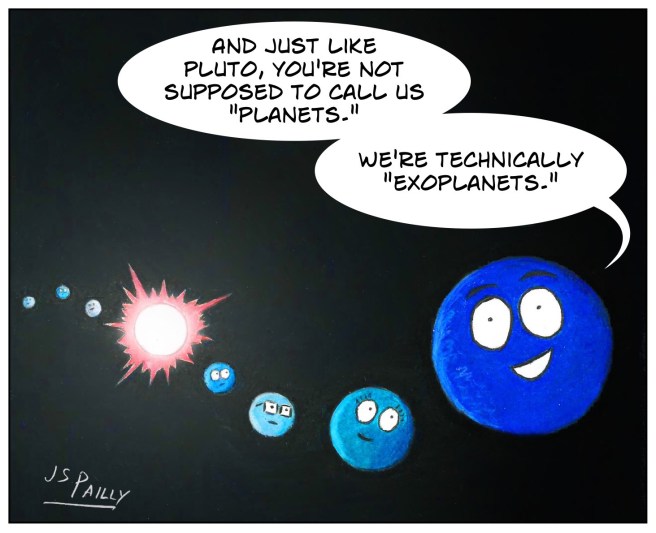
The inward migration of the TRAPPIST-1 planets—sorry, I mean exoplanets—is sort of the opposite of what happened in our own Solar System.  Our gas giants, according to the Nice model, started out closer to the Sun and then migrated away (except for Jupiter, which moved a little closer to the Sun).

That was the real point of that paper I cited last week. This is also the kind of thing that made TRAPPIST-1 so scientifically interesting in the first place: the alignment of those seven exoplanets makes it really easy for us to study orbital dynamics in a multi-planetary system, and to compare and contrast what we learn with what we know about our own Solar System.

The stuff about water and potential alien life… that was just a nice bonus.