Sciency Words: Syzygy

Hello, friends!  Welcome to Sciency Words, a special series here on Planet Pailly where we take a closer look at the definitions and etymologies of scientific terms.  Today on Sciency Words, we’re talking about the word:

SYZYGY

We’ve all seen pictures like this, with all eight planets lined up in a row:

And sometimes, on extra special occasions, the planets really do line up like that, or at least they come very close to it.  When this happens, we call it a grand syzygy.

The word syzygy traces back to ancient Greek.  It originally meant “yoked together,” as in: “The farmer yoked together his oxen before plowing the field.”  According to my trusty dictionary of classical Greek, the word could also mean “pair” or “union.”

Some closely related words in Greek referred to balance, teamwork, sexy times, etc.  And our modern English words synergy and synchronized have similar etymologies.  Basically, what all these words have in common is a sense of people or things coming together, in one manner or another.

For modern astronomers, syzygy means three or more celestial bodies coming together to form a straight line.  The most commonly cited example of this is the alignment of the Sun, Earth, and Moon that occurs during either a new moon or full moon, as observed here on Earth.

But an alignment doesn’t have to be perfectly straight to be called a syzygy, especially when we’re dealing with more than three objects.  According to this article from The New York Times, a syzygy of the Sun, Venus, Earth, Mars, Jupiter, and Saturn occured between March 25 and April 7, 1981.  The Sun and five planets came “within 2 degree of arc from a perfect straight line.”  Apparently that’s close enough.

But while that 1981 syzygy was pretty grand, it was not the grandest of grand syzygies.  The planets Mercury, Uranus, and Neptune were left out.  According to another article from The News York Times, a truly grand syzygy will happen on May 19, 2161, “[…] when eight planets (excluding Pluto) will be found within 69 degrees of each other […].”

So mark your calendars, friends!  You don’t want to miss the grand syzygy of 2161!

P.S.: And if you’re a Star Trek fan, you may recall that 2161 will be an auspicious year for another reason.  That’s the year when the United Federation of Planets will be founded—a political syzygy, one might say, occurring at the same time as an astronomical syzygy.

Dreaming About Pailly Crater

Hello, friends!

So this is kind of a weird time in my life.  A few weeks ago, I handed my manuscript over to my editor.  Now my editor has handed that manuscript back to me.  There’s surprisingly little that needs to be fixed, so I guess I’ll be moving forward with my self-publishing plan soon.

And that’s weird to me.  I’ve been writing for a really long time now.  I’ve come close to being published before, but this time is different.  My writing dreams have never felt so real to me, and yet at the same time nothing about what’s happening feels real to me at all.  I don’t know how to explain it any better than that.

I know a lot of writers fantasize about getting their book on a bestseller list or winning some sort of award.  I honestly don’t care about that.  So long as I make a living writing full time, I’ll be happy.  However, I will confess there is one prestigious honor that I do find myself daydreaming about, from time to time.  Is it premature for me to talk about this?  Yes.  Yes, it is.  Indulge me.

The International Astronomy Union has a longstanding tradition of naming craters on Mercury after artists, writers, and musicians.  To quote from this website, Mercury’s craters are to be named after:

Artists, musicians, painters, and authors who have made outstanding or fundamental contributions to their field and have been recognized as art historically significant figures for more than 50 years.

The most recent Mercury crater naming announcement came in September of 2019.  Among others, poet Maya Angelou and comic book artist Jack Kirby now have craters named in their honor.  Previously, craters have been named after H.P. Lovecraft, J.R.R. Tolkien, and Walt Disney (this is not Disney crater, which seems like a missed opportunity to me).  Click here to see a full list of Mercury’s crater names.

Mercury is the most heavily cratered object in the Solar System, so it seems to me there should be room on the I.A.U.’s list for a Pailly crater.  Maybe someday.  A writer can dream, right?

Next time on Planet Pailly, if you can’t make the planet fit for human life, maybe you should make human life fit for the planet.

Hobbit Holes of Mercury

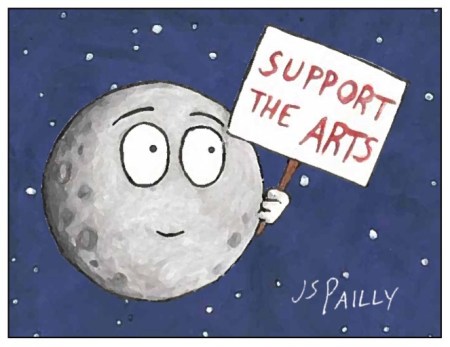
Scientists need artists.  This is especially true for those scientists who study the planet Mercury.  According to a convention established by the International Astronomy Union, craters on Mercury are to be named after famous artists, writers, and musicians. And it just so happens that Mercury is the most heavily cratered object in the entire Solar System.

So yeah… Mercury scientists need artists. Lots and lots of artists.

This brings me to one of my all time favorite facts: there’s a crater on Mercury named in honor of J.R.R. Tolkien. And it’s not just any boring old crater, at least not from the perspective of colonists who might one day be living on the first planet of the Solar System.

The best real estate on Mercury is near the planet’s north pole. Sheets of water ice have been detected in that region, within the permanently shadowed bowls of craters where the sunlight can’t reach them.  We recently learned there are similar ice sheets on the Moon, within craters near the Moon’s south pole.

Whether humans go to Mercury in pursuit of natural resources or for the purposes of scientific research, we’ll want to set up shop somewhere with easy access to water. Prokofiev crater (named after a Russian Soviet-era musician) is the deepest of Mercury’s polar craters, and thus likely the iciest.  But Tolkien crater appears to be pretty icy too.

We’ll also probably want to construct our habitats underground.  Underground habitats would provide us with some protection from solar and cosmic radiation, among other things.  Therefore I have to assume that in the distant future, the residents of Tolkien crater will refer to their underground dwellings as “Hobbit holes.”

Things I Don’t Understand: Mercury’s Wandering Sun

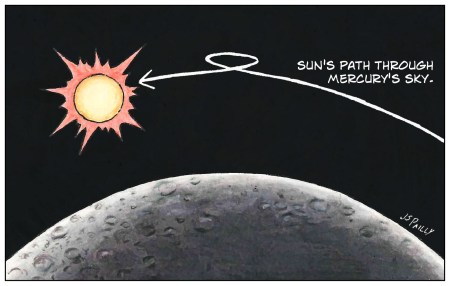
Okay, this is a thing I’ve read about multiple times, but no matter how many times it’s been explained to me I just don’t get it.  Apparently on Mercury, the sun sometimes appears to change directions in the sky.

Let me explain what I mean.  Imagine you’re standing on the surface of Mercury (and are somehow still alive).  You see the sun rise in the east, just as it does on most planets in the Solar System.  And then over the course of a long (very, very long) Mercurian day, you watch the sun slowly (so very, very slowly) travel from east to west.

But at one point, let’s say around midday, the sun appears to stop its east-to-west motion and then, for a short while (about 4 Earth days), it wanders from west to east instead.  Then the sun stops again and continues on its original westerly path.

Why does this happen?  I know it has something to do with the length of Mercury’s solar day versus its sidereal day.  A solar day on Mercury, the time it takes for Mercury to complete a rotation relative to the Sun, is approximately 176 Earth days long. But Mercury’s sidereal day, the time it takes for Mercury to complete a rotation relative to the ecliptic, equals about 59 Earth days.  Also, Mercury’s year is 88 Earth days long, so Mercury’s solar day is roughly twice as long as its year.

Obviously this all means the sun moves very slowly through Mercury’s sky, but why should it briefly stop, turn around, and go the other way?  I just don’t get it. I guess I just can’t conceptualize why this happens.  Maybe if I were better at math, all those numbers would add up for me, and I’d understand what’s going on.

Anyway, does this make sense to anyone else, or are you just as baffled by this as I am?

Update: Looks like I have a lot of really smart readers! It’s still kind of hard for me to conceptualize why this happens, but it’s starting to make a little more sense to me. The first comment from TureNorthBricks definitely cleared up a lot for me.

My First Scientific Paper

As a follow-up to yesterday’s post on how to read a scientific paper, I wanted to share the story of my first attempt to read such a paper myself. I was doing research in preparation for the 2015 Mission to the Solar System, and I’d found a paper titled “Thermal Stability of Volatiles in the North Polar Region of Mercury.”

I was under the impression this paper was sort of a big deal as far as Mercury exploration is concerned, so I felt I ought to read it. Previously I’d only read the abstracts of papers, and occasionally the conclusions. I’d never before tried to read a scientific paper in full.

It didn’t go well. Not at first. The paper was only four pages long, but it felt like forty and may as well have been four hundred. I was particularly confused by the usage of the word volatile, as in volatile chemicals. I thought I knew what that meant. Turned out I was wrong, and it took awhile for me to figure out what volatiles really are.

I must’ve read the paper straight through three or four times before something in my brain clicked. And then…

I got it! I actually got it! NASA had found water (a volatile) on Mercury! I’d already learned about this from another source, but the fact hit me with a new weight. Suddenly I not only knew about Mercury’s water, but I also knew where the water was located (frozen inside dark polar craters), why it hadn’t melted or sublimated away (at the poles, crater rims shield it from sunlight), and how NASA had found it (by bouncing radio waves off the ice sheets).

Maybe this will sound silly, but reading that “Thermal Stability” paper was a life-altering experience for me. I’ll never forget that moment of revelation when all that sciency stuff started making sense. For the first time, Mercury felt like a real place to me. For the first time, I “got” how NASA does what it does.

And most importantly, I learned that even though I’m just a science fiction writer and don’t have any kind of scientific degrees, I can still read and comprehend scientific publications. Which means I can bypass the unreliable science reporting I saw on T.V. or the Internet and go straight to the source for my scientific knowledge.