Sciency Words: Special Region

Today’s post is part of a special series here on Planet Pailly called Sciency Words. Each week, we take a closer look at an interesting science or science-related term to help us expand our scientific vocabularies together. Today’s term is:

SPECIAL REGION

It’s been several months now that I’ve been focusing almost all my research efforts on Mars. During that time, I’ve read a lot about those very special regions of Mars that might be home to alien life, but I didn’t realize until last week that “special region” is, in fact, a technical term.

Not only that, it’s a term whose precise definition has been and continues to be in dispute—exactly the kind of term most worthy of a Sciency Words post!

According to this paper from the journal Astrobiology, a special region is any region on Mars where “terrestrial organisms are likely to replicate” or where there is “a high potential for the existence of extant martian life forms.” By international agreement, NASA and other space agencies are not allowed to risk contaminating these special regions with our Earth germs. Since our current Mars rovers may not be 100% germfree, they’re all banned from exploring those areas.

But where are these regions, exactly? What are their boundary lines? This is where the definition of this term gets murky. We just don’t know enough about Mars to know which regions are special and which are not.

Initially I assumed it would be up to the International Astronomy Union (I.A.U.) to sort this out. They claim to be the sole authority on naming, categorizing, and defining space stuff. Even if you’ve never heard of the I.A.U. before, I can almost guarantee you’ve heard about at least one thing they did.

But in this case, I guess because this is a matter of international law, it’s a different organization that has to define what is or is not a special region. That organization is called COSPAR (Committee On SPAce Research), which is part of the International Council for Science. And COSPAR has been understandably reticent about setting any official definitions or drawing any official boundaries on a map. Like I said, we just don’t know enough about Mars yet.

Instead, COSPAR recommends evaluating potential landing sites on Mars on a case-by-case basis, keeping the latest scientific data in mind, to avoid contaminating any regions that might possibly someday turn out to be special (whenever we figure out what that means). According to this article from NASA, COSPAR reviews and updates the definition of “special region” every two years. Their next formal meeting is scheduled for July of 2018.

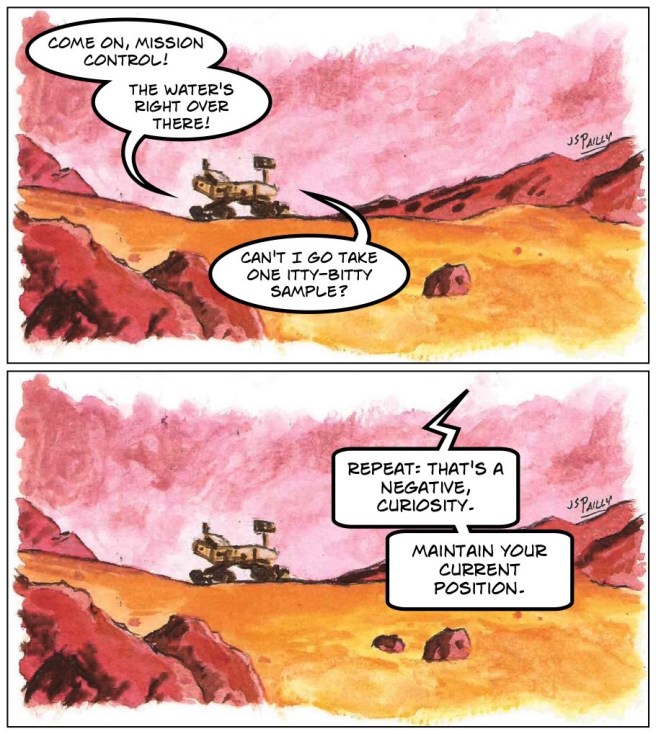
P.S.: Wait a second… who put that sign there? They better have decontaminated it first!

Molecular Monday: Mr. Asteroid’s Organic Delivery Service

A lot of what I write about on this blog, and also a lot of what I hope to do as a science fiction writer, comes from reading actual scientific research. Over the years, I’ve gotten pretty good (I think) at wading through all that scientific jargon. But sometimes I invest my time in reading something and… well, it just doesn’t give me a whole lot to work with.

There’s been a lot of press lately about how asteroids and comets deliver loads and loads of organic material to Mars, and what that may mean for our search for Martian life. I thought this would make an excellent Molecular Monday post (today’s post is part of a biweekly series called Molecular Mondays, blah blah, you know the spiel).

But after reading the actual paper, I can’t help but feel that this research has been overhyped.

Don’t get me wrong! It’s good research, as far as I’m able to judge, without any of the usual red flags I’ve learned to watch out for. But it’s based on a computer simulation, a simulation that depends upon quite a few assumptions about asteroid and comet populations in our Solar System. The authors are upfront and honest about this, and they do a good job explaining why they believe their assumptions are justified. This article from IFL Science calls these assumptions “reasonable assumptions,” and that may be true.

But still… this paper makes a lot of assumptions!

The general idea that asteroids and comets deliver organic material to Mars (and other planets) makes sense to me. The conclusion that we should search impact craters on Mars for organics seems sensible enough. It’s just… I don’t know, maybe I’ve missed something important (it wouldn’t be the first time), but with so many assumptions in play, I can’t take any of the specifics from this paper too seriously.

P.S.: I didn’t really talk about chemistry in this post, which is sort of off brand for Molecular Mondays. So I’ll just remind everyone that the word organic does not mean what you may think it means. You can have organic chemicals and organic chemistry without having living organisms.

Sciency Words: Science Autonomy

Today’s post is part of a special series here on Planet Pailly called Sciency Words. Each week, we take a closer look at an interesting science or science-related term to help us expand our scientific vocabularies together. Today’s term is:

SCIENCE AUTONOMY

The planet Mars now has its own super villain. In 2016, NASA uploaded new software to the Curiosity rover, giving it a program called AEGIS (Automated Exploration for Gathering Increased Science). Curiosity was already equipped with a high powered laser. Thanks to AEGIS, the rover is now free to use it with or without the input of humans back on Earth.

To quote this article from the Planetary Society:

AEGIS is an example of what we call “science autonomy’, where the spacecraft (the rover in this case) can make decisions on its own about scientific measurements and data—choosing which measurements to make, or having made them, which to transmit to Earth. This is distinct from autonomy in navigation, or in managing onboard systems—both of which Curiosity can also do.

Okay, in all seriousness, I think this is a great idea. One of the biggest frustrations about robotic space exploration is all the time wasted transmitting data back and forth across the Solar System. Due to speed-of-light delays, it can take many minutes, or even hours, to tell a rover what to do and then receive confirmation that the rover has done its job.

With regard to Curiosity’s laser, that instrument is used to vaporize Martian rocks. The resulting rock vapor is then spectroscopically analyzed to identify the rock’s chemical composition. Letting Curiosity do that sort of science on its own has, according to that Planetary Scociety article, saved NASA from a lot of wasted time and effort.

Even so, I can’t help but feel like, if we lived in a comic book universe, this science autonomy thing would be a very, very bad idea. Especially when laser are involved.

Mars Rovers Must Rove Responsibly

We’ve sent several robotic space probes to Mars already, and several more will be heading to the Red Planet in the next few years. Mars is already the second most heavily explored planet in the Solar System, after Earth.

But our robots are forbidden by international law from entering regions where Martian water appears to be flowing, or regions where Martian life could hypothetically exist. Why? Because there’s a chance that microorganisms from Earth hitched a ride aboard our space probes, survived the journey to Mars, and might start to grow and reproduce if they’re exposed to Martian water.

Yesterday, we talked about a paper in the journal Astrobiology which argued that the risk of contamination is minimal, and we should let our Mars rovers do their jobs. Go explore, and if there’s Martian life, go find it! Today we’re looking at a response to that paper, also published in Astrobiology, in fact in the same issue of Astrobiology. A response which raises several concerns, such as:

  • In the last few decades, we’re learned that Earthly microorganisms can be far more resilient than we ever imagined. Some of them very well might survive—and thrive—on Mars.
  • We’ve also learned that Mars is far less hostile to life than we previously assumed. Quite a few microbes from Earth might find Mars a rather comfortable place to live.

Taken together, these two points suggest that we have not overestimated the risk of contaminating Mars. In fact, we may have drastically underestimated the risks, and we need to be more careful, not less careful, about where we let our Mars rovers go. Otherwise:

  • We might destroy the very Martian life forms that we’re so desperately hoping to find.
  • We might make Mars’s water undrinkable for future human settlers.
  • We might end up misidentifying a stowaway microbe from Earth as a new form of life native to Mars, and the authors of this response paper argue that even our best gene sequencing technology might not be able to clear up the potential confusion.

Even if our Mars rovers keep their distance from Mars’s potentially-habitable or potentially-inhabited areas, there’s still a lot of valuable science they can do, especially when they’re investigating areas that used to be lakes or rivers, areas that could have supported lots and lots of alien life in the past, even if they’re bone dry and very thoroughly lifeless in the present.

So let’s take things slow. Let’s stick to the original plan (and current international agreements) and continue to explore Mars in a responsible and methodical manner.

Or maybe not. Gosh, I don’t know. After reading these two papers back to back, I really don’t know what to think.

Let a Mars Rover Rove

In the near future, human beings will probably set foot on the planet Mars. Human beings will likely do a lot of other things on Mars too: coughing, sneezing, peeing, pooping… it won’t be long until Mars is thoroughly contaminated with our germs.

We may have contaminated Mars already, at least a teeny bit, with our robotic space probes. You see, these probes may not have been as thoroughly cleaned and sterilized as they were supposed to be before they left Earth. Consequently, our Mars rovers, like the Curiosity rover, are forbidden from entering or even approaching sites where liquid water may be present.

This is to ensure that we don’t endanger any native Martian life that could hypothetically be living in those watery areas. It’s also to ensure that we don’t misidentify Earth germs as native Martian microbes at some point in the future.

But according to this paper published in the journal Astrobiology, we really should lighten up and let our Mars rovers do their jobs. We’ve spent billions on these robots, and we’re not using them to their best. While there is some risk of contamination, it’s only a small risk, or so the authors of the paper claim.

First off, the Martian environment is extremely cold, there’s lots of radiation, and an abundance of harsh, oxidizing chemicals in the soil. In short, Mars can do a better job sterilizing out space probes than we can. The very few Earth germs that might have made it to Mars thus far wouldn’t be able to spread far.

As for misidentifying an Earth germ as a Martian microorganism, the authors of the paper claim this wouldn’t be a problem. At this point, we have a pretty good idea which Earthly bacteria could have hitched a ride to Mars, because we know which bacteria were later found in the clean rooms where our space probes were built. Those bacteria can be easily identified with gene sequencing.

So let’s send the Mars rovers in. Let them do their jobs. Let them study Mars’s recurring slope lineae and other watery features, or any other areas where life could possibly exist. Let’s do this now, while the risk of contamination is still relatively low, because the humans are coming, and they’re bringing a whole lot more germs with them!

Or maybe not! As I’ve said before, these kinds of scientific papers should be understood not as final declarations of fact but as part of an ongoing conversation among scientists. In tomorrow’s post, we’ll talk about the other side of the argument.

Sciency Words: Polygon Terrain

Today’s post is part of a special series here on Planet Pailly called Sciency Words. Each week, we take a closer look at an interesting science or science-related term to help us expand our scientific vocabularies together. Today’s term is:

POLYGON TERRAIN

This phenomenon goes by several different names: polygon terrain, polygon patterned terrain, polygonal patterned ground formations… you get the idea. For the purposes of this blog, I’m making polygon terrain the official way to say it, because that matches up with other terrain-related terms we’ve seen, like chaos terrain or cantaloupe terrain.

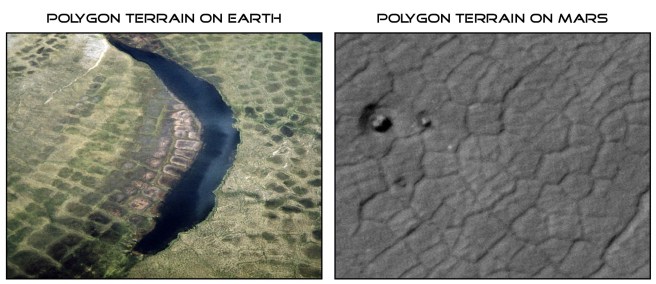
Polygon terrain is a distinctive pattern of either cracks or ridges that draw polygonal shapes across the landscape. On Earth, these polygons tend to appear in arctic climates. They’re caused by the repeated freezing and thawing of underground glaciers.

When the ice thaws, the ground above it can sink down a little. Then when it refreezes, the ground is forced back up. Overtime, the surface starts to break and crack, producing a landscape that looks like this:

Images courtesy of Wikipedia.

Polygon terrain seems to be uncannily common in Mars’s northern hemisphere, in regions such as Utopia Planitia. This suggests two things:

  • There are large glaciers buried beneath the layers of surface dust and surface rock.
  • Those glaciers periodically thaw and refreeze.

Thawing Martian glaciers might or might not produce liquid water. Instead, the ice may sublimate, skipping its liquid phase and turning directly into water vapor. But still, during warmer seasons, it’s possible we might find a trickle of liquid beneath these polygon terrain regions—perhaps even enough to sustain a few extremophile microorganisms.

In the future, human explorers on Mars may take a keen interest in Mars’s polygon terrain. This kind of surface geometrization may not have anything to do with advanced alien civilizations, but it’s still worth a look if you’re searching for simpler forms of alien life. Or at least, it’s a good place to check if your colony is in desperate need of liquid water.

P.S.: For a slightly more detailed (without being unintelligibly technical) discussion of polygon terrain, please check out this post from Planetary Geomorphology Image of the Month.

Dining on Mars, Part 4: Tilapia

The first colonists on Mars will have to be, out of necessity, vegans. Growing plants on Mars will be challenging enough; raising livestock would be utterly impractical. If we must include animal protein in a Martian diet, the only realistic option would be bugs like crickets or mealworms.

However, as a Mars colony grows, a few “luxury foods” might be added to the menu, including heartier sources of protein like seafood. That may not make a lot of sense at first. Mars is a barren, desert planet. How could we bring fish to a place like that?

But research has already done about how fish fare in space. The Japanese Aeropace Exploration Agency (JAXA) built a fish tank aboard the International Space Station.

Building large, underground aquariums on Mars wouldn’t be too difficult, compared to all the other aboveground and belowground structures a Mars colony would need. And if your colony settled in a region like Utopia Planitia, you should have more than enough water to fill your fish tanks (as we’ll see in Friday’s post).

In Robert Zubrin’s book The Case for Mars, he casually mentions that tilapia would be a good choice for Martian fish farming, because they’re herbivores and they could eat a lot of the plant matter that we can’t digest. I’ve found some research that seems to back Zubrin’s suggestion up; however, there’s some concern about whether or not Martian tilapia would be as nutritious as the Earthling kind. A lot will depend on the sorts of plant matter available for us to feed our Mars-born fish.

Personally, I love seafood. Also, I’m a big fan of aquariums, so living on Mars is starting to sound even more appealing to me. And there is still one more food source that I want to tell you about that might (might!) be a viable option for a self-sustaining Mars colony. Stay tuned!

P.S.: And if you want to try the Mars colony diet out yourself, check out Kate Rauner’s blog to get some recipes!

Sciency Words: Canali

Today’s post is part of a special series here on Planet Pailly called Sciency Words. Each week, we take a closer look at an interesting science or science-related term to help us expand our scientific vocabularies together. Today’s term is:

CANALI

In last week’s episode of Sciency Words, we looked at one of the maps of Mars drawn by Italian astronomer Giovanni Schiaparelli, and we talked about how Schiaparelli invented many of the place names we still use for Martian geography today. But Schiaparelli’s work also led to one of the most embarrassing mistakes in the entire history of astronomy, and it all happened because of a word: canali.

Looking through his telescope, Schiaparelli saw (or thought he saw) little lines crisscrossing the Martian surface, and he labeled these lines “canali,” which is Italian for channel, but the word was mistranslated into English as “canals.”

It seems Schiaparelli believed these “channels on Mars” were a natural phenomenon, but that’s not the impression English-speaking astronomers got when they started reading about “canals on Mars.” And some astronomers, most notably American astronomer Percival Lowell, were so excited by the idea of Martian canals that they turned their own telescopes on Mars and saw (or thought they saw) exactly what they wanted to see.

This would be the same kind of technological geometrization that Carl Sagan would later write about in reference to Earth, but on a much larger scale. Except it’s not true. Mars is not covered in canals. Even before NASA started sending space probes to Mars, researchers found that the whole thing was probably a trick of the eye. To quote from a paper from 1903:

Our conclusion from the entire experiment is that the canals of Mars may in some cases be, as Mr. Green suggested, the boundaries of tones or shadings, but that in the majority of cases they are simply the integration by the eye of minute details too small to be separately and distinctly defined.

However, in more recent times our space probes have discovered other oddly geometric patterns on Mars, the kinds of patterns that may reveal a very different kind of Martian secret. But I’ll save that for next week!

Martian Snowflakes

Thus far in my on-again/off-again mission to Mars, I’ve learned that while ancient Mars may have been a wet and watery place, that does not necessarily mean it was anything like Earth. The evidence I’ve seen from Mars’s Tharsis region and the surrounding area suggests that Mars has had a rather violent history with water. But I’ve heard that other regions—most notably the Utopia Planitia region—may have a different story to tell about Mars’s watery past… and its watery present.

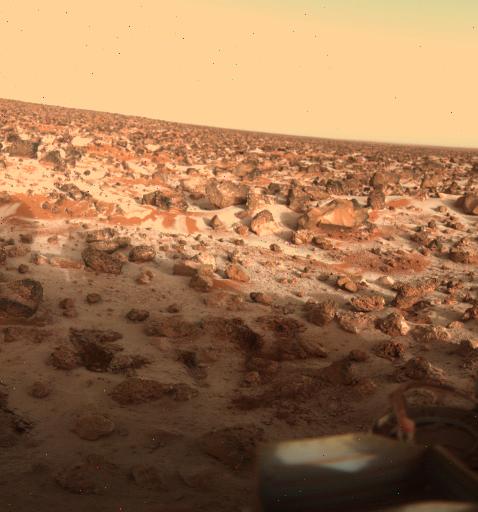
I’ve only just started learning about Utopia Planitia, and right away I was in for a surprise. On September 13, 1977, the Viking-2 Lander took a photograph of what appeared to be a light dusting of snow on the ground. Then on May 18, 1979, approximately one Martian year later, it happened again. This is the 1979 photo:

We can’t be 100% sure what happened, specifically. Did it really snow at the Viking-2 landing site, or does it just look like snow? Could it instead be a layer of frost, like how back on Earth morning dew turns to frost during the winter? Is this snow/frost made of frozen H2O, frozen CO2, or a mixture of both?

Personally I’d like to believe that it snowed, and that it was genuine H2O snow. I love snow. I love how quiet and pretty and restful snow is, and somehow the idea of snow drifting even more slowly to the ground (because of Mars’s reduced gravity) appeals to me. I wish I’d started studying something other than the Tharsis Bulge and Valles Marineris canyon earlier, because clearly I’ve been missing out!

P.S.: I think there should be something like the Lunar X-Prize for whoever builds the first snowman on Mars.

Sciency Words: Utopia Planitia

Today’s post is part of a special series here on Planet Pailly called Sciency Words. Each week, we take a closer look at an interesting science or science-related term to help us expand our scientific vocabularies together. Today’s term is:

UTOPIA PLANITIA

As a lifelong Star Trek fanatic, I’ve known the name Utopia Planitia for almost as far back as I can remember. It is (or rather, will be) the site of a prominent human colony on Mars, and by the 24th Century it will be the location of one of Starfleet’s most important shipyards. The U.S.S. Enterprise-D, the U.S.S. Defiant, and the U.S.S. Voyager will all be built there. But where did the name Utopia Planitia come from?

In the 1870’s and 1880’s, Italian astronomer Giovanni Schiaparelli drew what were, at the time, the most accurate and detailed maps of Mars ever produced. But Schiaparelli had a problem. He had trouble matching the pre-established names from older Mars maps to his new map. The old maps were, to put it bluntly, wrong. The new map looked so different that Schiaparelli had to throw out all the old geographic names (goodbye, Kepler-land and Cassini-land!) and make up new ones.

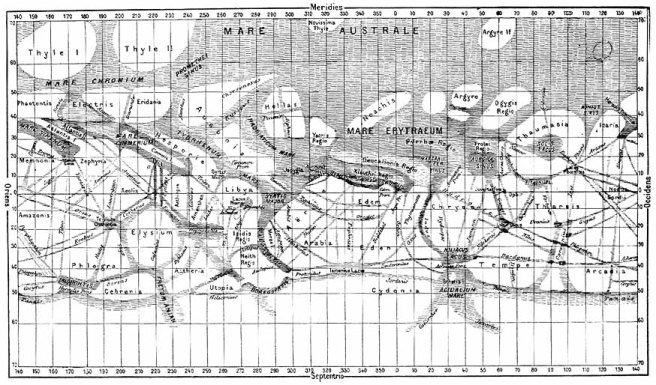
For inspiration, Schiaparelli turned to the Bible, Greek and Roman mythology, and other classical sources. That included several names for “paradise,” like Eden, Arcadia, and Utopia. Clicking the image below will take you to a NASA history page, where you can take a closer look at one of Schiaparelli’s maps (I believe it’s his original map from 1877, but I’m not 100% sure). Bear in mind that this map was drawn based on what Schiaparelli saw through his telescope, and it was intended for use by other telescope observers of his time, so north and south are flipped around.

At about 260° longitude and 50° north latitude, you’ll find a small, triangular shape marked Utopia.

In Greek, the literal meaning of Utopia is “no place,” but the word has come to mean paradise or fantasy-land… a place so idealistically perfect that “no place” like it could exist in reality. And so Utopia Planitia means “the plains of paradise” or “the plains of fantasy.” Thematically speaking, I can’t think of a better place for all those wonderful ships from Star Trek—and the idealistic vision of the future those ships are supposed to represent—to be constructed.