Sciency Words: Heartbeat Tone

Hello, friends!  Welcome back to Sciency Words, a special series here on Planet Pailly where we talk about those weird and wonderful terms scientists use.  Today’s Sciency Word is:

HEARTBEAT TONE

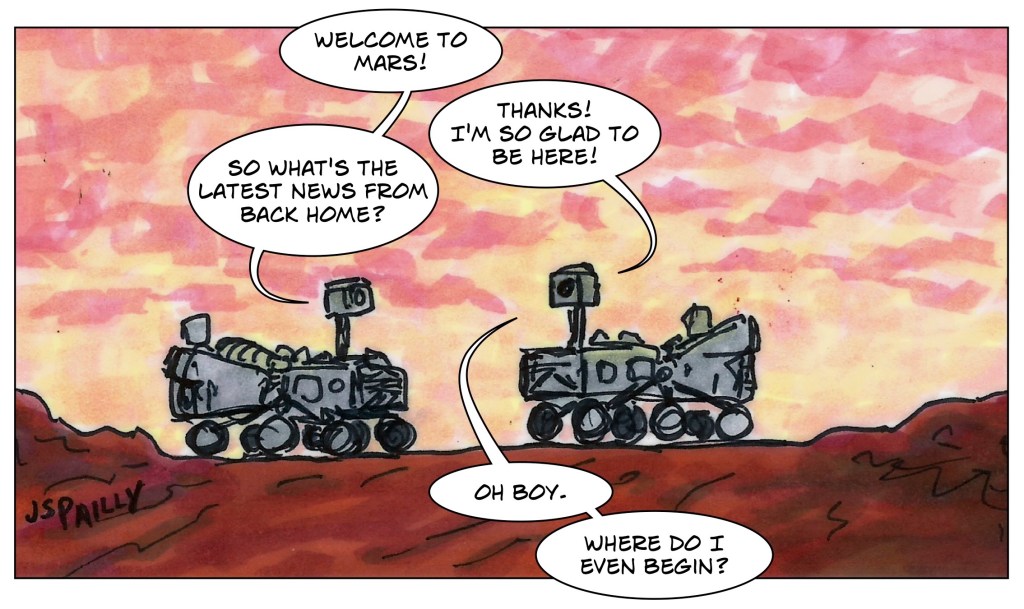
Last week, I watched NASA’s live coverage of the Perseverance rover landing on Mars.  Naturally, I had a notepad ready, and I picked up quite a few new scientific terms.  My absolute favorite—the one that brought the biggest smile to my face—was “heartbeat tone.”  I love the idea that Perseverance (a.k.a. Percy, the Mars Rover) has a heartbeat.

As this article from Planetary News describes it, Percy’s heartbeat tone is “similar to a telephone dial tone.”  It’s an ongoing signal just telling us that everything’s okay.  Nothing’s gone wrong, and everything’s still working the way it’s supposed to.

Of course, other NASA spacecraft use heartbeat tones as well.  According to two separate articles from Popular Mechanics, the Curiosity rover on Mars and the Juno space probe orbiting Jupiter also send heartbeat tones back to Earth.  And that article about Juno offers us a little bit of detail about what Juno’s heartbeat actually sounds like: a series of ten-second-long beeps, sort of like very long dashes in Morse code.

Based on my research, it seems like the earliest NASA spacecraft to use heartbeat tones (or rather, the earliest spacecraft to have this heartbeat terminology applied to it) was the New Horizons mission to Pluto, which launched in 2005.  As this article from Spaceflight 101 explains it, New Horizons’ onboard computers monitor for “heartbeat pulses” that are supposed to occur once per second.  If these pulses stop for three minutes or more, backup systems kick in, take over control of the spacecraft, and send an emergency message back to Earth.

So, I could be wrong about this, but I think this “heartbeat pulse” or “heartbeat tone” terminology started with New Horizons.  To be clear: I’m sure spacecraft were sending “all systems normal” signals back to Earth long before the New Horizons mission.  I just think the idea of using “heartbeat” as a conceptual metaphor started with New Horizons.  But again, I could be wrong about that, and if anyone has an example of the term being used prior to New Horizons, I would love to hear about it in the comments below!

P.S.: I recently wrote a post about whether or not planets have genders.  With that in mind, I was amused to note in NASA’s live coverage that everyone kept referring to Perseverance using she/her pronouns.  However, the rover has stated a preference for they/them on Twitter.  So going forward, I will respect the rover’s preferred pronouns.

Sciency Words: Preservation Bias

Hello, friends!  Welcome back to Sciency Words, a special series here on Planet Pailly where we take a closer look at interesting and new scientific terms in order to expand our scientific vocabularies together!  Today’s Sciency Word is:

PRESERVATION BIAS

So is there life on Mars?  Well, there could be.  It’s not totally impossible.  But as I’ve said before on this blog, I think the odds of us finding living things on Mars are pretty low.  The odds of us finding dead things on Mars, however… I think those odds are much better!

Or at least I did think that until I read this paper, entitled “A Field Guide to Finding Fossils on Mars.”  That paper introduced me to the concept of “preservation potential,” and subsequent research led me to learn about something paleontologists call “preservation bias.”

Basically, turning into a fossil isn’t easy.  A lot of factors have to come together just right in order for a dead organism to become preserved in the fossil record.  As that Martian fossil field guide explains:

On Earth, most organisms fail to fossilize because their remains are physically destroyed, chemically oxidized or dissolved, digested by their own enzymes, or consumed by other organisms.  Fossilization only occurs when processes of preservation outpace degradation.

Preservation bias refers to the fact that certain organisms—or certain parts of certain organisms—stand a better chance of fossilizing than others.  Preservation bias can also refer to the fact that some environments (rivers and lakes, for example) do a better job creating and preserving fossils than others (for example, deserts).

A lot of factors can get involved in this, but as a quick and easy example, think of the dinosaurs.  Dinosaur bones fossilize easily enough.  Other parts of the dinosaur… not so much.  That, my friends, is preservation bias at work, favoring hard tissue, like bone, over soft tissue, like muscle or fat.

Now imagine what would have happened if dinosaurs somehow evolved without bones (that’s a weird concept, I know, but just bear with me a moment).  How much would we know about those boneless dinosaurs today?  Would we know about them at all?  Those hypothetical boneless dinosaurs could have roamed the earth for billions of years and left hardly a trace of evidence for us modern humans to find!

Which brings us back to Mars.  There was a time, very long ago, when Mars was a much warmer and wetter planet than he is today.  It’s possible—no, I’d say it’s probable!—that life of some kind developed on ancient Mars, just as it did on ancient Earth.  But would that ancient Martian life have left us any fossils to find?  Maybe.  Maybe not.  It depends on the various factors involved in preservation bias.

P.S.: Boneless dinosaurs are delicious.

What Color are All the Planets?

Hello, friends!

So as you know, Earth is “the Blue Planet” and Mars is “the Red Planet.”  By my math, that leaves us with six other planets in our Solar System that don’t have color-related nicknames.  Today, I’d like to try and fix that.

Jupiter was the toughest.  He’s actually lots of different colors: red, grey, white, orange… and then the Juno mission recently showed us that Jupiter’s polar regions are blue!  Of course Jupiter is most famous for being red in that one specific spot, but even the Great Red Spot changes colors from time to time, fading from red to pink to white before turning red again.

Anyway, those are my picks for the color-related nicknames for all the planets.  Do you agree with my picks?  Disagree?  Let me know in the comments below!

Venus Has Phosphine Fever

Hello, friends!

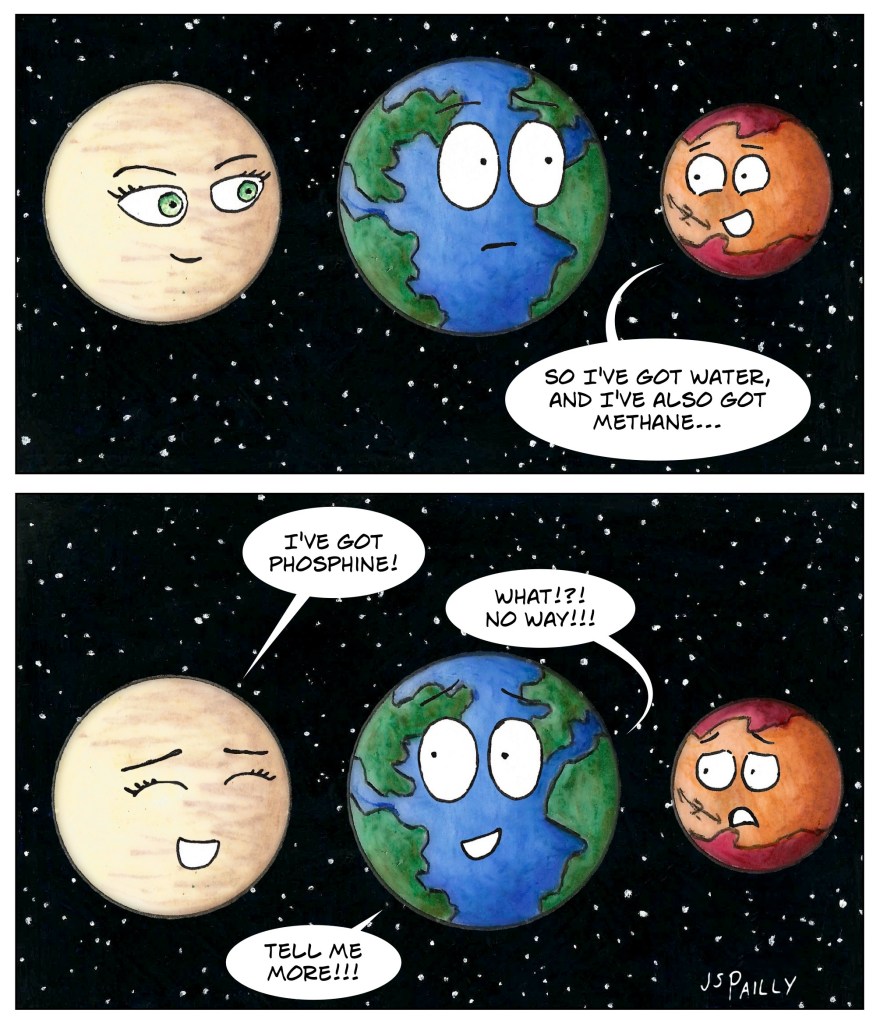
Over the last decade or so, Mars has been trying really hard to convince us that he can (and does) support life.  We’ve seen evidence of liquid water on the Martian surface, and traces of methane have been detected in the Martian atmosphere.  These things are highly suggestive, but none of that proves Martian life exists.

It would be nice if we knew of a chemical that clearly and unambiguously proved that a planet has life, wouldn’t it?  According to this paper published in Nature Astronomy, phosphine (chemical formula PH3) might be the clear and unambiguous biosignature we need.  Here on Earth, phosphine gas is a waste product produced by certain species of anaerobic bacteria.  It’s also produced by humans in our factories.  Either way, the presence of phosphine in Earth’s atmosphere is strong evidence that there’s life on Earth.

And according to that same paper from Nature Astronomy, astronomers have now detected phosphine on another planet.  No, it wasn’t Mars.

Okay, we humans do know of non-biological ways to make phosphine, but they’d require Venus to be a very, very different planet than she currently is.  For example, Venus would need to have a hydrogen-rich atmosphere, or Venus would have to be bombarded constantly with phosphorus-rich asteroids, or the Venusian surface would have to be covered with active volcanoes (more specifically, Venus would need at least 200 times more volcanic activity than Earth).

None of that appears to be true for Venus, so we’re left with two possibilities:

  • There is life on Venus.
  • There’s something we humans don’t know about phosphine, in which case phosphine is not the clear and unambiguous biosignature we hoped it was.

In either event, Venus is about to teach us something.  Maybe it’s a biology lesson.  That would be awesome!  Or maybe it’s a chemistry lesson.  Personally, I’m expecting it to be a chemistry lesson.  There must be some other way to make phosphine that we humans never thought of.

P.S.: Now I’m sure a lot of you are thinking: “Wait a minute, don’t Jupiter and Saturn have phosphine in their atmospheres too?”  You’re right.  They do, and we’ll talk about that in Wednesday’s post.

Sciency Words: Perseverance

Hello, friends!  Welcome back to Sciency Words, an ongoing series here on Planet Pailly where we talk about science or science-related terms.  Today on Sciency Words, we’re talking about:

PERSEVERANCE

Mars rovers are among the most advanced pieces of technology we humans have ever produced.  And by a longstanding tradition dating back to the Sojourner rover in 1997, the official names for NASA’s Mars rovers are chosen by school children.

The Perseverance rover, currently on route to Mars, was named by 7th grader Alex Mather.  He won an essay contest.  Here’s a video of Mather reading his essay, followed by a quick Q and A session with some NASA officials.

You know, after listening to Mather’s essay, I have to agree.  Perseverance is the right name for our newest Mars rover.  It’s even more right of a name now than it was back in March, when the name was announced.

Things are scary here on Earth.  So many people are suffering.  So many people are struggling.  So many lives are being needlessly lost.  But I do believe, as Mather says in his essay, that perseverance is our most important quality as a species.  In the end, humanity will persevere.

Sciency Words: Syzygy

Hello, friends!  Welcome to Sciency Words, a special series here on Planet Pailly where we take a closer look at the definitions and etymologies of scientific terms.  Today on Sciency Words, we’re talking about the word:

SYZYGY

We’ve all seen pictures like this, with all eight planets lined up in a row:

And sometimes, on extra special occasions, the planets really do line up like that, or at least they come very close to it.  When this happens, we call it a grand syzygy.

The word syzygy traces back to ancient Greek.  It originally meant “yoked together,” as in: “The farmer yoked together his oxen before plowing the field.”  According to my trusty dictionary of classical Greek, the word could also mean “pair” or “union.”

Some closely related words in Greek referred to balance, teamwork, sexy times, etc.  And our modern English words synergy and synchronized have similar etymologies.  Basically, what all these words have in common is a sense of people or things coming together, in one manner or another.

For modern astronomers, syzygy means three or more celestial bodies coming together to form a straight line.  The most commonly cited example of this is the alignment of the Sun, Earth, and Moon that occurs during either a new moon or full moon, as observed here on Earth.

But an alignment doesn’t have to be perfectly straight to be called a syzygy, especially when we’re dealing with more than three objects.  According to this article from The New York Times, a syzygy of the Sun, Venus, Earth, Mars, Jupiter, and Saturn occured between March 25 and April 7, 1981.  The Sun and five planets came “within 2 degree of arc from a perfect straight line.”  Apparently that’s close enough.

But while that 1981 syzygy was pretty grand, it was not the grandest of grand syzygies.  The planets Mercury, Uranus, and Neptune were left out.  According to another article from The News York Times, a truly grand syzygy will happen on May 19, 2161, “[…] when eight planets (excluding Pluto) will be found within 69 degrees of each other […].”

So mark your calendars, friends!  You don’t want to miss the grand syzygy of 2161!

P.S.: And if you’re a Star Trek fan, you may recall that 2161 will be an auspicious year for another reason.  That’s the year when the United Federation of Planets will be founded—a political syzygy, one might say, occurring at the same time as an astronomical syzygy.

Orbiting the Blogosphere: Aliens, NASA Missions, and Flat Earthers

Hello, friends!

Today, I thought we’d take a quick look around the blogosphere and see what other space/science enthusiasts have been writing about.

First up, why is science fiction so obsessed with alien life?  Steven Lyle Jordan explores that question in an article for Medium.  Click here to check out that article, or click here to visit Steven’s blog.

Next, NASA has announced the finalists for the next Discovery-class mission, and one of those finalists involves a return to Neptune (frickin’ finally, am I right?).  Specifically, this would be a mission to explore Triton, Neptune’s largest moon.  Jay Cole from Digestible Space can tell you more.  Click here!

Meanwhile, NASA’s InSight mission has been gathering a surprising amount of data about earthquakes on Mars (a.k.a. marsquakes).  Maybe Mars isn’t as geologically dead as we thought?  Blaine Henry from Gimme Space can tell you more.  Click here for that!

And lastly, but not leastly, Fran from My Hubble Abode pays tribute to a prominent Flat Earther who recently passed away.  Fran has done many great posts debunking Flat Earth nonsense and other conspiracy theories.  But still, everyone deserves some compassion and respect.  Fran has set a wonderful example of how to disagree with someone without being disrespectful.  Click here.

That’s all for now.  If you read and enjoyed any of these posts, please be sure to let the author know with a comment.  It’s important that we all keep sharing and spreading our love for space and for science!

Next time on Planet Pailly: this might sound like an odd question, but which way is time going?

Sciency Words: Colony

Hello, friends!  Welcome to another episode of Sciency Words.  Normally on Sciency Words, we talk about those strange words scientists use, but today we’re going to talk about a word scientists—or at least some scientists—would prefer to stop using.  And that word is:

COLONY

Mars is so eager for humans to come visit and maybe even stay permanently.  And plenty of humans are eager to do just that!  We’ll bring life to Mars.  Not only that, we’ll bring civilization and culture.  One might say it is humanity’s destiny to colonize Mars.

But is this language of “colonization” and “destiny” too evocative of European imperialism?  Some think so, and they would ask that we stop using such colonialist language when we talk about space exploration.

Now I want to be clear about where I’m coming from on this: I try my best to call people by the names and terms they prefer to be called, and if I find out that the language I use offends somebody, I’ll do may best to change.  Some would accuse me of being too P.C., but I think it’s just good manners.

And I have found that if you make an effort to be respectful and accommodating to others, others will make an effort to be respectful and accommodating to you, and in general they’ll be more willing to forgive you if/when you do slip up and say something unintentionally hurtful.

So a few years back, when I came across this article from National Geographic, I started reading it with an open mind and a willingness to change.  But by the end of the article, even I felt like this was an example of political correctness run amok.  The word “colony” is offensive.  So are the words “settlement” and “frontier.”  Okay.  What words should I use instead?  Even that National Geographic article seems to concede at one point that we don’t have many workable alternatives to these terms.

But this concern does seem to be coming up more and more.  Plenty of people in the scientific community are shying away from words like colony and colonization.  Bill Nye (the Science Guy) says he avoids the word colony, and this official glossary of SETI terminology warns that “settle” and “colonize” may have certain negative connotations for some people.

So at this point, I’m not sure what to think.  What about you?  Do you think this is much ado about nothing, or should we really start looking for alternatives to words like “colony” or “settlement” in our space exploration vocabularies?

Next time on Planet Pailly… I actually don’t have anything planned yet for my next blog post.  We’ll probably just talk about more space stuff.

Wait, What Do You Mean There’s No “Life” on Mars?

Hello, friends!

The other day, someone wanted to pick a fight with me.  This person said to me in a forceful, almost rude tone, that there is absolutely no chance we will ever discover life on Mars.  If you know me at all, you must surely know: them’s fightin’ words!

Except before this conversation could escalate into a full blown argument, it became apparent (to me, at least) that we were not actually talking about the same thing.  You see when I talk about life on Mars, I mean life of any kind, including microorganisms—especially microorganisms.  This other person was using the word “life” to mean, specifically and exclusively, intelligent life.

No, I do not expect we’ll find intelligent life on Mars.  There are no canals, no cities—none of that stuff Percival Lowell once imagined he saw in his telescope.  Nor do I expect to find non-intelligent animals or any kind of plant life.

The best we can hope for is that there might be Martian microorganisms hiding under a glacier, subsisting off a trickle of meltwater.  And to be honest, I’m not overly optimistic about finding even that much life on Mars.  But to say it is absolutely impossible?  No, I cannot agree with that.

And after explaining what I mean when I talk about life on Mars and what my expectations actually are, this person conceded (grudgingly, perhaps) that I might have a point.  Thus what could have been a bitter and fruitless argument turned into an opportunity to educate someone about the science of astrobiology.  Why?  Because I asked the question “Wait, what do you mean by life?”

Language is not as precise a tool as we often imagine.  People sometimes use the same words to mean very different things, leading to misunderstandings, hurt feelings, and unproductive arguments.  I think a lot of those arguments, both big and small, could be avoided if more people would stop and ask: “Wait, what do you mean by (fill in the blank)?”

Next time on Planet Pailly, am I too judgmental?  We’ll find out in this month’s posting of the Insecure Writer’s Support Group.

Sciency Words: Facies

Sciency Words: (proper noun) a special series here on Planet Pailly focusing on the definitions and etymologies of science or science-related terms.  Today’s Sciency Word is:

FACIES

So I’m currently reading a paper entitled “A Field Guide to Finding Fossils on Mars.”  Basically, if you’re hoping to dig up some fossils on Mars, you need to know where to look.  This paper is all about which “facies” are the most likely to have well preserved Martian organisms inside them.

I have to admit I’m having a tough time with the paper.  My first question, and perhaps your first question as well: what the heck is a facies?

The word facies comes straight from Latin, where it meant (believe it or not) face.  It could also mean facial expression or the generalized appearance of a thing.  According to this article from the Encyclopedia Britannica, Danish scientist Nicholas Steno was the first to use facies as a geology term in 1669, but it was Swiss geologist Amanz Gressly who reintroduced the term in 1838, leading to its modern usage.

Gressly was conducting geological research in the Jura Mountains, which lie along the border between France and Switzerland.  It was already known that there were different layers of rock stacked on top of each other.  We call these strata, and it’s now widely recognized that different strata correspond to different time periods in Earth’s past.

But Gressly noticed that, in addition to the strata stacked vertically on top of each other, there were also different “stratigraphic units” arranged horizontally beside each other—the facies, as Gressly decided to call them.  Gressly is quoted in this book as having written:

I think that the petrographic or paleontological changes of a stratigraphic unit in the horizontal are caused by the changes in environment and other circumstances, which still so powerfully influence today the different genera and species which inhabit the ocean and the seas.

In other words, if you find different facies within the same strata, then you’re looking at different environments or ecosystems that existed at the same time, side by side: a lakebed next to a forest, for example.

Or at least that’s what Gressly originally intended the word facies to mean.  But according to that same Encyclopedia Brittanica article, the term has since been generalized “[…] to encompass other types of variation that may be encountered as one moves laterally (e.g., along outcroppings of rock strata exposed in stream valleys or mountain ridges) in a given rock succession.”

So if you’re going fossil hunting on Mars, you want to look for rocks formations dating back to Mars’s Noachian Period—that’s when Mars had lakes and rivers and oceans of liquid water on its surface.  Rock formations from the very early Hesperian Period would also be good.  There was still some liquid water sloshing around at that time.

But within Noachian or Hesperian-aged strata, which facies should you look for?  Well, I’ll have to get back to you on that one.  As I said, I’m having a tough time with this paper, but I am determined to get through it!

P.S.: Bonus Sciency Word!  Those same Jura Mountains where Amanz Gressly did his geological research also gave us the name for Earth’s Jurassic Period.