Alien Eyes on Earth, Part 2

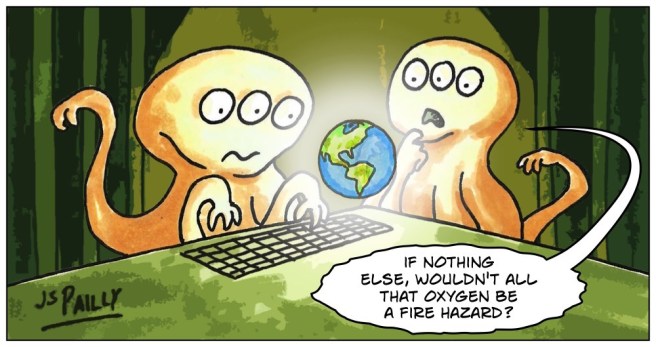
If an alien spaceship were passing by, there are several things the aliens would notice about Earth, even from a distance. Water, for one thing. And not just any old water, but water in solid, liquid, and gaseous phases. And if that weren’t enough to grab the aliens’ attention, a spectrographic analysis of the atmosphere would reveal another big surprise: oxygen. Alarmingly high quantities of oxygen.

We humans are used to thinking of oxygen as a good thing, something beneficial to life. From an alien perspective, that may not be so. Imagine if I told you about a planet with a 20% chlorine atmosphere. Would you want to go there? Probably not. Chlorine is a highly reactive, extremely toxic chemical. It’s an oxidizer. One of the strongest oxidizers on the periodic table.

But as you could probably guess from the name, oxygen is also a really strong oxidizer—almost as strong as chlorine. We humans have evolved in an oxygen-rich environment. We’re used to it, and we’ve adapted to it so well that oxygen has become a benefit to us rather than a liability.

To extraterrestrials, however, a 20% oxygen atmosphere could be as frightening as a 20% chlorine atmosphere would be to us.
So where does all that oxygen come from? The aliens already know about Earth’s water, so they might speculate about water molecules being broken apart by UV radiation from the Sun. This process, known as photolysis, would turn water (H2O) into atomic hydrogen and atomic oxygen, which could then recombine to make molecular hydrogen (H2) and molecular oxygen (O2). Light-weight hydrogen molecules would then escape to space and be swept off by the solar wind, leaving the heavier oxygen molecules behind.

That might account for some of Earth’s oxygen, but Earth has a lot of oxygen. A lot more than can be explained by photolysis alone. So how can there be so much oxygen? What keeps all that highly reactive oxygen from reacting itself away… unless something is constantly replenishing Earth’s oxygen supply?

These aliens observing our planet are good scientists, so they won’t jump to conclusions too quickly. It’s possible, the aliens might say to each other, that all this oxygen is being generated by biological activity. But they can’t know that for sure. Not yet.

Tomorrow on Sciency Words, we’ll look at a scientific term that you have almost certainly heard of before, but that the aliens maybe haven’t.

* * *

Today’s post was inspired by a 1993 paper by Carl Sagan and others. Sagan and his colleagues wanted to know which of Earth’s features can be observed by a passing spacecraft and, perhaps more interestingly, which features cannot.

Alien Eyes on Earth, Part 1

Aliens are naturally curious about Earth, once they notice it’s there. Earth is covered in water. That by itself isn’t so unusual, but even from a great distance it’s obvious there’s something special about Earth’s water.

Hydrogen and oxygen are the #1 and #3 most common elements in the universe, respectively; therefore, it shouldn’t surprise anyone that H2O, the simplest hydrogen/oxygen compound, is abundant throughout the cosmos.

In a gaseous form, water is often present in the atmospheres of gas giants. Solid water can be found on many asteroids and comets, as well as on icy worlds like Pluto, Titan, or Europa. Liquid water sometimes exists beneath the surfaces of these icy worlds, and it’s sometimes found on rocky worlds like Mars, typically with salt or other impurities mixed in to help lower its freezing point.

But any passing spaceship observing Earth would notice evidence not just of water, not just of liquid water, but clear evidence of water in all three phases.

  • Gaseous water: the characteristic absorption lines of water vapor can be detected in a spectrographic analysis of Earth’s atmosphere.
  • Solid water: highly reflective polar regions indicate the presence of ice.
  • Liquid water: and then there are specular reflections—glints of sunlight reflecting off very smooth surfaces, surfaces so smooth that they almost certainly must be liquid.

It would be one thing to have liquid water sitting stagnant on the planet’s surface, but Earth’s water appears (even from a distance) to be cycling through multiple phase transitions. Passing aliens might not know what that means, but it’s certainly strange enough to make them curious about Earth. Perhaps curious enough to come take a closer look.

* * *

Today’s post was inspired by a 1993 paper by Carl Sagan and others. Sagan and his colleagues wanted to know which of Earth’s features can be observed by a passing spacecraft and, perhaps more interestingly, which features cannot.

Sciency Words: Planet (An A to Z Challenge Post)

Today’s post is a special A to Z Challenge edition of Sciency Words, an ongoing series here on Planet Pailly where we take a look at some interesting science or science related term so we can all expand our scientific vocabularies together. In today’s post, P is for:

PLANET

In 2006, the International Astronomy Union approved a new, official definition of planet, and Pluto didn’t make the cut. Word has it Pluto took the news well.

The I.A.U.’s concern at the time was that more and more small, Pluto-like objects were being discovered, making Pluto seem less like the ninth planet and more like the first of some new class of thing.

To be fair, the I.A.U. did try to come up with a planet definition that would include Pluto while excluding the dozens or perhaps hundreds of other objects potentially out there. But it just didn’t work out.

So to meet the official, I.A.U. sanctioned definition, an astronomical body must meet three requirements:

  • It must orbit the Sun.
  • It must be spherical, due to the pull of its own gravity.
  • It must have cleared its orbital path of debris (this is the part of the planet test that Pluto failed).

Of course, if a definition can be changed once, it can be changed again. Recently, a group of six NASA scientists—specifically, six scientists from NASA’s New Horizons mission to Pluto—put forward a new proposal, which reads:

  • A planet is a sub-stellar mass body that has never undergone nuclear fusion and that has sufficient self-gravitation to assume a spheroidal shape adequately described by a triaxial ellipsoid regardless of its orbital parameters.

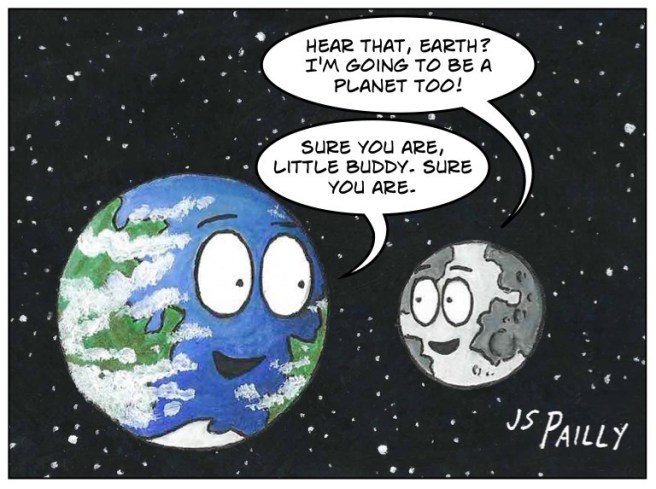
In other words, if it’s round, and it’s not a star or wasn’t a star at some point in the past, then it’s a planet. Under this new definition, Pluto’s back in the planet club! And so is the Moon, weirdly enough, along with many other moons elsewhere in the Solar System. In fact, the new definition would reclassify over one hundred Solar System objects as planets—possibly more than that.

The next I.A.U. general assembly meeting will be held in August, 2018. If they’re going to change the definition of planet again, that’s when they’ll do it. But I very much doubt it’ll happen.

Even though this is probably a lost cause, I want to say something in defense of the New Horizons team’s proposal. The strongest objection seems to be that moons should not be planets. I get that, but in my mind any world that I can picture myself standing on or walking on… I don’t know, that just feels planet-y to me.

I frequently catch myself calling Titan and Europa planets, even though they’re moons. Same for Pluto, Eris, Ceres, and all the other objects currently in the dwarf planet category. And I can’t help myself, but I keep calling Endor from Star Wars a planet, even though it’s specifically referred to multiple times in dialogue as a “forest moon.” All of these places—even fictional moons like Endor—feel planet-y to me.

And yes, even the Moon—the most quintessential moon of them all—has a certain planet-esque quality to it when I imagine myself living there, walking around, going about my daily business. I could get used to the Moon being a planet.

Next time on Sciency Words: A to Z, we’ll shrink from planet-scale to the scale of subatomic particles, and we’ll find out what’s so quantum about quantum mechanics.

Sciency Words: Earth (An A to Z Challenge Post)

Today’s post is a special A to Z Challenge edition of Sciency Words, an ongoing series here on Planet Pailly where we take a look at some interesting science or science related term so we can all expand our scientific vocabularies together. In today’s post, E is for:

EARTH

What planet do you live on? What is its name? Officially?

If you’re a regular reader of science fiction, you may have seen your home planet referred to by several “official” names: Terra, Gaia, Telluria, or perhaps Sol III.

But in real life, the International Astronomy Union (I.A.U.) is the only organization that gets to decide what planets and other objects in space are officially named. We’ll be hearing a lot about the I.A.U. as this Sciency Words: A to Z challenge continues.

And according to the I.A.U., our planet is officially and unambiguously named Earth. Except when it’s not. The I.A.U. makes the concession that Earth’s name is different in different languages, though they do insist that it should always be treated as a proper noun.

That may seem like common sense. It would be extremely culturally insensitive to force the English name for our planet on every other culture in the world. But in fact the I.A.U. seems to be making a special exception for Earth (and also for the Sun, the Moon, and the Solar System) by allowing other languages to use other names.

For example, they want you to call Mars Mars regardless of what language you speak, at least for the purposes of scientific discourse. Saturn should always be called Saturn, and Pluto should always be called Pluto—and don’t you dare call Pluto a planet!—according to the I.A.U.

As I said, we’ll be hearing a lot about the I.A.U. as the month progresses.

Next time on Sciency Words: A to Z Challenge, we’ll leave Earth (or whatever it’s called) behind and visit a frostier region of the Solar System.

Sciency Words: Earth Similarity Index

Sciency Words BIO copy

Today’s post is part of a special series here on Planet Pailly called Sciency Words. Each week, we take a closer look at an interesting science or science-related term to help us expand our scientific vocabularies together. Today’s term is:

EARTH SIMILARITY INDEX

As I’m sure you’ve heard by now, astronomers have discovered seven planets orbiting a nearby star called TRAPPIST-1. Even more exciting, most or all of these new worlds are being described as Earth-like planets. But what does that actually mean?

You’d be surprised by how many “Earth-like” planets/moons we have right here in our own Solar System.

Ag16 Earth-like Worlds
From left to right: Venus, Earth, Mars, and Titan (Saturn’s largest moon).

Earth-like is a rather vaguely defined term. So in 2011, a paper published in the journal Astrobiology attempted to establish an official mathematical system for calculating just how Earth-like an exoplanet is. It’s called the Earth Similarity Index or E.S.I.

Basically, the E.S.I. takes certain characteristics of a planet that can be quantified—such as a planet’s mass, radius, temperature, etc—and compares them to Earth’s. An E.S.I. score of zero indicates a planet that has absolutely nothing in common with Earth, while an E.S.I. of one means the planet is an exact match for Earth… at least with regard to the characteristics being measured and included in our calculations.

Of course even a planet with an E.S.I. of one is not necessarily habitable, so the same Astrobiology paper also proposes a Potential Habitability Index or P.H.I. But that, I think, is a Sciency Word for another day.

P.S.: If you want to dive into the math behind the E.S.I., click here.

Sciency Words: Apollos and Atens

Sciency Words BIO copy

Today’s post is part of a special series here on Planet Pailly called Sciency Words. Each week, we take a closer look at an interesting science or science-related term to help us expand our scientific vocabularies together. Today we’ve got two terms:

APOLLOS and ATENS

Asteroid are classified into different “groups” based on their orbital properties. The Apollo asteroids and Aten asteroids are two such groups, and these groups are of particular interest to anyone who doesn’t want a repeat of the K-T Event (which wiped out the dinosaurs) or the Tunguska Event (which flattened a forest and could have done the same to a whole city).

Technical Definitions

  • Apollo asteroids have a semimajor axis greater than 1.0 AU and a perihelion less than Earth’s aphelion of 1.017 AU. The first known Apollo was 1862 Apollo, for which the group is named.
  • Aten asteroids have a semimajor axis less than 1.0 AU and an aphelion greater than Earth’s perihelion of 0.983 AU. The first known Aten was 2062 Aten, for which the group is named.

Less Technical Definition

  • Apollo asteroids spend most of their time beyond Earth’s orbit, but cross inside at some point.
  • Aten asteroids spend most of their time inside Earth’s orbit, but cross outside at some point.

nv25-apollo-and-aten-orbit-diagrams

The important thing to know is that both Apollos and Atens cross Earth’s orbit at some point. Keep in mind that space is three-dimensional, so their paths don’t necessarily intersect with Earth’s. They might pass “above” or “below” Earth, so to speak.

But the orbits of enough Apollos and Atens do intersect with Earth’s orbital path that they might one day hit us. Atens are particularly worrisome. They spend so much time inside Earth’s orbit, in relatively close proximity to the Sun, that it’s hard for astronomers to find them.

So if a giant asteroid ever does sneak up on us and wipe out human civilization, my guess is it’ll be an asteroid from the Aten group. Those are the asteroids that frighten me the most.

nv25-aten-asteroid

Don’t Panic: It’s Just Another Asteroid

People ask me all the time: “Hey, did you hear about that asteroid?” These people then tell me about some asteroid that’s supposed to “just barely miss us” is the next day or so. Sometimes, they also ask, “Aren’t you worried?”

There are certain kinds of space news that I simply can’t get excited about anymore. This is one of them. Why?

nv23-asteroid-flybys

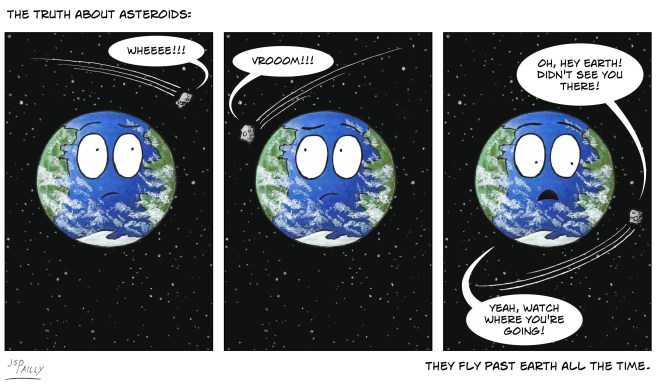
There’s actually a newsletter about asteroid flybys. It’s called Daily Minor Planet, and I have a subscription (it’s free). Every day in my inbox, I’m notified of the latest asteroid or other object skimming past Earth. Every day. Sometimes there are more than one per day.

Occasionally, one of these objects will pass within the radius of the Moon’s orbit. That’s not an everyday thing, but still… it happens more often than you might think.

So when people ask if I’ve heard about the latest asteroid flying past Earth, the only thing I can really say is, “Which one?” And if someone asks me if I’m worried, my answer is no. The asteroids that make headlines on the news and the asteroids that appear in Daily Minor Planet… those are asteroids we know about. It’s all the asteroids we don’t know about that scare the bejesus out of me.

Sciency Words: Shadow Biosphere

Sciency Words MATH

Today’s post is part of a special series here on Planet Pailly called Sciency Words. Each week, we take a closer look at an interesting science or science-related term to help us all expand our scientific vocabularies together. Today’s term is:

SHADOW BIOSPHERE

Crazy Talk

We are not alone on planet Earth. There are aliens among us. Their existence has gone unnoticed and unsuspected for millions of years.

Truth be told, I shouldn’t call them “aliens.” They evolved here on Earth, side by side with what we, in our arrogance, call “organic life.”

They’re everywhere. There’s a whole biosphere of these weird creatures sharing our planet with us. It’s called the shadow biosphere.

Not Crazy Talk

I first heard about the shadow biosphere on an episode of SciShow, and I’ve been seeing the term more and more lately. It seems like some sort of astrobiology buzzword at the moment.

The idea is that an alternative form of life could have evolved here on Earth, and we just haven’t discovered it yet. Maybe it lives in areas totally inaccessible to us, like deep beneath the Earth’s crust. Or maybe it’s so different from us that we don’t yet recognize it as a life form.

Personally, I take this as more of an astrobiology thought experiment than a serious hypothesis about life on our planet. It’s a way of reminding us how limited our understanding of life is and show how difficult it might be to identify alien life should we happen to find it.

You see, to determine if something is alive, we must try to identify ways in which it is similar to other living things. Does it move? Grow? Reproduce? On a more fundamental level, is it cellular in structure? Does it have a carbon-based biochemistry? A DNA-like genetic code?

oc14-pet-rocks
Little did the humans suspect that their “pet rocks” were in fact silicon-based life forms.

But all these questions presuppose that newly discovered life forms will be similar to life forms we already know about. What if we’re dealing with a life form totally dissimilar to life as we know it? What if they’re non-cellular, non-carbon-based organisms that don’t have anything resembling DNA?

Why, such organisms might be so strange to us that they could exist all around us, even right here on Earth, and we wouldn’t know it. Or so this type of thought experiment may lead you to conclude.

Back to Crazy Talk

It’s not just a thought experiment. The shadow biosphere is real. It’s real, I tell you! Wait, where are you taking me? No, I don’t want to take my medicine. Are you working for them? Did the pet rocks send you?

Earth vs. Asteroids

My25 Earth vs Asteroids

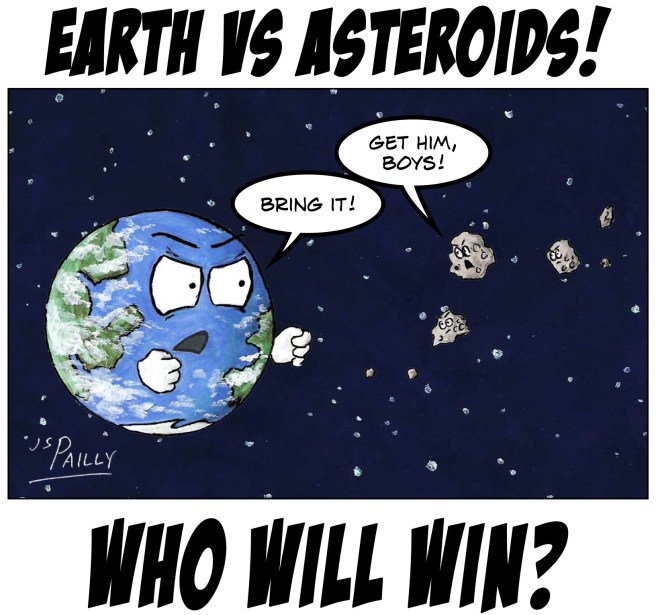
Is your planet safe? Nobody wants another Tunguska Event. Certainly we don’t want another K-T Event. So what are we doing to protect ourselves?

Thanks to grant money from NASA, the University of Hawaii has started setting up a series of telescopes specially designed to hunt for Near Earth Objects (N.E.O.s). These are objects, such as asteroids, with orbital paths that approach or cross Earth’s orbit.

The University of Hawaii’s new telescopes are collectively known as ATLAS (Asteroid Terrestrial-impact Last Alert System). Once fully operational, ATLAS promises to provide us with several weeks notice for large, incoming asteroids. For smaller, though still hazardous asteroids, ATLAS should give us at least a few hours warning.

So is our planet safe?

As more and more programs like ATLAS come online, we should get better coverage of the night sky and longer warning times for incoming objects. But there will still be a problem—a huge problem.

You see, you can’t really do astronomy during the day. That means asteroids coming at us from a sunward direction will go completely undetected. You may remember back in 2013 when a significantly-sized asteroid exploded over Russia, shattering windows and injuring over a thousand people. That asteroid came from a sunward direction.

No amount of ground-based telescopes could have detected that 2013 asteroid. But perhaps a space telescope, similar to the SOHO telescope we use to monitor solar flares, could help plug this gap in our planet’s defenses.

Sciency Words: The K-T Event

Sciency Words MATH

Today’s post is part of a special series here on Planet Pailly called Sciency Words. Each week, we take a closer look at an interesting science or science-related term to help us all expand our scientific vocabularies together. Today’s term is:

THE K-T EVENT

You already know this story. It was 65 million years ago. There were dinosaurs, there was an asteroid…

It’s easily the most famous asteroid impact in Earth’s history, and it’s called the K-T Event, or sometimes the K-Pg Event.

In geology shorthand, the letters stand for:

  • K: the Cretaceous period, which is spelled with a K in German. This was the last period of geological history in which dinosaurs roamed the Earth.
  • T: the Tertiary period, which immediately followed the Cretaceous. According to the International Commission on Stratigraphy (ICS), we’re not supposed to use this name anymore, but people still do. It’s sort of like how some people keep calling Pluto a planet, no matter what the International Astronomy Union (IAU) says.
  • Pg: the Paleogene period, which is the period immediately following the Cretaceous according to the ICS’s new list of geological periods. Please note, the Tertiary and Paleogene are not really interchangeable terms. They have the same starting point, but different end points.

Geologists and paleontologists puzzled for decades over a layer of clay separating Cretaceous and Tertiary (or Paleogene) rock. They called it the K-T boundary. There were several competing hypotheses about what might have caused this boundary and how it related to the mass extinction event that killed off the dinosaurs.

Then in 1980, a paper came out entitled “Extraterrestrial Cause for the Cretaceous-Tertiary Extinction.” This paper reported the discovery that the K-T boundary contained abnormally high levels of the element iridium.

Platinum group metals like iridium are extremely rare on Earth (except in the planet’s core) but common in asteroids. So whenever you find lots of iridium in Earth’s crust, you can justifiably assume an asteroid put it there.

The most likely scenario is that a large asteroid, about 10 km in diameter, smashed into Earth, flinging dust and debris high into Earth’s atmosphere. Enough to block out the sun worldwide for several years. This global dust cloud would have included plenty of material from the asteroid itself, which would have been partially vaporized by the heat of the impact.

A major problem with the original 1980 paper was that, at the time, no known impact crater of the appropriate age was sufficiently large. But of course, that was back in 1980. The crater has since been found in the Yucatan Peninsula, and now just about everybody knows the story of the K-T Event (even if they don’t know it’s called that).

P.S.: The K-T Event is not to be confused with the Katie Event. You know, that time your BFF Katie had waaaaay too much to drink and threw a temper tantrum of apocalyptic proportions.

Addendum: While there does seem to be general, widespread consensus that the K-T asteroid impact either caused the extinction of the dinosaurs or contributed significantly to their demise, there is not universal agreement. As Planetary Defense Commander notes in the comments, there are other possibilities worth considering.