Venus and Mother Russia

If you want to land on Mars, the United States can help. The U.S. has a pretty good track record for successfully landing space probes on Mars. But if you’d rather land on Venus, talk to the Russians. They’ll tell you how it’s done.

Mr07 Vodka

In fact, I’d say Russia’s special relationship with Venus began in 1761 when Russian astronomer Mikhail Lomonosov discovered that Venus has its own atmosphere.

In more recent history, Russia’s Venus-related accomplishments include:

  • Venera 1: First spacecraft ever sent to Venus, or any other planet for that matter. Sadly, radio contact was lost before Venera 1 reached its destination.
  • Kosmos 27: Failed in Earth orbit.
  • Zond-1: Failed on route to Venus.
  • Venera 3: First spacecraft to land on Venus. Well, crash land.

Okay, a lot of these missions didn’t go so well, but the Soviet space program can teach us all the value of persistence. And eventually, Russian persistence paid off.

  • Venera 4: Successfully transmitted data from inside Venus’s atmosphere.
  • Venera 7: First successful landing on Venus. Plenty of data transmitted back to Earth.
  • Venera 11 and 12: Observed thunderstorms on Venus.
  • Venera 13: First color photos from the surface of Venus.
  • Vega 1 and 2: First weather balloons deployed to study Venus’s atmosphere.

As an interesting side note, Russia’s Venera 4 entered Venus’s atmosphere at almost the same time that the U.S.’s Mariner 5 was passing by. Despite the tensions of the Cold War, this was just too good an opportunity to pass up. The sharing of data from the two spacecraft was one of the earliest examples of international cooperation in space exploration.

Russia’s next mission to Venus won’t be for a while. The launch of the Venera-D space probe is currently scheduled for 2024.

Links

Russia’s Unmanned Missions to Venus from Russian Space Web.

When the Veneras Challenged Venus’s Hellish Atmosphere from Discovery News.

Soviet Balloon Probes May Have Seen Rain on Venus from Wired.com.

Sciency Words: Ad Hoc Hypothesis

Sciency Words BIO copy

Today’s post is part of a special series here on Planet Pailly called Sciency Words. Every Friday, we take a look at a new and interesting scientific term to help us all expand our scientific vocabularies together. Today’s word is:

AD HOC HYPOTHESIS

“Ad hoc” is a Latin phrase meaning “for this,” as in “for this one and only one purpose.” Within the sciences, the term has rather negative connotations. Basically, it’s technical jargon for “Oh come on! You just made that up!”

A scientific hypothesis can be labeled “ad hoc” if any one of the following conditions are met.

  • The hypothesis attempts to explain one and only one phenomenon.
  • The hypothesis contradicts part or all of our current body of scientific knowledge.
  • The hypothesis cannot be tested in any meaningful way.

The ad-hoc-ness of an ad hoc hypothesis increases when you find any combination of the above conditions. Please remember that ad hoc hypotheses are not necessarily wrong, but in the minds of scientists, they are highly suspect.

You’ll encounter the term ad hoc in many scientific papers as well as in books and articles about science. There’s even an event called BAH-Fest (that’s the Festival of Bad Ad Hoc Hypotheses) where professional scientists compete over who can come up with the most hilarious ad hoc hypothesis.

And yet, the term does not seem to appear very often in science fiction, despite the fact that it fits so well with a common Sci Fi trope: the scientific genius whose radical new theory has not been accepted by his/her peers.

Rejected dialogue from Back to the Future:

Marty McFly: But Doc, your time travel theory falls apart without the ad hoc explanation of the flux capacitor.

Or as a response to meaningless technobabble:

Rejected dialogue from Star Trek:

Ensign Chekov: The ship must have entered some sort of quantum asymmetrical graviton loop singularity!

Commander Spock: Mr. Chekov, kindly refrain from postulating ad hoc theories. We must investigate this phenomenon further.

Or in any discussion involving conspiracy theories:

Rejected dialogue from The X-Files:

Agent Mulder: These crop circles must be part of an elaborate government cover-up.

Agent Scully: Do you have any evidence for that, or is this just another ad hoc hypothesis?

Okay, maybe those aren’t the best examples. So how would you use the term ad hoc in a story?

Life on Venus (The Unknown Absorber)

Venus loves keeping secrets. One of the biggest, most frustrating secrets has to do with the planet’s upper atmosphere. Something is absorbing ultraviolet light, and no one can figure out what.

Mr05 Ultraviolet Mystery

A Scientific Explanation

Specific atoms and molecules absorb specific wavelengths of light, producing what’s called an absorption spectrum. Given the prevalence of sulfur compounds in Venus’s atmosphere, it seems like a safe bet that some kind of sulfur containing compound is responsible for this mysterious ultraviolet absorption.

But the absorption spectrum doesn’t match with sulfur dioxide, sulfuric acid, or any other sulfur-based chemical thus far identified on Venus. After decades of observation and research, scientists can’t reach any consensus on what the heck is going on.

A Sci-Fi Explanation

Chlorophyll is a pretty important (and pretty complicated) chemical here on Earth. It’s what makes photosynthesis possible in plants, and therefore it’s what makes life as we know it possible. And it just so happens that chlorophyll’s strongest absorption lines are in the blue part of the spectrum, not far from ultraviolet. Could Venus’s unknown absorber be a sulfur-based, chlorophyll-like chemical?

In other words, could there be something alive on Venus? Could there be some kind of alien algae drifting about in Venus’s sky? Venus’s atmosphere contains a rich mixture of chemicals, including carbon dioxide and water vapor.

Even those thick, fluffy clouds of sulfuric acid might not be dangerous to creatures that evolved to live there. Who knows? Maybe sulfuric acid is highly nutritious if you have the right biochemistry.

And if these cloud algae phosphoresce, as some species of algae do on Earth, that might explain the mystery of Venus’s ashen light.

Final Thoughts

I’m presenting these cloud algae as science fiction, but many well-respected scientists have speculated about this possibility. Even so, this idea is a bit farfetched. Odds are sulfur-based life on Venus is completely impossible.

Mr05 Cloud Algae

Links

Does Alien Life Thrive in Venus’s Mysterious Clouds from Discovery News.

Could There Be Life on Venus? from Venus Dispatches.

Solar System Bodies: Venus from NASA’s Office of Planetary Protection.

Recommended Reading

Venus Revealed: A New Look Below the Clouds of Our Mysterious Twin Planet by David Grinspoon.

Molecular Monday: Venus’s Sulfuric Acid

Welcome to the first official installment of Molecular Mondays, a new series here on Planet Pailly where we take a closer look at the atoms and molecules that make up our universe. Today, we’ll be talking about sulfuric acid, specifically the sulfuric acid that is so disturbingly prevalent in Venus’s upper atmosphere.

Mr04 Melting Spaceship

How to Make Sulfuric Acid

The first step is for sulfur dioxide to pick up an extra oxygen atom, creating sulfur trioxide. Sulfur trioxide then reacts with water, yielding sulfuric acid.

SO2 + O -> SO3

SO3 + H20 -> H2SO4

On Earth, we make sulfuric acid in factories, and it has many scientific and industrial uses. But on Venus, this is happening not in tanks or vats but in the open air, far above the planet’s surface.

Venus’s Sulfur Cycle

Sulfur containing chemicals like sulfur dioxide rise through the air on Venus, possibly originating from Venus’s many volcanoes. These chemicals get zapped by ultraviolet radiation from the Sun, causing sulfur and oxygen atoms to separate and recombine. One possible recombination is sulfur trioxide, which then reacts with traces of water vapor hanging around in Venus’s atmosphere.

Sulfuric acid then condenses into clouds. Sooner or later, the clouds condense further, producing rain: the most horrible rain you could possibly imagine. Fortunately, this sulfuric acid rain never reaches the planet’s surface (not that it matters much because if you’re on the surface of Venus, you’re already dead).

Thermal Dissociation of Sulfuric Acid

Because Venus’s surface temperature approaches 900 degrees Fahrenheit, the sulfuric acid rain begins to evaporate. In fact, the temperature is so high that sulfuric acid molecules break apart in a process called thermal dissociation.

What we’re left with are water vapor and sulfur containing chemicals like sulfur dioxide. The water and sulfur compounds start rising through the atmosphere, and the process begins again, repeating over and over, ensuring that Venus’s atmosphere maintains high levels of corrosive acid… forever.

It’s almost like Venus is being deliberately evil.

Mr04 Evil Venus

Links

Sulfuric Acid from Essential Chemistry Industry Online.

Aerosols and Clouds on Earth and Venus from the University of Colorado, Boulder.

Photolysis of Sulphuric Acid as the Source of Sulphur Oxides in the Mesosphere of Venus from Nature Geoscience.

The Sulfur Cycle on Venus: New Insights from Venus Express from the 2009 Lunar and Planetary Science Conference.

Recommended Reading

Venus Revealed: A New Look Below the Clouds of Our Mysterious Twin Planet by David Grinspoon.

Sciency Words: Ashen Light

Sciency Words MATH

Today’s post is part of a special series here on Planet Pailly called Sciency Words. Every Friday, we take a look at a new and interesting scientific term to help us all expand our scientific vocabularies together. Today’s word is:

ASHEN LIGHT

First observed in 1643, ashen light is an as yet unexplained phenomenon on the planet Venus. It’s a mysterious aura or glow sometimes seen on the planet’s night side.

The light can’t be sunlight (this is the night side, after all), and it can’t be reflected moonlight since Venus doesn’t have any moons.

At one time, scientists thought ashen light could be evidence of alien life (maybe the light comes from cities?), but at this point, I think we can rule that possibility out.

Some scientists have dismissed ashen light as an optical illusion, and maybe they’re right. None of the space probes we’ve sent to Venus have been able to detect the phenomenon. Then again, it took decades for our probes to confirm the existence of Moreton waves on the Sun.

So what do you think is going on on Venus? What secrets is our nearest planetary neighbor hiding?

Links

Jan 9, 1643: Astronomer Sees Ashen Light of Venus from Wired.com.

The “Loch Ness” of Venus from Sky News.

IWSG Muse Chat 3: The Law of Writerly Motion

InsecureWritersSupportGroup

As has become my custom for these Insecure Writers Support Group posts, I’m going to turn the floor over to my muse. She has something she wants to say, and maybe its advice your muse would like to hear.

* * *

Hi, I’m James’s muse. As such, I live inside James’s brain, and since James is a huge science geek, I have access to a surplus of sciency factoids. Here’s something from some English bloke named Isaac Newton.

Objects in motion tend to remain in motion and objects at rest tend to remain at rest unless acted on by an external force.

This “law of physical motion” caught my attention. As a muse who’s spent countless hours studying her writer’s habits, both the good and the bad, I would like to propose my own “law of writerly motion.”

A writer who’s writing tends to keep writing and a writer who’s not writing tends to keep not writing unless acted on by an INNER force.

My fellow muses, that inner force is us. We don’t need to hold our writers’ hands through the entire writing process. We only have to provide that initial push. Once writers get started, they generally keep going due to their own momentum.

Mr02 Initial Push

It’s also our responsibility as muses to let our writers know when to stop. I’ve learned to be careful or my writer will either hurt himself or ruin his story. More on that in next month’s Muse Chat.

* * *

If I had my way, I’d keep writing and writing without end. It’s annoying when my muse forces me to stop, but I guess she has her reasons.

Anyway, if you or your muse enjoyed today’s post, please let us know in the comments below. Click here to find out more about the Insecure Writer’s Support Group and to see a full list of participating blogs. Next month, my muse will tell us about the “writing speed limit.”

Women are NOT from Venus

I’d like to dispel a common misconception about Venus. Women do not come from Venus. Nobody comes from Venus.

Aside from Earth, no place in the Solar System is exactly friendly to human life, but Venus takes its unfriendliness to a whole other level. In fact, Venus is almost diabolically evil.

Mr01 Slaughter

If you ever decide to go to Venus, here are a few of the many ways Venus will try to kill you.

  • In the upper atmosphere, you will encounter sulfuric acid clouds and sulfuric acid rain.
  • Descending through the atmosphere, atmospheric pressure will increase to 90 times greater than Earth-normal, so you’ll be crushed like a soda can.
  • Due to interactions with the solar wind, spontaneous explosions sometimes occur in Venus’s atmosphere. Let’s file this under “fire hazard.”
  • The surface temperature is almost 900 degrees Fahrenheit, which is well above the auto-ignition temperature of the human body. So again, fire hazard.
  • By the time you reach the planet’s surface, assuming you still have lungs, you’d choke on the extremely high concentration of carbon dioxide in the air.
  • Not that it matters at this point, but there’s no water.
  • Whatever’s left of your corpse may be struck by lightning during one of Venus’s intense thunderstorms.

As we continue our exploration of the Solar System with a month-long visit to Venus, I’d like to take this opportunity to dub the second planet from the Sun “Venus, the Overkill Planet.”

Links

Clouds on Venus from Universe Today.

Planet Venus Facts: A Hot, Hellish & Volcanic Planet from Space.com

The Weather on Venus Calls for Massive Mid-air Explosions from io9.

Sciency Words: The Anomalous Precession of the Perihelion of Mercury

If you’re anything like me, you’ve probably looked at planetary orbits and asked yourself: why does Mercury’s perihelion precess so anomalously? That simple, straightforward question is the subject of this week’s edition of Sciency Words.

Sciency Words is a special series here on Planet Pailly where we take a look at a new and interesting scientific term so we can all expand our scientific vocabularies together. Today’s term is:

THE ANOMALOUS PRECESSION OF THE PERIHELION OF MERCURY

I know, it’s a bit of a mouthful, but trust me… this anomalous precession thing is pretty cool.

Gravity According to Newton

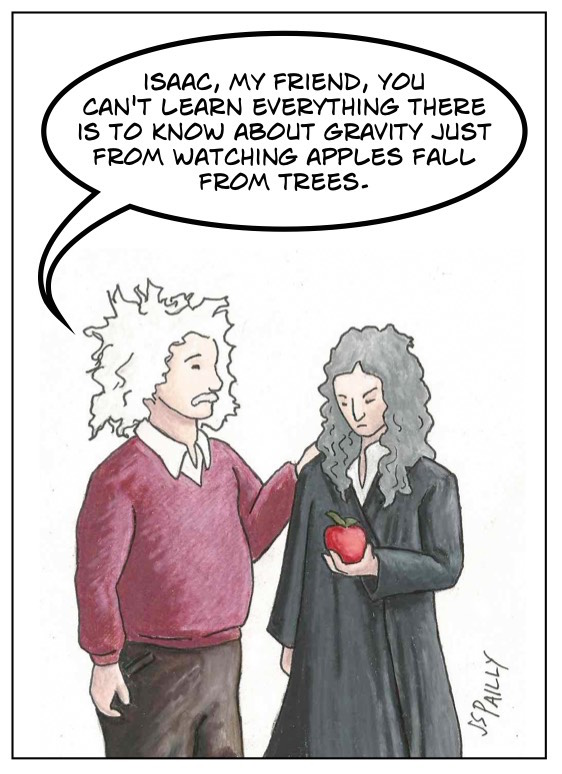
Back in the 17th Century, Isaac Newton found a mathematical way to describe gravity, and his mathematical description worked for everything from falling apples to the orbits of all the planets. Well, all the planets except Mercury.

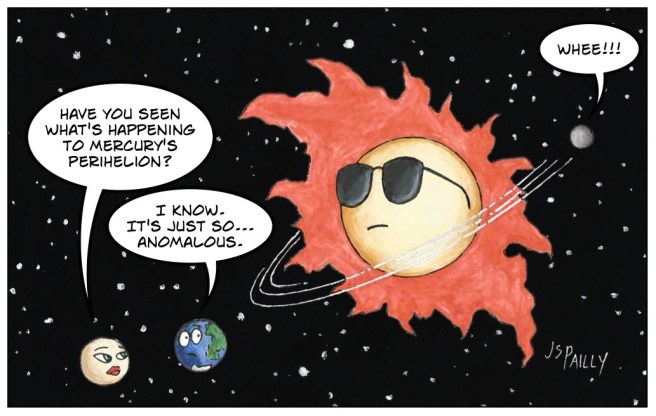
Mercury’s perihelion (the point where Mercury is as close to the Sun as it gets) moves.  That in and of itself isn’t so strange, but the perihelion moves a tiny bit faster than it should according to Newton.
Mercury’s perihelion (the point where Mercury is as close to the Sun as it gets) moves. That in and of itself isn’t so strange, but the perihelion moves a tiny bit faster than it should according to Newton.

The mystery of Mercury’s orbit (or the “anomalous precession of the perihelion of Mercury,” to use the technical lingo) baffled scientists for centuries. That is until Albert Einstein came along.

Gravity According to Einstein

Einstein’s theory of general relativity postulates that space and time are not separate entities but two aspects of what physicists now call space-time. General relativity predicts that the force of gravity causes space-time to bend or warp.

Needless to say, the Sun has a lot of gravity. Turns out that the warping of space-time around the Sun precisely explains Mercury’s weird orbit. In fact, every planet experiences some degree of this anomalous perihelion thing. It’s just that, because Mercury is so much closer to the Sun, the warping effect is significantly more noticeable.

Fe12 Time Warp

This is perhaps the planet Mercury’s greatest contribution to science. The anomalous precession of Mercury’s perihelion provided one of the earliest proofs that general relativity—and all the wibbly-wobbly, timey-wimey stuff that comes with it—is not just science fiction.

Fe12 Albert and Isaac

Links

The 200-Year-Old Mystery of Mercury’s Orbit—Solved! from io9.

The Mysterious Orbit of Mercury from The Great Courses.

Accounting for General Relativity at Mercury from The Planetary Society.

Probing Mercury

In 1974, the first space probe form Earth skimmed past Mercury.

Fe11 Mariner 10
Mariner 10 flies past Mercury for the first time.

As we discussed in a previous post, getting to Mercury is a challenge, so it wasn’t until the early 21st Century that we tried again. This second mission was more ambitious than the first.

The MESSENGER spacecraft achieves Mercurial orbit.

Unfortunately, MESSENGER can’t maintain its orbit forever. By the end of 2015, the probe is expected to run out of fuel. After that, it will eventually crash somewhere on Mercury’s surface.

But don’t worry! The European Space Agency (ESA) and the Japanese Aerospace Exploration Agency (JAXA) have teamed up to send two new probes to Mercury.

Fe11 BepiColombo
The BepiColombo spacecraft will separate into two probes once it reaches Mercury.

The ESA-JAXA mission is named BepiColombo in honor of the Italian mathematician and scientist Giuseppi “Bepi” Colombo. It was Professor Colombo’s calculations that enabled Mariner 10 to safely approach Mercury back in the 1970s.

The BepiColombo spacecraft is scheduled to launch in July of 2016, and the two probes should reach Mercury in early 2024.


Molecular Mondays

Today, I’m announcing a brand new series here on Planet Pailly called Molecular Mondays. Posts in this series will feature specific atoms or molecules, the basic building blocks of our universe.

Fe10 Molecules

I originally conceived the idea for this series several years ago, but I chickened out before I even started writing it.

In school, I took honors biology, honors chemistry, and honors physics. I did well in biology. I did really well in physics, and if not for my greater passion for art and literature, I probably would have pursued a career as a physicist.

But chemistry… I barely passed chemistry. I think I averaged a D+, which became a C- thanks to the generosity of my professor. So yeah… by introducing a chemistry series on my blog, I’m stepping way outside my comfort zone.

But just because a subject is difficult for me doesn’t mean I can keep ignoring it. Almost everything that happens in this universe happens because of chemicals and chemical reactions. If I really want to be a better science fiction writer, I need to learn some of this stuff.

So every other Monday, I’ll be trying my best to handle the atoms and molecules that constitute our physical universe. Two weeks from today, as we continue our ongoing exploration of the Solar System, we’ll take a look at Venus’s infamous sulfuric acid clouds and the chemical processes that ensures that those clouds never, ever go away.