The Tectonic Theory (It’s Not “Just a Theory”)

Earth is a weird little planet. I’m not talking about all the oxygen and liquid water. I’m not even talking about life (although that is really weird). You may not have thought about this before, but there’s another thing that makes Earth strange: earthquakes.
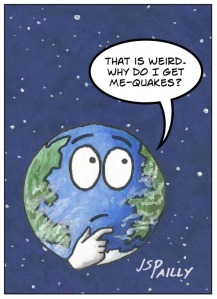
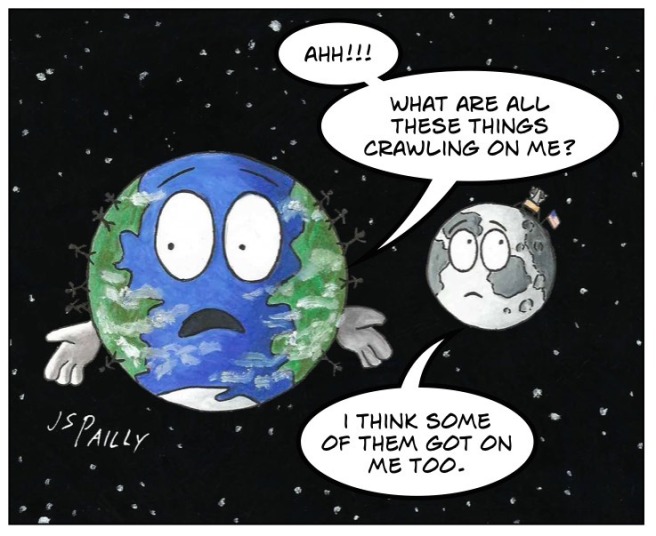
Ap04 Me-Quakes

Of all the terrestrial planets and moons in the Solar System, only Earth has active plate tectonics (also, maybe Mars… maybe).

The theory of continental drift was first proposed by Alfred Wegener in the 1910’s with his book entitled The Origin of Continents and Oceans. At the time, the idea was not well received. Though Wegener had plenty of evidence that the continents had moved, he couldn’t explain why. His contemporaries preferred imagining the world as solid and unchanging. They didn’t want to believe continents could move. (Also, it says nothing about continental drift in the Bible.)

A more formal theory of plate tectonics didn’t emerge until the 1960’s, and it has since become the unifying theory of geology. We now know that massive tectonic plates drift about, jostling against each other, pushed and pulled by the rising and sinking of magma in the Earth’s interior.

Where plates meet, they form three types of boundaries:

  • Divergent boundaries: two plates move apart, allowing magma to fill the gaps between them.
  • Convergent boundaries (a.k.a. subduction zones): two plates collide, forcing one plate beneath the other.
  • Transformal boundaries: two plates moving alongside one another scrape against each other. Most earthquake zones, like the San Andreas Fault in California, occur near transformal boundaries.

As we try to understand Earth, especially how life developed and thrived here, we should take note of all of Earth’s weird traits. Water and oxygen are not the only things that make our planet special.

Links

Without Plate Tectonics Life on Earth Might Never Have Gained a Foothold from Daily Galaxy.

Shift Happens: Mars May Have Plate Tectonics from Discovery News.

Molecular Monday: Oxidation, Part One

With this new Molecular Mondays series, I’m challenging myself to dive into the world of chemistry. As a science fiction writer, I really should know this stuff. Just because I had some bad experiences in high school chemistry class doesn’t mean I can keep avoiding the subject forever.

I have long suspected (and now know for certain) that my biggest problem with chemistry is that I don’t understand oxidation. In school, the concept was explained in a dreadfully confusing way. As I recall, I was told that oxidation has nothing to do with oxygen, and then I was given examples of how the process works, all of which involved oxygen.

So before I go any further with chemistry, I need to get this straightened out.

At this point in my research, I can say that the name oxidation is slightly misleading, as is the name of oxidation’s counterpart chemical process: reduction.

  • Oxidation: an atom (like iron) loses electrons to another atom (like oxygen).
  • Reduction: an atom (like oxygen) gains electrons from another atom (like iron).
  • Redox: since oxidation and reduction always occur together, redox refers to this chemical reaction in its entirety.

Scientists sometimes name newly discovered phenomena before they are fully understood. By the time a phenomenon can be better explained, it’s often too late to change the name. Thus, reduction means gaining electrons and oxidation does not necessarily have anything to do with oxygen.

It seems that the first time oxidation was studied scientifically, oxygen was the main culprit. When oxygen bonds with other atoms, it sort of hogs electrons.

Ap03 Greedy Oxygen

So because of its particular greed for electrons, oxygen does a whole lot of oxidizing. But we now know oxygen is by no means the only element that does so.

The next few editions of Molecular Mondays will continue to focus on oxidation—or rather, redox reactions as a whole. I’ll try my best to keep you updated on how my studies are progressing. Any advice, insight, or encouragement would be greatly appreciated.

P.S.: One of the best chemistry resources I’ve found so far is the YouTube series Crash Course: Chemistry with Hank Green (the guy from Sci Show). Hank has done a great job getting me started on this subject.

If you’d rather learn about something else, there are plenty of other Crash Course series available on YouTube, such as Crash Course: World History and World History 2.

Sciency Words: Anthropocene

Today’s post is part of a special series here on Planet Pailly called Sciency Words. Every Friday, we take a look at a new and interesting scientific term to help us all expand our scientific vocabularies together. Today’s word is:

ANTHROPOCENE

As recently as 2012, scientists have confirmed there is life on Earth. Do not underestimate the effect life can have on a planet. Do not underestimate the even greater effect of intelligent life.

Ap02 Life on Earth

The term Anthropocene is a fairly new addition to the scientific lexicon. It’s still unclear whether or not the term will stick.

Anthropocene loosely refers to the era of Earth’s geological history when human beings (anthropos is Greek for human) have had the greatest geological impact on the planet.

How have we impacted the geology of our planet? Just think of all the digging we do. Think of all the minerals we’ve extracted from Earth’s crust. Think of how acid rain weathers the landscape or how garbage decomposes (or sometimes doesn’t), changing the makeup of the soil, the atmosphere, the oceans…

Think of all the effects of artificial rather than natural processes: this is the meaning and significance of the Anthropocene epoch.

Of course, the use of this term is not without controversy. Geological epochs are supposed to correspond to rock strata. They’re supposed to have clearly defined boundaries. Where, exactly, is the boundary marking the beginning of the Anthropocene? There isn’t one, yet, because we’re still living in it.

In the future, especially the distant future, the boundaries of the Anthropocene might be very easy to identify. Hundreds or thousands of years from now, the Anthropocene may be a well-established historical and geological fact. Or maybe not.

So do you think characters in a Sci-Fi future would talk about the Anthropocene epoch? If they do, what would they say?

P.S.: Throughout the month of April, as part of the 2015 Mission to the Solar System, we’ll be exploring the planet Earth—in many ways the strangest planet in the Solar System, for reasons you might not expect.

Links

What Is the Anthropocene and Are We in It? from Smithsonian.com.

Generation Anthropocene: Stories About Planetary Change.

IWSG Muse Chat 4: When to Stop

InsecureWritersSupportGroupFinally, my muse turns up. She has some fantastic inspiration to give me, and we’re making real progress on our current writing project. The hours fly by. Words come easily. Writing should always be like this!

And then, my muse tells me to stop.

For the last few months worth of Insecure Writer’s Support Group posts, I’ve been turning the floor over to my muse so that she can tell us about her mystical world of imaginary things. So today, I thought I’d ask her: what’s the deal? Why do I have to stop writing just when things are going so well?

* * *

Hello. I’m James’s muse. That means it’s my job to give James that tiny flash of inspiration he needs to start writing. But a good muse (and I like to believe I’m a good muse) concerns herself with more than just writing. She must remain mindful of her writer’s happiness, health, and general well-being.

And that means signaling to our writers when it’s okay to stop.

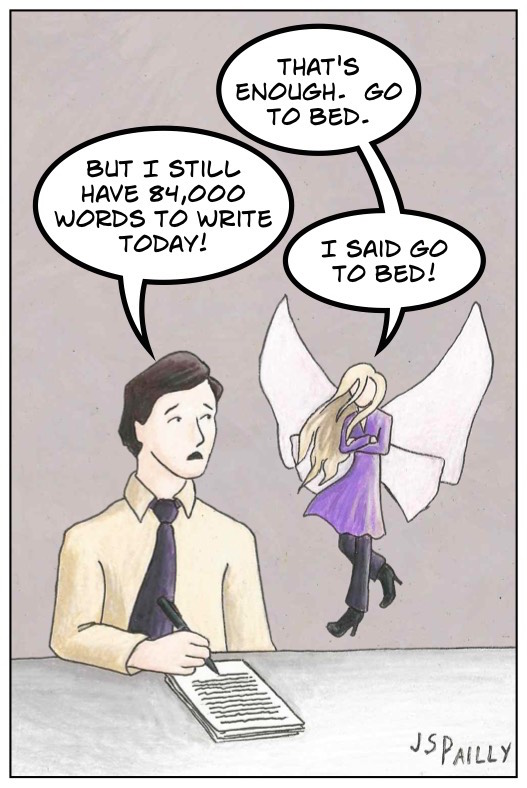
Ap01 Go to Bed

My writer obsesses over writing schedules, looming deadlines, and word count quotas. As a result, he suffers terrible anxiety whenever he doesn’t live up to his own lofty expectations. He argues with me, telling me I don’t understand the pressure he’s under—whatever that means.

But last week, my writer ran into trouble finishing a blog post for his Solar System series. He wanted to just plow through it. He thought he knew how to fix it. But I told him to relax, and for once, he listened!

As a result, the blog post came out a day behind schedule, but it ended up being one of the best in the whole series (at least in my writer’s opinion).

Creativity only grows in the right environment, and it won’t grow in the mind of a fatigued and frustrated writer. That’s why responsible muses must tell their writers to take breaks, eat nutritious meals, and get a full night’s sleep.

* * *

If you or your muse found today’s post helpful, please let us know in the comments below. Today’s post is part of the Insecure Writer’s Support Group, a blog hop hosted by Alex J. Cavanaugh. Click here for more information about I.W.S.G. and to see a full list of participating blogs.

The Aphrodiocentric Theory

What is the aphrodiocentric theory? It’s something I made up. It comes from aphrodio-, the scientific prefix meaning Venus, and centric, meaning center, as in center of the universe. We’ve had a geocentric theory and a heliocentric theory, but sadly, there was never an aphrodiocentric theory.

Mr13 Aphrodiocentric
The discovery that Venus orbits the Sun had huge implications for Earth’s place in the cosmos.


In 1610, Galileo began observing Venus through his telescope. At certain times, Venus appeared as a full circle, just like any other planet. But at other times, Venus appeared as a crescent shape or half-circle shape or some other not-quite-a-circle shape.

In other words, Venus as observed from Earth had phases, just like the Moon. After puzzling over these observations, Galileo soon concluded that Venus must orbit the Sun. It’s not much of a leap from there to realize that all the planets, including Earth, orbit the Sun.

If you remember nothing else about Venus, remember this: right from the start, Venus has been teaching us about our own planet. It taught us the folly of our geocentrism, it taught us the dangers of greenhouse gases, and no doubt it will continue to teach us in the future.

This is the final post in my series on Venus. Clearly there is a lot more to say about such a mysterious and chemically active planet, but it is time for us to move on. The 2015 Mission to the Solar System will continue on Friday as we begin our exploration of Earth.

Sciency Words: Venus Syndrome

Today’s post is part of a special series here on Planet Pailly called Sciency Words. Every Friday, we take a look at a new and interesting scientific term to help us all expand our scientific vocabularies together. Today’s word is:

VENUS SYNDROME

On Thursday, we talked about what it would take to terraform Venus. Turning Venus into another Earth is, in short, difficult. So instead, how about we turn Earth into another Venus?

Mr12 Earthly Earth

In the worst-case scenario for climate change, accumulating greenhouse gases in Earth’s atmosphere trigger a runaway greenhouse effect analogous to what happened long ago on Venus. Hence the name “Venus syndrome.”

Here’s how Venus became the charming hellhole we know today:

  • Venus had oceans: Early Venus probably had oceans of liquid water. As the early Sun grew brighter, these oceans warmed up, releasing water vapor. Water vapor, believe it or not, is a greenhouse gas. It’s transparent, so light energy passes straight through; but it traps heat, so once light energy becomes heat energy, it can’t escape.
  • The oceans boiled: The initial temperature change would have been relatively minor, but it created a positive feedback loop. More water vapor trapped more heat, which evaporated more water, which trapped more heat, until the oceans boiled away completely. Then things got worse.
  • The rocks sublimated: The temperature rose to the point that certain carbon-containing rocks sublimated (turned from solids directly into gases). Carbon dioxide took over for water vapor as Venus’s principle greenhouse gas. More CO2 caused more rocks to sublimate, generating more CO2, and… well, you get the idea.
  • The sulfur cycle began: The now ludicrous temperatures also released sulfur compounds into the planet’s atmosphere, providing the key ingredient for Venus’s infamous sulfuric acid clouds.

So could this happen on Earth? Could manmade greenhouse gases initiate a runaway greenhouse effect, ultimately boiling our oceans and sublimating the carbon and sulfur in Earth’s crust?

Mr12 Venus-y Earth

According to the U.N.’s International Panel on Climate Change, human activities have “virtually no chance” of causing Venus syndrome. They’re predicting less dramatic consequences: rising sea levels, mass extinctions, etc. So that’s reassuring, I guess.

The problem is we don’t know the point at which slight changes to Venus’s environment began spiraling out of control. This makes Venus the subject of rather urgent research by both climatologists and planetary scientists.

Venus syndrome is a worst-case scenario, meaning it’s the greatest extreme on a spectrum of possibilities. But that doesn’t mean we can ignore it. The story of humanity’s exodus from a Venus-like Earth needs to be told, perhaps as science fiction, before it has the chance to become science fact.

Links

2009 Assessment Report from the International Panel on Climate Change.

Venus and Mars Hold Priceless Climate-Change Warnings for Earth from The Daily Galaxy.

Could Greenhouse Gases Turn Earth into Venus? (Yes, But Not Anytime Soon) from Mother Jones.

Let’s Fix Venus

Venus wants to kill you.

Mr11 Venus Won't Lie

With its sulfuric acid clouds, dangerously high atmospheric pressure, absurdly high surface temperature, et cetera, et cetera, Venus has more options for killing humans than any other planet in the Solar System. But maybe we can fix that. Maybe we can make Venus more like Earth.

To terraform Venus (or any other planet) we must do two things:

  • Add stuff that we need to survive, like water and oxygen.
  • Remove or mitigate conditions that would harm us.

Most discussions on terraforming seem to overlook that second part, perhaps because the biggest threats to life-as-we-know-it are not always immediately obvious.

Turning Venus into Earth

Converting Venus’s noxious atmosphere of CO2 and sulfuric acid into a friendly oxygen/nitrogen mix will require some creativity. Since I’ve never personally terraformed a planet (yet), I can only guess about the tools required; but my educated guess is that some sort of bioengineered algae would work best.

We’d need something that converts carbon dioxide into oxygen. Algae already do this. We’d need something that can endure prolonged exposure to sulfuric acid and solar radiation. Some species of bacteria can do that. We’d also need something that can survive, at least at first, in a high temperature environment where water is scarce. Again, life on Earth has already shown that this is possible. We just have to design a new species that puts all of these qualities together.

Once our bioengineered algae start gobbling up Venus’s CO2, removing Venus’s primary greenhouse gas, a process of global cooling should begin. Cooler temperatures would disrupt the sulfur cycle, so the sulfuric acid clouds would start disappearing on their own, and traces of water vapor in the upper atmosphere would be able to condense into liquid water.

Admittedly, this liquid water would only result in a few puddles, so we’d still have to transport in more water. Also, I’m not sure how to deal with the atmospheric pressure. But still, we’re off to an amazing start. Unfortunately, Venus has other plans.

Mr11 Terraformed Venus

Turning Venus Back into Venus

I sometimes joke that I want to live on Venus because I’d have so many more hours in my day to get stuff done. From sunrise to sunset, a day on Venus is over 2,800 hours long.

Venus has an abnormally slow rotation. In fact, compared to the rest of the Solar System, Venus is rotating backwards (the only planet weirder than Venus in this regard is Uranus, which rotates sideways).

2,800 hours of daylight can have some peculiar effects on a planet, especially an Earth-like planet. The oceans that our algae worked so hard to create would soon boil. Water vapor would act as a greenhouse gas. The planet’s carbon cycle would come to a grinding halt, allowing CO2 to accumulate in the atmosphere once again, and the rising temperatures would kick start a brand new sulfur cycle.

Without constant efforts by us to maintain cool temperatures on Venus, the planet would rapidly turn back into its old self. In the end, Venus kills you.

Mr11 Venus Warned You

I normally end these posts with links to some of my sources, but today, I want to end with a book recommendation: Venus Revealed by David Grinspoon. Without getting into too much technical detail, Grinspoon covers many key topics related to Venus, including a brief but illuminating section on terraforming. The book is a wealth of knowledge not only on Venus but concerning planetary science in general (although the bits about exoplanets are now out of date).

UPDATE: The length of a day on Venus has been corrected in this post.  According to this article from Universe Today, the time from sunrise to sunset equals 116.75 Earth days (which comes out to 2,802 hours).  I apologize for my previous mistakes, in which I stated a figure of 1,400 hours and, before that, a mere 60 hours.

Molecular Monday: Carbon Monoxide vs. Carbon Dioxide

Today’s post is part of a special series here on Planet Pailly called Molecular Mondays. Every other Monday, we take a closer look at the atoms and molecules that are the building blocks of our universe, both in reality and in science fiction. Today’s molecule—or rather, today’s molecules—are:

CARBON MONOXIDE and CARBON DIOXIDE

As I’ve mentioned before, I’m not the best at chemistry. So when someone told me carbon monoxide and carbon dioxide are basically the same thing, I felt pretty sure this was wrong. But not 100% sure. So I did some research.

On the surface, carbon monoxide (CO) and carbon dioxide (CO2) do seem kind of similar. They’re both colorless, tasteless, odorless gases. They’re both produced by combustion. And they’re both deadly to humans.

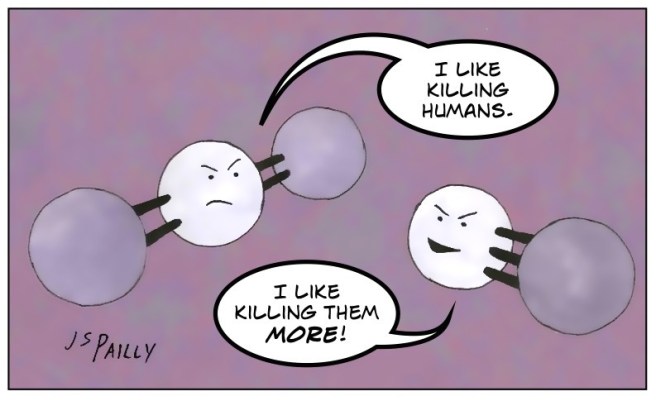
A common conversation between CO2 (on the left) and CO (on the right).

Death by Carbon Dioxide

If you breathe in too much CO2, you’re probably not getting all the oxygen you need. In most cases, this will make you feel a little uncomfortable, and you’ll probably experience an uncontrollable urge to step outside for some fresh air.

It takes a lot of CO2 to kill a human, so unless you’re knocked out or otherwise incapacitated (inhaling large quantities of CO2 could cause you to faint), you’ll probably be okay.

Carbon monoxide, on the other hand, is a more aggressive killer.

Death by Carbon Monoxide

Carbon monoxide loves bonding with the hemoglobin in your blood. It sort of has a fetish for anything that contains iron or similar metals. So inhaling CO reduces your total oxygen intake AND reduces your blood’s capacity to transport whatever oxygen you do get.

This double whammy means it takes a lot less CO to incapacitate and kill a human. Even if you do survive, CO is reluctant to leave your bloodstream once it’s bonded with hemoglobin. So your blood could have diminished oxygen-carrying capacity for a long, long time after exposure.

Similar but Different

So are carbon monoxide and carbon dioxide basically the same thing? In some ways, yes. But if you’re human (or any other respirating animal), there is at least one crucial difference.

Links

Carbon Monoxide from Molecule of the Month.

Why Does Pure CO2 Kill You? from The Naked Scientists.

Inert Gas Asphyxiation from Wikipedia.

Sciency Words: Global Resurfacing Event

Sciency Words MATH

Today’s post is part of a special series here on Planet Pailly called Sciency Words. Every Friday, we take a look at a new and interesting scientific term to help us all expand our scientific vocabularies together. Today’s word is:

GLOBAL RESURFACING EVENT

Sometime between 300 and 600 million years ago, Venus experienced what scientists call a global resurfacing event.

Mr09 Makeover

It seems that all of a sudden, in some cataclysmic event, molten hot lava spread all over the planet’s surface, covering up pretty much everything. We know this because Venus’s surface, which has been mapped using radar altimetry, appears to be much younger than the planet itself, free of many of the impact crater blemishes we find on all the other terrestrial worlds in the Solar System.

What caused the global resurfacing event is a topic of heated debate (get it… heated!). Maybe this happened due to a really bad volcano day. Maybe some large object (Venus’s former moon?) collided with the planet. Maybe aliens bombarded Venus with planet crusher missiles… you know, as a warning to the dinosaurs. It’s also possible that Venus goes through periodic resurfacing events.

If this was a one time event, you have to wonder what Venus was like before it got resurfaced. If this is a recurring event, then it could be fun (as a science fiction writer) to speculate about what might happen when the next resurfacing event begins.

Links

Craters on Venus from Universe Today.

Tectonics on Venus from Teach Astronomy.

Colonizing Venus

Mr08 Venus or Bust

No place in the Solar System (except Earth) is exactly welcoming to human life, but Venus’s anti-human hostility reaches a whole other level. Venus will try to kill you eight different ways before you even touch the ground. You’ll never have to worry about the lack of water or oxygen because you’ll already be dead.

And yet, there is serious discussion about colonizing Venus. The trick, it turns out, is to not bother trying to land. Instead, Venusian colonists would live in cities suspended in the upper atmosphere. The oxygen/nitrogen air that we breathe would have sufficient lifting force on Venus to keep our floating cities aloft, so we don’t even need helium or hydrogen balloons.

NASA has even produced this video showing what our first manned mission to Venus might look like. Get ready for space blimps!

The magic number is 55. At an altitude of 55 kilometers above the Venusian surface, the temperature is about the same as a warm summer’s day on Earth, with 90% Earth gravity and atmospheric pressure only a hair above Earth normal. The environment actually sounds pleasant—aside from the hurricane force winds and sulfuric acid clouds.

So could we colonize Venus? Sure. It’s definitely possible, and there may be good scientific reasons for doing it. Just so long as I’m not the one who has to go.

Links

Colonization of Venus, a proposal by Geoffrey A. Landis.

Acid Clouds and Lightning from ESA.

Super-Hurricane-Force Winds on Venus are Getting Stronger from ESA.