Uniform

I wrote a flash fiction story, and it went live yesterday over at Fiction Can Be Fun! I hope you’ll go check it out, along with two other cool stories posted with it. They’re all based on the writing prompt “uniform.”

@breakerofthings's avatarFiction Can Be Fun

Express Yourself

I’m here today for the second in my series of interviews with the journalist, biographer, pundit and bon vivant, Jocelyn Humpheries.  Today we’re focussing on her writing as a biographer and in particular some of the little snippets that didn’t make the final cut.  Jocelyn: which of your biographical subjects was your favourite?

Oh! That is rather invidious – I do so detest those sorts of questions.  I enjoyed writing all of them, even – perhaps especially! – the scathing ones.  I do have a soft spot for the first one I wrote where the subject was, at the time, still living.  He was such a dear!  I don’t know if people say that about me now, but he would have been about the same age as I am now when I interviewed him.

That would be Colonel Hart-More?

Indeed. Although he didn’t really like to use his…

View original post 1,121 more words

Sciency Words: Exoplanet

Today’s post is part of a special series here on Planet Pailly called Sciency Words. Each week, we take a closer look at an interesting science or science-related term to help us expand our scientific vocabularies together. Today’s term is:

EXOPLANET

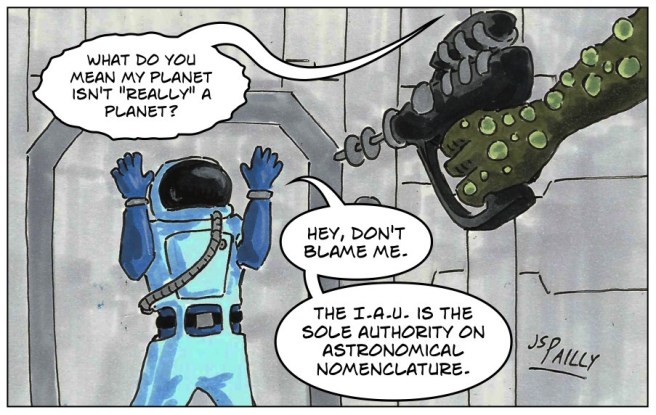
According to the International Astronomy Union (I.A.U.), an astronomical object qualifies as a planet if:

  • It orbits the Sun.
  • It’s round due to the pull of its own gravity.
  • It’s cleared its orbital path of asteroids or other debris (this is the part of the planet test Pluto failed.

The I.A.U.’s planet definition has caused a lot of grumbling and controversy, and not only because of Pluto. Let’s focus today on the first criterion for planethood: in order to be a planet, an object has to orbit the Sun. Not just any sun, but the Sun, as in our Sun. With a capital S.

Which means big, round objects orbiting other stars don’t qualify. The I.A.U. suggests calling them exoplanets or extrasolar planets, but they aren’t, strictly speaking, planets.

I have mixed feelings about this. On the one hand, it seems awfully geocentric of us to have one word for objects orbiting our Sun and a different word for the same type of objects orbiting other stars.

However, I have to admit having a special term for “planet orbiting another star” is kind of handy. It saves me time in conversations and cuts down on the word counts of blog posts. So I guess it’s worth knowing the official I.A.U. definition for this handy, time-saving term.

Except the I.A.U. doesn’t have an official definition for exoplanets. Why not? Let’s try adapting the current planet definition to exoplanets and see what happens.

  • An exoplanet has to orbit a star other than our Sun. (Seems okay so far).
  • An exoplanet has to be round due to the pull of its own gravity. (Our telescopes can’t visually confirm that exoplanets are round, but based on estimates of their mass we can safely assume they’re round. We’re probably still okay.)
  • An exoplanet has to have cleared its orbital path of debris. (This is a real problem because in most cases there’s no way to confirm, visually or otherwise, that an exoplanet has done this.)

There is a proposal to change the I.A.U. planet definition again, this time based on quantitative data rather than visual observations. This, by the way, is different than the geophysical everything’s-a-planet definition I wrote about previously. The geophysical definition would make Pluto a planet again; the quantitative definition would not.

Back in 2006, the I.A.U. changed the definition of planet, excluding Pluto from the planet club, because we’d learned new information about our Solar System. More new information about planets, exoplanets, and other planet-like objects has been piling up since then, which is why we keep hearing about these proposals to change the definition again.

Personally, I like the more inclusive geophysical definition, but that’s just my preference. Plenty of intelligent and well-meaning people disagree. But I think sooner or later, the I.A.U. will have to revisit this issue to ensure the definitions of planet and exoplanet match.

Exoplanet Explorer: Poltergeist

Today’s post is part of a semi-regular series here on Planet Pailly exploring exoplanets: planets orbiting stars other than our Sun. Today, we’re exploring the exoplanet:

POLTERGEIST

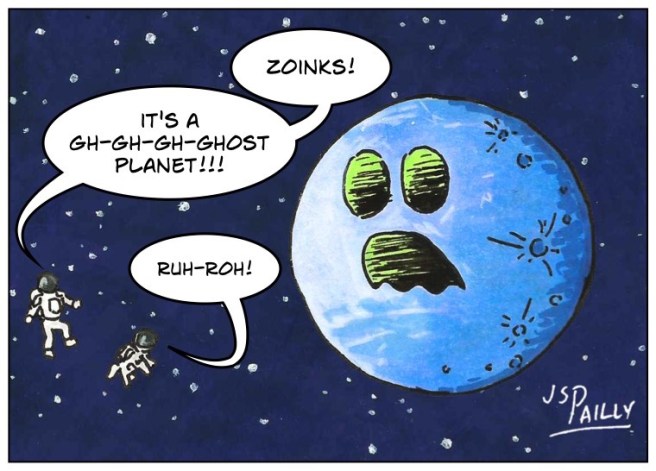
In 2015, our friends at the International Astronomy Union gave in to public pressure and finally started assigning actual names to exoplanets. Thus, the exoplanet designated PSR B1257+12 c is now known as Poltergeist.

Poltergeist is actually the very first exoplanet we humans ever discovered. It’s approximately four times as massive as Earth, has an orbital period of 66 days, and is located in a star system roughly 2,300 light-years away in the constellation Virgo.

It’s hard to say much else about a planet so far away from us, but based on what we do know at this point, I’m willing to bet Poltergeist is a barren rock stripped of any appreciable atmosphere and depleted of all or almost all of its volatiles.

That’s because Poltergeist’s sun is no ordinary star. It’s a pulsar: the tiny, rapidly-spinning, gamma radiation flashing remnants of a star that went supernova. As of 2015, the I.A.U. has named this pulsar Lich, and there are two other planets in the Lich System: Draugr and Phobetar. The official naming scheme for this system is apparently the undead.

  • Lich: an undead thing with magic powers to control other undead things.
  • Draugr: a reanimated corpse from Norse mythology.
  • Poltergeist: a ghost, especially a noisy and troublesome ghost.
  • Phobetor: the ancient Greek god of nightmares.

According to this paper (published in 1993, right after the discovery of Poltergeist and Phobetor but before the discovery of Draugr), there are quite a few scenarios that could explain how a pulsar like Lich ended up with its own planets. We can’t say for sure which scenario is correct, but all the most likely scenarios have one thing in common: the planets formed after the supernova.

Perhaps the planets that existed before the supernova were destroyed, and Poltergeist and company re-coalesced from the rubble (this paper from 2015 seems to rule that possibility out). Or perhaps Lich was once part of a binary system, and the planets formed after Lich ripped its companion star apart. Or maybe Lich is the product of a violent merger of two white dwarf stars, or a white dwarf and a neutron star, with the planets forming from matter the got spewed into space during the merger (this is reportedly the most plausible scenario).

So it would seem Poltergeist and the other planets of the Lich System really are the ghosts left over by some cataclysmic event (even if we’re not certain which specific cataclysm occurred) which is why their creepy, Halloween-style names are so appropriate.

Mystery Blogger Award

Oh my gosh, I won an award! Yay me! A very special thanks to Outside Perception for nominating me for this award, and also thank you to Okoto Enigma for creating this award. According to Enigma’s website:

“Mystery Blogger Award” is an award for amazing bloggers with ingenious posts. Their blog not only captivates; it inspires and motivates. They are one of the best out there, and they deserve every recognition they get. This award is also for bloggers who find fun and inspiration in blogging; and they do it with so much love and passion.

Okay, I’m blushing. Look, I know these kinds of awards are a bit silly, but still it’s nice to be recognized.

So as part of accepting this award, I’m supposed to tell you three facts about myself and then answer five questions from Outside Perception. Here goes:

Three Facts About J.S. Pailly

  • For my day job, I work at a local T.V. news station. I can’t say I like my job, but I do pick up a lot of good story ideas for my true passion, which is…
  • Writing! Also illustration, and space stuff, but mostly my true passion is writing.
  • In 2012/2013, I wrote a series of short stories about a journalist who travels through time. I have a top-secret plan to rewrite and revise these stories and publish them as an ebook. Oh shoot! That was supposed to be a secret!

Five Questions from Outside Perception

1. Tell us about something you used to believe only to find out it was incorrect.

All my life, I’d heard the story about how Albert Einstein failed math. Turns out it’s not true. Apparently Einstein’s school switched grading scales during his final year, so his school records make it look like he failed when in fact he got perfect marks every single year.

2. If given the choice between cake or death, what would it be?

Well, the obvious answer would be cake, but I suspect this is a trick question. You see, I’ve played Portal. I know the cake is a lie. Death might be preferable.

3. What was your imaginary friend’s name and what special skills did they have?

Was? Did? My imaginary friend is still around! She’s asked me to never reveal her true name on the Internet; however, she makes semi-regular appearances on my blog. She’s my muse, and her special skill is inspiration, supposedly.

4. What is your all time most watched movie?

Star Wars. The three original Star Wars movies, to be precise. They’re the only movies I watched obsessively as a kid and still watch obsessively today.

5. When you have down time… (laugh… yah, I know). Okay, if you ever had down time, what would you do?

I’ve been slowly amassing a Lego collection. Most Lego enthusiasts end up building Lego cities. I’d like to do that someday, except rather than a traditional city, I want to build a huge Lego Mars colony.

As part of this award, I’m supposed to nominate a bunch of other people for the award and ask them five questions of my own choosing.

And the Nominees Are:

My Questions

  • What do you want to be when you grow up?
  • What book has had the most influence on you?
  • Has a movie ever brought you to tears? If so, what movie was it?
  • If you were a dinosaur, which dinosaur do you think you’d be and why?
  • What will be the title of your autobiography?

Now I don’t want to put any pressure on anybody, because I know not everyone likes these kinds of blogging award things. If I nominated you and you want to accept the award, the rules are listed below. If not, I still got to link to some pretty cool blogs, and that makes me happy.

Award Rules

  • Put the award logo on your blog.
  • List the rules.
  • Thank whoever nominated you and link to their blog.
  • Mention the creator of the award (Okoto Enigma) and provide a link as well.
  • Tell your readers 3 things about yourself.
  • Nominate roughly 10 – 20 people for this award.
  • Notify your nominees by commenting on their blogs.
  • Ask your nominees five questions.
  • Share a link to your best/favorite post that you’ve written.

Right, almost forgot about that last thing. I’m not sure if this is my best or my favorite post, but there is a post that’s been on my mind a lot lately for some reason. It’s an old IWSG post called “Research Rant.”

Sciency Words: Basic

Today’s post is part of a special series here on Planet Pailly called Sciency Words. Each week, we take a closer look at an interesting science or science-related term to help us expand our scientific vocabularies together. Today’s term is:

BASIC

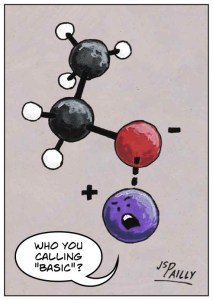
During this year’s A to Z Challenge, I ended up covering several scientific terms that do not mean what you might think they mean. Notable examples include reduction, metallicity, and volatile. Basic is another good example, but I already had something else I really wanted to do for B.

Whenever I hear someone talking about basic chemicals, it’s not always clear to me what they mean. On the one hand, basic could mean simple or ordinary.

But basic can also mean fundamental or foundational, as in a base is a foundation upon which you can build something. This gets us closer to what the word means (or should mean) whenever we’re talking about chemicals.

A “Base” for Salt

The modern usage of base and basic in chemistry can be traced back to the mid-1700’s, to Guillaume-François Rouelle, a French scientist who studied the chemical formation of salts. Rouelle found that certain substances, such as alkalis, served as good “bases” for creating salts.

All you have to do is take one of Rouelle’s bases, add an acid, and voilà! you have a salt. And if your base happens to be sodium hydroxide and your acid happens to be hydrochloric acid, you end up with water and sodium chloride, a.k.a.: table salt.

So the next time you run out of table salt but have plenty of sodium hydroxide and hydrochloric acid around, you know what to do!

A “Base” for Protons

Our understanding of acid-base chemistry is a little more sophisticated today than it was in the 1700’s. Rouelle wouldn’t have known about protons, for example. Fortunately, the original terminology still makes a certain sense, even after we learned of protons and the role they play in acid-base reactions.

In most cases (excluding Lewis acids and Lewis bases), an acid can be thought of as a molecule with a proton dangling loosely off the side. This dangling proton will break off at the first opportunity, so long as the proton can find a better place to go.

In this context (again, excluding Lewis acids and Lewis bases), a base can be thought of as a molecule that can accept a proton that has broken free of an acid. In other words, it’s the “base” upon which the proton can land and make a new home for itself.

Basic Chemicals Aren’t So Basic

So if you hear someone talking about basic chemicals, you might want to ask for some clarification. By “basic,” do they mean (wrongly) a common or easy-to-make chemical, or are they talking (in a more proper sense) about acid-base chemistry?

IWSG: Reflections on the A to Z Challenge

Today’s post is part of the Insecure Writer’s Support Group, a blog hop where insecure writers like myself can share our worries and offer advice and encouragement. Click here to find out more about IWSG and to see a list of participating blogs.

Today’s post is also my reflections post following my first A to Z Challenge.

Back in March, I mentioned to a friend that I was having a hard time with writing. I believe I said something like, “I’ve fallen out of love with writing.” Under the circumstances, I didn’t feel up for something like the A to Z Challenge; and yet I did it anyway, and I’m glad I did.

My theme was scientific terminology (a.k.a. Sciency Words), because of course that would be my theme. My Sciency Words series is an obvious fit for A to Z. How could I not do that?

The real challenge for me in the A to Z Challenge wasn’t writing 26 blog posts, nor was it reading everybody else’s blogs over the course of 26 days. No, the real challenge, at least for me, was doing both at the same time.

Whenever I was in the heat of writing the next batch of posts, I fell behind on all the blogs I wanted to read. I couldn’t even keep up with the comments people were leaving on my own posts (if you commented on something, and I never responded or came to check out your site, I’m really sorry).

And then when I was keeping up with all the cool/inspiring/thought-provoking blogs I was reading, I started falling behind—way behind—on my own writing schedule. I have to admit that Sciency Words: A to Z almost ended in disaster toward the end of week three.

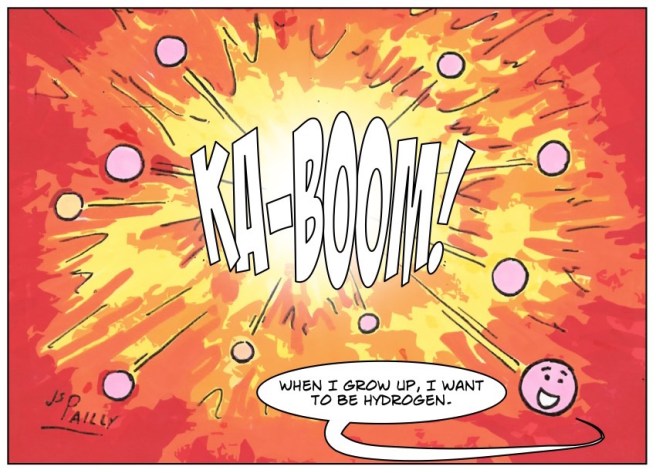
Oh well. Lessons learned, and I’ll try to do better next year. And honestly, despite the problems I had I met a lot of cool new people, and also I’m pretty happy with how my 26 posts turned out. The thing I’m most proud of was this cartoon from Sciency Words: Planet.

Going into May, I’m now feeling a lot better and a lot more confident about my writing. I guess the A to Z Challenge was just what I needed to fall in love with writing again.

Molecular Monday: Why Chemistry?

The first Monday of the month is Molecular Monday here on Planet Pailly!

We just wrapped up this year’s A to Z Challenge, and I ended up writing a lot about chemistry. A lot more than I expected. You’d think I must really love chemistry.

But I don’t.

I really don’t.

For a long time, I tried to avoid the subject completely due to bad memories from high school chemistry. My professor was extremely generous in giving me a just-barely-passing grade.

So when I made the commitment to include more science in my science fiction, I figured I could get by with just the “fun” sciences like physics and astronomy. Then in 2015, I did my yearlong Mission to the Solar System, and the planet Venus forced me to start learning this chemistry stuff.

As you can see in this totally legit actual Hubble image, Venus has some very special chemical activity going on.

There’s simply no way to understand what’s happening on Venus without getting into the weird sulfur chemistry of the Venusian atmosphere. But once you do make sense of that sulfur chemistry, a strange new world is suddenly open to you: a world of both heavenly beauty and acid rain hellfire death.

Since my experiences with Venus, I’ve come to realize that understanding chemistry, even at a basic level, makes my work as a science blogger and science fiction writer so much easier.

  • Is there life on Mars or Europa? What about life in other star systems, or silicon-based life? If alien life is out there, it will be the product of chemistry.
  • What about humans traveling to other worlds? What would be safe for us to eat or breathe? Chemistry can help answer that too.
  • Venus isn’t the only world defined by chemistry. Earth has been shaped in large part by the chemistry of oxygen and water; the gas giants by ammonia and methane; and then there’s a true oddball like Titan with its tholen chemistry.
  • And how am I going to get my rocket ship off the ground? By mixing rocket fuel. In other words, by doing chemistry.

Chemistry is by no means the most fundamental science, but for the kinds of things I write, it is the most applicable science. So even though I don’t enjoy the subject, I’ve forced myself to stick with it.

And if I’m being perfectly honest, in those aha-moments when complex chemical reactions suddenly makes sense to me, I may quietly murmur to myself, “Okay, chemistry is kind of fun.”

Sciency Words: Zoosemiotics (An A to Z Challenge Post)

Today’s post is a special A to Z Challenge edition of Sciency Words, an ongoing series here on Planet Pailly where we take a look at some interesting science or science related term so we can all expand our scientific vocabularies together. In today’s post, Z is for:

ZOOSEMIOTICS

As a writer, words are my trade. As a science fiction writer, I feel scientific terminology is crucial to what I do, which is why I write this Sciency Words series.

But it’s also important to recognize the limitations of written and spoken words, and to be aware of the fact that language—as we humans understand the concept—is not the only means of communication available to us… or to life in general.

Zoosemiotics (pronounced with a double-o sound, zo-o-semiotics) comes from two Greek words: zoe, meaning life (specifically animal life, in this case), and semeion, meaning sign or signal. The term refers to the way animals communicate with each other and the study of this communication.

Well know examples include:

  • Birdsong
  • Whale-song
  • The dance of bees
  • Ants laying down scent trails
  • Dogs marking their territory
  • Squid rapidly changing colors

In all these cases, animals attempt to convey a message of some kind to each other using signs or signals. Sometimes these signals are interpreted correctly; sometimes they’re not, especially when different species are involved (interspecies zoosemiotics).

But whenever an animal is trying to communicate an idea to another—even simple ideas like “Danger!” or “Food this way!”—you can bet a zoosemiotician would really like to study what’s going on.

The field of zoosemiotics also covers the study of how animals try to use signs and signals to communicate with humans (anthropological zoosemiotics). Of course if you’re a pet owner, you probably don’t need a degree in zoosemiotics to know how animals communicate with us. You already know.

Next time on Sciency Words: A to Z… oh wait, we’re done with that. Tomorrow, if I hate chemistry so much, why have I forced myself to keep studying it? Tune in for the return of Molecular Mondays.

Sciency Words: Ylem (An A to Z Challenge Post)

Today’s post is a special A to Z Challenge edition of Sciency Words, an ongoing series here on Planet Pailly where we take a look at some interesting science or science related term so we can all expand our scientific vocabularies together. In today’s post, Y is for:

YLEM

When George Gamow and Ralph Alpher were developing the Big Bang Theory (the actual theory, not the T.V. show), they needed a term for the bizarre form of matter they predicted would have existed in the early universe. They ended up picking the awkward-sounding word ylem.

In a 1968 interview, Gamow had this to say about the word’s origins: “You can look in the Webster dictionary. This is a word—I think it’s an old Hebrew word, but Aristotle was using it—in Webster dictionary (sic) is says ‘material from which elements were formed.’”

As a word nerd, I’m compelled to make two points of clarification before we can move on. First, I hate when people cite “Webster’s dictionary” as a source. Webster is not a trademarked name (Merriam-Webster is), so anybody can stick “Webster” on a dictionary and make it sound authoritative. Second, ylem does not come from Hebrew; the etymology traces back to the Greek word for matter (this according to my favorite real dictionary, The New American Heritage Dictionary, Fifth Edition).

Okay, word nerd rant over.

Aristotle did have something to say about the “fundamental matter” from which the elements formed. By elements, of course, he meant earth, fire, wind, and water. Aristotle’s term for this was proto-hyle. Over the millennia since Aristotle’s time, the hyle part of proto-hyle changed phonetically (Latin added an m, French dropped the h), and thus ylem entered English as a philosophy term.

Gamow and Alpher then turned it into a scientific term. Regardless of which dictionary they were looking at, for them it meant the primordial matter that existed after the Big Bang but before the chemical elements formed.

In a sense, this isn’t too far from the proto-hyle Aristotle was talking about. Except by elements, Gamow and Alpher meant things like hydrogen and helium, not earth or fire. Also, they could be a whole lot more specific about what ylem actually was: a highly charged plasma of protons, neutrons, and electrons that took roughly 400,000 years to cool off before it could start combining as atoms.

Next time on Sciency Words: A to Z, animals may not be able to talk, but they have other ways to communicate with us.

Sciency Words: Xena (An A to Z Challenge Post)

Today’s post is a special A to Z Challenge edition of Sciency Words, an ongoing series here on Planet Pailly where we take a look at some interesting science or science related term so we can all expand our scientific vocabularies together. In today’s post, X is for:

XENA

In January of 2005, astronomers at the Palomar Observatory in California discovered a new “planet.” Except this planet had a highly inclined (tilted) and wildly eccentric (non-circular) orbit. Pluto’s modestly eccentric, Neptune-crossing orbit was weird enough, but this? Planets aren’t supposed to have orbits like this, are they?

The Palomar Observatory astronomers decided to name their discovery Xena.

Personally, I think that name fits: a convention defying name for what was, at the time, a convention defying planet. But Xena was only intended to serve as a placeholder until the International Astronomy Union (I.A.U.) could assign an official name, and they chose the name Eris.

In Greek mythology, Eris was the goddess of discord. This name also seems fitting, given the amount of discord that would soon follow, because Eris was officially classified not as a planet but as a dwarf planet, along with Pluto.

There is now a proposal to reclassify Pluto, Eris, and about a hundred other Solar System objects as planets. It’s a proposal I like, for reasons I tried to lay out in a previous post, but it’s not something I expect to go anywhere. Most professional astronomers seem to be against it.

Anyway, the story of Xena/Eris is an example of something that seems to happen a lot in the field of astronomy. New discoveries get temporary names (pop culture references aren’t uncommon here) until the I.A.U. can review the discovery and assign a name officially.

As another example, the team behind NASA’s New Horizons mission came up with a ton of names for geological features on Pluto and its moon, Charon. Many of these names came from Star Trek, Star Wars, Doctor Who, Battlestar Galactica, The Lord of the Rings… apparently there are a ton of nerds at NASA. You can expect the I.A.U. to change most of those names—but perhaps not all of them. Sometimes a pop culture reference gets the I.A.U.’s okay (especially Lord of the Rings references, I’ve noticed).

In the case of Eris, Eris’s moon (originally named Gabrielle) was officially renamed Dysnomia. Dysnomia was the ancient goddess of lawlessness, and Lucy Lawless was the actress who played Xena on T.V. That was apparently an intentional, though rather convoluted, way to honor what could have been Xena: Warrior Dwarf Planet.

Next time on Sciency Words: A to Z, in the beginning there was the Big Bang. Then there was ylem. A whole lot of ylem.