Mars Month!!!

I took some time off from my special Mars mission this year because… well, because I felt like blogging about some other stuff for a while. But I always intended to pick this up again where I left off.

The month of March seems like a pretty good time to do it. March is, after all, named in honor of Mars. Mars the god of war, obviously, rather than the planet… but still, March is now officially Mars Month here on Planet Pailly, and that feels right to me.

Sci-Fi Wisdom: Great Allowance Should Be Made

Today I’d like to share a quote from one of my all-time favorite books: Frank Herbert’s Dune.

When strangers meet, great allowance should be made for differences of custom and training.

This quote comes from the Lady Jessica during the famous dinner party scene that happens fairly early in the novel. It’s probably not among Dune’s most famous lines, but it’s a line that’s stuck with me over the years.

It’s so easy—too easy, in fact—to take offense when no offense was intended. Sometimes it seems as though there are people who are eager to be offended by something just so they have an excuse to lash out at people.

But really, we all come from different backgrounds, with different customs. We’ve all been trained to live by different social rules, and it’s not always clear—especially when meeting someone for the first time—where the boundaries of offensive and inoffensive behavior are being drawn.

I know I’ve said and done things that others found offensive, just as I know I’ve been offended by the things other people say or do. So I try to keep this little nugget of Sci-Fi wisdom in mind whenever someone, whether in real life or here on the Internet, offends me in some way.

Anyway, that’s just my two cents. Feel free to disagree, and if you do I promise not to be offended.

Molecular Monday: The Imaginary Sulfide Ion

Just when I feel like this chemistry stuff is starting to make sense to me, I learn something new that makes me feel like I don’t understand it at all. Maybe I’m not the only one. Maybe even the professional chemists feel the same way sometimes. With that in mind, it’s time for another episode of Molecular Mondays.

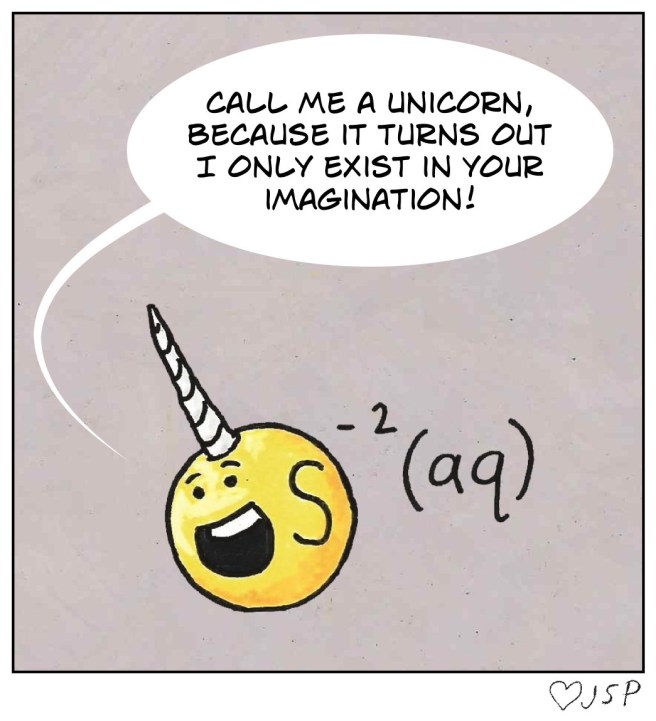
This month (February, 2018), a paper was published by the Royal Society of Chemistry that casts doubt on a longstanding assumption made by chemists. It involves the S-2 ion in aqueous solutions.

First off, this may have been the most amusing scientific paper I’ve ever had the pleasure of reading. No, the authors didn’t make any references to unicorns, but they did mention something about fairies at the bottom of a well, and then there was this delightful quote: “[…] there has been a growing awareness amongst solution chemists that the S-2(aq) emperor may have no clothes.”

As I understand it, the existence of an aqueous S-2 ion is the kind of thing that makes sense on paper. It allows chemists to easily balance their chemical equations, and it’s been included in textbooks and chemical computer databases for so long now that everyone just takes it for granted that the thing exists.

But apparently the experimental evidence of this particular ion was lacking, and aqueous solutions incorporating several different sulfide compounds did not produce any S-2 ions. At least not according to a Raman spectroscopic analysis.

Now as I’ve written before, papers like this should NOT be interpreted as final proclamations handed down from the ivory tower of science. Rather, this kind of paper should be understood as the beginning of a conversation among scientists. Does this S-2(aq) ion exist or not? If not, how many prior scientific studies need to be reexamined?

There will be further research, and perhaps a rebuttal will be published. Then there will be a rebuttal to the rebuttal, and so forth. But I think, regardless of how this plays out, that this is a good reminder that in science—as in life—what makes sense on paper does not necessarily work in the real world.

Sciency Words: Paracosm

Today’s post is part of a special series here on Planet Pailly called Sciency Words. Each week, we take a closer look at an interesting science or science-related term to help us expand our scientific vocabularies together. Today’s term is:

PARACOSM

I love this word. I was a little hesitant, at first, about calling it a scientific term, but it didn’t take much digging for me to learn (to my delight) that it is used in scientific literature. In fact, the word has its origins in science.

In the late 1970’s and early 1980’s, psychologist Robert Silvey was conducting research on the phenomenon of imaginary friends. Ben Vincent, a participant in Silvey’s research, is credited with coining the term paracosm to describe a rather special, rather complex form of imaginary play.

Paracosm combines two Greek words which can be translated as “the world beside,” as in the world that exists besides, or in addition to, the real world. A paracosm is a private fantasy world that is created and maintained over a long period of time within one’s mind.

An important thing to note is that, from the paracosmist’s perspective, this fantasy world does not exist instead or reality. It does not replace reality. Rather, fantasy and reality exist side by side, and the paracosmist lives in both. A paracosmist is not confused about what is real or what is make-believe.

According to the expert sources I’ve looked at, these fantasy worlds are highly detailed. They may be populated by humans, or talking animals, or space aliens and robots, or whatever. They may include their own history, geography, language, social order…. Also, time may not pass at the same rate in the fantasy world as it does in reality. I… I didn’t get that from any expert sources. I guess I could point to Narnia as an example, but instead I’m just going to tell you to trust me on this one: I have personal experience with this accelerated time thing.

Most of the research I’ve found about paracosms focuses on children, with generalized conclusions ranging from “this is a normal and healthy part of childhood” to “this a coping mechanism used by some children to mentally escape from abuse or neglect, or from the loss of loved ones, or from other forms of trauma.”

There’s far less research available on the phenomenon in adults, aside from the suggestion that childhood paracosmic fantasies, or aspects of them, can linger into adulthood and have an ongoing impact on people’s lives. This seems to have been the case for several well-known authors, including Emily Brontë, C.S. Lewis, and J.R.R. Tolkien.

I really do love this word. I love finally having a word to describe something that’s been part of my life for nearly twenty years. Yes, I’ve been maintaining my own paracosmic fantasy world for almost twenty years now, and I have journal entries dating back to 1998 to prove it. And during that time, thanks to the accelerated time thing I mentioned earlier, I’ve “witnessed” nearly a thousand years of fantasy history.

For a writer, that’s plenty of material to draw upon for storytelling. On rare occasions I’ve even allowed elements of my private fantasy world to seep into this blog.

And despite the lack of research on the subject, I suspect my experience of having imaginary friends and an imaginary world stick with me well into adulthood is not all that unusual, at least not for writers, artists, and other creative types.

Road Trip to Mars

Way back when I was just starting to teach myself this science stuff in order to improve my science fiction, I discovered Google Earth included, in addition to a highly detailed map of the whole Earth, highly detailed maps of the Moon and Mars. I’m told the program now includes even more worlds to explore: Pluto, Europa, Titan… I imagine there’ll be a whole Google Solar System soon enough.

Anyway, back in those early days of my sciency self-education, I was playing with Google Mars, trying to get a better feel for Martian geography, when a little window popped up asking if I’d like driving directions to the location I’d just clicked on. I’m sure you can imagine my reaction: “Oh, yes please!” But of course this was only a glitch or something, and all the “get directions” options were grayed out.

There’s just something whimsically delightful about the idea that you could hop in your car and drive to space, drive all the way to Mars if you want. Apparently I’m not the only person who thought so. I wonder if those “get directions” options would still be grayed out today, now that Elon Musk has sent one of his old cars on a Mars-ward orbital trajectory.

I realize some people were a bit peeved about the whole first car in space thing. How tacky. How wasteful. Who’s this crazy billionaire throwing his money away on a stunt like that? I get it. To be honest, I kind of agree, and I would’ve preferred it if SpaceX had used the Falcon Heavy’s first test flight to launch something more pragmatic, like a weather satellite or something. Maybe that was too risky, given that a lot of people (myself included) expected the Falcon Heavy to blow up on the launch pad. I don’t know.

But what’s done is done, and while I have mixed feelings about sending a car to space, I do enjoy the whimsy of it. Also, I’ve been pleasantly surprised over the last few weeks by how many people are still talking about the “space car,” and how many of my friends and co-workers have suddenly taken an interest in space, how many of them are asking me about Elon Musk and SpaceX and Mars exploration. I doubt that would have happened if SpaceX had launched a boring old weather satellite or something aboard the Falcon Heavy.

Anything that gets people talking about space and science is a win in my book, but what do you think? Was sending a car to space stupid and wasteful? Totally awesome? Or do you have mixed feelings about it, like I do?

Correction

Thanks to Simon for giving me the heads up about this: Musk’s Tessla Roadster is not, strictly speaking, the first car in space. Click here for more info.

Sciency Words: Baily’s Beads

Today’s post is part of a special series here on Planet Pailly called Sciency Words. Each week, we take a closer look at an interesting science or science-related term to help us expand our scientific vocabularies together. Today’s term is:

BAILY’S BEADS

This is going to be a quick one. I sort of blew all my writing hours this week finishing the first episode of my new short story series: Omni-Science. I don’t regret that. Writing Omni-Science felt awesome, and I hope you liked reading it.

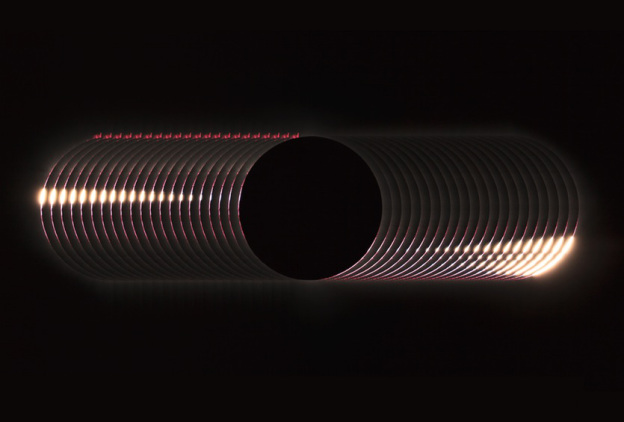
The writing prompt that inspired Omni-Science was this photograph of the “Mondretti cylinder.”

That’s a very strange and mysterious image, certainly strange and mysterious enough to get the machinery in this writer’s brain started. But being the science nerd that I am, I also recognized that this is actually a time-lapse/composite image of a solar eclipse, showing off the “Baily’s beads” effect. (Also when I downloaded the image, the file name had the words “Baily’s beads” in it, which removed any doubts I had about what I was really looking at.)

As I’m sure you know, the Moon is not a smooth, perfect sphere. It’s covered in craggy terrain, and so during an eclipse, just before the Sun disappears entirely behind the Moon, the last rays of sunlight peak out from the gaps between mountains and craters and so forth. As a result, those of us who are using proper safety gear get to see these “beads” of light around the edges of the Moon.

I’m guessing Francis Baily was not the first person to notice this, but in 1836 he became the first to explain it in a paper for the Royal Astronomical Society titled “On the remarkable phenomenon that occurs in total and annular eclipses of the sun.” Those 19th Century English astronomers certainly did have a way with words, didn’t they?

Omni-Science, Episode One: “By Definition”

This short story was inspired by a writing prompt from Fiction Can Be Fun. Basically the prompt was to write something about the mysterious “Mondretti cylinder” pictured below.
OMNI-SCIENCE

Episode One

“By Definition”

The public relations director, Mrs. Clark, was away for the week giving the keynote at some big conference in Chicago when the “object” came into existence in laboratory #4. There would have to be an official announcement, though in a sense the object had already announced itself. The gravitational distortions had sent minor tremors up and down the East Coast. But with Mrs. Clark out of town until Monday, the problem of what to say to the media and how to say it (so as not to cause a panic) fell upon Mrs. Clark’s assistant, Nick.

To be 100% blunt, Nick Shue hated his job. He’d never wanted it in the first place. He was too into celebrity gossip and everything Hollywood for all this sciency stuff. His dream, upon graduating with his B.A. in communications, had been to move to California, maybe do P.R. work for a talent agency, or maybe even become a talent agent himself, but he would have settled for the New York scene if he’d got the chance. So when the rep from Omni-Science Laboratories offered Nick the job at their main facility in Arlington, it had been Nick’s intention to say no. He’d meant, with all his heart, to say no. But somehow over the course of a forty-minute phone conversation with a perky, young girl from human resources, a conversation in which Nick felt compelled to be very polite and very agreeable, he’d found himself accidentally agreeing to take the position. And once he’d said yes to the job, Nick didn’t feel as though he could back out of it without looking like a real fool—even more of a fool than friends, family, and the average perfect stranger already assumed him to be.

Working at Omni-Science felt like the reverse of high school. The nerds were the popular ones here, while people like Nick sat by themselves in the farthest corner of the company cafeteria. But after almost a year in Arlington, Nick had seen a lot and heard a lot, and he’d developed something of a pet theory about how science really worked: at least half of science was just very smart people quibbling over what stuff was called. The scientists Nick worked with insisted this wasn’t true. A few of them also informed Nick, without any apparent irony, that he should really call his “theory” a hypothesis, seeing as he hadn’t performed any studies to support his claim.

Anyway, with Mrs. Clark out of town, it was Nick who ended up standing there in lab #4 listening to two of the most brilliant women in the world arguing over—what else?—what their enigmatic creation should be called.

“Look at the rotation! Look at the gravitational flux!” Dr. Hoshiko was saying.

“I am looking,” said Dr. Bakshali, “but I do not see this the way you see it. Go back to your initial parameters.”

But Dr. Hoshiko was flipping forward to another chart on her computer. “No, no! There can’t be any doubt, see? This thing extends both forwards and backwards in time!”

“Yes, but not in such a way as to violate causality. A Mondretti cylinder must, by definition, be the cause of its own existence. And the experimental data does not support that conclusion.”

Nick took a deep breath. Patience, he told himself. Patience is a virtue. Except the media were clamoring for answers, and Mrs. Clark had left multiple messages on Nick’s voicemail about how she wanted him to handle this.

Nick glanced up at the… whatever it was in the test chamber, the enormous thing that hung suspended midair by its own gravity/anti-gravity effects. Nick had seen the photograph which was supposed to go out with the press release, but seeing the object in person was different. It just… it looked wrong somehow. It felt wrong, just being in its presence. Nick didn’t know how to put it into words. Here was a thing that defied all easy labels that might be applied to it. Was it a cylinder? No, not in the conventional sense. Not in the sense of a cylinder as a Platonic solid, according to Dr. Hoshiko, whatever that meant. But it was round, wasn’t it? Nick blinked, and though the object looked exactly the same, it was also somehow different. It wasn’t round at all, Nick realized. It had corners. And it was moving ever so slightly. Except no, it was perfectly motionless. It appeared to be a flat, black, emptiness yet also it seemed aglow with color, to be overflowing with bright color and light. And it made a sound: a low buzzing noise, or a soft whispering… and yet the lab was dead silent. Unnervingly silent, aside from the ongoing scientific debate, of course.

Nick wasn’t a religious man (who was these days?) but even if he couldn’t bring himself to believe in any sort of god, this thing was weird enough to convince Nick it must be the Devil’s work. Nick shook his head, pinched his nose. The thing hurt his eyes. It hurt his brain.

“Ladies,” Nick finally said, “I’m sorry, but I have to write something for the press release. Can I call this thing a Monstreddi cylinder or not?”

“It’s Mondretti.”

“Not Monstreddi.”

“And no, you cannot.”

“Yes, he most certainly can!”

And the women were at it again. Nick would have to look up this Mondro-whatever thing on the Internet. He could only hope there’d be more to find than just a stub on Wikipedia.

Molecular Monday: Quasar-Induced Chemistry

Today’s post is part of a bi-weekly series here on Planet Pailly called Molecular Mondays, where we take a closer look at the atoms and molecules that make up our physical universe.

As a science fiction writer, one of the things I’m really doing with my research is trying to find excuses to break the laws of physics. So anything that might produce a previously unknown material substance, a substance that might be imbued with properties that are useful for storytelling purposes… that sort of thing is of great interest to me. With that in mind, I recently read a news article about quasars and the weird, unexpected chemical reactions they can cause.

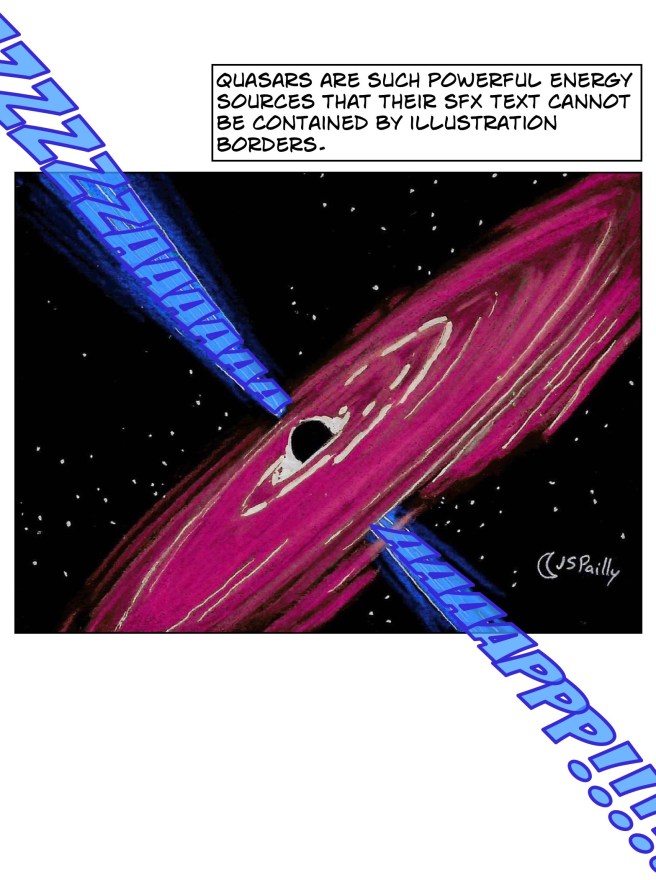
Quasars are black holes with disks of superheated gas and dust swirling around them. Due to the intense heat of the disk, the extreme gravity of the black hole, and the crazy electromagnetic field the two produce together, you end up with these twin laser-like jets of super-accelerated particles shooting away from the quasar in opposite directions.

According to this research paper published in the Monthly Notices of the Royal Astronomical Society, and according to this slightly less technical summary from Physics World, any molecules that happen to get caught in a quasar’s laser beams are ripped apart by a process known as photolysis. Then, after these quasar-zapped particles have had some time to cool off, they can recombine to form new molecules.

I was led to believe by the initial news report I read that this sort of extreme scenario might also cause atoms to recombine in ways that they normally wouldn’t. Unfortunately I don’t see anything in the actual research to back that up. For the most part, quasar chemistry produces fairly ordinary molecules like hydroxyl, carbon monoxide, and molecular hydrogen.

Still, for the purposes of science fiction, some sort of quasar-induced chemical reaction producing strange, new, potentially valuable chemical substances… that may be too awesome of a concept for me to pass up.

Sciency Words: Moon Village

In this week’s episode of Sciency Words, the Moon would like to ask a question, the same question it’s been asking since 1972:

The answer is we humans may be returning to the Moon fairly soon, perhaps within the next decade, but this time we’ll be bringing a far more diverse set of flags to add to the Moon’s collection.

The European Space Agency, also known as the E.S.A., is taking the lead on the next round of Moon missions. For the last few years, Johann-Dietrich “Jan” Wörner, the current E.S.A. director-general, has been talking up the idea of building a Moon village near the Moon’s south pole, a region where large quantities of water ice have been detected.

Apparently interest in Wörner’s Moon village has been growing steadily to the point that Wörner has been quoted saying the village is already “more or less a fact.” I have a feeling the recent successful test of SpaceX’s Falcon Heavy rocket will accelerate that growth in interest.

But my biggest question about this, and the reason I felt this was worthy of a Sciency Words post, is this: why aren’t we talking about a Moon base? Why is it a village? Apparently the terminology was a very deliberate choice. On the E.S.A. website, Wörner writes:

By ‘Moon Village’ we do not mean a development planned around houses, some shops and a community centre. Rather, the term ‘village’ in this context refers this: a community created when groups join forces without first sorting out every detail, instead simply coming together with a view to sharing interests and capabilities.

I remember in first or second grade painting a mural as a class project. Each student was free to paint whatever he or she liked within the guidelines set by the teacher. The Moon village sounds like a similar concept to me, with every participating country or company or other privately funded group doing their own thing within the broader guidelines set by the E.S.A.

I just hope the end result is not quite the eyesore that that mural was when I was a kid.

IWSG: Have I Pushed My Writer Too Hard?

For this month’s episode of the Insecure Writer’s Support Group, I’m going to turn the floor over to my muse. She has something to say, and perhaps it’s something your muse would like to hear.

* * *

Over the last few months, I’ve had trouble getting my writer to be productive. Many of the juiciest story ideas I’ve brought him had to be put on hold because real life keeps getting in the way.

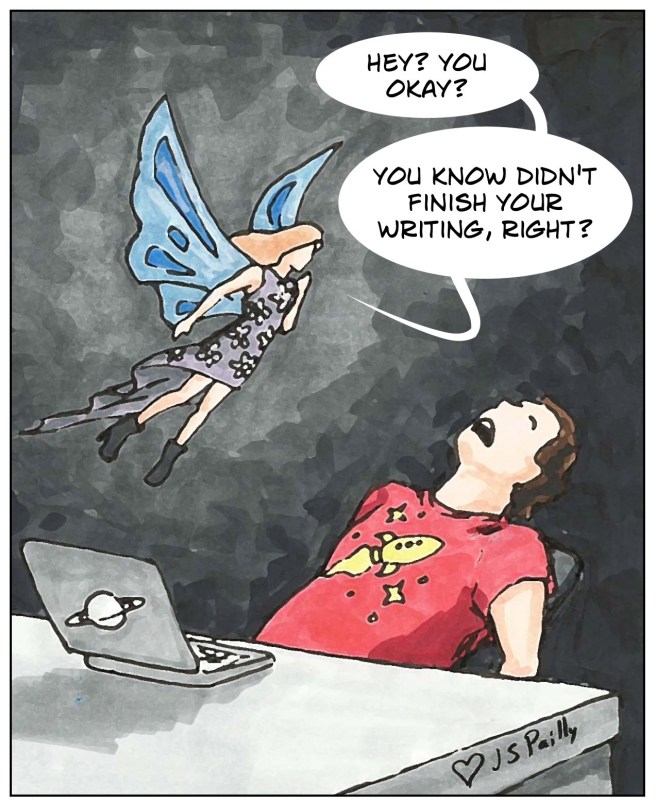
As I reported in my previous Insecure Muse’s Support Group post, I’ve had some success using writing as a distraction from those real world problems. Unfortunately it’s been sporadic success. Some days my writer would get thousands of words down on paper. Other days, I’d find him like this:

To be honest, I think a lot of the problems my writer is dealing with are less severe than he thinks they are, but the fear and the stress still feel real to him. Writing helps calm him down. There’s no doubt about that. But sometimes my writer is so emotionally drained that he just can’t write no matter how badly he needs to.

So I’d like to ask my fellow muses (writers, you can chime in too if you want): how do you know when to push your writer harder and when to let him or her take some time to recover?