IWSG: When Science Gets in the Way…

Today’s post is part of the Insecure Writer’s Support Group, a blog hop where insecure writers like myself can share our worries and offer advice and encouragement.  Click here to find out more about IWSG and see a list of participating blogs.

The month of May brought me one of the highest highs I’ve ever experienced: I finished a certain long anticipated manuscript.  May also brought me one of my lowest lows.  Two close friends agreed to look over the manuscript, and… well, let’s just say they didn’t think it was very good.

After a heartbreaking week and a half of going over my friends’ feedback, I’ve realized that I made two fundamental mistakes.

  • First off, I’d been playing with a new writing style. It was very flowery. Very fancy.  I thought it sounded awesome, until I tried to read it out loud.
  • And secondly, I tried to cram as much science into the story as I could. I thought I was making my Sci-Fi universe more believable, but all I was doing was adding info dumps.  Very flowery info dumps.

When I started this blog, part of my intention was to force myself to do the kind of research that I, as an aspiring science fiction author, thought I ought to be doing.  But in one of my earliest posts, or maybe it was an early tweet, I wrote that I’d never let a scientific fact get in the way of a good story.

This blog really has served its purpose.  I’ve done a lot of research over the last eight years.  Can you blame me for wanting to show off everything I’ve learned?  But, of course, I let all that science get in the way of good storytelling, and now I need to fix it.

For a start, I’m breaking up some of those long, flowery sentences.  And as for the science, I’m not going to remove it entirely, because I still believe good science is crucial for good science fiction.  But maybe I don’t need to spend so much time explaining everything.

So now, back to writing.  Or rather re-writing.

Molecular Monday: Carbon vs. Silicon

I recently completed a certain long anticipated manuscript, and I’m currently in the process of rewriting and revising it. Editing this thing has me thinking about a certain line from Macbeth, which I’ll paraphrase as: I have walked so deep into blood that, should I go no farther, returning will be as tedious as continuing onward.

That’s morbid, I know.  What do you expect?  It’s Shakespeare!  But simply replace the word blood with red ink, and I think you’ll understand how the editing is going for me.

Anyway, I’ve waded so far into that “red ink” that I haven’t had much time for research; so for today’s episode of Molecular Monday I thought we’d take a look back at one of my older posts.  A very old post, from all the way back in 2011, long before I really knew what I was talking about with regard to organic chemistry.

And yet despite my ignorance and inexperience, I think I still got the general idea right with this one.  Also, this post includes one of my very first attempts at science illustration, so I hope you’ll enjoy that!

CARBON vs. SILICON

It’s often suggested that the aliens from the Aliens movies, sometimes referred to as xenomorphs, are silicon based rather than carbon based like us.  There are a lot of silicon based aliens in science fiction, but no one knows if such a thing is really possible.

Carbon and silicon have one thing in common: they both have four bonding sites, meaning they can bond with up to four other atoms when making a molecule.  Other than that, they’re completely different.  Silicon is a metalloid; carbon is a nonmetal.  Carbon is much lighter and more flexible, and it’s ten times more abundant in the universe.

If the idea of silicon based life is simply to replace carbon atoms with silicon, it wouldn’t work.  Take breathing for example.  We breath oxygen in, and exhale carbon dioxide.  When a silicon based alien breaths in oxygen, it will have a hard time exhaling silicon dioxide; silicon dioxide is better known as quartz crystal.

I don’t remember any xenomorphs hacking up quartz crystals in the movies, but maybe they use silicon for something else.  Carbon has to be part of their biochemistry anyway, or they wouldn’t be able to grow inside human hosts.

Humans are not only carbon based.  We also depend on oxygen, nitrogen, hydrogen, phosphorus, and sulfur.  Not only that, but we need traces of iron, sodium, potassium, etc as well.  So maybe the xenomorphs can be carbon based and silicon based at the same time.

Sciency Words: Thiea

Today’s post is part of a special series here on Planet Pailly called Sciency Words.  Each week, we take a closer look at an interesting science or science-related term to help us expand our scientific vocabularies together. Today’s term is:

THEIA

When I wrote about the Nice model, I said it does a nice job (pun intended!) of explaining how the planets of the Outer Solar System started out, and how they ended up where they are today.  But what about the Inner Solar System?  Well, it turns out we may have started with a few more planets than we have today, and one of those hypothetical early planets has been named Theia.

Technically speaking, Theia wouldn’t have been a planet (not according to the I.A.U. definition), but it was definitely planet-sized, perhaps as large as modern day Mars.  But Theia had to share its orbit with another planet that wasn’t technically a planet (yet): Earth.

Theia got stuck near one of Earth’s Lagrange points, about 60 degrees ahead of Earth in Earth’s almost circular orbital path.  There’s some weird gravitational voodoo going on at these Lagrange points, and so this arrangement of Earth and Theia could theortically have remained stable long term.

Except Jupiter and/or Venus disrupted the gravitational balance, pulling Theia a little this way, a little that way, nudging Theia away Earth’s Lagrange point and closer to Earth itself, until one day….

I would call this the worst disaster in Earth’s history, except this collision was sort of the moment when Earth (as we know it) really began.  I gather there’s still a lot of disagreement about the details, like whether this was a head-on collision or more of a glancing blow, but the two really important things to know are:

  • Theia knocked a large amount of Earth debris into space. That debris eventually coalesced to form our Moon.
  • Most of Theia is probably still here.Theia has become part of Earth, and the bulk of Theia may have would up becoming Earth’s core.

This idea that early Earth suffered a cataclysmic collision with another planetary body has been credited to a lot of different people, but it first appeared in the scientific literature in this paper from 1975.  The name Theia wasn’t introduced until much later, in this paper from 2000.

In Greek mythology, Theia was the Titaness who gave birth to the Moon.  That checks out. The name definitely seems appropriate.  In the myth, Theia also gave birth to the Sun.  That part doesn’t match up with the science so well.

But not to worry!  In next week’s episode of Sciency Words, we’ll meet the Sun’s real mother.

TRAPPIST-1: When Icy Planets Thaw

Last week we talked about TRAPPIST-1 and its seven planets.  Turns out those planets have a whole lot of water (or at least they have very low densities, so they probably have a whole lot of water).  And yes, it’s entirely possible that something could be swimming around in all that water.  But the paper I cited last week wasn’t really about water or alien life.  Not really.

I mean, the stuff about water was important, but it wasn’t the real point of the paper.  The real point was that such water-rich planets could not have formed so close to their star.  They must have formed farther away, somewhere beyond TRAPPIST-1’s frost line, so that they’d be able to accumulate large quantities of water (and/or other volatiles) in the form of ice.  Then they migrated inward.

It would be sort of like if the ice-covered world of Pluto, or any of the large, icy moons of the Outer Solar System, were suddenly transplanted to the Inner Solar System.  All that frozen nitrogen and frozen methane would sublimate, turning into a generously thick atmosphere.  And all that frozen water would melt, turning into a deep, deep ocean—a global ocean so deep it would make Earth’s oceans look like puddles.

That’s what the TRAPPIST-1 planets are probably like: Pluto-like worlds that thawed.

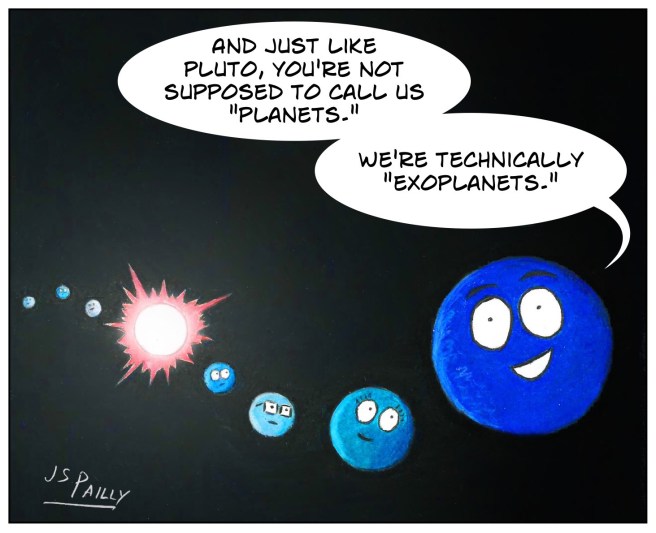
The inward migration of the TRAPPIST-1 planets—sorry, I mean exoplanets—is sort of the opposite of what happened in our own Solar System.  Our gas giants, according to the Nice model, started out closer to the Sun and then migrated away (except for Jupiter, which moved a little closer to the Sun).

That was the real point of that paper I cited last week. This is also the kind of thing that made TRAPPIST-1 so scientifically interesting in the first place: the alignment of those seven exoplanets makes it really easy for us to study orbital dynamics in a multi-planetary system, and to compare and contrast what we learn with what we know about our own Solar System.

The stuff about water and potential alien life… that was just a nice bonus.

Sciency Words: Degeneracies

Today’s post is part of a special series here on Planet Pailly called Sciency Words.  Each week, we take a closer look at an interesting science or science-related term to help us expand our scientific vocabularies together. Today’s term is:

DEGENERACIES

Okay, I have to be honest with you: I really don’t understand what this term means.  It’s a statistics thing, and it gets really mathy.  But since I came across this term in a paper about the TRAPPIST-1 planets, I felt I should try to get some sense of what a degeneracy is.  What I learned, at least in relation to planets, was interesting enough that I thought it was worth sharing with you.

Imagine we’re playing a game of “Guess Who?”  You know my person has red hair, but you still don’t know my person’s age or gender, you don’t know if my person is wearing glasses, or if my person has freckles.  That one datapoint—my person has red hair—eliminates a lot of possibilities from the board, but there are still plenty of possibilities left over.

Those left over possibilities can be refered to as degeneracies (if I’m understanding the proper usage of this term).  In that paper on the TRAPPIST-1 planets, it says: “The derivation of a planetary composition from only its mass and radius is a notoriously difficult exercise because of the many degeneracies that exist.”

In other words, if you’re playing “Guess Who?” with planets, knowing a planet’s mass and volume (and thus being able to calculate its density) still leaves you with a whole lot you don’t know about that planet.

This reminds me a lot of the Earth Similarity Index and the problems with using that system to identify Earth-like planets. Venus, for example, scores rather highly on the E.S.I. because its mass and volume are so similar to Earth’s, but Venus is not at all Earth-like in the sense that most people mean when they talk about Earth-like planets.

I’d say I plan to study this concept more, but I think I’m done for now.  I tried to read this paper from 2010 which seems to have introduced the subject of degeneracies to planetary science and warned that they’d be a real problem in the study of exoplanets.  But after attempting to slog my way through that paper, I think I’ve had enough mathy stuff for a while.

TRAPPIST-1: Too Much Water to Support Life?

I’m still catching up on my research after having something of a rough start to the year.  A few months ago, I saw headlines saying that water had been discovered in the TRAPPIST-1 system.  A whole lot of water.  Too much water, in fact.  Normally where there’s water there could be life, but according to the news articles I read back in February, the TRAPPIST-1 planets have so much water that life probably could not exist there (not enough carbon, not enough minerals).

Bummer.

But now I’ve finally read the actual research, and I’m really glad I did because a lot of journalists in the popular press clearly did not.  This paper, titled “Inward Migration of the TRAPPIST-1 Planets as Inferred From Their Water-Rich Compositions,” ends thusly:

[…] while these planets may be habitable in the classical definition, any biosignature observed from these planets system may not be fully distinguishable from abiotic, purely geochemical sources.  Thus, while M-dwarfs may be the most common habitable planet-host in our Galaxy, they may be the toughest on which to detect life.

In other words, these planets very well might be able to support life, but we may not be able to detect that life if it’s there.

This reminds me of a paper Carl Sagan wrote in the 1990’s showing how difficult it is to conclusively prove there is life on Earth based solely on observations made by a passing NASA spacecraft.

Earth’s oceans in particular do an outstanding job masking the usual biosignatures we would be looking for.  As far as that NASA spacecraft could tell, Earth’s oceans appeared to be completely lifeless.

So if the planets of the TRAPPIST-1 system really are as that inward migration paper describes them—15% to 50% water, with their surfaces covered entirely by ocean—then we are going to have a really difficult time finding life there.  But that is not the same as saying there’s no life there to find!

Molecular Monday: Dihydrogen Monoxide

Welcome to another episode of Molecular Mondays, a special biweekly series here on Planet Pailly where we take a closer look at the atoms and molecules that make up our physical universe, both in reality and in science fiction.

I had a really bad time in high school chemistry.  That was the closest I ever came to failing a class, and the experience sort of traumatized me. But there was one lesson from my high school chemistry class that I did learn well.  It involved a chemical with the very scary sounding name dihydrogen monoxide.

The teacher gave us a handout to read, laying out the case that dihydrogen monoxide (also known as DHMO) is a horrifyingly dangerous chemical that should be banned.  DHMO has been found to be present in cancer cells, and yet it continues to be incorporated into our processed foods.  It’s one of the chemical components of acid rain, and yet we keep putting more of it into our atmosphere.  Inhaling DHMO has caused deaths, the U.S. Navy has conducted weapons tests using DHMO, etc, etc, etc…

My teacher seemed a bit like an aging hippie and probably an environmentalist too, so I thought I understood why he was having us read this.  I had the vague suspicion that I was being scammed somehow, that this article about dihydrogen monoxide might not be telling the whole story.  But when the teacher asked us what should be done, I went along with the crowd and voted to outlaw DHMO.

Everyone in the class voted to outlaw it, except one kid: the stereotypical super smart, super nerdy kid (every class has one, I think).  He just sat there with a big grin on his face.  The teacher, who was also grinning at this point, asked what was so funny, and the smart kid of the class proceeded to explain that “dihydrogen” means two hydrogen atoms, and “monoxide” means one oxygen atom: H20.  We’d just voted to outlaw water.

Going back through everything it said in the handout:

  • DHMO is found in cancer cells… yes, it’s found in all your cells.
  • It’s in processed foods… sure, unless your food’s been dehydrated.
  • It’s in acid rain… because acid rain is still rain.
  • We’re putting it into the atmosphere… yes, everytime we boil water.
  • Inhaling it can kill you… that’s called drowning.
  • The U.S. Navy uses it… obviously!

I guess the lesson I learned that day had more to do with linguistics than chemistry.  Just because something has a scary-sounding name, that does not necessarily mean it’s a scary thing.  People may try to deceive you while hiding the truth in plain sight. This is especially true with science, where you can rely on the science illiteracy of the general public.

So stay skeptical, and whenever you’re confronted with a strange and unfamiliar word, don’t be afraid to ask what that word actually means.

P.S.: High school students aren’t the only ones who’ve fallen for the DHMO hoax.  At least one politician, when confronted with similar facts about this very dangerous chemical, called for outlawing water.

Sciency Words: Nice Model

Today’s post is part of a special series here on Planet Pailly called Sciency Words.  Each week, we take a closer look at an interesting science or science-related term to help us expand our scientific vocabularies together.  Today’s term is:

NICE MODEL

I recently assembled Lego’s Saturn V rocket set, and I have to say it’s a really nice model.  It even has these little orange pieces to represent the floaty things for when the Apollo capsule returns to Earth and splashes down in the ocean. That, I thought, was a really nice touch!

But as nice as that Lego model is, that’s not the model we’re talking about today.  Nope, today we’re talking about the Nice model, with a capital N.

In May of 2005, three papers were published in the journal Nature which did a nice job explaining some of the big mysteries of our Solar System.

  • First (in order of page number) was a paper on the anomalous orbital eccentricities and inclinations of the four gas giant planets.
  • Next came a paper on the Trojan asteroids which hang out around Jupiter’s Lagrange points, 60º ahead and 60º behind Jupiter in its orbital path.
  • And lastly, there was a paper on the Late Heavy Bombardment, a period of time when the Moon (and also the four inner planets) got pummeled with asteroids.

All three of these papers share a common idea: that the four gas giants of our Solar System must have started out much closer together, with a broad disk of rocky and icy debris beyond them, like a super-sized Kuiper belt.  Then, approximately 700 million years after their initial formation, three of those gas giants (Saturn, Uranus, and Neptune) started drifting farther and farther away from the Sun and away from each other.

Jupiter seems to have drifted slightly closer to the Sun, but stopped short of entering and demolishing the inner Solar System thanks to a last minute gravitational interaction with Saturn (thanks, Saturn!).

As the gas giants spread out, they threw that super Kuiper belt into chaos.  Some of that rocky and icy debris was hurled toward the inner planets, causing the Late Heavy Bombardment.  Some of the debris got stuck around Jupiter’s Lagrange points, becoming the Trojan asteroids.  And with so many complicated gravitational interactions happening at once, it’s no wonder the four gas giants ended up with some anomalies in their orbital paths.

This one idea—that the gas giants drifted apart after they formed—does a pretty nice job explaining three of the biggest mysteries about our Solar System.  But sadly, that’s not why it’s called the Nice model.  The name actually isn’t pronounced like the English word “nice” but rather like the French city of Nice (which rhymes with geese or fleece).  That’s because the model was originally formulated at an observatory in Nice, France.

Unfortunately, I didn’t find that out until I’d already sprinkled a bunch of nice puns into this post, and I don’t feel like taking them out.

The End for Juno?

We’ve always known the Juno Mission to Jupiter would be a short one.  Often times planetary science missions like Juno will get extra funding for extended missions, because it costs less to keep using a spacecraft you already have than it does to design, build, and launch a new one.  But as I wrote two years ago, this really wouldn’t be an option for Juno.

The reason is that Jupiter has at least one moon (Europa) and perhaps two others (Ganymede and Callisto) which may be home to alien life.  Based on everything I’ve read about Europa in particular, I think it would be a bigger surprise if we didn’t find life there; that’s how promising the place looks.

NASA absolutely cannot risk letting Juno crash into and contaminate any of those moons (especially Europa).  So after completing its scheduled mission, which was meant to take about two years, Juno would do a suicide run into Jupiter’s atmosphere, destroying itself to ensure there are no future accidents, and also collecting a little extra atmospheric data in the process.

Except shortly after Juno arrived in Jupiter orbit, it ran into some engine trouble, something to do with a pressure valve opening too slowly. As a result, Juno wound up stuck in a much wider and much longer orbit than originally planned.  Rather than getting a science pass every 14 days, we’re getting them every 53 days, which has dramatically slowed down Juno’s progress.

Juno’s two years are almost up, but because of that pressure valve malfunction its mission is only half complete.  So now Juno needs that mission extension that it was never supposed to get.  A planetary scientist working on the Juno Mission was recently quoted as saying: “I think for sure the continuation mission will go on.”  He then added: “I’m hopeful but nervous.”

Funding for the Juno mission (for ground operations, mission control stuff, etc) will run out in July of this year. Given the circumstances, I have to assume NASA will grant Juno an extension, but as of this writing they have not done so.  Navigating the bureaucracy here on Earth can be just as nerve-wracking as all the hazards of space.

I’m not sure how much Congress is involved in the decision making process here, so maybe that’s what’s holding things up. Or maybe Juno has run into other technical issues which NASA hasn’t made public yet.  I don’t know, but if anything else went wrong with the spacecraft during its extended mission, we might lose control of it, and we really, really do not want it crashing into those icy-on-the-outside, watery-on-the-inside moons.

So fingers crossed.  Hopefully everything works out okay and Juno can get its extended mission.