Where Are the Earthlings?

Have you ever looked up at the night sky and wondered if maybe, somewhere out there, someone might be looking back at you?  Well, I’m here to tell you the answer to that question is yes.  Or at least there are aliens out there who are trying very hard to find us.  I even have video evidence to prove it!

For us Earthlings, it’s pretty obvious that there’s life on this planet.  How could you possibly miss it?  But for aliens observing Earth from a distance—perhaps a very great distance—the most obvious biosignatures are frustratingly difficult to detect.

In the early 1990’s, Carl Sagan wrote a famous paper about this problem.  One of NASA’s own space probes, which was heading out to Jupiter, briefly turned all its instruments back on Earth.  Based on that data alone, without any prior knowledge about this planet, you could probably figure out there’s life on Earth. Probably.

This more recent paper published in The Astrophysical Journal follows up on Sagan’s work.  Assuming the aliens are smart (a big assumption, based on what the video evidence shows us), they should be looking for a planet with both an oxidizing gas AND a reducing gas in its atmosphere.

Oxidizing and reducing agents should react with each other relatively quickly, removing each other from the planet’s atmosphere.  So in order to have those two things coexisting long term, some exotic process (like biological activity) must be constantly replenishing them.

A spectroscopic analysis of Earth’s atmosphere would reveal a whole lot of the chemicals in our air, but not all of them. Apparently some spectral signatures are so strong they cover up others, which I think is an important thing to know.  But oxygen (an oxidizing gas) should still be detectable in the visible light part of the spectrum, and methane (a reducing gas) should show up in visible and infrared.

But still, it sounds like difficult work, teasing the signatures of oxygen and methane out of all the other spectral signatures you’d get from Earth’s atmosphere.  This could be why the aliens are having such a hard time finding us, and also why we are having such a hard time finding them.

Where Are the Aliens?

I fell way behind on my science and space exploration research last year.  I now have a tall pile of to-be-read books and papers in my reading room.  But I’m now starting to catch up, beginning with this paper on the atmospheres of Earth-like planets.

As explained in this article from the Planetary Society, the goal of this paper is to start creating a guidebook for finding planets that might be home to alien life.  And based on what the paper says early on, it sounds like there are plenty of “habitable Earth-like planets” out there to be found!

If we’re looking only at red dwarf stars, which are the smallest and most common of stars, about 30% of them should have a habitable Earth-like planet orbiting them.  And between 5 and 20% of orange, yellow, and yellow-white dwarf stars should have habitable Earth-like planets too.  Our own Sun, by the way, is a yellow dwarf star.

Statistically speaking, this means we should find another Earth orbiting a red dwarf within only 2 parsecs of us.  And there should be another another Earth orbiting an orange, yellow, or yellow-white dwarf within 6 parsecs.  I feel like that’s surprisingly close, at least in the grand scheme of our universe.

Except when astronomers talk about Earth-like planets, what they’re actually describing does not necessarily sound much like Earth.  Any planet that’s about the same size and mass as Earth can be called Earth-like, and by that standard Venus is about as Earth-like as any planet can be, aside from Earth itself.

And when this paper talks about habitable Earth-like planets, I’m pretty sure all the authors mean are planets within the habitable zones of their parent stars.  But just because a planet orbits within a habitable zone does not mean that planet is truly habitable.  Again, look at Venus.

So when we do find a “habitable Earth-like planet” within 2 or 6 parsecs of us, how will we know we’re looking at another Earth and not another Venus?  That’s a tricky question.  Maybe it would help to think about the problem from a different perspective.  You see, while we humans are having a really difficult time finding alien life, the aliens may also be having a very difficult time finding us.

More on that in the next post!

Sciency Words: Karman Line

Sciency Words: (proper noun) a special series here on Planet Pailly focusing on the definitions and etymologies of science or science-related terms.  Today’s Sciency Word is:

THE KARMAN LINE

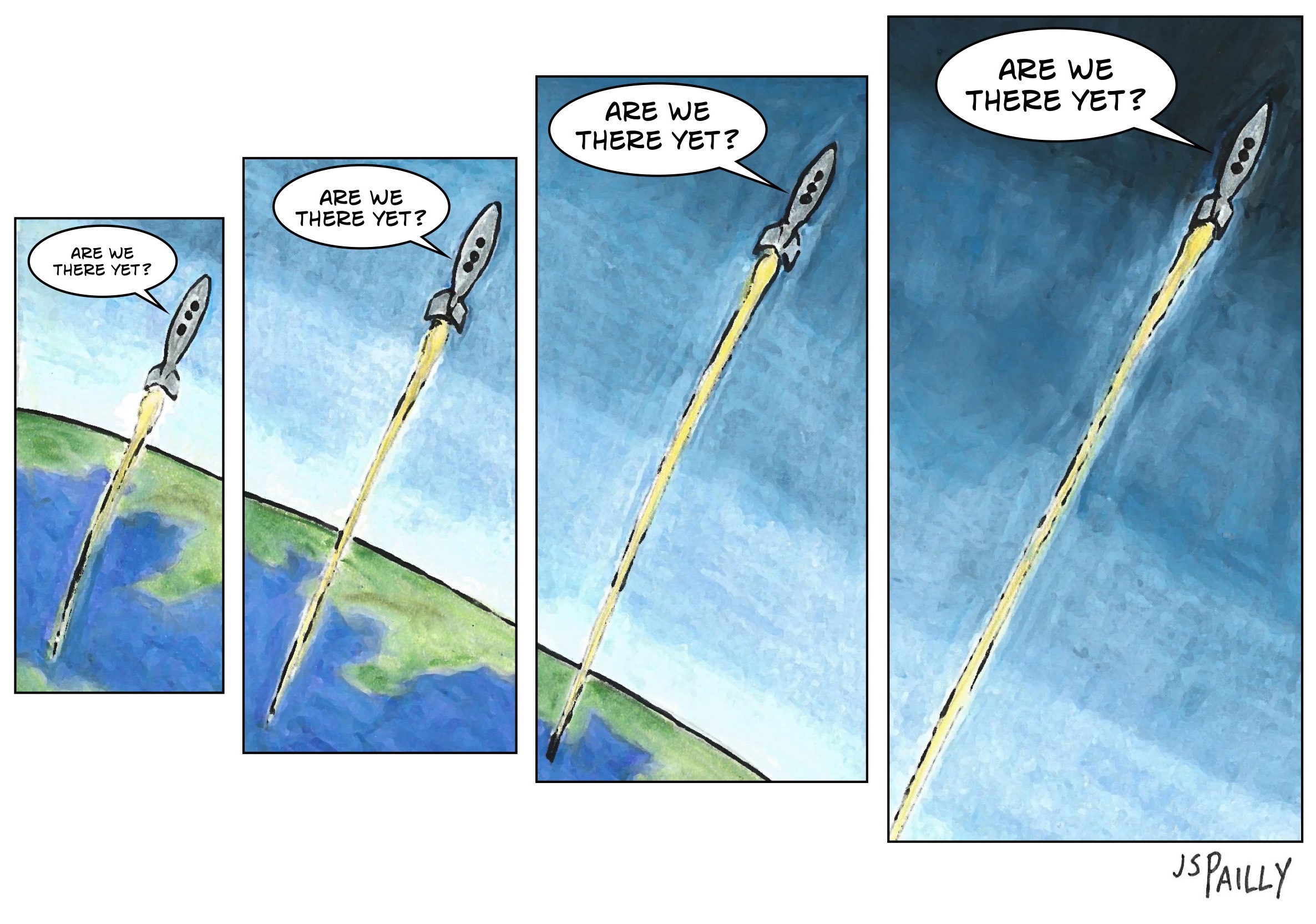
If I may begin on a personal note, I spent most of 2018 essentially grounded by real life problems.  So for 2019, I’m dusting off the old imaginary spaceship, and I’m ready to launch myself back into outer space.  It seems I have a whole lot of space research I need to catch up on!  But first, where exactly is space?  How far away is it?

In the early 1960’s, Hungarian-American physicist Theodore von Kármán proposed an idea that has come to be known as the Karman line. Basically, the Karman line can be defined as the altitude where you need to stop thinking in terms of aerodynamics and start thinking in terms of orbital mechanics.

A traditional aircraft flying above the Karman line will no longer get enough lift to stay aloft, and a satellite or other space vehicle that dips below the Karman line will experience too much atmospheric drag to maintain its orbit.  Technically speaking, there are still more layers of Earth’s atmosphere above that line, but still this seems like a sensible enough place to define the beginning of outer space.

So how high up is the Karman line?  According to the Fédération Aéronautique Internationale (F.A.I.), which is sort of like the Guinness Book of World Records specifically for air and space flight, the Karman line is 100 km above sea level.  This is the value that seems to be most commonly accepted around the world, but it is not the value accepted by one noteworthy space agency: NASA.

According to NASA, space begins 50 miles above sea level. This 50 miles number is not merely a result of America’s famous disdain for the metric system.  As explained in this paper from Acta Astronautica, calculating the exact altitude where aircraft can no longer fly and satellites can no longer maintain their orbits has been a challenge for many decades; however, an estimate of 80 km (approximately 50 miles) may be closer to the real Karman line than the 100 km estimate set by the F.A.I.

A lot may depend on your spacecraft’s design, the parameters of your orbit, and solar activity, which causes Earth’s atmosphere to puff up slightly at times.  But to quote from that Acta Astronautica paper:

[…] elliptical orbits with perigees at 100 km can survive for long periods. In contrast, Earth satellites with perigees below 80 km are highly unlikely to complete their next orbit.

In other words, a satellite can safely dip below an altitude of 100 km, but if it gets as low as 80 km, that satellite is toast.

So when I climb back into my imaginary spaceship, how far up do I need to go to reach space?  50 miles?  100 km?  Or is there some other number I should be aiming for?

I’m still not sure.  But given the places I’m planning to go with my research in the coming year, maybe it doesn’t really matter.  Me and my imaginary spaceship will be flying well beyond the Karman line, wherever precisely that line is.

#IWSG: Rewriting Writing Rules

Welcome to the Insecure Writer’s Support Group!  If you’re a writer, and if you feel in any way insecure about your writing life, click here to learn more about this awesome group!

Life is complicated.  Writing is even more complicated than that.  Maybe that’s why writing rules are so popular, because they make writing sound so much easier.  Just follow these simple rules and your writing will be good, guaranteed!

When I first started writing, I took these rules very seriously.  I used to agonize over my work.  Did I break a rule here?  What if I broke a rule there?  What should I do if two rules seem to contradict each other?

I actually had a notebook full of all the rules I’d read about or heard about.  There was a lot of stuff in that notebook.  But then my muse came along.  For those of you who haven’t met my muse before, she’s the little fairy person who hovers over my shoulder and nags me whenever I’m not writing.     For a while, my muse liked to tell me that writing rules are made to be broken.  Then she thought of a cleverer way to phrase it:

So it’s with some trepidation that I’ve decided to start the New Year by setting some new writing rules for myself. But really, these “rules” are more like lessons learned from bad writing experiences.  They’re meant to keep me from repeating the same mistakes that I’ve made over and over again in my writing life.

  • When a new idea pops into your head, stop everything and write it down, because good ideas don’t stick around in the brain for long.
  • Don’t talk about currently active writing projects with anyone, at least not until the editing phase, because you never really know what it is you’re writing until it’s finished.
  • Don’t try to fix every flaw you see (or think you see) in your work, because perfect writing is dull and the occasional flaw can provide its own unique charm.

Are these good writing rules?  Maybe.  If not, as my muse likes to say, I can always rewrite them! So what writing rules have you written—or rewritten—for yourself?

Early Holiday Break

On account of me being sick this weekend, I didn’t get much writing done, and I don’t have anything prepared to share with you this week.  Since I was planning to take a little time off for the holidays anyway, I figure I may as well start my break a little early.  So I’ll see you all in January!

Sciency Words: Cyborg

Welcome to another episode of Sciency Words, a special series here on Planet Pailly where we take a closer look at the definitions and etymologies of science or science-related terms so we can expand our scientific vocabularies together.  Today’s term is:

CYBORG

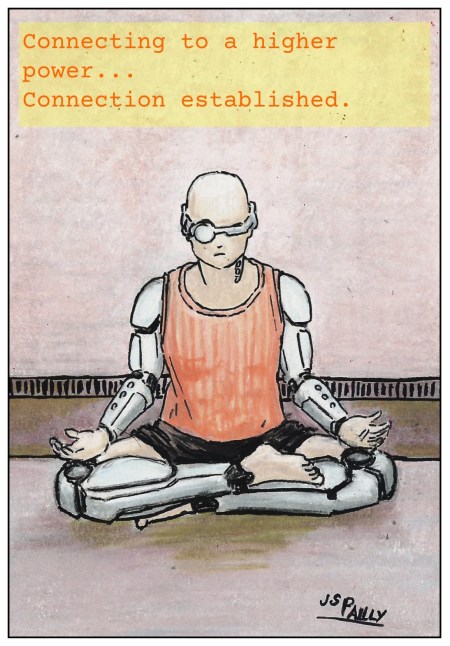
In 1960, two American researchers named Manfred Clynes and Nathan Kline were worried.  How could human beings ever hope to survive in the extreme conditions of outer space?  As they saw it, there were two solutions: we could either create artificial environments for ourselves, or we could alter our bodies to better suit the harsh realities of space.

That first option—creating artificial environments for ourselves in space—seemed utterly impractical to these two men. They equated it to fish inventing mobile fishbowls so they could leave the sea and go explore the land.

No, it would be far safer, easier, and cheaper (they reasoned) to reengineer the human body and mind through the use of technology, pharmaceuticals, and hypnosis.  So, first at a symposium on human space flight and then in this article for the journal Astronautics, Clynes and Kline described a “self-regulating machine-man system,” and they decided to call this hypothetical invention a cyborg.

The word is a portmanteau, combining the first three letters of the word “cybernetic” with the first three letters of the word “organism.” It’s actually Manfred Clynes who’s generally credited with coining the word.  Kline apparently liked the word well enough, but according to this article from The Atlantic, he expressed some concern that it sounded too much like the name of a town in Denmark.

Clynes and Kline seem to have had some rosily optimisitic notions about what our cyborgized future might have been like. Becoming cyborgs would not, in any way, diminish our humanity.  Rather, we would be elevated, both physically and spiritually, by all the new opportunities that would suddenly be available to us to go out and explore the universe.

With the benefit of historical hindsight, I think it’s easy to see at least one flaw in this idea.  The original question was how would human beings be able to survive in space?  Our options were the mobile fishbowl method or the total cybernetic reengineering of our bodies.

Well, since 1960, human beings have been to space quite a few times.  Our mobile fishbowls have their flaws, but they work well enough most of the time.  Replacing the human respiratory and digestive systems with technological alternatives (as Clynes and Kline suggested we’d need to do, among other things) does not sound like a safer, easier, or cheaper solution.  I mean, as difficult and expensive as it was to build the International Space Staion, that’s still probably easier and cheaper than doing the kind of surgery Clynes and Kline were talking about.

Maybe someday, that kind of cybernetic augmentation will become a reality.  But we’ll have to learn a whole lot more about how our bodies work first.  At least that’s how I see it.

P.S.: Clynes and Kline would have argued that cyborgs are still human, but better.  A superior form of human being, perhaps.  That is a position that the titular cyborg in my “Dialogue with a Cyborg” story would not agree with.

Dialogue with a Cyborg, Part 2

After much delay, and an embarrassing amount of procrastination, and one night of anxious editing and reediting, part two of “Dialogue with a Cyborg” is finally here!

For those of you who read my recent IWSG post, you know that I recently had a really exciting shiny new idea, and that this shiny new idea messed up my timetable for a preexisting project.  “Dialogue with a Cyborg” was that project that got messed up.

I still can’t say what this shiny new idea is, but I can tell you that part two of “Dialogue” is the first story to make use of it.  For me, this ended up being an experiment, a first test run to see if the new idea would play well with older material. Hopefully no one will even notice what changed between the first and second installments of this story.

So without further ado, please click here for the continuation of “Dialogue with a Cyborg.”  Or if you haven’t read part one, please click here.

Sciency Words: Qubit

Welcome to another episode of Sciency Words, a special series here on Planet Pailly where we take a closer look at the definitions and etymologies of science or science-related terms so we can expand our scientific vocabularies together.  Today’s term is:

QUBIT

I’m starting to think I can get used to just about any weird quirk of language.  When I first saw the word qubit, referring to the quantum bits inside a quantum computer, I’m pretty sure my eye twitched.  The spelling of that word… it just looks so… so wrong.

And I’m not the only one who to feel that way.  In a paper titled “From Cbits to Qbits,” American physicist N. David Mermin laments that “the prevailing ‘qubit’ honors the English rule that should be followed by but ignores the equally powerful requirement that qu should be followed by a vowel.”  Mermin would prefer the spelling qbit.  I would prefer the hyphenated form q-bit.  Unfortunately, neither of those options seem to have caught on.


So who is responsible for this crime against English spelling rules?  It was another American physicist by the name of Benjamin Schumacher, who originally introduced the term in this 1995 paper on quantum information theory.  In the brief acknowledgements section at the end of the paper, Schumacher explains: “The term ‘qubit’ was coined in jest during one of the author’s many intriguing and valuable conversations with W.K. Wootters, and became the initial impetus for this work.”

As a writer, I kind of identify with Schumacher here. I’ve had the experience many times of either learning a new word or inventing one, and having that spur fresh and exciting new thoughts.  But still, why is the word spelled that way?

Several other sources (including Wiktionary) say the word qubit is formed by analogy with cubit, the ancient unit of measure equal to the length of an adult male’s forearm (from elbow to fingertips).  There is a certain inherent uncertainty involved in cubit-based measurements, given the amount of variation there can be among adult male forearms.  So I guess connecting that to all the inherent uncertainties of quantum science and quantum computing makes a sort of sense.

I don’t know.  Maybe I’ve gotten so used to seeing the word spelled the way it’s spelled that it doesn’t bug me as much as it used to.  And knowing a little about the word’s history, and its apparent association with the cubit, probably helps to make the weird spelling a little more palatable for me.  But what about you?  Are you okay with qubit, or does that weird spelling make your eye twitch when you see it?

IWSG: Shiny New Idea Syndrome

Today’s post is part of the Insecure Writer’s Support Group, a blog hop where insecure writers like myself can share our worries and offer advice and encouragement.  Click here to find out more about IWSG and see a list of participating blogs.

As I said in a recent post, I have a lot on my mind right now.  Good stuff.  Writing-related stuff. But still, it’s hard to focus on actual writing when I’m so distracted by writing-related ideas.

So for today’s episode of the Insecure Writer’s Support Group, I going to turn the floor over to my muse.  She has something she’d like to say, and maybe it’s something your muse would like to hear.

* * *

Hello, I’m James’s imaginary friend, also known as his muse. It’s totally normal for adults to have imaginary friends, especially when those adults are writers.

It seems that I have created a problem for myself and my writer.  I recently brought him a new idea.  What is this idea?  That’s not important right now.  It’s a new idea, and it’s a really good idea (if I do say so myself), and that’s all that matters right now.

That was not the reaction I was hoping for. It’s one thing for a writer to be excited about a new idea, but quite another for a writer to get overexcited. Overexcited writers are a danger to themselves, their muses, and every single character in their story worlds.

As a muse, obviously you have to bring your writer great ideas, the best ideas you can find lurking in the depths of the subconscious. I do want my writer to use this new idea.  I wouldn’t have brought it to him otherwise.  But it’s a tricky thing, getting my writer to keep things in perspective, making sure he does not neglect all his other writerly duties.

So, my fellow muses, what do you do to keep your writers in line when a shiny new idea gets them a little too excited?

Wisdom of Sci-Fi: For the Benefit of Humanity

I’ve wanted to do a Wisdom of Sci-Fi post about Ann Leckie’s Ancillary Justice trilogy for some time now.  I absolutely love these books, and I’ve been telling every complete stranger I meet to go read them.  These books are full of so much wisdom.

But they’re not easy to quote.  For these Sci-Fi Wisdom posts, I really like to have a nice, pithy quote.  Something that really brings an important idea into focus.  That’s kind of hard to do with the Ancillary series.  I feel like you have to be immersed in the politics and culture and language of that universe before the truly poignant moments start to make sense.

However, I did find a quote in Ancillary Mercy (book three of the series) that does a decent job summing up what this series is all about:

How can there be any benefit at all?  She tells herself that, you know, that all of it is ultimately for the benefit of humanity, that everyone has their place, their part of the plan, and sometimes some individuals just have to suffer for that greater benefit. But it’s easy to tell yourself that, isn’t it, when you’re never the one on the receiving end.

The “she” referred to here is Anaander Mianaai, the ruler of the great and powerful space empire in which these stories are set.  Through the course of the series, we’ve either heard about or witnessed the many things Mianaai and her empire have done for the alleged benefit of humanity.

I guess you could say Mianaai has a “the ends justify the means” philosophy.  It’s easy to fall into that mode of thinking, even when you’re not the ruler of a vast space empire.  Who doesn’t want to fight for the benefit of their family, friends, co-workers, etc….  These are worthy causes.  The benefit of humanity is a worthy cause.  But when you accept that the ends justify the means, when you really start to believe that, then maybe all you’re doing is making excuses.  Maybe you’re just telling yourself you’re doing what’s right, even though you know you’re doing what’s wrong, and you’re desperately trying to ignore the full consequences of your actions.

Something to think about, at least, and to be on guard against in yourself and others.

P.S.: And seriously, if you haven’t read Ancillary Justice, I highly recommend it.  It’s the best book I’ve come across in many, many years.