Sciency Words A to Z: Quijote

Welcome to a special A to Z Challenge edition of Sciency Words!  Sciency Words is an ongoing series here on Planet Pailly about the definitions and etymologies of science or science-related terms.  In today’s post, Q is for:

QUIJOTE

The International Astronomy Union (I.A.U.) still seems to think they were right about the whole Pluto thing.  However, they also seem to realize that they made a mistake in being so very dismissive of public opinion on the matter, and they’ve been trying to do a better job with public outreach since then.

To that end, in 2014 the I.A.U. announced a partnership with Zooniverse, and they enlisted the general public in the process of assigning official names to exoplanets.  As stated in this I.A.U. press release:

For the first time, in response to the public’s increased interest in being part of discoveries in astronomy, the International Astronomy Union (IAU) is organizing a worldwide contest to give popular names to selected exoplanets along with their host stars.

Now the I.A.U. already had a system in place for naming exoplanets, but that system produced “names” like HD 219134g, or KOI-4427b, or PSR 1257+12c.  There are astronomers who can rattle off this alphanumeric gobbledygook with ease, but I have a tough time with it.  As Doctor Who once said about planets: “I’m terribly old-fashioned. I prefer names.”

But of course letting the general public decide these sorts of things doesn’t always go well.  The I.A.U. did not want something like the Boaty McBoatface scenario to happen to some poor planet.
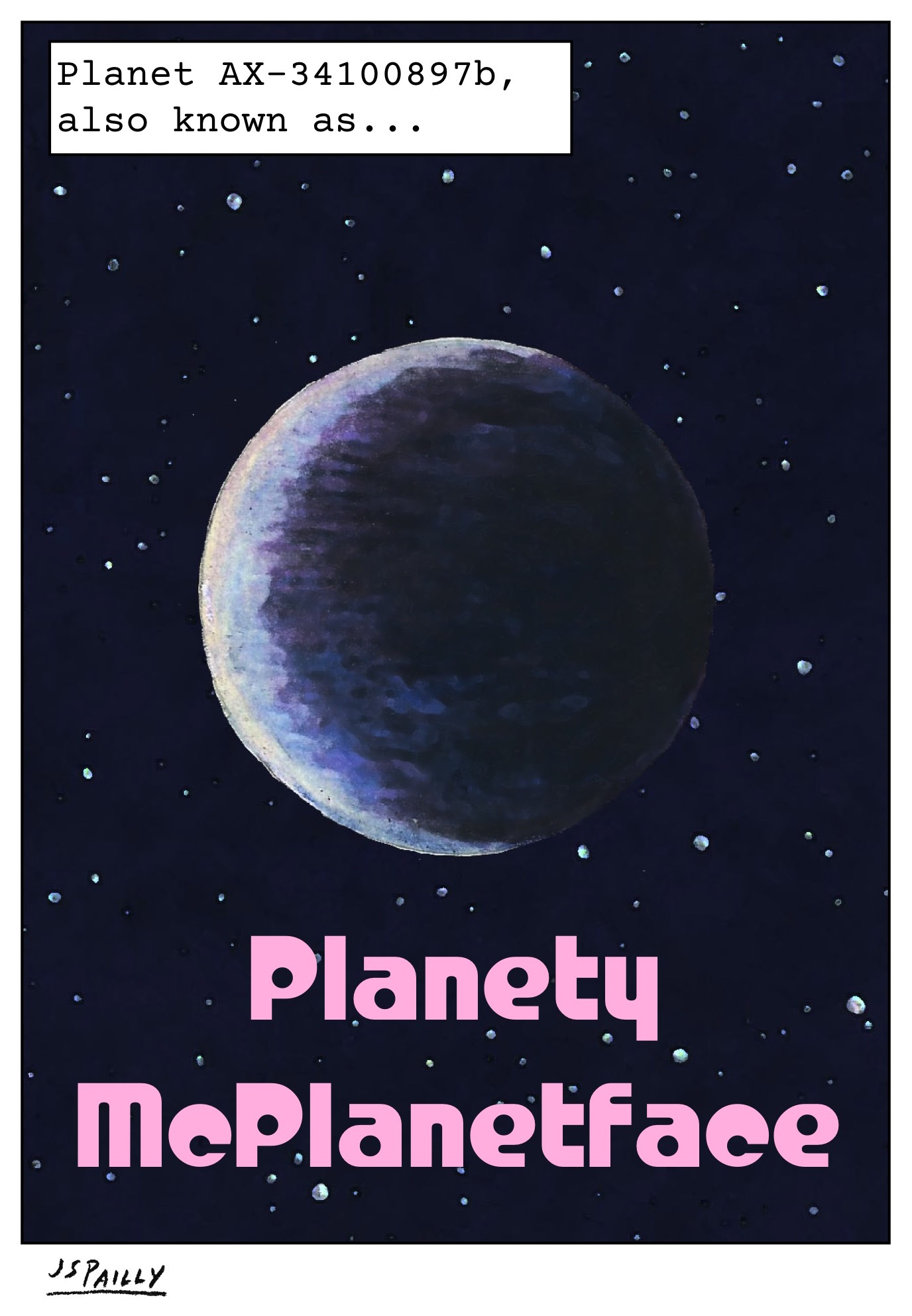
So the official process was that astronomy clubs and non-profit astronomy organizations (i.e.: people who would take this seriously) got to submit names, and then an I.A.U. committee picked the best options and put those up for a vote.

Quijote—as in Don Quijote (or Don Quixote, as it’s spelled in English) of the famous Spanish novel—was one of the winners.  According to Wikipedia, Quijote was initially thought to have a highly eccentric orbit, but after we learned more about the planet, it turned out its orbit was not as eccentric as it first seemed.  I’m not super familiar with the Don Quijote story, but from what I’ve heard the name seems fitting.

In that same I.A.U. naming contest, Quijote’s star got the name Cervantes, in honor of the author of Don Quijote, and all the other known planets in the system were named after other characters from the book.  As for astrobiological interest in Quijote, the planet does lie within Cervantes’ Goldilocks zone; however, Quijote is a gas giant, so it’s E.S.I. score must be quite low.

Still, it’s conceivable that Quijote might have Earth-like moons. So as we continue our quixotic search for alien life, Quijote might not be a bad place to check.

Next time on Sciency Words A to Z, could it be that we really are alone in the universe?

P.S.: Scattered disk object (225088) 2007 OR10 is currently the largest unnamed object in the Solar System.  If you’d like to vote on what the I.A.U. should name it, click here.

P.P.S.: I cast my vote for “Holle,” the only female name on the ballot, because I think we need more female representation in the cosmos.

Sciency Words A to Z: Panspermia

Welcome to a special A to Z Challenge edition of Sciency Words!  Sciency Words is an ongoing series here on Planet Pailly about the definitions and etymologies of science or science-related terms.  In today’s post, P is for:

PANSPERMIA

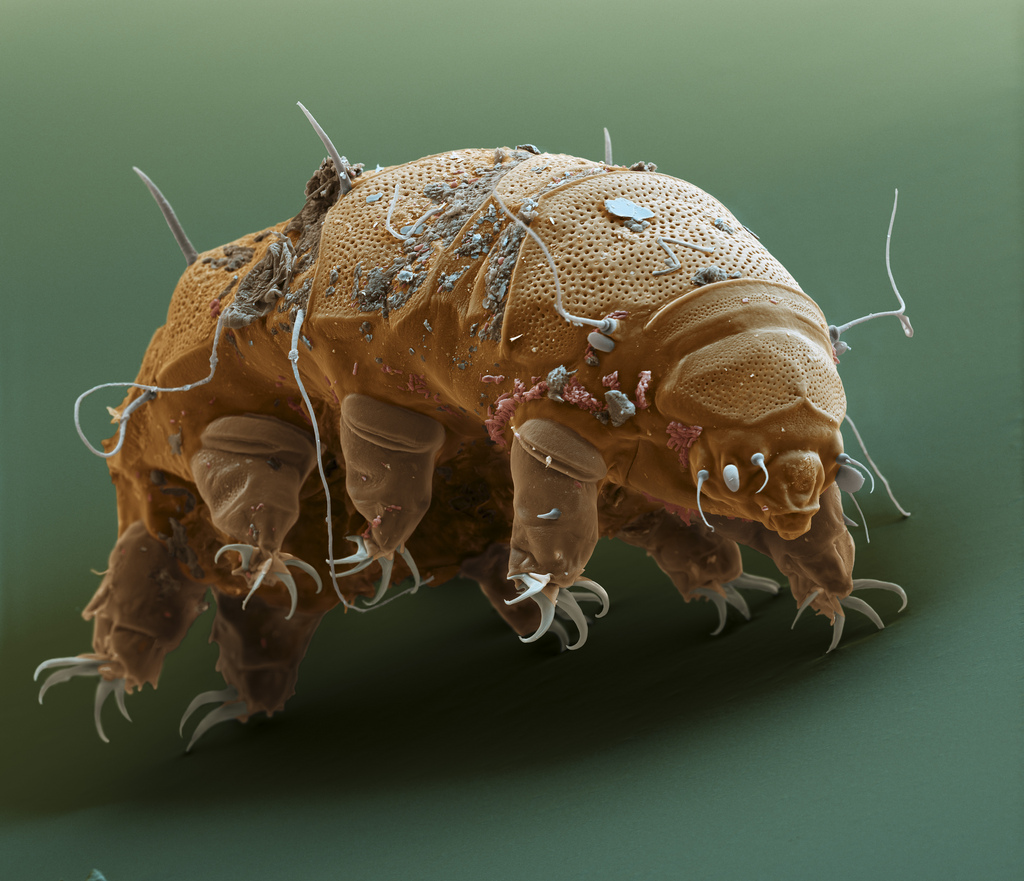
Pictured above is a tardigrade, also known as a water bear.  Tardigrades are pudgy-looking, almost cuddly-looking (depending on the photograph) microorganisms that reside here on Earth.  But due to some alleged confusion about their genetic lineage, it was at one time speculated that tardigrades might have come from somewhere else.  Perhaps they migrated to Earth through a process called panspermia.

The word panspermia goes all the way back to ancient Greece, and it can be translated to mean “seeds everywhere,” as in the seeds of life have spread all over the universe.  According to this article by Chandra Wickramasinghe, one of the leading proponents of the panspermia hypothesis, serious scientific discussion of the idea began in the late 1800’s.  In Wickramasinghe’s article, Lord Kelvin is quoted thusly:

… Hence, and because we all confidently believe that there are at present, and have been from time immemorial, many worlds of life besides our own, we must regard it as probable in the highest degree that there are countless seed-bearing meteoritic stones moving through space.  If at the present instant no life existed upon the Earth, one such stone falling upon it might, by what we blindly call natural causes, lead to its becoming covered with vegetation.

While Lord Kelvin and other late 19th and early 20th Century scientists may have taken panspermia seriously, the idea soon fell out of vogue.  Yes, from time to time, perhaps a “meteoritic” impact or a volcanic explosion (or maybe even a really strong gust of wind) might loft a few bacterial spores into a planet’s upper atmosphere.  Perhaps those spores could then escape into space.  But surely those spores would not survive for long after that.

It was British astronomer Fred Hoyle and Sri Lankan-born British astronomer Chandra Wickramasinghe who repopularized panspermia in the 1970’s and 80’s.  As explained in this paper, titled “Progress Towards the Vindication of Panspermia,” the Hoyle-Wickramasinghe interpretation of panspermia is founded on two basic premises: that microorganisms “have an almost indefinite persistence and viability,” and that once they find themselves in the right environment, “microbes can replicate exponentially.”

I’d say both of those premises make sense.  We all know how rapidly microbes can replicate given the chance.  As for their “almost indefinite persistence and vitality”… tardigrades famously survived in the vacuum of space.  No air, no water, extreme temperatures, extreme radiation… the tardigrades handled space quite well. Other microorganisms also survived similar experiments.

But could these microbes survive the thousands or perhaps millions of years it would take to travel from one planet to another?  Hoyle and Wickramasinghe clearly thought so, and they made some pretty outrageous claims about how much biological material we should expect to find drifting through open space.

[…] by 1983 we inferred confidently that some 30 percent of the carbon in interstellar dust clouds had to be tied up in the form of organic dust that matched the properties of degraded or desiccated bacteria.

Panspermia is now one of the most important concepts in the field of astrobiology.  It’s gained a lot of credence, especially since the discovery of those bacteria shaped objects in the ALH84001 meteorite.  However, although it is an important concept, it also remains highly speculative.  As I’ve said several times now in these A to Z posts, astrobiologists must hold themselves to the same standards as a court of law: proof beyond a reasonable doubt.  And there are still plenty of reasonable doubts about panspermia.

Next time on Sciency Words A to Z, call me old fashioned, but I prefer it when planets have names.

Sciency Words A to Z: Oxygen Catastrophe

Welcome to a special A to Z Challenge edition of Sciency Words!  Sciency Words is an ongoing series here on Planet Pailly about the definitions and etymologies of science or science-related terms.  In today’s post, O is for:

OXYGEN CATASTROPHE

Oxygen.  What could be more healthy or more wholesome to life than oxygen?  But oxygen is, in fact, one of the most dangerous and deadly chemicals on Earth.  It is, as you might easily guess, a powerful oxidizer, and it reacts with just about everything—especially organic matter!

True, life on Earth as we currently know it would not be possible without oxygen, but left to its own devices oxygen would eagerly burn us all up.

It started with cyanobacteria (also known as blue-green algae).  Cyanobacteria were the first organisms on this planet to develop photosynthesis, a process that uses sunlight to convert water and carbon dioxide into biomolecules.  But photosynthesis also produces hazardous oxygen as a waste product.

Things were okay for Earth’s biosphere for a while, but eventually the oxygen situation turned deadly.  As David Grinspoon explains in his book Earth in Human Hands:

For hundreds of millions of years, the cyanobacteria kept spitting out oxygen, but all the excess was hungrily snapped up by the abundant iron in Earth’s crust and interior.  Yet eventually, around 2.4 billion years ago, the crust was thoroughly oxidized and there was no more available iron lying around.

Grinspoon goes on to explain how life would eventually learn to protect itself from the harmful effects of oxygen exposure and even learn to control oxygen, transforming what was (and still is, in some respects) a deadly poison into a valuable and powerful new fuel.

Before we evolved that ability, however, the buildup of corrosive oxygen in the atmosphere was massively fatal for most of the species that existed on Earth at the time.

This event, approximately 2.4 billion years ago, is generally known as the Great Oxidation Event, but it’s also sometimes called the Oxygen Catastrophe.  I prefer calling it the Oxygen Catastrophe, because the consequences were truly catastrophic for almost everyone who was not a cyanobacteria. This was, in fact, Earth’s first mass extinction event.

As we continue our search for alien life, I think it’s important to keep oxygen’s true nature in mind.  To us, oxygen means life, but it could just as easily be seen as a deadly poison.  There may be other worlds out there with “poisonous” atmospheres, and those worlds may turn out to be the ones we should pay the most attention to.

Next time on Sciency Words A to Z, what if life on Earth started somewhere else?

Sciency Words A to Z: Noachian

Welcome to a special A to Z Challenge edition of Sciency Words!  Sciency Words is an ongoing series here on Planet Pailly about the definitions and etymologies of science or science-related terms.  In today’s post, N is for:

NOACHIAN

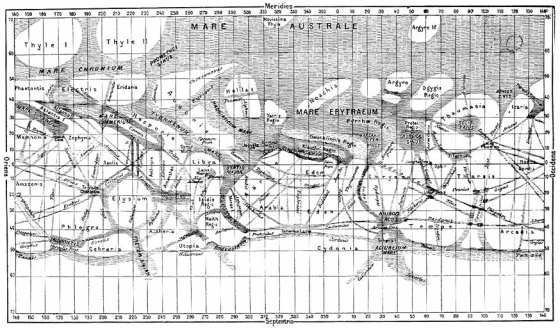
In the 1870’s, Italian astronomer Giovanni Schiaparelli began producing the most detailed and accurate maps of Mars anyone had ever seen.  Schiaparelli also assigned many of the names we still use today for Martian surface features today. One of those regions on Schiaparelli’s map got the name Noachis Terra—the Land of Noah.

In my opinion, no other name could have turned out to be more apt.  Schiaparelli got many of his names from the Bible, and I’m sure you remember the biblical story of Noah and the Great Flood.

Schiaparelli’s map of Mars.

Much like the geological history of Earth, Mars’s geological history is divided up into different periods.  Noachis Terra spawned the name for Mars’s Noachian Period, a time that roughly corresponds with the Archean Eon here on Earth—the time when the very first microbes were appearing on our planet.

So what was happening on Noachian Mars?  Based on the evidence presented in this textbook on Astrobiology, it wasn’t quite like the Great Flood in the Bible, but it was close!  Most if not all of Mars’s northern hemisphere was probably covered in water.  Circumstantial evidence of shorelines can be seen today.

And in the southern hemisphere, in regions like Noachis Terra, we see unambiguous evidence of ancient flowing water.  Craters show obvious signs of erosion.  There are dried up lakes and rivers, and those rivers appear to have been fed by tributaries, which tells us it used to rain on Mars.

And there’s more.  Many Noachian-aged minerals and rock formations are most easily explained if we assume there was water.  In some cases, water is the only possible explaination.  Our Mars rovers have found mudstone, clay minerals, sedimentary rock… iron and magnesium carbonate… hematite, jarosite, and more!  Some of these minerals would have required a hot and slightly acidic environment, like you might find in a hot spring or near a hydrothermal vent.

We shouldn’t jump to conclusions.  After all, there’s still so much we don’t yet know about Mars, and new discoveries are being made all the time.  But I’m going to go ahead and call a spade a spade here: Noachian Mars sounds an awful lot like Arcean Earth, and it’s easy to imagine that whatever was happening on Arcean Earth (by which I mean LIFE!!!) must’ve also been happening on Noachian Mars.

However, the Noachian Period did not last long—a mere 400 million years.  Earth and Mars have had very different geological histories since then.  After the Noachian, Mars rapidly lost its internal heat, its atmosphere, and its oceans.  By the time of Earth’s Cambrian explosion, when complex, multi-cellular organisms really “exploded” onto the scene, Mars had fully transformed into the barren, inhospitable world we know today.

Modern day Mars has been trying really hard to get our attention and convince us that it might still support life.

And maybe that’s true.  During the Noachian, life had a great opportunity to get started on Mars, and it’s possible that some isolated remnant of a Noachian ecosystem has persisted to this day.  But in my opinion, it’s far more likely that we’ll find fossils left over from the Noachian Period (assuming we haven’t found some already).

Next time on Sciency Words A to Z, did you know there’s a deadly chemical in the air you breathe?  It’s called oxygen.

Sciency Words A to Z: METI

Welcome to a special A to Z Challenge edition of Sciency Words!  Sciency Words is an ongoing series here on Planet Pailly about the definitions and etymologies of science or science-related terms.  In today’s post, M is for:

METI

In a sense, SETI researchers are just sitting by the phone waiting for somebody to call.  Maybe that’s the wrong way to go about it.  Maybe it’s time to pick up the phone, start dialing numbers, and see who picks up.

This idea is sometimes called active SETI, but it’s more common (and according to this paper, more appropriate) to use the term METI: the messaging of extraterrestrial intelligence.

Earth has been broadcasting TV and radio signals for over a century.  This has led to a common misconception that even now, aliens on some far off planet might be gathering around their equivalent of a television set, watching old episodes of Howdy Doody  or The Honeymooners.  Or perhaps, if the aliens live nearby, they’re currently listening to our more recent music.

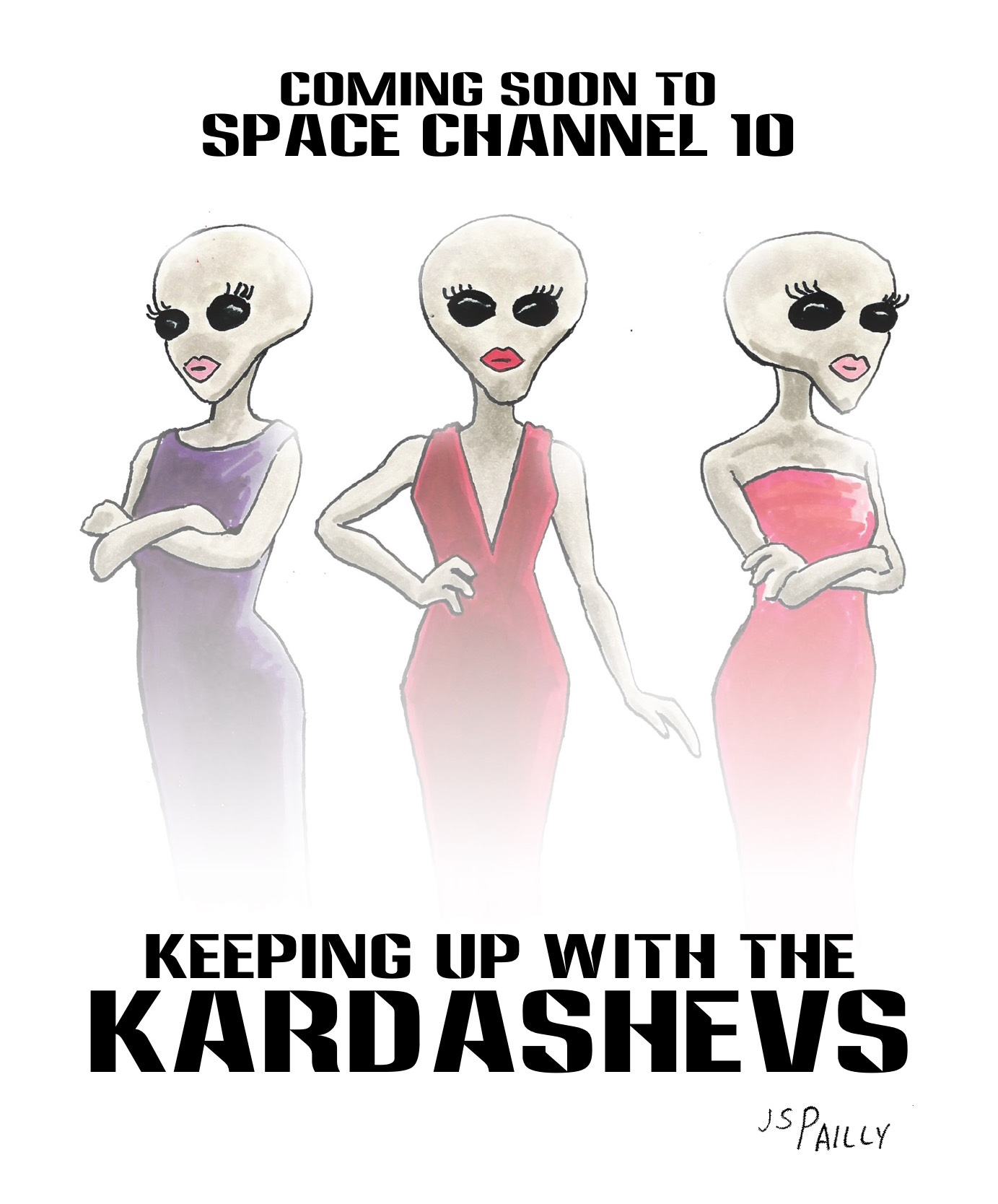
But Humanity is only a Type 0 or Type I civilization, depending on which version of the Kardashev scale you’re using. Either way, our broadcasts are not actually that strong.  As David Grinspoon explains in his book Earth in Human Hands:

Our television signals are diffuse and not targeted at any star system.  It would take a huge antenna, much larger than anything we’ve built or planned, to pick up on them.  From a radio point of view our planet is not completely hidden, but it is hardly conspicuous.  This could easily change.  Targeted messages sent directly toward nearby stars would cause Earth suddenly to turn on like a spotlight, becoming an obvious beacon announcing, for better or worse, “We are here!”

Of course we’ve already done this.  Several times, in fact.  But not with enough consistency to truly make our presence known.

The first attempt was in 1974, when Frank Drake and Carl Sagan transmitted a message from the Arecibo radio telescope in Puerto Rico, aimed at the M13 globular cluster.  But according to Grinspoon, if aliens ever do pick up that signal, “[…] they might dismiss it as a momentary fluke.  We would.”  That’s because the Arecibo message was a quick, one-time thing.  By itself, it’s hardly proof beyond a reasonable doubt that life exists on Earth.

If we really want to get somebody’s attention, we have to send a sustained, repetitive signal, kind of like those repetitive radio pulses Jocelyn Bell detected in the 60’s.  We have the technology.  We can make METI a reality.  But should we?  Some say yes, others no.  After all, we have no idea who might hear our signal, or what form their response might take, and there is no guarantee that the aliens will be friendly.

METI is a discussion and a debate that maybe we all, as a species, should be part of.  Perhaps we should take a vote, because in the end, we all have a stake in what might happen.  And while we’re at it, there are some other issues we all, as a species, should vote on.  Or at least that’s what Grinspoon says we should do in his book.

Next time on Sciency Words A to Z, we’ll go back in time and check out the oceans of Mars.

Sciency Words A to Z: LGM-1

Welcome to a special A to Z Challenge edition of Sciency Words!  Sciency Words is an ongoing series here on Planet Pailly about the definitions and etymologies of science or science-related terms.  In today’s post, L is for:

LGM-1

In the mid-1960’s, Jocelyn Bell (later known as Jocelyn Bell Burnell) was a grad student at Cambridge.  Through Anthony Hewish, her Ph.D. advisor, she became involved with the construction and operation of a brand new radio telescope specially designed to hunt for quasars.  But that telescope ended up finding something more than just quasars.

Bell Burnell recounts the story in this speech, as published by Cosmic Search Magazine.  Part of her job was analyzing data from the telescope, which came in the form of chart paper—literally miles worth of paper—produced by a set of “3-track pen recorders.”  And on those chart papers, Bell saw some odd markings, which she described as bits of “scruff.”

Naturally, that scruff required further investigation. Faster, more accurate recordings were made, and the scruff resolved itself into a series of regular radio pulses.  These pulses were so consistent, so evenly spaced, that you’d think they must be artificial. It was almost like someone out there in space was trying to get our attention!

Bell named the source of those radio pulses LGM-1, which stood for little green men #1.  But as I said in a previous post, when it comes to discovering alien life, scientists must hold themselves to the same standard as a court of law: proof beyond a reasonable doubt.  While Bell may have been happy to joke about little green men, she did not actually believe that’s what she’d discovered.  As she explained in her speech:

Just before Christmas I went to see Tony Hewish about something and walked into a high-level conference about how to present these results.  We did not really believe that we had picked up signals from another civilization, but obviously the idea had crossed our minds and we had no proof that it was an entirely natural radio emission. It is an interesting problem—if one thinks one may have detected life elsewhere in the universe how does one announce the results responsibly?  Who does one tell first?

After her Chistmas break, Bell returned to work and found a big pile of fresh data to analyze, and there was more “scruff.” In total, Bell found four distinct radio sources, located in completely different parts of the sky.

And that finally put the “little green men” hypothesis to rest.  It seemed highly unlikely that four different alien civilizations, located in completely different regions of space, would all try to get our attention at the exact same time, in the exact same way, using the exact same radio frequencies.

LGM-1 is now believed to be a neutron star, spinning rapidly, projecting twin beams of radio waves out into space like some sort of cosmic lighthouse.  It’s an entirely natural phenomenon, the result of a supernova explosion.  Today, we call this sort of object a pulsar.

Next time on Sciency Words A to Z, maybe it’s time to stop waiting for aliens to contact us.  Maybe it’s time we tried to contact them.

Sciency Words A to Z: Kardashev Scale

Welcome to a special A to Z Challenge edition of Sciency Words!  Sciency Words is an ongoing series here on Planet Pailly about the definitions and etymologies of science or science-related terms.  In today’s post, K is for:

KARDASHEV SCALE

In 1963, Soviet scientist Nikolai Kardashev published this paper concerning the search for extraterrestrial intelligence. Kardashev seems to have been primarily interested in how much information aliens might be able to transmit to us across the vastness of space.  This, in turn, relates to how much energy an alien civilization is able to produce, because the more energy you have, the stronger your radio signals can be.

Kardashev summarized his thoughts on this by devising a scale—now known as the Kardashev scale.  In Kardashev’s original system, there were only three types of civilizations:

  • Type I: a civilization that has harnessed energy on a planet-wide scale.  Kardashev considered Earth to be a Type I civilization.
  • Type II: a civilization that has harnessed the energy of an entire star, perhaps by building a Dyson sphere or some other megastructure around their own sun.
  • Type III: a civilization that has harnessed the energy of an entire galaxy.  Kardashev doesn’t offer any examples of this, but I might point to something like the Galactic Republic/Galactic Empire in Star Wars—they’re approaching Type III status.

Later scientists have expanded on the Kardashev scale.  Humanity has been demoted to a Type 0 civilization, because we don’t really use all the energy available to us on our planet.  Not yet, at least.

We can also talk about Type IV civilizations, which can harness the energy of the whole universe, and Type V civilizations, which can harness all the energy of the multiverse, or perhaps all the energy of alternative timelines, or something like that. Examples?  I don’t know, maybe the Timelords from Doctor Who or the Q-Continuum from Star Trek. Or maybe these people.

So which of these civilizations should we expect to find out there? What sort of transmissions do we expect to see?

The problem with Type IV and V civilizations is that their activities would be, to us mere mortals, virtually indistinguishable from nature.  As for Type 0 and Type I, their radio signals (if they’re sending any) may be too weak for us to detect over all the background radiation of the cosmos.

But the Type II and Type III civilizations… Kardashev was pretty optimistic about our chances of finding them.  In his 1963 paper, Kardashev argues that it’s absurd to think Earth is the only planet with intelligent life, and furthermore most alien civilizations should be far older and far more advanced than we presently are.  You may recall Enrico Fermi made a similar argument.

So there should be plenty of Type II civilizations out there, and perhaps a few Type IIIs as well, all chattering away in loud, easy-to-detect radio transmissions.  Or so Kardashev claims.  “In any case, the deciding word on this question is left to experimental verification,” he wrote.  But after fifty years of trying to detect something… anything… what has the experimental evidence shown us?

That’s a fair question.  And yet I have to agree with Kardashev: it is absurd to think Earth is the only planet with intelligent life.  So once again, in the immortal words of Enrico Fermi, where is everybody?

Next time on Sciency Words A to Z… wait, did we detect a signal?  Nope.  False alarm.

Sciency Words A to Z: JUICE

Welcome to a special A to Z Challenge edition of Sciency Words!  Sciency Words is an ongoing series here on Planet Pailly about the definitions and etymologies of science or science-related terms.  In today’s post, J is for:

JUICE

Speaking as a space enthusiast and a citizen of the United States, I have to confess I’m a bit disappointed with the status of the American space program.  While there have been some success stories—New Horizons, Curiosity, Scott Kelly’s year in space—I can’t help but feel like NASA has spent the last decade or so floundering.

However, it’s encouraging to see that so many other space agencies around the world are starting to pick up the slack.  My favorite example of this is the JUICE mission, a project of the European Space Agency (E.S.A.).

Astrobiologists have taken a keen interest in the icy moons of Jupiter.  There’s compelling evidence that one of those moons (Europa) has an ocean of liquid water beneath its surface.  There’s also a growing suspicion that two more of those moons (Ganymede and Callisto) may have subsurface oceans as well.

The original plan was for NASA and the E.S.A. to pool their resources for one big, giant mission to the Jupiter system.  But then the 2008 financial crisis hit.  The U.S. Congress was loath to spend money on anything—especially space stuff.  “Due to the unavailability of the proposed international partnerships […]”—that’s how this E.S.A. report describes the matter.

So the E.S.A. decided to go it alone. Personally, I think this was a very brave move.  E.S.A. has never done a mission to the outer Solar System before, not without NASA’s help.  But there has to be a first time for everything, right?  And so JUICE—the JUpiter ICy moons Explorer—began.  It’s not my favorite acronym, but it works.

According to E.S.A.’s website, JUICE will conduct multiple flybys of Europa and Callisto before settling into orbit around Ganymede.  You may be wondering why JUICE won’t be orbiting Europa.  This is in large part because of the radiation environment around Jupiter.  Europa may be more exciting to astrobiologists, but Ganymede is a safer place to park your spacecraft.

Meanwhile, NASA has recovered much of the funding it lost after the 2008 financial crisis, and they’re once again planning to send their own mission to the Jupiter system.  So maybe NASA and E.S.A. will get to explore those icy moons together after all!  Or maybe not.  According to this article from the Planetary Society, NASA’s budget is under threat once again.

I guess we’ll have to wait and see, but no matter what happens to NASA’s budget, E.S.A. seems fully committed to JUICE.  So speaking as a space enthusiast, at least I have that to look forward to.

Next time on Sciency Words A to Z, how do you measure the size of an alien civilization?

Sciency Words A to Z: Intelligence

Welcome to a special A to Z Challenge edition of Sciency Words!  Sciency Words is an ongoing series here on Planet Pailly about the definitions and etymologies of science or science-related terms.  In today’s post, I is for:

INTELLIGENCE

In 1959, this paper by Giuseppi Cocconi and Philip Morrison appeared in the journal Nature.  The ideas Cocconi and Morrison laid out in that paper were bold, and maybe a little presumptuous, but they became the foundation for a very important subfield of astrobiology: the search for extraterrestrial intelligence, or SETI for short.

The A to Z Challenge being what it is, it’s too early for us to start digging in to the subject of SETI research.  But we can talk about part of it.  Specifically the I part—“intelligence.”  It’s fairly obvious what “search” means, and “extraterrestrial” simply refers to something that’s not from Earth. But what is the definition of “intelligence”?

What does it mean to be intelligent? How would we recognize an extraterrestrial intelligence if and when we find one?  Are we sure we humans are a good example of what an intelligent life form is like?  (No, wait, maybe don’t answer that last one!)

In this article from Space.com, the famous SETI scientist Jill Tarter is quoted as saying:

SETI is not the search for extraterrestrial intelligence.  We can’t define intelligence, and we sure as hell don’t know how to detect it remotely.  [SETI]… is searching for evidence of someone else’s technology.  We use technology as a proxy for intelligence.

This reminds me of a joke from the Hitchhiker’s Guide to the Galaxy, that humans think we are the most intelligent creatures on Earth because we built cities and nuclear weapons and things like that, while dolphins believe they are more intelligent than us because they chose not to do those things.

So it is time we change SETI to SETT—the search for extraterrestrial technology?  It sounds like Tarter would support that change.  She calls the SETI acronym “problematic” and suggests that we “talk about a search for technosignatures” instead.  But as regular readers of Sciency Words should know by now, once a word gets embedded in the scientific lexicon, it’s really, really, really hard to change it, no matter how problematic it might seem. Don’t believe me?  Click here or here or here or here or here.

And I suspect that Jill Tarter knows this.  In this report on SETI nomenclature, which is co-authored by Tarter, it says, “Definitions of intelligence are slippery […]” however, “[the word’s] use in the acronym SETI is sufficiently entrenched that we recommend against a more precise rebranding of the field.”

So what does it mean to be intelligent?  For the purposes of SETI, no one knows.  The term is vague to the point of being unusable for official scientific discourse.  But scientists have been talking about and writing about this for decades—remember, that Cocconi-Morrison paper came out in 1959—so at this point we’re sort of stuck with the I in SETI.

Next time on Sciency Words A to Z, we’ll get the latest juicy gossip from the moons of Jupiter.

Sciency Words A to Z: Hydrothermal Vents

Welcome to a special A to Z Challenge edition of Sciency Words!  Sciency Words is an ongoing series here on Planet Pailly about the definitions and etymologies of science or science-related terms.  In today’s post, H is for:

HYDROTHERMAL VENTS

In his book All These Worlds Are Yours, Canadian astronomer Jon Willis recounts the story of how hydrothermal (hot water) vents were first discovered here on Earth.  It was 1977.  A scientific research vessel was towing a deep-sea probe along the ocean floor in the Pacific when the probe detected a temperature anomaly.

This was exactly what the crew of that research vessel was hoping to find: a sort of underwater volcano, right where two tectonic plates were moving apart.  But the real surprise came when that research team brought their deep-sea probe back to the surface and developed all its photographs.  They saw the hydrothermal vent they were expecting to see, but they also saw things living—yes, living!—all around it.

Marine microbiologist Holger Jannasch, who was part of a follow-up expedition in 1979, had this to say:

We were struck by the thought, and its fundamental implications, that here solar energy, which is so prevalent in running life on our planet, appears to be largely replaced by terrestrial energy—chemolithoautotrophic bacteria taking over the role of green plants.  This was a powerful new concept and, in my mind, one of the major biological discoveries of the 20th Century.

It’s become fashionable to suppose that, rather than the “warm little pond” that Charles Darwin once wrote about, perhaps life began its conquest of Earth in an environment like this: a place deep under water where heat and chemicals come spewing up out of the planet’s crust.

An Introduction to Astrobiology actually cites science fiction writer Arthur C. Clarke as the first to realize what all this might mean for life in our Solar System.  Specifically, Clarke thought of the icy moons of Jupiter.  In his 2001: A Space Odyssey novels, Clarke tells us of a hydrothermal vent on Europa—a “warm oasis” populated by plant-like, slug-like, and crab-like creatures.

The idea of life on Europa (or Saturn’s moon Enceladus) clustered around hydrothermal vents may have started out as science fiction, but it is now a possibility that astrobiologists take very seriously. But we’ll talk about that later this week.     

Next time on Sciency Words A to Z, what’s wrong with the I in SETI