#IWSG: Ulterior Motives

Hello, friends, and welcome to this month’s meeting of the Insecure Writer’s Support Group.  If you’re a writer, and if you feel in any way insecure about your writing life, click here to learn more about this amazingly supportive group!

I don’t know about you, but my writing productivity crashed and burned toward the end of March.  Right now, I’m feeling insecure because I’ve done virtually nothing to prepare for this year’s A to Z Challenge.  I’m also feeling insecure because the timeline for publishing Tomorrow News Network, book one, has totally fallen apart.

I have no one to blame but myself.  Wait, no, that’s not true.  The coronavirus deserves a lot of the blame too.  Not all of the blame, but a lot of it.

So here’s my plan.  Even though I’m as ill-prepared for the A to Z Challenge as I could possibly be, I’m doing the challenge anyway.  My theme is the story universe I created for Tomorrow News Network.  Obviously, I have an ulterior motive for doing this.  It’s my way of saying: “Buy my book!”

Except the first book of the Tomorrow News Network series isn’t out yet. It won’t be released until (checks timetable, mutters curse at the coronavirus)—okay, I still have to figure out what my new release date will be.  But it’s coming soon!

I have a second ulterior motive as well.  You see, book one is more or less finished, but I still have to write books two, three, four, five (etc, etc, etc).  So as I tell you all about this fictional universe I’ve created, your feedback, dear reader, will be invaluable as I plan out the rest of the Tomorrow News Network series.

And lastly, my third ulterior motive may be the most important of all, given my current mental state during the coronavirus crisis.  As I said at the beginning of this post, my writing productivity crashed and burned near the end of March, and I’m having a tough time getting back into my creative groove.  I’m hoping that by participating in the A to Z Challenge—and by writing, specifically, about my own story universe—I’ll jumpstart my writing brain.  I guess we’ll have to wait until the end of April to know if that works.

In the meantime, please click here to check out the first Tomorrow News Network: A to Z post.  Today, A is for Alkali Extraction Incorporated, a faceless mega-corporation that’s mining alien planets for their resources.

Alkali Extraction Incorporated (Tomorrow News Network: A to Z)

Hello, friends!  For this year’s A to Z Challenge, I’ll be telling you a little about my upcoming Sci-Fi adventure series, Tomorrow News Network.  In today’s post, A is for:

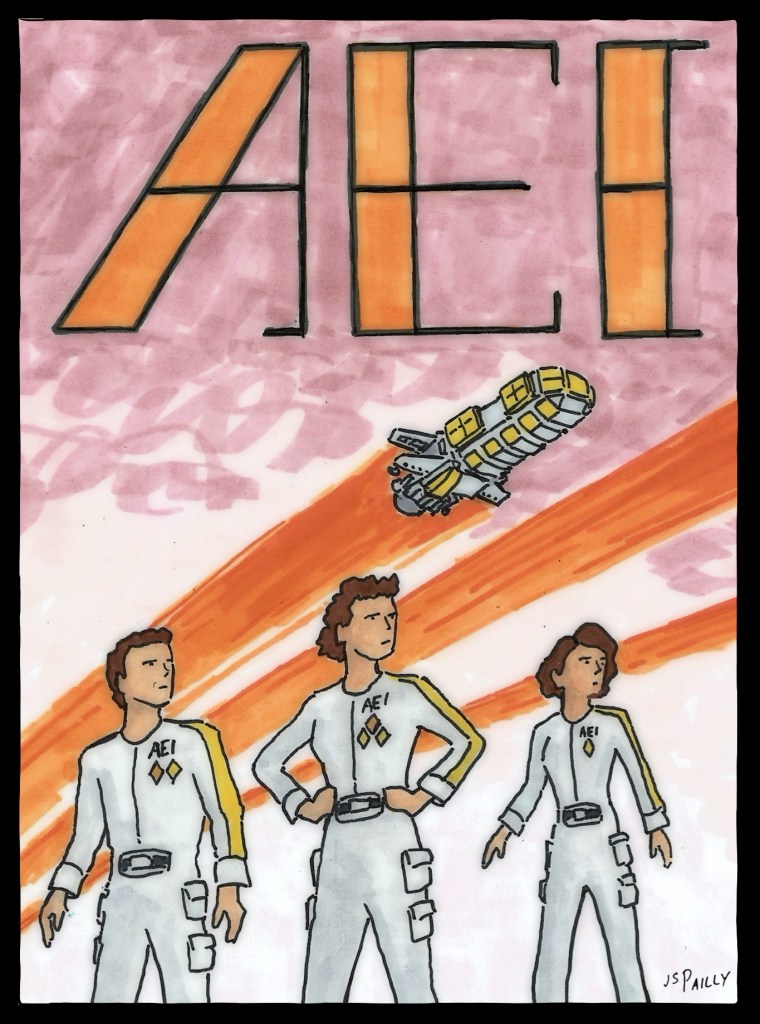
ALKALI EXTRACTION INCORPORATED (A.E.I.)

Faceless mega-corporations are everywhere in science fiction.  We see them in the Alien movies.  We see them in RoboCop, we see them in Blade Runner.  So when I started writing the first story in my Tomorrow News Network series, including a faceless mega-corporation just felt right.

In early drafts, I wanted to say as little about this faceless mega-corporation as possible.  I didn’t even give it a name.  The good people of Litho Colony all work for “the Company,” and whenever somebody mentioned “the Company,” everyone else would know which company they were talking about.  There was no need to be more specific.

My thought was that the Company was so big and so faceless that it didn’t need a name.  My critique group disagreed.  I got a lot of feedback from people asking who this giant corporate entity was.  What did they do?  What products or services did they sell?  And thus Alkali Extraction Incorporated (better known as A.E.I.) was born.

A.E.I. is a mining company specializing in the mining of rare chemical resources from planets along the galactic frontier.  They’re one of the leading suppliers of lithium for the Earth Empire, and they’ve recently expanded into the market for mesotronic elements—chemical elements that are stuck in a quantum state between matter and antimatter.

Litho Colony is the property of A.E.I.  The colonists do sometimes refer to A.E.I. as “the Company,” but they also sometimes refer to the Company by its actual name.  How could they not?  The letters “A.E.I.” are stamped everywhere, a constant reminder to the colonists of who their employers are.

Looking back on those early drafts of Tomorrow News Newtwork, book one, I get what I was trying to do with my faceless and also nameless mega-corporation.  But my critique group was right, and I’m glad I listened to them.

Next time on Tomorrow News Network: A to Z, the planet Berzelius has five moons.  Wait, let me count again.  Sorry, the planet Berzelius has six moons.

Tomorrow News Network: A to Z

Hello, friends!  At long last, I’m ready to announce my theme for this year’s A to Z Challenge.  And that theme is:

Tomorrow News Network is my own Sci-Fi adventure series, featuring time traveling journalist Talie Tappler, her cyborg cameraman Mr. Cognis, and the many high-profile news stories they cover across the space-time continuum.

Robot uprisings?  Alien invasions?  Mass extinction events?  Talie and Cognis will be there.  In fact, being time travelers, Talie and Cognis tend to show up before such cataclysmic events occur.

For the A to Z Challenge, I’ll introduce you to some of the characters (M is for Milo Marrero) and settings (L is for Litho Colony) that will appear in Tomorrow News Network, book one.  We’ll also explore some of the big concepts (J is for journalistic integrity) and small details (D is for digi-stream downloads) that will feature prominently in the Tomorrow News Network series going forward.

So on Wednesday, April 1st, we’ll kick things off by meeting a faceless mega-corporation that’s mining alien planets for their resources.  Also on Wednesday, it’ll be Insecure Writer’s Support Group day, and I’ll reveal my secret ulterior motives for picking my own story universe for this year’s A to Z Challenge.
Living in a Michael Crichton Novel

Hello, friends!

I’m sorry for not having a Sciency Words post for you today.  Also, I was supposed to announce my A to Z Challenge theme earlier this week, but… well, it’s been a rough week.

Part of the problem is, of course, the coronavirus.  Right now, I feel like we’re all trapped in a Michael Crichton novel (specifically, this Michael Crichton novel).

Part of the problem is also work.  In my day job, I work for a local T.V. news station.  At times like this, working in the news business can be a mixed blessing.  On the upside, I’m still employed.  I’m still getting paid, and I can still pay my bills.  A lot of people can’t right now.  On the downside, covering a crisis like this is extremely stressful, as I’m sure you can imagine, and it has taken a real toll on me.

So as I said, it’s been a rough week.  At this point, I have to reevaluate my plans for this year’s A to Z Challenge.  In the past, I’ve picked science-heavy, research-heavy themes.  I was going to do that again this year, but given the current situation, I don’t believe I’ll have the time or energy to do the job properly.

But I still want to do something for A to Z.  So this weekend, I’m going to sit down with my muse, and we’re going to pick a new theme for this year’s challenge.  One option would be a “behind the writing” series where we’d talk about the creative process.  Another option would be a series about the Tomorrow News Network universe, where I’d introduce you to the story world I’ve created for my upcoming book series.

If you have a preference, let me know in the comments.  I’ll announce my decision on Monday.

Sciency Words: Pandemic

Hello, friends!  Welcome to this week’s episode of Sciency Words, a special series here on Planet Pailly where we talk about the definitions and etymologies of scientific terms.  Today’s Sciency Word is:

PANDEMIC

I normally write about space stuff.  Life on Mars, Pluto’s planet status… things like that.  But I thought I’d change things up a bit and talk about a medical science thing.  Why?  Oh, no particular reason.

In 1666, English physician Gideon Harvey wrote a book called Morbus Anglicus.  According to the Oxford English Dictionary, that book includes the earliest known usage of the word pandemic.

Pandemic comes from two Greek words meaning “all” and “people.”  For Gideon Harvey, it seems that pandemic diseases (leprosy, the bubonic plague, and most especially tuberculosis) are diseases that afflict all people, regardless of social status.  At least that’s my inference after reading the first chapter of Morbius Anglicus.

In modern usage, the meaning of the word pandemic has changed.  The World Health Organization (W.H.O.) and the Centers for Disease Control and Prevention (C.D.C.) use several different terms to categorize disease levels.  According to this online textbook from the C.D.C., those terms include:

  • Endemic: a level of disease that is normal for a given population.
  • Outbreak: a sharp increase above the endemic level of a disease within a geographically small area.
  • Epidemic: a sharp increase above the endemic level of a disease within a geographically large area.
  • Pandemic: an epidemic that is no longer geographically contained, i.e.: an epidemic that has crossed national borders or spread from one continent to another.

Those may seem like clear, straightforward definitions on paper, but according to several sources (like this one or this one or this one), that official definition for pandemic may be inadequate.  Lots of diseases cross national borders.  Lots of diseases hop from continent to continent.  The W.H.O. and the C.D.C. don’t issue pandemic alerts every time this happens.

The problem apparently came to a head in 2009 with the H1N1 swine flu.  Yes, swine flu was crossing borders, but public health officials started quibbling over whether swine flu was new enough or infectious enough or deadly enough to qualify for pandemic status.  Those qualifiers aren’t included in the official definition, but for a lot of people, it feels like they should be.  Otherwise, the seasonal flu would be a pandemic.

Now I’m not particularly well versed in medical science, so allow me to end this post by talking about a space thing.  In the early 2000’s, astronomers started arguing about whether Pluto was truly a planet.  This led to the International Astronomy Union issuing a new, more detailed definition of the word planet (and nobody had an argument about Pluto ever again).

Based on everything I read while researching this post, I feel like a similar story is unfolding over the word pandemic.  Perhaps, as scientists learn more about the spread of infectious diseases in our modern, globalized society, a new, more detailed definition for pandemic will emerge (and I’m sure it will be as universally accepted as the I.A.U.’s planet definition was).

Next time on Planet Pailly, it’s time to reveal my theme for this year’s A to Z Challenge.

Giving the Gift of Coronavirus

Hello, friends!

I have recently returned from my trip to visit family.  My grandmother just turned 100 years old.  Happy birthday to Grandma Pailly!

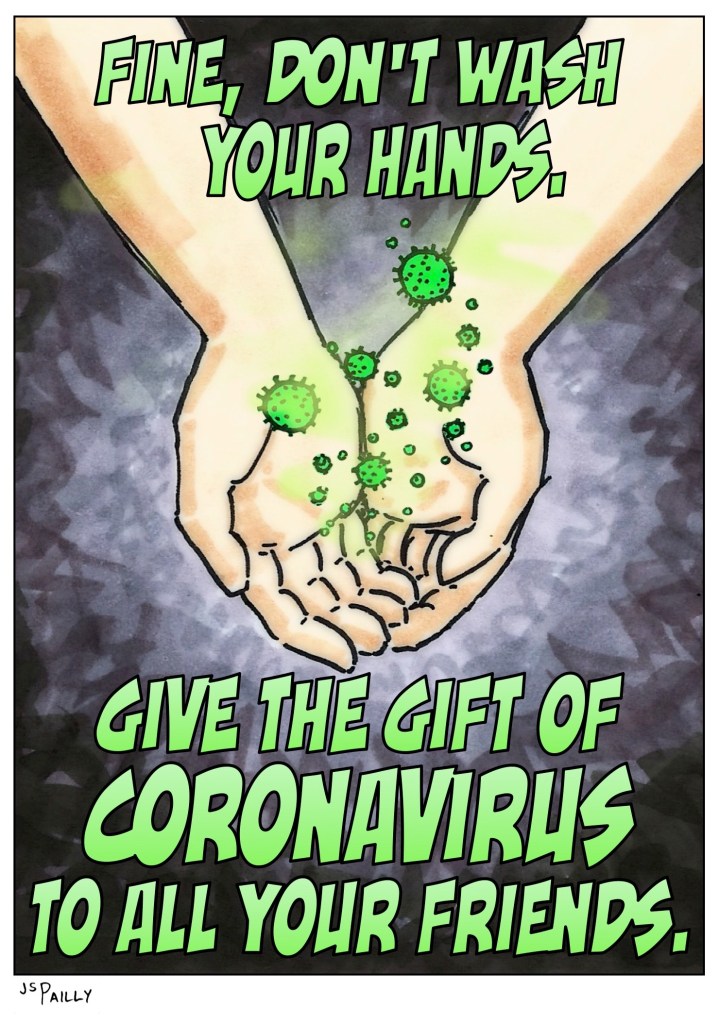
But today’s post isn’t about that.  Nope.  For today’s post, I have some new artwork to share, artwork that was inspired by that one guy—you know the guy I mean.  I’m talking about that guy in the public restroom who never washes his hands.

Of course I didn’t say anything to that guy.  Instead, I did the most passive aggressive thing I could think of: I made art about the incident and posted it on the Internet.

But I mean, come on!  It’s always gross when people don’t wash their hands after using the restroom.  But seriously, at a time like this?  Seriously?!?

If Proxima c Exists, It Must Be Beautiful!

Hello, friends!

For over a week now, I’ve been teasing you with promises of a very pretty picture of a very pretty planet.  Proxima Centauri is already known to have at least one planet, named Proxima b.  Now a second planet, Proxima c, may have also been discovered.

So how do we know Proxima c is there?  Well, we don’t.  I would be an irresponsible science blogger if I didn’t make this 100% clear: astronomers do not know for certain if Proxima c exists.  The evidence, as it currently stands, is highly circumstantial.

  • First off, we have the possible detection of asteroid belts encircling Proxima Centauri.  The presence of asteroid belts would imply the presence of planets, since it would take a planet’s gravity to keep the gaps between those asteroid belts clear.
  • Second, as reported in this paper, we have the possible detection of a “compact source” of thermal emissions.  There could be multiple explanations for this, but one possibility is a planet with a large, Saturn-like ring system.
  • Lastly, according to this paper, Proxima Centauri is wobbling in place.  That sort of wobbling in a star usually means a planet’s gravity is tugging on that star.  Usually.

As I said, all this evidence is highly circumstantial.  Proxima Centauri is known to have extremely violent solar flares, which may also explain why the star is so wobbly.  And that compact source of thermal emissions could be lots of things other than a planetary ring system (it might even be an error in our data).  And as for Proxima’s asteroid belts, we haven’t confirmed those exist yet.  It would be premature to say anything about possible planets based on possible asteroids.

But as this article from Scientific American explains it, all this circumstantial evidence seems to be lining up in such a way that you have to go hmmm.  If Proxima Centauri’s wobbles are caused by a planet, astronomers can make an educated guess about where that planet must be located.  And that location lines up with that compact source of thermal emissions.  And that compact source of thermal emissions is right where a planet would need to be to keep the gap between the asteroid belts clear. Coincidence? Well, maybe.

Again, this is highly circumstantial evidence.  It will take a lot more observation and data analysis to determine whether or not Proxima c is really there.

But for a planet that may not exist, we know an awful lot about what Proxima c should be like.  Based on Proxima Centauri’s wobbliness, we know Proxima c must be more massive than Earth, but less massive than Neptune.  We also know it must be very cold.  It’s a long way away from the habitable zone.  Due to Proxima Centauri’s intense solar flare activity, we’d expect Proxima c to have some crazy bright aurorae.  Oh, and as we already established, Proxima c would have a large, Saturn-like ring system.

In short, Proxima c sounds like it must be a very pretty planet.

If it exists.  Which is still a pretty big if.

Quick programming note: I’m going to take a few days off from blogging.  I’ll be away on a trip to visit family.  My grandmother is turning 100 years old this weekend, so it’s going to be a party!

I’ll be back some time next week with updates about my book and an announcement about this year’s A to Z Challenge.  See you soon!

Sciency Words: Null Hypothesis

Hello, friends!  Welcome to Sciency Words, a special series here on Planet Pailly where we look at the meaning and origins of scientific terms.  Today on Sciency Words, we’re talking about:

THE NULL HYPOTHESIS

Whenever there’s a big scientific discovery in the news, my first question is always: should I take this seriously?  The answer is usually no.  The popular press may say one thing, but when you dig into the actual science, you often find the facts do not support the hype.

So when I started reading about a second possible planet in the Proxima Centauri system, I wanted to know: should I take this seriously?  In this article from Scientific American, the astronomers who discovered this possible planet are quoted as saying:

Since the very first time we saw this [potential planetary] signal, we tried to be its worst enemy.

The astronomers are then quoted saying:

We tried different tools to prove ourselves wrong, but failed.  However, we have to keep the doors open to all possible doubt and skepticism.

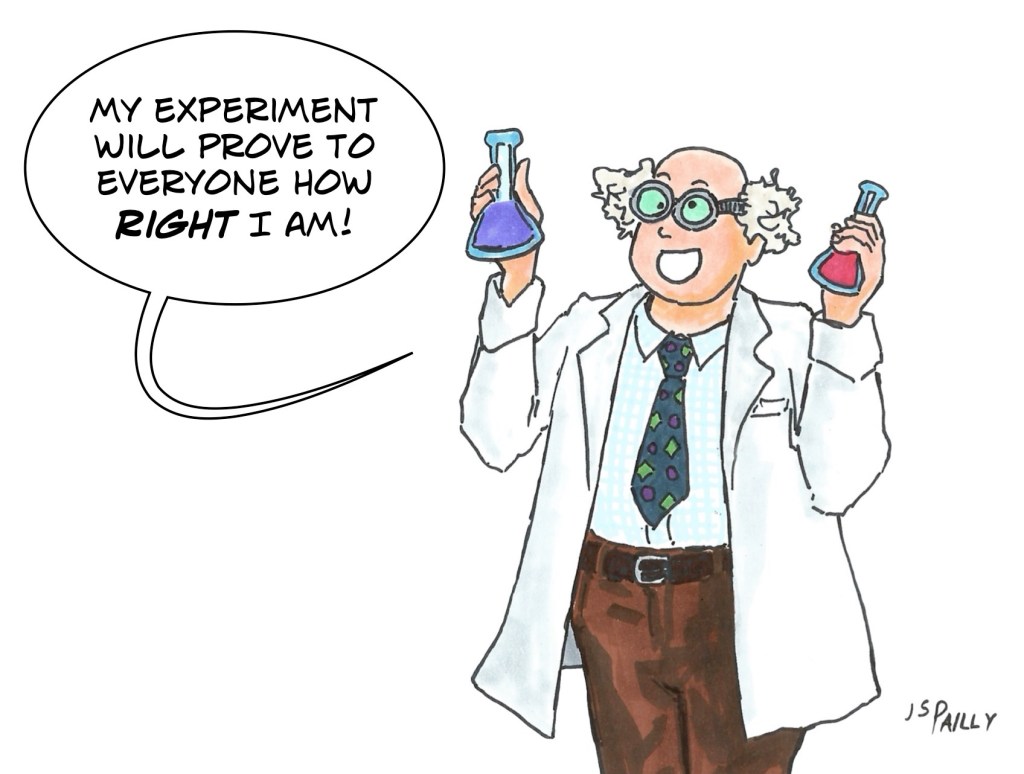
For me, this is the most reassuring thing any scientist could say.  Too often in popular culture, scientists are portrayed a certain way.

For a multitude of reasons, this is not a real scientist.

But no, good scientists are not out to prove to the world that they’re right.  They’re trying as hard as possible to prove to themselves that they’re wrong.  Which brings me to the null hypothesis.

According to the Oxford English Dictionary and other sources (like this one), the term “null hypothesis” can be traced back to British statistician Ronald Fisher.  Fisher first wrote about the null hypothesis in 1935, in a book titled The Design of Experiments.

As a way of introducing the concept, Fisher tells us the story of a woman who claimed to have an oddly specific talent.

A lady declares that by tasting a cup of tea made with milk she can discriminate whether the milk or the tea infusion was first added to the cup.

The Design of Experiments, by Ronald Fisher

Fisher then describes an experiment to test this woman’s claim.  She’s given eight cups of tea, four with the milk added first, and four with the milk added afterward.

In the context of this experiment, the null hypothesis predicts that the woman will not be able to tell which tea is which—she’s only guessing.  Or to put that in sciencier language, the null hypothesis asserts that there will be no statistically significant relationship between the way this woman’s tea was prepared and the way she believes her tea was prepared. As Fisher explains:

[…] it should be noted that the null hypothesis is never proved or established, but is possibly disproved, in the course of experimentation.  Every experiment may be said to exist only in order to give the facts a chance of disproving the null hypothesis.

The Design of Experiments, by Ronald Fisher

A null hypothesis is usually paired with an “alternative hypothesis,” which asserts that a statistically significant relationship does exist.  In Fisher’s tea tasting example, the alternative hypothesis would be that the woman really can tell which tea is which.  You can never really prove that either the null hypothesis or the alternative hypothesis is true, but a well designed experiment should be able to prove that one hypothesis or the other is false.

Going back to that possible planet in the Proxima Centauri system, the article from Scientific American does not explicitly mention the null hypothesis; however, the spirit of the null hypothesis is clearly in play.  Astronomers are trying their best to prove that that planet does not exist, and so far they can’t do it.  And that’s enough to convince me that I should take this new planet seriously (at least for now).

Next time on Planet Pailly, we’ll find out what this not-yet-disproven planet might look like.

#IWSG: Editing on Valentine’s Day

Hello, friends!  Welcome to March’s meeting of the Insecure Writer’s Support Group.  If you’re a writer and if you feel in any way insecure about your writing life, click here to learn more about this amazing group!

This year, I was fortunate enough to spend Valentine’s Day with my one true love: writing.

Well, actually I spent Valentine’s Day (and many other recent days) reading and reviewing the notes from my editor.  I had to invent an elaborate color coding system to keep track of everything.  I marked changes I agreed with in blue, changes I disagreed with in orange, and changes that I had questions about in pink. Thank goodness I bought all those pens in pretty colors a few months ago!

Having my manuscript professionally edited has turned out to be a slower, more contemplative process than I expected.  My editor has given me a lot to think about.  It’s tough.  But I’m not going to dwell on that today, because if you’re a writer, you already know how tough every aspect of the writing process can be.

But I do want to share something about this process that I wasn’t expecting.  For those of you who feel anxious about turning your manuscript over to an editor, this might help alleviate some of your fears.  There were several sections of my manuscript that I was especially worried about.  I’d agonized over these sections for months and couldn’t find a way to make them any better.  To my surprise, my editor did not flag these sections as problems.

At our last meeting, I asked about this.  My editor read through a few of those sections again, shrugged, and told me I was worried about nothing.

Writing is still tough.  Editing is still tough.  But to have a professional look at my manuscript and tell me to stop worrying about this part or that part or those other things—what a huge relief!

Next time on Planet Pailly, we’ll compare a real scientist to a movie scientist.

Touring Proxima Centauri’s Asteroid Belts

Hello, friends!

As you know, sometimes things don’t go according to plan.  For today’s post, I was planning to draw a really pretty picture of a really planet—a planet that astronomers may (or may not) have found in the Proxima Centauri system.  But as I did my research about this possible planet, I realized I needed to draw something else for you first.

As reported in this 2017 paper, temperature readings indicate that Proxima Centauri may have at least one and as many as three asteroid belts.  Based on what I’ve read, it sounds like the presence of these belts has not been definitively proven yet.  But no one seems to be able to definitively disprove them either.

So here is a map of everything we currently know or suspect exists in the Proxima Centauri system.

As you can see, the planet Proxima b is in an extremely tight orbit around its star.  But since Proxima Centauri is much smaller and cooler than our Sun, Proxima b is technically in the star’s habitable zone.  Click here for my post on whether or not Proxima b could actually support life.

Beyond the orbit of Proxima b, we find our first possible asteroid belt.  In that 2017 paper I cited above, this innermost belt is described as the warm dust belt.  It appears to be located approximately 0.4 AU away from its star (roughly equivalent to the orbit of Mercury in our Solar System).

A little farther out, we find a second possible asteroid belt, which the authors of that 2017 paper describe as the cold dust belt.  Remember: we suspect these dust belts exist because of temperature measurements, hence the names.  The cold dust belt appears to be spread out between 1 AU and 4 AU (roughly equivalent to the space between the orbits of Earth and Jupiter in our Solar System).

And then farther out still, there appears to be a third belt, referred to as the outer dust belt (in my opinion, it should have been named the colder dust belt).  The outer dust belt appears to be located approximately 30 AU away from its star (roughly equivalent to the orbit of Neptune).

I want to emphasize again: as far as I can tell from my own research, no one has definitively proven or disproven these dust belts exist.  All we have are some temperature measurements that suggest something might possibly be there.

But if all those dust belts do exist, that tells us there should be planets orbiting in the gaps between the belts.  It would take a planet’s gravity to keep those gaps empty.  And now that you know that, I think we’re ready to take a closer look at Proxima c.

Except tomorrow is Insecure Writer’s Support Group day, so our trip to Proxima c will have to wait.  But I promise the wait will be worth it.  Science predicts that if Proxima c really exists, it must be the most gorgeous planet you’ve ever seen!

Next time on Planet Pailly, the unexpected benefits of having your manuscript edited.