#IWSG: Frank Herbert, Will You Be My Beta Reader?

Hello, friends!  Welcome to September’s meeting of the Insecure Writer’s Support Group, a support group for insecure writer’s like myself.  If you’d like to learn more about this amazing group, click here!

This month’s optional I.W.S.G. question is:

If you could choose one author, living or dead, to be your beta partner, who would it be and why?

I’d have to pick Frank Herbert, the author of Dune, one the greatest science fiction novels of all time.  Of course there are other Sci-Fi authors I’d love to meet and chat with.  I wish I could talk politics with Mary Shelley and H.G. Wells, and I feel like Arthur C. Clark and Isaac Asimov would be great people to turn to for career advise.  But for the purposes of beta reading, it’s got to be Herbert.

First off, have you read Dune?  I mean, forget about all the Sci-Fi stuff.  Forget about all those planets and spaceships and psychic superpowers.  Forget about the giant sandworms and Fremen warriors and the plans within plans within plans.  At the most basic, most fundamental level, the way Frank Herbert strings a sentence together is marvelous.  It’s prose elevated almost to the level of poetry.  Even if Herbert wrote in some other genre, I’d love getting feedback from someone who had such mastery over the English language!

But of course, Frank Herbert does (I mean, did) write science fiction, and there are precious few Sci-Fi authors who handle the sciency stuff so artfully.  When you read Dune, you might not even notice all the ecology lessons sprinkled throughout the book.  That’s real science.  You’re learning real science!  But the science is integrated seamlessly into the story, like any other aspect of setting or plot would be.   I’d love to get a little guidance from a man who could pull off a trick like that!

Now I’ve worked with a lot of beta readers over the years, some good, some not so good.  The not-so-good ones make writing feel like a chore, with lots of rules and regulations.  Based on what I’ve read about Frank Herbert, I don’t think he’d be like that.  Shortly after Herbert’s death in 1986, Sci-Fi author Ben Bova wrote this about him:

He knew pain.  But to Frank, pain was something you got around, one way or the other, so you could get on with the main business of life: having fun.  Creating great novels was fun.  Being with friends was fun.  Living life to its fullest was the real goal of existence, and he did exactly that.  Life was a banquet, as far as Frank was concerned; his advice was to pull up a chair and enjoy yourself.

Someone who sees writing as fun—pure fun—just another part of the sheer joy of living?  Now that sounds like the best recommendation for a beta reader anyone could ever make.

P.S.: Oh, and if I were beta partners with Frank Herbert, that would mean I could give him a little feedback too, right?  Because I would like to talk with him, just a bit, about gender roles in his books.  That’s one thing I think he could’ve handled better.

Sciency Words: Orthofabric

Hello, friends!  Welcome to Sciency Words, a special series here on Planet Pailly where we explore the definitions and etymologies of scientific terms.  Today on Sciency Words, we’re talking about:

ORTHOFABRIC

If you’re planning to spend any amount of time floating around in outer space, you need to dress appropriately.  You’ll need protection against solar and cosmic radiation.  You’ll need protection against extreme temperatures, both extreme cold and extreme heat (direct sunlight in the vacuum of space can make things super hot super quick).  Oh, and there are lots of tiny micrometeoroids whizzing about up there.  You’ll need protection against those too.

Around the same time that the space shuttle program got going, NASA started using a new fabric for the outermost layer of their spacesuits.  That fabric is still used today for spacesuits aboard the International Space Station.  It’s called Orthofabric (sometimes spelled with a hyphen: Ortho-fabric).

Orthofabric is made by a company called Fabric Development Inc., based in Quakertown, PA.  Orthofabric is made using three different synthetic fibers: Gore-Tex, Nomex, and Kevlar.  As reported in several research papers (like this one or this one), Orthofabric consistently holds up well against the harsh conditions found in space.  That’s why NASA keeps using it.

For these Sciency Words posts, I think it’s important to say something about the etymology of the word we’re talking about, but I had an extremely hard time finding any sort of etymology for this one.

The prefix “ortho-” comes from a Greek word meaning righteous, virtuous, or pure (hence the word orthodox).  “Ortho-” can also mean upright or straight (hence the word orthopedic).  But what do either of those meanings have to do with Orthofabric?  The prefix “ortho-” also has a specialized meaning in chemistry, but based on my research, the chemistry sense of “ortho-” didn’t seem relevant to Orthofabric either.

So finally, I picked up the phone, called Fabric Development Inc., and asked.  I was told the name Orthofabric was chosen after some back and forth consultation with NASA.  The name doesn’t mean anything in particular.  It’s just a name.  I guess somebody thought it sounded good.  End of story.

P.S.: NASA’s new Perseverance rover will be searching for life on Mars, but as a little side experiment Perseverance is also carrying a small sample of Orthofabric, along with samples of other commonly used spacesuit materials.  NASA wants to see how well these spacesuit materials hold up in the windy and dusty Martian environment.

So Betelgeuse is Back to Normal?

Remember Betelgeuse? The red giant star named Betelgeuse, over in the constellation Orion? Remember a year ago when astronomers thought Betelgeuse was about to go supernova?

Seti Astro's avatarSpace With Seti

A few months ago, well actually almost a year ago, astronomers studying Betelgeuse noticed some major dimming in the star, and the news spread like wildfire!

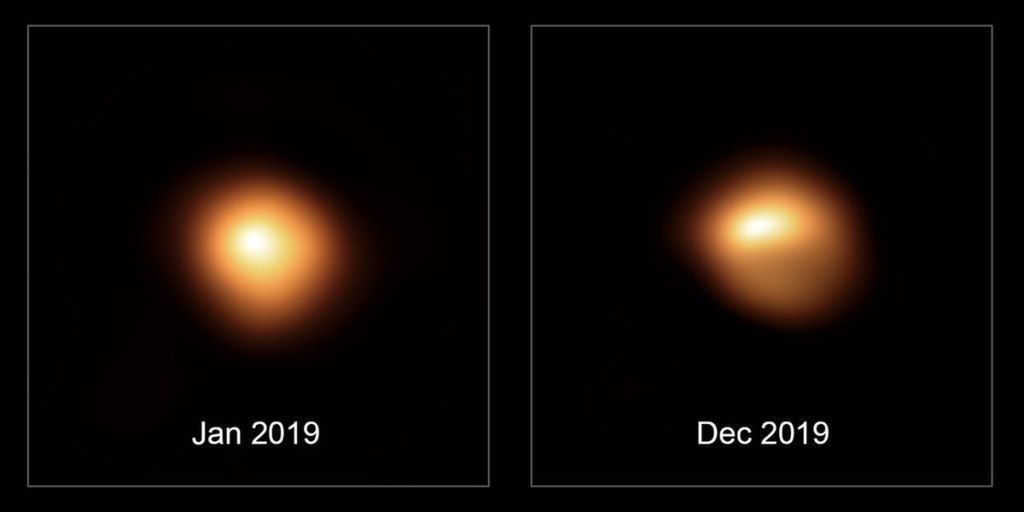
The issue arised when in 2019 astronomers observed dramatic dimming in the Southern part of the star, making it about 3 x fainter! With Betelgeuse being an enormous red supergiant we know its days left are few, so many thought extreme dimming meant the star is about to go supernova!

This comparison image shows the star Betelgeuse before and after its unprecedented dimming. The observations, taken with the SPHERE instrument on ESO’s Very Large Telescope in January and December 2019, show how much the star has faded and how its apparent shape has changed. Credit: ESO/Montargès et al.

So what caused the dimming?

A large group of astronomers lead by Andrea Dupree from multiple observatories have gathered evidence to suggest that the reason behind…

View original post 186 more words

Sciency Words: How Words Change

Hello, friends!  Welcome to Sciency Words, a special series here on Planet Pailly where we talk about those highly specialized words scientists use.  Words like:

I thought we’d do something a little different today and talk about some linguistic terms.  Linguistics is a science too, right?  Right.  So let’s go!

  • Semantic Generalization: a process of linguistic change where a word with some specific meaning ends up having a more general meaning.  My favorite example is the word “escape,” which originally meant “to get out of your clothes” (ex-cape) but has since generalized to mean getting out of all sorts of things.
  • Semantic Narrowing: a process of linguistic change where a word with a general meaning comes to mean something more specific.  A good example is the word “meat,” which used to refer to food in general but now refers specifically to food that comes from animal flesh.
  • Amelioration: a process of linguistic change where a word with a negative meaning or connotation comes to have a more positive meaning or connotation.  An example of amelioration that I’ve witnessed in my own lifetime is the word “geek.”  Geeks are cool now.  We didn’t used to be.
  • Pejoration: a process of linguistic change where a word with a positive meaning or connotation becomes more negative.  A great example is the word “awful.”  Originally, awful meant “worthy of awe.”  But if something’s worthy of awe, it could also be worthy of fear, and that no doubt contributed to the negative meaning we know today.

When I’m researching the etymologies of scientific terms, these four linguistic processes—generalization, narrowing, amelioration, and pejoration—come up a lot.  So much so that I thought I should do a post about them.  Don’t be surprised if I link back to this post in future Sciency Words posts!

Science is Wrong About Everything

Hello, friends!  So one day when I was a little kid, I got into a huge argument with another kid in school.  I’d said something about how Earth is a sphere, like all the other planets.  The other kid told me (firstly) that Star Trek isn’t real and (secondly) that the earth is flat.

As evidence, the other kid told me to just look around.  It’s obvious that the world is flat.  If I needed more proof, I could look at a map.  More kids soon jumped into this argument.  They all agreed: the earth is flat, and also I’m a huge nerd for watching so much Star Trek.  I was outnumbered, and being outnumbered was further proof that I must be wrong.

I went home so mad that day.  How could those other kids be so stupid?  I was right.  Everybody else was wrong.  I’m tempted to turn this into a metaphor for Internet culture, but that’s not the point I want to make today.

Yes, when those other kids said the Earth is flat, they were wrong.  But when I said the Earth is a sphere, I was wrong too.  Less wrong, obviously.  But still, I was wrong.

Isaac Asimov’s essay “The Relativity of Wrong” is a brilliant summation of how science works.  It should be required reading for every human being (click here to read it).  As Asimov explains:

[…] when people thought the earth was flat, they were wrong.  When people thought the earth was spherical, they were wrong.  But if you think that thinking the earth is spherical is just as wrong as thinking the earth is flat, then your view is wronger than both of them put together.

As Asimov goes on to explain, there was a time, long ago, when educated people really did believe the world was flat, and they had good reasons for thinking it to be so.  But then discoveries were made.  New knowledge was learned, and people came to think of the world was a sphere.  Then more discoveries were made, and people started to think of the world as an oblate spheroid (round, but slightly bulgy at the equator).  And then still more discoveries were made, and even the oblate spheroid model turned out to be slightly inaccurate.

People (including people on the Internet) will gleefully point out that science has been wrong about stuff in the past; therefore, science could be wrong about stuff today—stuff like evolution, climate change, general relativity—also stuff like vaccinations and COVID-19.  When science is wrong so much, why pay attention to science at all?

Well, it’s true.  In absolutist (this-or-that-ist) terms, science is wrong.  Science is always wrong, about everything, all the time.  Science is full of educated guesses and close approximations of observed reality.  It’s not perfect.  It will never be perfect.  But with each new discovery, science is a little less wrong today than it was yesterday.  And you can trust science to keep being less and less wrong, even if it will never be 100% right.

And that process of constant refinement and improvement, that process of getting closer and closer to the truth—that’s something worth paying attention to, something worth taking seriously, don’t you think?

P.S.: I’ll concede that those kids in school were right about one thing.  I was, and still am, a huge Star Trek nerd.

When the Muse Withholds Ideas

Hello, friends!  Sorry I’ve been M.I.A. from blogging lately.  I’ve been suffering from a severe case of writer’s block.  Or, to say that another way, my muse has been withholding ideas from me.  Why would my muse do such a thing?  I’ll let her explain.

Stress isn’t always bad.  Psychologists draw a distinction between good stress (eustress) and bad stress (distress).  If you feel like you’re stretching your limits, if you’re stepping out of your comfort zone, if you’re confident that you can prevail against the challenges in front of you—that’s the good kind of stress.  But if you feel like something’s snapped, like you’re totally overwhelmed and can’t cope with it all—that is the bad kind of stress.

For me, writing is the good kind of stress, always.  But in these distressful, COVID-ful times, writing has not made things better.  I always assumed good stress and bad stress would cancel each other out, but maybe it doesn’t work that way.  Maybe it’s more like multiplying a positive with a negative—you just end up with a bigger negative.

And so my muse—the magical fairy person who’s supposed to make me do my writing—made me take a break from writing.  It was for my own good.  I needed the rest—some properly lazy and self-indulgent rest.

Now that I’ve had that period of rest, I’m going to try to get back to my regular writing and blogging routine.  No guarantees, though.  We’ll see how things go.

P.S.: My muse did help me write this blog post.  That has to be a good sign, right?

#IWSG: Confidence

Hello, friends!  Welcome to the Insecure Writer’s Support Group.  If you’re a writer and if you feel in any way insecure about that, click here to learn more about this amazingly supportive group!

I’m feeling a little confused right now, both about my “real” life and my writing life.  A lot of stuff seems to be happening.  Very little of it makes any sense to me.  I wasn’t sure what I wanted to say for this month’s IWSG post, but then I saw the optional IWSG question:

Quote: “Although I have written a short story collection, the form found me and not the other way around. Don’t write short stories, novels or poems. Just write your truth and your stories will mold into the shapes they need to be.” 

Have you ever written a piece that became a form, or even a genre, you hadn’t planned on writing in? Or do you choose a form/genre in advance?

Oh, that’s an easy one!  I always know I’m writing science fiction.  I have never been interested in writing anything else, not even for a moment, not even once!

At various points in my life, writing teachers have tried to convince me to be more flexible.  They’d ask me to try something different.  Sometimes they would insist, as teachers do.  “You never know,” they’d say.  “You might like it!”  But I did know.  I was not going to like it.  Not unless I could sneak a Sci-Fi element into the assignment somehow.

I’ll admit I was surprised to discover how much I enjoy writing short stories and novella length fiction.  When I was young, I assumed I wanted to write Sci-Fi novels.  But by writing in shorter forms, I can tell more Sci-Fi stories.  And that’s the thing I want most.  That’s the thing I’ve always wanted most: to tell more and more and more Sci-Fi stories!

And you know, with all the weird and confusing stuff going on right now, it is nice to feel confident about at least one thing.  I write science fiction.  That’s the only thing I’ve ever wanted to write.  That’s the only thing I ever will want to write.  I may be questioning a bunch of other stuff about myself right now, but I can at least feel confident about that one thing.

Sciency Words: Perseverance

Hello, friends!  Welcome back to Sciency Words, an ongoing series here on Planet Pailly where we talk about science or science-related terms.  Today on Sciency Words, we’re talking about:

PERSEVERANCE

Mars rovers are among the most advanced pieces of technology we humans have ever produced.  And by a longstanding tradition dating back to the Sojourner rover in 1997, the official names for NASA’s Mars rovers are chosen by school children.

The Perseverance rover, currently on route to Mars, was named by 7th grader Alex Mather.  He won an essay contest.  Here’s a video of Mather reading his essay, followed by a quick Q and A session with some NASA officials.

You know, after listening to Mather’s essay, I have to agree.  Perseverance is the right name for our newest Mars rover.  It’s even more right of a name now than it was back in March, when the name was announced.

Things are scary here on Earth.  So many people are suffering.  So many people are struggling.  So many lives are being needlessly lost.  But I do believe, as Mather says in his essay, that perseverance is our most important quality as a species.  In the end, humanity will persevere.

Sciency Words: The Milky Way

Hello, friends!  Welcome back to Sciency Words, a special series here on Planet Pailly where we talk about the definitions and etymologies of science or science-related terms.  Today on Sciency Words, we’re talking about:

THE MILKY WAY

A while back, there was a very famous marketing campaign, coupled with a very famous slogan.  Some of you may remember it.  The purpose of this marketing campaign was, obviously, to encourage tourists to visit our galaxy.

According to ancient Greek mythology, the Milky Way was created as a result of a breastfeeding accident.  You see, the demigod Heracles was absurdly strong, even as a baby.  One day, the goddess Hera was breastfeeding baby Heracles.  Because Heracles was so strong, he started suckling too hard, and Hera had to pull him off her breast.  As a result, Heracles spat up all the milk he’d been drinking.  And, once again because Heracles was so absurdly strong, he ended up spewing milk all the way up into the sky.

Thus, the Greeks called all that “milk” in the sky Galaxias Kyklos, or “the Milky Circle.”  The “Way” part came later, thanks to the Romans, who looked at that same wide band of light cutting across the nighttime sky and thought it looked kind of like a road.  Thus, the Romans named it Via Lactea, which can be translated as “Road of Milk” or “Way of Milk.”  Or “Milky Way.”

So that’s how our galaxy came to be known officially as the Milky Way.  Except… is that really the official name?  I tried really hard, but I couldn’t find any statement or document from the International Astronomy Union (I.A.U.) concerning the official name of our galaxy.  The official names of other galaxies?  Sure, there are rules for that.  But our own galaxy?  Nothing.

I suspect the I.A.U.’s stance on this is similar to their stance on the official names for the Earth and the Moon, or the Sun and the Solar System: just keep using whatever names you already use in your native language.

According to Wikipedia, our galaxy is known as the Silver River (China), the Heavenly River (Japan), and the Ganges of the Sky (India).  In large portions of Africa and Central Asia, our galaxy is called the Straw Way or the Straw Thief’s Way.  Several cultures in and around the Arctic Circle call it the Bird’s Path, because it is said that birds follow that pathway of stars during migratory seasons.

Personally, I don’t think the Milky Way looks much like milk.  It’s too shiny.  Too sparkly.  Thanks to light pollution, I’ve only seen the Milky Way a few times in my life.  The first time was while camping in the backwoods of Indiana.  I thought then, and I still think now, that the Milky Way looks like someone spilled diamonds across the sky.

So if I ever got the chance to rename our galaxy (and as a science fiction writer, perhaps I will have that chance at some point), I’d want to name it something diamond-y.  The Diamond Way, or the Diamond River, or something like that.

So what do you think?  Do you like the name Milky Way, or do you prefer a different name like Silver River or Bird’s Path?  Or would you rather make up your own name, if you had the chance?

P.S.: According to the Mars Wrigley’s website, the Milky Way candy bar was NOT named after the galaxy.  As a space nerd, I was deeply disappointed to learn this.  In the future, I will be spending my candy allowance elsewhere.

Sciency Words: Necroplanetology

Hello, friends!  Welcome back to Sciency Words, a special series here on Planet Pailly where we talk about those weird words scientists use.  Today on Sciency Words, we’re talking about:

NECROPLANETOLOGY

I’d like to introduce you to a very special exoplanet, one of the very first exoplanets to be photographed by a telescope (by the Hubble Space Telescope, in fact!).  Its name is Fomalhaut b.  Its also known as Dagon, and here’s what it looks like…

Oh no!  What happened!?!

The prefix “necro-” comes from a Greek word meaning dead.  So necroplanetology refers to the study of planets and planetary bodies that are… dearly departed.  The term was first introduced in this 2020 paper, published in The Astrophysical Journal.

That 2020 paper describes a white dwarf star designated WD 1145+017.  A white dwarf is, as you may already know, the stellar remnant left behind after the death of a sun.  WD 1145+017 appears to have some debris orbiting it: the wreckage of a destroyed planet (or planets).

Finding planetary debris like that is an incredible opportunity for astronomers.  Like forensic scientists studying blood splatters at a crime scene, astronomers can observe this sort of planetary debris to determine how planets die, and they can also learn more about what the interiors of planets must have been like before their deaths.  That’s what the study of necroplanetology is all about!

Potential subjects of necroplanetological research include WD 1145+017, KIC 8462852 (a.k.a. Tabby’s Star), Oumuamua, Alderaan, and Fomalhaut b.  In the case of Fomalhaut b, the planet sure did look like a planet when its discovery was announced in 2008 (though Fomalhaut b appeared to be unusually bright at that time, given its estimated mass and other characteristics).  But since then, Fomalhaut b seemed to fade and disperse, suggesting that rather than observing a planet, we’ve been observing the debris field left behind after a recent planetary collision.

And another possible subject of necroplanetological research may be Proxima Centauri c.  As I told you in Wednesday’s post, Proxima c appears to be a lot brighter than we’d expect, given its estimated mass and other characteristics.  As this paper suggests, that excess brightness could be caused by a “conspicuous ring system” reflecting lots and lots of sunlight.  But that same paper also draws the unavoidable analogy with Fomalhaut b.  We may not be looking at a planet after all.  We may be looking at an expanding debris field left behind by a recent planetary collision.

We’ll have wait and see if Proxima c starts to fade and disperse, like Fomalhaut b did.  Personally, I hope that doesn’t happen.  But if it does, the destruction of a planet in the star system right next door to our own will be an incredible opportunity for necroplanetologists.