Sorry, I don’t have a Sciency Words post for you this week. I was researching a thing, but it turned out that I’d bit off more than I could chew. I really don’t think I should do a blog post on a topic when I understand that topic so poorly.
If you really had your heart set on learning some scientific terminology today, please check out this video from SciShow on some of the “ridiculous” names scientists have given to animal species. Though personally, I’m not sure what they mean by ridiculous. Han solo sounds like a perfectly sensible genus/species name to me.
Hello, friends! Welcome to this month’s meeting of the Insecure Writer’s Support Group, a group that supports writers who might feel a little insecure about their writing. If you’d like to learn more about IWSG and see a list of participating blogs, click here.
This may be one of the hardest thing for people to understand: sometimes, two mutually contradictory statements can both be true. Here’s an example. I love writing. Also, I hate writing. Let me unpack what I mean.
First off, I really do love writing. It’s the single greatest source of joy and pleasure in my life. Being something of an ethical hedonist, I’ve been trying for years now to maximize the joys and pleasures of my life. In other words, I’ve been trying to squeeze more writing time into my schedule (as well as more time for other sources of personal joy, like drawing and reading).
I cannot take full credit for this pun. Versions of this have been circulating the Internet for years.
In order to keep maximizing my writing time, I’ve slowly been transitioning from writing as a hobby to writing as a career. But (this is the tricky part) if writing is my job now, if I’m not writing purely for my own amusement anymore, then I have to set a production schedule. I have to deal with word count quotas and deadlines and other boring stuff like that.
And when I’m up against a deadline (self-imposed or otherwise), it tends to stunt my creativity and spoil my fun. Writing starts to feel like a chore. I am not at my writerly best when writing feels like a chore. I don’t want to do it anymore. All of a sudden, I hate writing.
It really are the deadlines that ruin writing for me. Case in point: I’m writing this IWSG post well in advance of IWSG day, rather than scrambling to get it done the night before. And I feel like this is turning out to be a much more expressive and honest post than what I typically write for IWSG. Or at least, I feel a lot happier with this post than I normally do.
But if I want to make a career out of writing (and I do!), then I will have to learn to accept the bad with the good. I have to learn to live with this tension in my writing life: I love writing, and also I hate writing. I’m not really looking for advice here, by the way. I am merely acknowledging to myself and to you that this is the way things are, and I’m trying to be very zen about the whole situation.
So this is what the writing life is like for me. Perhaps some of you, my fellow insecure writers, understand what I’m talking about.
Hello, friends! Just wanted to share some artwork today. This is a bookwyrm. As you know, most dragons hoard gold, but this one hoards literature. Perhaps some of you can relate.
Hello, friends, and welcome to a special Halloween edition of Sciency Words! Today, we’re talking about the spookiest of scientific terms. And that super spooky term is:
QUANTUM ENTANGLEMENT
Quantum mechanics is the study of the tiniest of tiny things in our universe: things like atoms and quarks and electrons. And these super tiny things do some pretty weird stuff, if our current mathematical models are to be believed. Stuff that seems to defy our human notions of common sense.
In the 1930’s, when quantum theory was still brand new, Albert Einstein did not approve of all that common-sense-defying stuff that quantum mechanical models were predicting. So in 1935, Einstein and two of his colleagues, Boris Podolsky and Nathan Rosen, published a paper that was supposed to prove quantum theory was incorrect, or at least that it was woefully incomplete.
The Einstein-Podolsky-Rosen paper (or E.P.R. paper, as it’s now commonly known) didn’t quite get the job done. Quantum theory survived the attack. In response to the E.P.R. paper, Erwin Schrödinger (of Schrödinger’s cat fame) wrote a letter to Einstein. It was in this letter, from Schrödinger to Einstein, that the word “entanglement” was first used in reference to quantum theory. Well, actually, Schrödinger used the word Verschränkung, a German word which translates into English as “entanglement.” (The relevant section of Schrödinger’s letter is quoted in this article from The Stanford Encyclopedia of Philosophy.)
Entanglement refers to the way a pair of quantum particles can interact with each other and then remain “entangled” with each other after their interaction is over. If you measure the quantum state of one entangled particle, the other will instantaneously change to match. This implies that entangled particles can somehow exchange information at faster-than-light speeds. As Schrödinger wrote in his letter, this is not just a weird quirk of quantum theory; it’s the “characteristic trait” that makes quantum mechanics so radically different from classical physics.
Einstein was still not happy. Neither was Schrödinger; however, as I’ve come to understand the story, Schrödinger was able to set his personal feelings about quantum theory aside and continue his research. Einstein, meanwhile, kept trying to prove quantum theory was wrong until the day he died.
You might even say the idea of quantum entanglement haunted Einstein for the rest of his life. In 1947, in a letter to another physicist named Max Born, Einstein referred to entanglement as spukhafte Fernwirkung, a phrase which is commonly translated into English as “spooky action at a distance.” (The relevant section of Einstein’s letter is quoted in this book.)
Thus, quantum entanglement is the spookiest scientific term.
I don’t like to get political on this blog or anywhere else on the Internet. It’s not that I’m afraid to talk about politics. It’s just that I think other people do the politics stuff better than I ever could, and I’d rather focus my time online talking about other things. Mostly outer space stuff. Sometimes also dinosaur stuff.
But recently, I came across a video that I really, really, really wanted to share. You see, I’ve been working on the next Tomorrow News Network novella, and a big part of my research for the next T.N.N. novella involves learning more about post-World War II era America. Mind you: not the stereotypes about post-war America, but the reality—both the good and the bad.
In the course of my research, I came across this P.S.A. from 1947 entitled “Don’t Be a Sucker (for Fascism).” And I was shocked—absolutely shocked—by how relevant this 1947 P.S.A. is to the world we live in today. So if you have seventeen minutes to spare today, please check out this video. I think you’ll find it is well worth your time.
And remember: don’t gamble with the liberties of others. If you do, you may find your own liberties being taken away as well.
Hello, friends! Welcome back to Sciency Words, a special series here on Planet Pailly where we talk about science or science-related terms. Today’s Sciency Word is:
FLYING SAUCER
Okay, first question: does this really count as a scientific term? Probably not, but the origin of the term “flying saucer” is pretty interesting nonetheless. I’m going to go ahead and say this one’s sciency enough for Sciency Words!
So, on June 25, 1947, an article appeared in The East Oregonian reporting on the sighting of “nine saucer-like aircraft flying in formation.” American businessman and aviator Kenneth Arnold had been flying his airplane near Mount Rainier, in Washington State, when he saw something he could not explain: nine flashes of light, like sunlight glinting off metal.
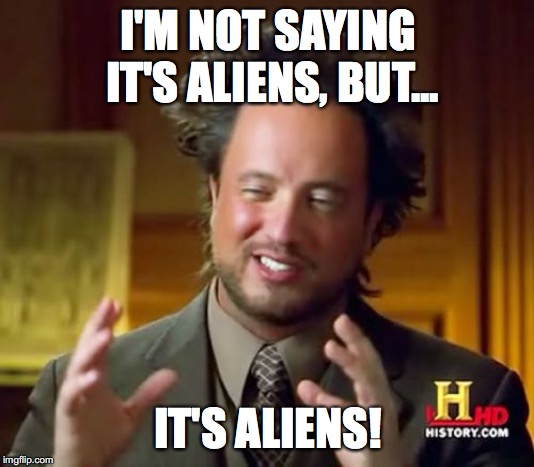
By all accounts, Arnold was legitimately confused by these strange lights. But he did not jump to any conclusions. He did not immediately assume he was looking at a squadron of extraterrestrial spaceships. In other words, Kenneth Arnold was not this guy:
Instead, Arnold tried to observe and record as much information as he could, in an objective and unbiased manner, paying attention to any details that might help solve the mystery. Based on what it says in this article (an interview with the newspaper reporter who initially interviewed Arnold), it sounds like Arnold went to the press in the hope that someone out there might read the story and come forward with a plausible explanation for what those weird light really were.
But some details of Arnold’s story were not reported accurately. Most notably, Arnold never said the flying objects he saw looked saucer-like. In this article from The Atlantic, Arnold is quoted trying to clear up the confusion:
These objects more or less fluttered like they were, oh, I’d say, boats on very rough water or very rough air of some type, and when I described how they flew, I said that they flew like they take a saucer and throw it across the water. Most of the newspapers misunderstood and misquoted that too. They said that I said that they were saucer-like; I said that they flew in a saucer-like fashion.
According to that same article from The Atlantic, this may have been “one of the most significant reporter misquotes in history.”
It’s not entirely clear when “saucer-like aircraft” got simplified into “flying saucer,” but it seems to have happened in a matter of weeks, if not days. The original news article was published on June 25, 1947; according to the Oxford English Dictionary, the earliest known usage of “flying saucer” is from July 8th of the same year, and the quotation cited by the O.E.D. makes it sound like this “nickname” was already in widespread usage.
And thus, flying saucers became part of the popular lexicon, not because Kenneth Arnold said that’s what he saw but because Arnold was misquoted by a newspaper reporter.
Hello, friends! Welcome to Sciency Words, a special series here on Planet Pailly where we take a closer look at some interesting and new scientific term so we can expand our scientific vocabularies together. Today’s Sciency Word is:
VIRA
You don’t mind if I do one more post about Venus, do you? Venus is my favorite planet, after all, and the detection of phosphine (a possible biosignature!) in Venus’s atmosphere has got me really excited. I’ve been reading lots of papers and articles about Venus lately, and many of those papers and articles mention something called VIRA.
VIRA stands for Venus International Reference Atmosphere. VIRA is actually a book, originally published in 1985 by an international committee on space research. The purpose of VIRA was to consolidate everything we knew about Venus’s atmosphere at that time into a single, easy to use reference guide. As planetary scientist David Grinspoon describes it in his book Venus Revealed:
Although not exactly a best-seller, [VIRA] is a cherished reference among students of Venus’s atmosphere, and many a copy has become dog-eared and worn. The tables and summaries of atmospheric data found therein are still the standard on Earth for Venus models, and the wide use of this standard allows us to make sure that we are comparing apples with apples, when making models and sharing new results.
One thing I don’t understand: why are Venus researchers still relying so heavily on a reference guide from 1985? I’ve found several scientific papers (like this one or this one or this one) offering updates and improvements to VIRA. And yet, unless I’m missing something (I feel like I must be missing something), it sounds like the original 1985 VIRA is still used as the gold standard for modeling Venus’s atmosphere.
Anyway, when people say we can’t explain where Venus’s phosphine comes from, in a sense, what they mean is that there’s nothing in VIRA that helps explain it. So maybe the discovery of phosphine in Venus’s atmosphere will finally give scientists the push they need to update VIRA for the 21st Century.
P.S.: According to this paper, there’s also a Mars International Reference Atmosphere, or MIRA. And I’m guessing there are similar reference atmospheres for other planets and moons in our Solar System as well.
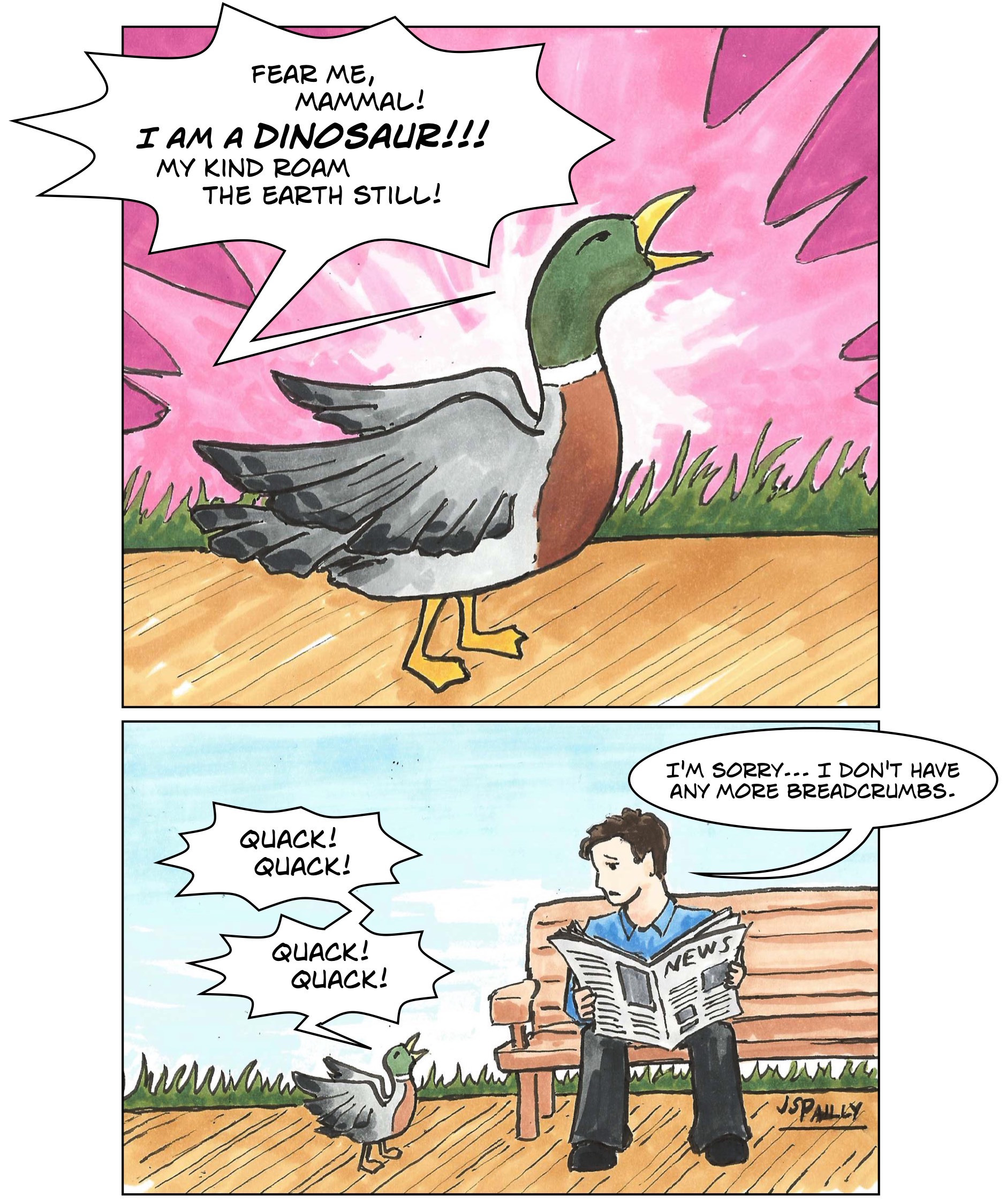
There’s an important science fact that I wish more people were aware of. Birds are not merely the descendants of dinosaurs. According to a taxonomic system called cladistics (also known as phylogenetic systematics), birds are dinosaurs. To quote this article from DinoBuzz:
Using proper terminology, birds are avian dinosaurs; other dinosaurs are non-avian dinosaurs, and (strange as it may sound) birds are technically considered reptiles. Overly technical? Just semantics? Perhaps, but still good science.
So with that in mind, the following statements are 100% true:
I often wake up to the sound of noisy dinosaurs outside my window.
I sometimes see dinosaurs swimming in the river near my house.
I hate it when dinosaurs poop on my car.
I enjoy eating dinosaur meat. Sometimes I put dinosaur meat on sandwiches or in salads.
Anyway, what sort of experiences have you had with dinosaurs in your daily life? Please share in the comments!
P.S.: Have you seen those dinosaur-shaped chicken nuggets in the grocery store? They’re cute. I’m just not convinced that they’re made from 100% real dinosaur meat.
Hello, friends! Welcome back to Sciency Words, a special series here on Planet Pailly where we talk about those wild and crazy words scientists like to use. Today on Sciency Words, we’re talking about:
GLOBAL RESURFACING
Venus is a mysterious planet. Ever since the detection of phosphine in the Venusian atmosphere, the mystery du jour has been: does Venus support life?
We’ll circle back to Venus’s phosphine in a moment, but first I’d like to turn our attention to a different mystery concerning Venus: where did all of Venus’s craters go?
Impact craters are a common sight in the Solar System, especially here in the inner Solar System. You’ll find plenty of craters on the Moon, of course. You’ll find lots of them on Mercury, Earth, and Mars as well. Some of those craters look fresh and new. Others, due to weathering and erosion, look quite old—sometimes extremely old.
But the surface of Venus is relatively crater free, and the few craters we do find appear to be very, very recent. In his book Venus Revealed, American planetary scientist David Grinspoon describes Venus’s craters thusly:
All the craters on Venus look unnaturally pristine. Instead of blending into the volcanic plains that cover most of the planet, they seem planted on top as an afterthought, as though a crew had built a cheap movie-set planet and realized at the last minute that they had better throw in some craters.
Grinspoon goes on to explain how this might have happened:
Suppose that half a billion years ago something happened to Venus, wiping out all older craters. Vast lava flows occurring simultaneously all over the planet would do the trick. Then, if there has been relatively little surface activity since that time and Venus has been slowly collecting craters all along, things should look as they do.
This sudden event, when the whole surface of Venus got covered in fresh lava, is called “global resurfacing.” That’s a nice euphemism for an apocalyptic event, isn’t it?
Now this is important: Venus should have had little-to-no volcanic activity since her last global resurfacing event. Otherwise, those younger, fresher, “unnaturally pristine”-looking craters would have gotten resurfaced too. But in the last few years, circumstantial evidence has emerged suggesting that there are active volcanoes on Venus after all.
And now, finally, we circle back to the detection of phosphine in the Venusian atmosphere. Some have suggested that that could be evidence of Venusian life. But according to this preprint paper, that phosphine signature could also be interpreted as further evidence of volcanic activity. Maybe global resurfacing was not a one-time event half a billion years ago. Maybe resurfacing is an ongoing process that’s still happening today!
In a previous post, I said that Venus is about to teach us something we did not know: maybe it’ll be a biology lesson, or maybe it’ll be a chemistry lesson. But now I think there’s a third possibility: maybe it’ll be a geology lesson.
P.S.: Special thanks to Mike Smith from Self Aware Patterns for sending that preprint paper my way. At this point, it is just a preprint paper waiting to go through the peer review process, so don’t get too excited. But the more I think about it, the more I feel like the authors of that paper are on the right track.
Hello, friends, and welcome to this month’s meeting of the Insecure Writer’s Support Group. If you’re a writer and if you feel in any way insecure about your writing life, click here to learn more about this amazingly supportive group!
This month’s optional I.W.S.G. question asks, in part: “When you think of the term working writer, what does that look like to you?” My muse and I have had a lot of discussions about what it means to be a working writer. We have a very clear picture of what that should look like for us. It should look like this:
But that doesn’t happen most of the time. Why not? Because writing only generates a small portion of my income (Oh, before I forget: click here to buy my book!), and I still have to make the rest of my money doing a non-writing job. All the time spent away from writing, due to that other job, leaves me feeling frustrated and my muse feeling sad.
Honestly, I don’t really care if I call myself a working writer or a hobbyist. I don’t care if I’m a professional or an amateur. Those are just labels. What matters to me is getting more time in my day for writing. My muse and I want to have our little writing party (as pictured above) every single day for the rest of our lives.
So if being a “working writer” can help make that happen, then that’s what I intend to do.





 Planet Pailly